
New Astronomy with the Swift Observatory: Discovery of Cosmic Baby, Supernova explosion and other Extremes
Analysis of Swift observed data offer us a new concept on supernova explosion and gamma ray bursts moulding on our old ideas. Swift space telescope observatory was launched in 2004 mainly for observation of gamma ray bursts (GRBs) with an operational active duration of two years. According to the new picture of supernova explosion — firstly shocks break out with the emission of x-rays and then exploding will occur while conventional idea was a new born neutron star compresses, rebounds and then triggers a shock wave that finally blows the star’s gaseous outer layers. Another invaluable discovery of Swift observatory was detection of Cosmic Baby, i.e. Swift J1818.0 – 1607 which is a young magnetar of ~ 240 years aged. It is also exhibiting triaxiality (as a triaxial star) having interior core magnetic field and ellipticity are 8.9424 x 10¹⁷ G and ~ 9 x 10⁻³, respectively. Nearly twenty years in service after its launching Swift is in good health and expected will remain active for few years also. So, new astronomy awaits from the Swift mission.
Abbreviations
GRBs: Gamma Ray Bursts; BATSE: Bursts and Transient Source Experiment; HETE: High Energy Transient Explorer; GLAST: Gamma Ray Large Area Space Telescope; BAT: Burst Alert Telescope; XRT: X-ray Telescope; UVOT: Ultra-violet/ Optical Telescope.
Introduction
The Gamma Ray Bursts (GRBs) are the most powerful bursts of gamma rays and these flashes are originated from the most luminous explosions in the universe, ever to have been detected by man [1, 2, 3]. These bursts become active during tense of seconds with an unimaginable energy output which is comparable with that of the sun for a period of approx 1010 years.
The detection of GRBs in the late of 1960 was a serendipitous, unexpected discovery. At the beginning astronomers thought that the origin of GRBs are either supernova explosions of massive stars, or the collisions of two dense supernova remnants i.e. neutron stars. Now, if these bursts are occurred very close enough to Earth, then radiation produced could affect the Earth’s ozone layers resulting which our Earth would suffer the effect of exposed space hazards like sun’s ultra-violet radiation.
In order to search for the origin of GRBs NASA sent “Vela” satellite (carrying payload of X-ray, gamma ray and neutron detectors) in Oct’1963. After this, a series of satellite based space observatories like IMP6 (in 1971), IPN (in 1976), Compton Gamma Ray Observatory with BATSE (Bursts And Transient Source Experiment ) instrument (in 1991), BeppoSAX (in 1996), HETE (High Energy Transient Explorer) (in 2000), INTEGRAL (in 2002), Swift (in Dec 2003), GLAST (Gamma Ray Large Area Space Telescope) (in 2006) were active in space (Table 1). The significant contributions obtained from the analysis of the observed data collected by these space telescopes are:
| Name of Space Telescope Observatory | Results / Conclusion |
|---|---|
| Vela a, b | Not disclosed at that time. Disclosed in 1973. |
| GRBs are indeed “of Cosmic Origin” | |
| IPN | Using the process of triangulation the sources of GRBs are localized to a few arc minutes. |
| Two classes of GRB source exist and separate are from GRBs ( later study shows it its true and GRBs are classified into short and long GRBs). | |
| GRBs do come from very distant sources. | |
| CGRO (BATSE) | Detected more than 2700 GRBs |
| Observed data proves that GRBs are uniformly distributed across the sky (not concentrated along the plane of out Milky Way galaxy). This means that the origin of GRBs are far outside of the Milky Way galaxy. | |
| Analysis of observed data suggests that energy associated with these bursts are so enormous that GRBs are to be detectable across the entire observable Universe (presently this idea is true and GRBs are now viewed as cosmological). | |
| BeppoSAX | Detected an x-ray afterglow associated with a GRB in the event |
| GRB 979228 for the first time. | |
| This opens a new era of studying “GRB Afterglow”. | |
| Study of the detected afterglow of GRB 990123 shows that | |
| i) energy is released through a channel (i.e. beamed) ; | |
| ii) The output energy associated with the GRB 990123 one hundred quadrillion times more luminous than the Sun. | |
| iii) Analysis of the emission lines from the GRB 990705 indicates an iron-absorption line implying the characteristic of supernova. | |
| Japanese ASCA, & NASA Chandra X-ray Observatory | Detected iron emission lines from GRB 991216 afterglow indicates pinpoint a distance to the burst. |
| XMM (X-ray Multi Mirror Telescope | Detected the GRB 011211. |
| Detected emission lines imply the firm evidence of the presence of Silicon, Sulfur, Argon and other elements in the shell of gas surrounding the burst. | |
| Such elements are also associated with supernovae. | |
| HETE | Detected a burst so quickly that turns as first evidence of the death of a massive star as well as the birth of a blackhole. |
| Detected the first “Dark GRB” having afterglow. | |
| Long duration GRBs (lasting > 10s) originate from the death of massive stars as well as simultaneous creation of black hole | |
| Glast | Detected sudden flares of gamma rays produced by gamma ray bursts and solar flares |
| Swift | Detected more than 1400 GRBs. |
| Detected the magnetar Swift J 1818.0 - 1607 (known as Cosmic Baby) with characteristic age ~ 240 years | |
| Detected GRB 090429B was the most distant (i.e. ~ 13 billion light-years from Earth) among these detected so far. | |
| Made first observation of a supernova in the act of exploding. | |
| Integral | Detected gamma rays produced from the first merger of two neutron stars. |
| Detected gamma rays from a Fast Radio Bursts | |
| Detected GRBs spectroscopically associated with a supernova | |
| Measured first the variable polarization in the GRB prompt emission indicating the existence of a low luminosity population of GRBs |
Table 1: Results of Significant contributions obtained from the analysis of the observed data collected by these different space
During its ~ 15 years of operation till 2019 Swift had detected more than 1400 GRBs and its operation is still continuing actively. Many significant detections are under its credit. For example, on 29 April 2009 it captured the signal of the event GRB 090429B originated from the explosion about 13 billion light-years away from Earth. Another important detection, occurred on 19 March 2018, was the capturing of the signal GRB 080319B generated from a so powerful explosion that could have been observed with the naked eyes, even though its distance was 7.5 billion light years away. As an another one important credit was that Swift recorded the precise location of a short gamma ray burst i.e. GRB 050509B. Swift also made an important milestone when it observed a supernova in the act of exploding. This was the first evidence of exploding supernova that astronomers / scientists have ever seen.
As more than 15 years of its service till 2019 and still in good health as on 2024 Swift will be capable to offer many (A) (B)
more rare events to the astronomers.
Swift Observatory
Regarding the origin of gamma ray bursts (GRBs) it was astronomers’ thought that these are coming from either supernova explosion of massive stars, or from the coalescence of two neutron stars. To learn more about the origin of GRBs NASA sent Swift Radio Telescope observatory (or simply Swift Satellite) in space on 20 November 2004. Originally it was planned for a two years mission but it remains in good health as of mid- 2018 and still working satisfactorily as per health checkup in January 2024.
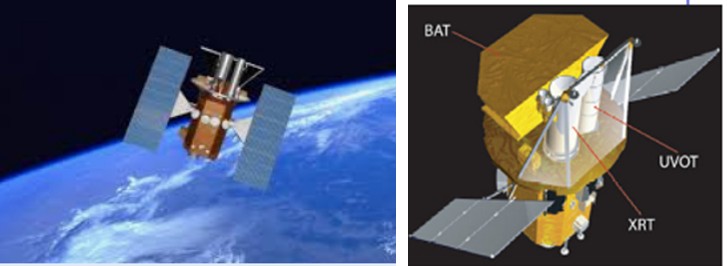
Swift was designed to observe in different wave lengths through three instruments: BAT (Burst Alert Telescope), XRT (X-ray Telescope) and UVOT (Ultra-violet / optical Telescope) (Figure 1B) [1]. The key observational purposes were
- Determine the origin of GRBs
- Classify the GRBs along with searching of new type of bursts
- Determine the burst evolution scenarios and interactions with the surroundings
- Use of observed GRB data to study the early Universe
• Perform the first sensitive hard X-ray survey of the sky.
- After launching Swift piled up various interesting observations along with observational data in its first few years of operation. In fact, the Swift mission shows its capability to provide answers of the four key GRB physics questions (see reviews Gehrels N, et al. [4], Bufano F, et al. [5], Gehrels N, et al. [6]):
- What are the progenitors of GRBs?
- Different classes of bursts with unique physical processes involved actively with it;
- Scenarios involved during the evolution of blast waves and interact with its surroundings;
- What information can GRBs provide us about the early universe?
Swift observatory was operating in optical, ultraviolet and x-ray lines through its supported instruments BAT, UVOT and XRT. Its rapid response will allow the astronomers to search and study the expected x-ray lines as well as direct red-shift associated with the x-ray afterglow. Note that, all the long GRBs have x-ray afterglow but not all have bright optical or radio afterglow. The reason may be due to optical extinction resulting which it is possible in some cases the presence of optical (and x-ray) afterglow but decays much more rapidly i.e. density of the local environment has an important role (Figure 2).
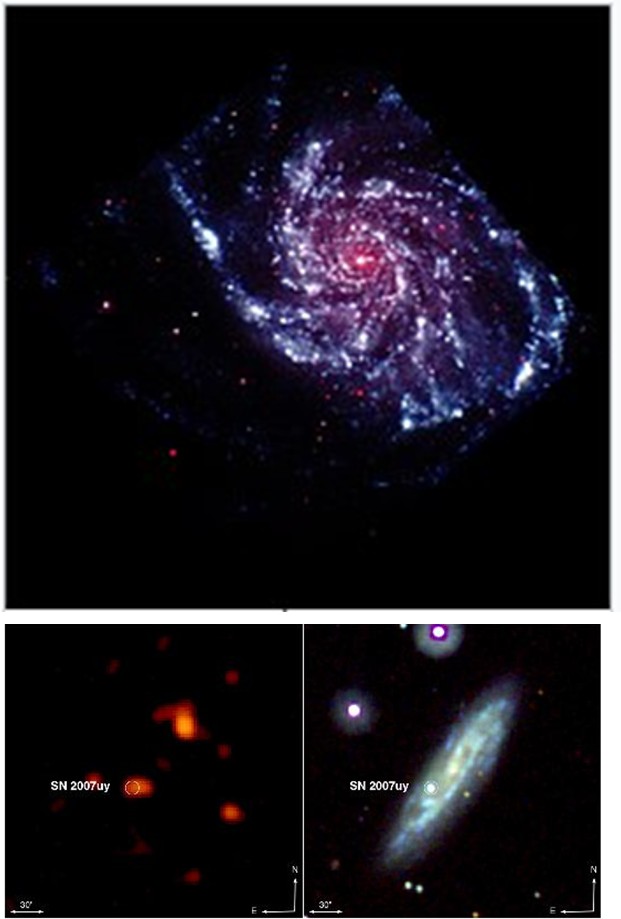
In order to resolve this problem it was decided that Swift will observe x-ray lines during the early phase of the afterglow. On 09th January 2008 swift detected first time a shock break out when it was observing a s supernova SN2007uy, located 90 million light year away from Earth, in the spiral galaxy NGC 2770 (Figure 3a). Coincidently, another supernova SN2008D reached under the view angle of the Swift.
(3A) Description: Swift Satellite took these images of Supernova SN 2007 uy in the galaxy NGC 2770 before SN 2008D exploded. An X-ray image is on the left and it’s image in visible light. (CREDIT: NASA/Swift Science Team/ Stefan Immler).
![Figure 3: Discovery image of XRO080109 / SN2008D. Panel (A): X-ray (left) and UV(right) image of the field obtained on 7th January 2008 when Swift observing the SN2007uy. No source is detected at the galaxy top position. Panel (B): Same image on X-ray and UV observation on 09th January 2008. Panel (C) X-ray light curve of XRO 080109 (adopted from Soderberg AM, et al. [7], Courtesy – NASA).](/fulltextimages/12873/fig_3.png)
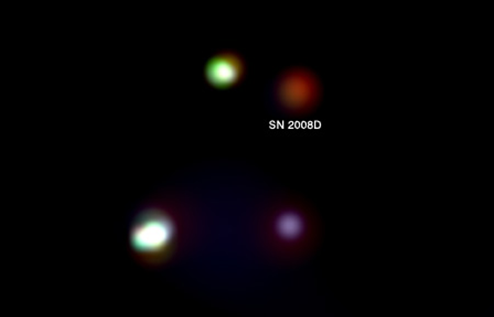
(3B) Description: Swift caught a bright X-ray burst from an exploding star on 09th January 2008. A few days later this unknown exploding star was identified as SN2008D that appeared in visible light. (CREDIT: NASA/Swift Science Team/Stefan Immler).
Figure 3: Discovery image of XRO080109 / SN2008D. Panel (A): X-ray (left) and UV(right) image of the field obtained on 7th January 2008 when Swift observing the SN2007uy. No source is detected at the galaxy top position. Panel (B): Same image on X-ray and UV observation on 09th January 2008. Panel (C) X-ray light curve of XRO 080109 (adopted from Soderberg AM, et al. [7], Courtesy – NASA).
After decoding the observed data Soderberg AM, et al. [7] found that the energy and pattern of the x-ray outburst are consistent with a shock wave bursting from the surface of the progenitor star implying that SN2008D was in its birth phase (i.e., it marks the birth of supernova) (Figure 3b). As the Swift is equipped with multiple instruments for observing gamma ray, x-ray and ultraviolet light, the situation was like that during observation of an extremely bright 5 minute x-ray outburst (i.e., SN2007uy) occurred in another part of spiral galaxy NGC 2770, at the same moment Swift was observing in other part of NGC 2770 where Sn2008D’s shock wave was blowing up the star i.e. the right time when supernova SN2008D started from the first moment (Figure 4). Another supernova explosion moment was captured by Swift (see Figure 5).This was a rare moment because the astronomers are able to detect them only when they grow brighter after the start of star’s violent death, although supernova explosions are taking place all over the universe.
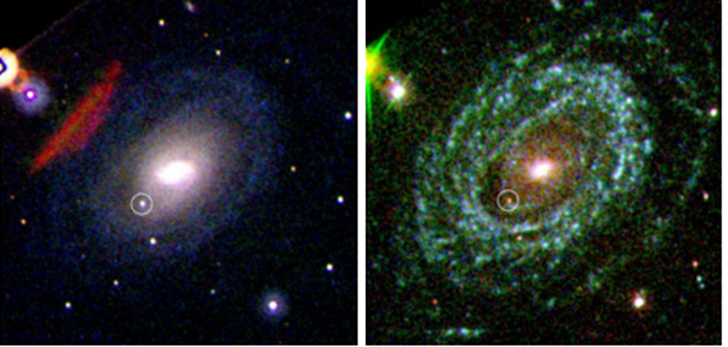
Another significant result Soderberg AM, et al. [7] found in their investigation that radio and x-ray observation data showed no evidence of a jet played in a role in the supernova explosion which ruling out our old idea that a rare type stellar explosion originates the GRBs.
Several Milestones Touched by Swift
Analysis of observed data obtained by Swift during the last 15 years of its active operation shows that several breakthrough results that can nullify our previous findings / ideas. For example:
Various Extremes
- During the merger of parent galaxies, supermassive black holes emit hard x-rays, although scientists/astronomers were not sure about the process i.e. how the high energy bursts occurred?
- Swift spotted a burst of x-ray in the event GRB 100621A such that this burst was so powerful bright light source that ever seen in x-rays at cosmological distances.
- During the period of operation till 2010 swift detected more than 500 GRBs. But in deep sense each burst has turned into a new piece of puzzle with a clear emerging picture etc (Table 2).
| Name of GRBs | Significant results | Redshift z |
|---|---|---|
| GRB 090429B | Most distant with photometric redshift estimate | z = 9.4 |
| GRB 090423 | Most distant with spectroscopic redshift | z = 8.2 |
| GRB 110918A | Most Luminous | z = 0.984 |
| GRB 221009A | Most Energetic | z = 0.151 |
| GRB 111209A | Long duration with duration at least 7 hrs | _ |
| GRB 080319B | Most distant naked eye brightness GRB | z = 0.937 |
Table 2: Significant results of GRBs along with Redshift z values.
Two Goldmine Touches
Discovery of Cosmic Baby: The Swift Burst Alert Telescope (BAT) detected typical characteristics of a short burst from a magnetar on 12th March 2020 at 21:16:49 UT [4, 6, 8]. Swift E-ray telescope (XRT) finally detected this new but un-catalogued X-ray source as Swift J1818.0 – 1607 which is presently known as Cosmic Baby (Figure 6). The significant parameters of cosmic baby are:
- Characteristic age ~ 240 years [9]
- Surface magnetic field strength ~ 2.7 x 10¹⁴ G
- Dipole magnetic field strength ~ 7 x 10¹⁴ G
- Spin period = 0.7333920s
- Coherent periodicity of X-ray signal = 1.36s
- Period derivative ~ 9 x 10–11 s. s-1 [10].
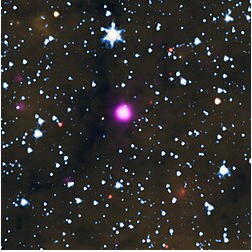
Based on the initial observed data Parui RK [11, 12, 13] estimated internal core magnetic field strength and elliptiicity of this cosmic baby and found 8.9424 x 10¹⁷ G and 9 x 10⁻³, respectively. It is seen that deformation due super- strong magnetic field turns it into a “triaxial star”. As its age is ~ 240 years this cosmic baby will exhibit its triaxiallity for next 760 years. The importance of cosmic baby is that it shows the first evidence of the existence of a triaxial star that was predicted by Chandrasekhar S [13] in 1969 i.e. more than 50 years ago [14]. This means that physical existence of a triaxial star is possible.
Supernova with Act of Exploding in Real-time: A normal or typical supernova arises at the end of stellar evolution when the core of a massive star runs out of nuclear fuel and collapses under its own gravity to form an ultra-dense compact object like neutron star. This new born neutron star, according to our conventional ideas, compresses, then rebounds and finally trigger a shock wave that blows the star’s gaseous outer layers.
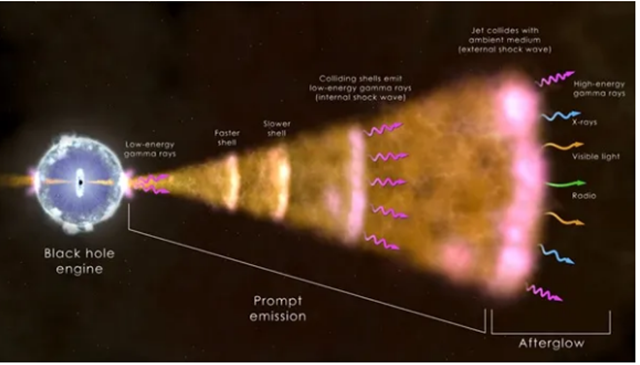
But Swift observatory captured a new picture of supernova explosion. As discussed earlier, analysis of observed data indicates —Firstly, the shock break out with the emission of x-rays and then exploding takes place (Figures 3a & 3b) Figure 7 represents the modeling of origin of a GRB based on the new ideas [15, 16]. The core collapse of a massive star (i.e. neutron star) turns into a blackhole (left side). This newly formed black hole sends a jet moving around the collapsed star and come out into space after collision with the hot ionized gas arises in the vicinity of the newly born black hole and finally produce afterglow scenario. For the real time supernova explosion, X-ray plays an important role because they are only capable to provide a distinct view of the exploding star in the last minutes of its life [17].
Conclusion
Swift, a medium sized space explorer mission (operated by NASA), was launched on 20th November 2004 mainly for searching the origin of Gamma Ray Bursts (GRBs) as well as use of the observed data as probes of the early universe. It is a multiwavelegth observatory carrying three instruments: the Burst Alert Telescope (BAT; Gamma Ray), the X-ray Telescope (XRT) and the Ultraviolet/Optical Telescope (UVOT).
The sequence of action of these three instruments are : As soon as the BAT detects a new GRB then Swift rapidly relays its 1-4 arcmin position estimate to the ground and triggers an autonoumos spacecraft slew to bring the burst within the field of view of XRT and UVOT to follow-up the afterglow.
During 2008 coincidently these three instruments were active simultaneously when observation was concentrated on NGC 2770. Swift was able to observe supernova SN2007uy and SN2008D.
Resulting which a rare event, i.e. real time of birth and right moment of explosion of a supernova, had been known to the astronomers. Decoding of the observed data hints that no significant role of a jet has for stellar explosion. The most important result the Swift has given to the astronomers / scientists as nature’s gift is the Cosmic Baby with its age only 240 years. As a result, continuous observation of the cosmic baby can be used as probes for understanding the real-time evolutionary scenarios of a compact object (i.e. Magnetar, as well as applicable to neutron star) from its birth phase to aged phase.
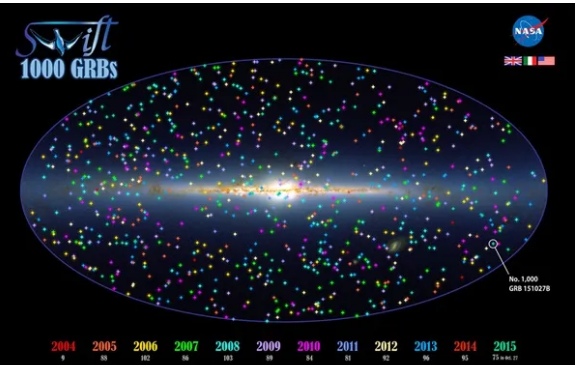
Till date Swift has detected more than 1000 GRBs. Out of these the distant measurement for 30% Swift GRBs are known to the astronomer. Figure 8 shows the positions of 1000 Swift GRBs on an all-sky map oriented to the plane of our own galaxy the Milky Way running across the center. This mapping helps the astronomers to investigate how these powerful GRB events are distributed across the space and time. Not only that distance record of GRB 090423 means that it exploded at the dawn of star formation in the universe. This implies that its light took more than 13 billion years to reach Earth.
Swift’s good health means astronomers can expect its operational activeness resulting which many more detectable GRBs will be offered us in near future. Chronology of its success, as listed below indicates that Swift, in fact, is an amazing versatile observatory. In other sense, it is a fabulous discovery machine which is helpful for finding unknown type of GRBs originated from stars, galaxies and even from gamma ray bursts themselves.
Chronology of Notable Success achieved by Swift Mission
| Date | Description / Detection of GRB | Significance |
|---|---|---|
| 01st February 2005 | First light captured by UVOT | Indication of Swift observatory is operational active |
| 9-May-05 | Swift detected GRB 050509B, a burst of gamma rays that lasted one-twentieth of a second. | Marked the first time the accurate location of a short-duration gamma-ray burst had been identified. |
| The first detection of X-ray afterglow in an individual short burst | ||
| 4-Sep-05 | Swift detected GRB 050904 ( with a redshift value of 6.29 and a duration of 200 seconds) | The most distant yet detected at approximately 12.6 billion light-years. |
| 18-Feb-06 | Swift detected GRB 060218, | An unusually long (about 2000 seconds), nearby (about 440 million light-years) burst may be an indication of an imminent supernova. |
| 14-Jun-06 | Swift detected GRB 060614, a burst of gamma rays that lasted 102 seconds in a distant galaxy (about 1.6 billion light-years). | No supernova was seen following this event. |
| Speculate that it represented a new class of progenitors. While others suggested that these events could have been massive star deaths. It is suggested that produced too little radioactive 56Ni may be useful to power a supernova explosion. | ||
| 9-Jan-08 | Swift, during observing a supernova in NGC 2770, witnessed an X-ray burst coming from the same galaxy. The source of this burst was found to be the beginning of another supernova, later known as SN 2008D | Never before had a supernova been seen at such an early stage in its evolution |
| 8 and 13 February 2008 | Swift provided critical information about the nature of Hanny’s Voorwerp, mainly the absence of an ionizing source within the Voorwerp or in the neighboring IC 2497. | _ |
| 19-Mar-08 | Swift detected GRB 080319B, a burst of gamma rays amongst the brightest celestial objects ever witnessed. At 7.5 billion light-years | Swift established a new record for the farthest object (briefly) visible to the naked eye |
| 13-Sep-08 | Swift detected GRB 080913, at the time the most distant GRB observed (12.8 billion light-years) | Until the observation of GRB 090423 a few months later |
| 23-Apr-09 | Swift detected GRB 090423, the most distant cosmic explosion ever seen at that time, at 13.035 billion light- years. | The universe was only 630 million years old when this burst occurred |
| 29-Apr-09 | Swift detected GRB 090429B | which was found by later analysis published in 2011 to be 13.14 billion light-years distant (approximately equivalent to 520 million years after the Big Bang), even farther than GRB 090423 [17]. |
| 16-Mar-10 | Swift tied its record by again detecting and localizing four bursts in a single day. | _ |
| 13-Apr-10 | Swift detected its 500th GRB | _ |
| 28-Mar-11 | Swift detected Swift J1644+57 which subsequent analysis showed to possibly be the signature of a star being disrupted by a black hole or the ignition of an active galactic nucleus | This is truly different from any explosive event we have seen before |
| 16 and 17 September 2012 | Discovery of ultra-long class of gamma-ray bursts | _ |
| 24-Apr-13 | The outburst, produced by a rare X-ray nova, announced the presence of a previously unknown stellar-mass black hole undergoing a dramatic transition from the low/hard to the high/soft state | Later observations by the NuSTAR and the Chandra X-ray Observatory confirmed the detection |
| 27-Apr-13 | Swift detected the “shockingly bright” Gamma-ray burst GRB 130427A. Observed simultaneously by the Fermi Gamma-ray Space Telescope, it is one of the five closest GRBs detected and one of the brightest seen by either space telescope. | _ |
| 45529.875 | Evidence for kilonova emission in short GRB | _ |
| By October 2013 | Swift had detected more than 800 GRBs | _ |
| 23-Apr-14 | Swift detected the strongest, hottest, and longest-lasting sequence of stellar flares ever seen from a nearby red dwarf star | The initial blast from this record-setting series of explosions was as much as 10,000 times more powerful than the largest solar flare ever recorded |
| 3-May-14 | Detection of a UV Pulse from an iPTF discovered young Type Ia SN | _ |
| June–July 2015 | The brown dwarf OGLE-2015-BLG-1319 was discovered using the gravitational microlensing detection method in a joint effort between Swift | _ |
| 27-Oct-15 | Swift detected its 1000th gamma-ray burst, GRB 151027B | _ |
| 18-Aug-17 | Swift discovers UV emission from the kilonova AT 2017gfo, the electromagnetic counterpart to GW170817 | _ |
| 23-Sep-17 | Swift is the first to identify TXS 0506+056 as the possible source of the IceCube-170922A extremely high energy | _ |
| 14-Jan-19 | Swift discovers the most powerful observed gamma-ray burst, GRB 190114C, reaching tera electronvolt energies | _ |
| Cosmic Baby | _ | |
| 9-Oct-22 | Swift discovers, simultaneously with Fermi, GRB 221009A | One of the closest GRBs ever detected and the brightest ever detected. |
| GRB 080319B, one of the brightest astronomical events ever detected, seen in X-ray and visible/UV light.GRB 151027B, the 1000th GRB detected by Swift.All-sky map of GRBs detected by Swift between 004 and 2015 | _ |
Table 3: Yearly Detection of GRB along with its Significance.
Acknowledgement
The author expresses his sincere gratitude to the anonymous referee for his / her valuable comments and fruitful suggestions. He is greatly indebted to Dr Lara Carroll for her kind invitation and to Dr Ramon Clerk for his kind help. He also wishes to thank Prof. H. N. K. Sarma, Dept. of Physics, Manipur University; Mr B. K. Ganguly, Airports Authority of India, Kolkata; Mrs. Tapati Parui and Sri Rajarshi Parui for their kind encouragement and help.
Data Availability Statement
No new data used
Competing Interest
Not applicable
References
-
Ryde F (2008) On the origin of gamma ray bursts. Philo Trans Royal Socy A 368(1884): 4605.
-
Nakar E (2007) Short hard gamma ray bursts. Phys Reports 442(1-6): 166-236.
-
Kumar P, Zhang B (2015) The Physics of Gamma Ray Bursts and Relativistic Jets. Phys Reports 561: 1-109.
-
Gehrels N, Chincarini G, Giommi P, Mason KO, Nousek JA, et al. (2004) The Swift Gamma Ray Bursts Mission. Astrophys J 611(2): 1005-1020.
-
Bufano F, Immler S, Turatto M, Landsman W, Brown P, et al. (2009) Ultraviolet spectroscopy of Supernovae, The first two years of Swift observation. Astrophys J 700(2): 1456.
-
Gehrels N, Razzaque S (2013) Gamma Ray Bursts in the Swift Fermi Era. Frontiers Phys 8: 661-678.
-
Soderberg AM, Berger E, Page KL, Schady P, Parrent J, et al. (2008) An Extremely luminous X-ray outburst at the birth of a supernova. Nature 453: 469-474.
-
Evans PA, Gropp JD, Kennea JA, Klingler NJ, Laha S, et al. (2020) Swift-BAT trigger 960986: Swift detection of a new SGR Swift J 1818.0 – 1607. GCN Circular 27373.
-
Esposito P, Rea N, Borghese A, Zelati FC, Vigano D, et al. (2020) A very young radio-loud Magnetar. Astrophys J Lett 896: L30.
-
Champion D, Desvignes G, Jankowski F (2020) Spin evolution of the new magnetar J1818.0–1607. Astron 13559.
-
Parui RK (2023) A Remark on Do triaxial star supermassive compact star exist. Int Astron Astrophys Res J 5(1): 33-37.
-
Parui RK (2023) A New Compact Star-the Triaxial Star- and the Detection of a Cosmic Baby: A Possibility. Int Astron Astrophys Res J 5: 38.
-
Parui RK (2023) Cosmic Baby and detection of a new compact star — the Triaxial Star: A possibility. Astrophys Space Sci 368(6): 46.
-
Chandrasekhar S (1969) Ellipsoidal Figures of Equilibrium. In: McNall D (Ed.), Yale University Press, USA. Geophysical Journal International 21(1): 103-104.
-
Balberg S, Loeb A (2011) Supernova shock breakout through a wind. MNRAS 414(2): 1715-1720.
-
Bayless AJ, Fryer C, Brown PJ, Young PA, Roming PWA, et al. (2022) Supernova shock breakout/Emergence detection Predictions for a wide field X-ray survey. Astrophys J 931(1): 15.
-
Vigliano AA, Longo F (2024) Gamma Ray Bursts: 50 years and Counting. Universe 10(2): 57.
- Early Universe: Hadronic Crystals Coherent Micro Gravitational Wave Emitters PHYSICS Part II
- The Solar System Constraint Maze: A Scientific Dead-End Revealing the Interuniversal Machine
- Assessment of Radiofrequency Radiation from 2G and 3G Mobile Phone Handsets
- Early Universe Magneto-Gravitational Coupling Genesis Physics: Part I
- Falsifiability of the Classical Law of Gravitation and Unveiling the Time-temperature Entanglement of the Universe
- Origin of Ancient Civilisations The Southern Hemisphere’ Scenario