
Ionic Thrusters for Deep-Space
This analysis explores the basic principles, notable technological progress, and varied uses of ionic thrusters in modern space exploration. Furthermore, it discusses the obstacles and potential future developments of this technology, highlighting its crucial contribution to advancing our exploration of the universe
Abbreviations
GEOs: Geostationary Earth Orbits; LEOs: Low Earth Orbits; SPTs: Stationary Plasma Thrusters; FEEP: Field Emission Electric Propulsion.
Introduction
Since the 1960s, high-power non-air-breathing propulsion systems have played a crucial role in space exploration. Ion thrusters have emerged as a revolutionary technology, offering improved efficiency compared to traditional chemical propulsion systems. Currently, more than 250 artificial satellites utilize electric propulsion for station-keeping in geostationary Earth orbits (GEOs) and low Earth orbits (LEOs) [1]. Companies like Space Systems/Loral have proven the reliability of stationary plasma thrusters (SPTs) with over 10,000 operational hours in ground testing and satellite operations [2]. The widespread use of electric propulsion highlights its significance in modern space technology, with ion thrusters providing high specific impulse and efficient propellant usage, making them ideal for long-duration missions [3].
This transition from high-thrust, short-duration propulsion to low-thrust, long-duration propulsion signifies a paradigm shift in deep-space exploration, emphasizing the importance of efficient propulsion systems as humanity continues to explore the cosmos [4].
Principles of Ionic Thrusters
Ionization Process: The core component of an ionic thruster is the ionization chamber, where a neutral gas, usually xenon, is converted into a plasma by ionization [5]. This method entails removing electrons from xenon atoms, leading to the formation of positively charged ions and unbound electrons. The ionization process can be represented by the following equation:
X𝑒→ X𝑒++𝑒− (1)
The produced plasma plays a vital role in generating thrust, enabling the thruster to attain optimal efficiency and necessary control for missions in deep space. The transformation of neutral xenon atoms into energetic ions and electrons through ionization can be compared to a choreographed particle movement. This intricate process results in the formation of a dense plasma, which is crucial for the acceleration stage. Initiating this plasma is similar to lighting a controlled flame that drives the spacecraft’s engine, propelling it into space with exceptional accuracy and effectiveness.
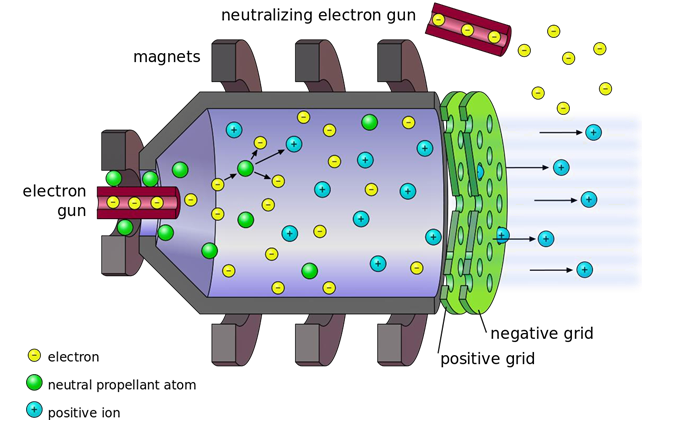
Acceleration Mechanism: Positively charged ions are accelerated by being directed through a sequence of grids or electrodes which produce a powerful electric field. This electric field propels the ions out of the thruster at significant speeds, resulting in the generation of thrust [6]. The motion of the ions is governed by the following equation:
F=qE (2)
The force, F, is exerted on the ion with charge q in the presence of an electric field, E. Unlike conventional rockets that rely on explosive combustion, ion thrusters utilize electromagnetic fields for propulsion, ensuring that each ion contributes to the forward thrust. This approach offers exceptional precision and control, making ion thrusters well- suited for extended missions. The acceleration process can be likened to a well-coordinated orchestra, where each ion is meticulously guided through the electric field to attain the speeds necessary for efficient spacecraft propulsion. The precision and control offered by ion thrusters make them a remarkable technological achievement, showcasing human ingenuity and creativity (Figure 1). Once accelerated, the ions exit the thruster, generating a continuous and gentle thrust force that is ideal for the consistent propulsion needed in deep-space missions [7].
Types of Ionic Thrusters
Gridded Ion Thrusters: Ion thrusters with grids are designed with a set of precisely adjusted grids that manage the flow of ions, decreasing collisions and improving effectiveness [8]. These grids work together in harmony to facilitate the movement of ions smoothly and decrease energy wastage. Through ongoing testing and enhancements, the performance and dependability of these thrusters have been greatly enhanced. Gridded ion thrusters showcase the dedication to achieving excellence in space propulsion, delivering top-notch functionality with minimal inefficiencies and maximum effectiveness.
2 P T I g = (3)
0 sp where, T is the thrust, P is the power, 𝐼𝑠𝑝 is the specific impulse, and 𝑔𝑜is the standard gravitational acceleration.
Hall Effect Thrusters: Hall effect thrusters utilize magnetic fields to propel ions, removing the necessity for physical grids and streamlining the design [9, 10]. Their effectiveness and dependability have established them as a favored option for prolonged missions. These thrusters can be viewed as conductors of propulsion, directing ion motion via magnetic fields. Their streamlined design and exceptional efficiency highlight their significance in modern space exploration, offering a sturdy and dependable propulsion system for extended missions.
𝐹=m*𝑣𝑒 (4) where m is the mass flow rate and 𝑣𝑒is the exhaust velocity of the ions.
Field Emission Electric Propulsion (FEEP): FEEP thrusters utilize powerful electric fields to ionize liquid metals, providing exceptional accuracy and effectiveness [11]. They are well-suited for tasks that demand precise
Recent Technological Developments
modifications, such as maintaining satellite positions and navigating between planets [12]. FEEP thrusters act as the adept conductors of space propulsion, possessing the ability to execute small adjustments with extraordinary precision. Their sophisticated technology guarantees that spacecraft can execute intricate maneuvers with unmatched precision, establishing their indispensability for missions that prioritize precision and dependability.
2 1 2 e P mv = (5) where P is the power, m is the mass flow rate, and 𝑣2 is the exhaust velocity.
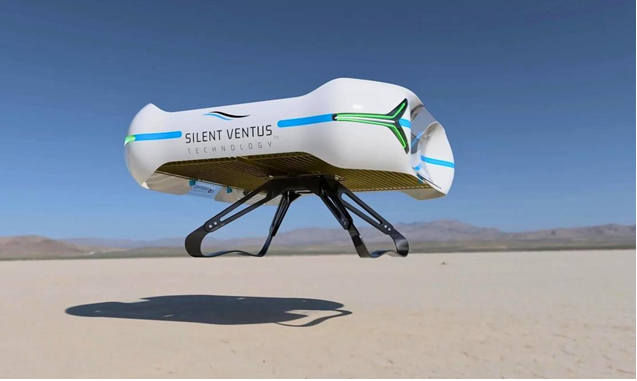
Advanced Materials: Progress in materials technology has tackled the problem of material degradation caused by ion bombardment. Breakthroughs like graphene composites and advanced ceramics have greatly improved the strength and lifespan of thrusters, enabling longer mission durations and decreased maintenance [13]. These materials can be likened to the resilient armor of a medieval knight, built to withstand continuous ion bombardment. The integration of these materials into thruster design marks a significant step forward, offering a strong solution that boosts the durability and dependability of ion thrusters, guaranteeing their ability to withstand the challenging space environment for prolonged periods. Power Electronics: Breakthroughs in power electronics have transformed the design of ion thrusters. By utilizing compact and high-efficiency power supplies, thrusters can now operate with increased efficiency and reduced weight.
This has broadened their application in various sizes of spacecraft, including large spacecraft and small satellites [14]. The power electronics play a crucial role in the thruster by providing the essential energy needed to propel ions accurately and efficiently. These advancements guarantee that ion thrusters continue to lead the way in space propulsion technology, improving their overall performance and flexibility to meet the evolving demands of contemporary space missions. Optimization Techniques: Current research focuses on optimizing ionization processes and improving thruster performance [15]. Advances in ion optics and control algorithms have increased efficiency, enabling ion thrusters to compete with traditional propulsion systems. Optimization techniques are like fine-tuning a high-performance sports car, ensuring each component operates at peak efficiency. These developments continuously expand the capabilities of ion thrusters, cementing their role as a critical tool in space exploration. The ongoing improvements guarantee that ion thrusters remain at the cutting edge of space propulsion
Applications in Space Exploration
Deep Space Missions:
technology, providing a reliable and efficient solution for future space missions (Figure 2).
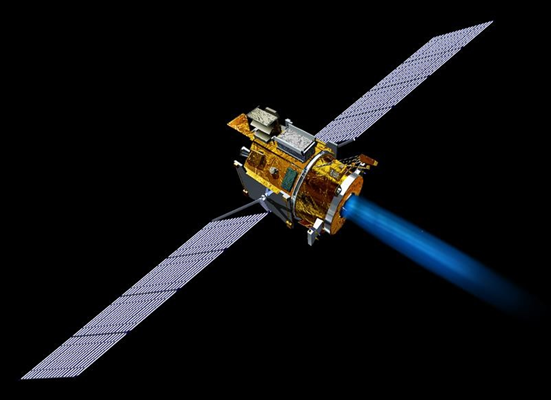
Ion thrusters are well-suited for deep-space exploration because of their high specific impulse and fuel efficiency [16]. The potential of ion propulsion was demonstrated by NASA’s Dawn spacecraft, which extended mission lifespans and reached distant celestial bodies such as Vesta and Ceres [17]. Envision a spacecraft traveling through the cosmos, driven by the steady and efficient thrust of ion propulsion (Figure 3). These missions are not only scientific pursuits but also extraordinary adventures that expand the limits of human exploration. The success of such missions underscores the vital role of ion thrusters in advancing our comprehension of the universe and facilitating the exploration of previously inaccessible destinations.
e sp v I g = (6)
0 Where, 𝐼𝑠𝑝 is the specific impulse, 𝑣𝑒 is the exhaust velocity, and 𝑔0 is the standard gravitational acceleration.
Satellite Maneuverability: Satellites rely on precise maneuvers to sustain their orbits and carry out intricate operations. Ionic thrusters offer a dependable means of adjusting orbits and upholding positions, diminishing the dependence on conventional chemical thrusters and prolonging the lifespan of satellites [18]. Similar to skilled performers who depend on exact movements, satellites rely on ion thrusters for their delicate maneuvers. These thrusters guarantee that satellites remain on track, executing essential functions with unwavering reliability. The incorporation of ion thrusters in satellite propulsion systems signifies a noteworthy progression, elevating the efficiency and durability of these critical space assets. Interplanetary Travel: Ion thrusters are essential for missions aiming to reach other planets and moons within our solar system [19]. Their efficiency allows spacecraft to carry more scientific instruments, increasing the mission’s potential for discovery. Picture a spacecraft gracefully gliding through space, powered by the continuous thrust of ion propulsion. These missions are not only scientific pursuits but also extraordinary journeys that push the limits of human exploration. The use of ion thrusters in interplanetary travel demonstrates their ability to sustain lengthy missions, ensuring spacecraft can navigate through space with enhanced efficiency and precision, making the dream of exploring distant celestial bodies a reality.
Challenges and Future Prospects
Thrust Limitations
Ion thrusters have a lower thrust compared to chemical rockets, which limits their use to specific mission profiles. Scientists are investigating hybrid propulsion systems and creative designs to address this limitation [20], ensuring that ion thrusters can meet the changing requirements of future space missions. These endeavors represent a quest for a new frontier in propulsion technology, where ion thrusters can attain the same level of power and adaptability as their chemical counterparts. The continuous pursuit of solutions to enhance thrust capacity ensures that ion thrusters continue to lead the way in space propulsion, capable of fulfilling the varied needs of upcoming missions.
T=m*a (7)
where T is the thrust, m is the mass, and a is the acceleration.
Reducing Costs
The development and deployment of ion thrusters can incur significant costs. Enhancements in manufacturing and the realization of economies of scale are essential in order to enhance the accessibility of this technology [15]. The reduction of expenses is imperative in order to facilitate wider adoption and to further advance space exploration. Decreasing costs is comparable to making space travel more accessible, enabling a broader range of missions and organizations to participate. This objective is steering efforts to streamline production processes and capitalize on economies of scale, ensuring that ion thrusters can be deployed more extensively and cost-effectively. The emphasis on cost reduction is critical for broadening the utilization of ion thrusters, enabling more missions to benefit from their advanced propulsion capabilities.
Environmental Impact
Ion thrusters are considered more environmentally friendly compared to chemical propulsion, but there are still environmental challenges associated with the production and disposal of certain components. To tackle these issues, sustainable practices and recycling technologies are being developed [20]. Emphasizing sustainability ensures that space exploration has a minimal environmental footprint, preserving the pristine nature of space. The focus on sustainable practices and recycling technologies is essential to prevent negative environmental impacts from advancements in ion propulsion. Prioritizing sustainability is key to conducting space exploration responsibly and ethically.
Conclusion
Ion thrusters are a groundbreaking advancement in space propulsion technology, providing unparalleled efficiency and versatility. Their importance in missions to deep space, satellite maneuvering, and travel between planets cannot be emphasized enough. As technology advances, ion thrusters are positioned to have a crucial role in the future of space exploration. The creation of ion thrusters showcases human ingenuity and the relentless pursuit of knowledge. These propulsion systems go beyond mere instruments; they embody our desire to venture into the cosmos. The outlook for ion thrusters is promising, with continuous research and innovation pushing the limits of what is possible, ensuring they remain at the forefront of space exploration technology.
References
-
Sekerak MJ (2015) Plasma Wave Measurements in a 6-kW Hall Thruster. Journal of Applied Physics 118(23): 233301.
-
Mazouffre S (2016) Electric Propulsion for Satellites and Spacecraft: Established Technologies and Novel Approaches. Plasma Sources Science and Technology 25(3): 033002.
-
Patterson MJ (1999) Ion Propulsion: Technology and Applications. NASA Technical Reports Server.
-
Goebel DM, Katz I (2008) Fundamentals of Electric Propulsion: Ion and Hall Thrusters. Wiley pp: 486.
-
Jahn RG, Choueiri EY (2003) Electric Propulsion. Encyclopedia of Physical Science and Technology, pp: 125-141.
-
Anderson JR, Hargus WA (2017) Characterization of High-Power Gridded Ion Thrusters. Journal of Propulsion and Power 33(4): 795-803.
-
Hsu W, Wilbur P (2014) Electromagnetic Field Utilization in Space Propulsion. Journal of Spacecraft and Rockets 51(5): 1340-1352.
-
Beal BE, Gallimore AD, Hargus WA, Haas JM (2004) Plume Characteristics of a Low-Power Hall Thruster. Journal of Propulsion and Power 20(6): 985-991.
-
Fearn DG (2001) Ion Thruster Development Activities in the UK. Acta Astronautica 48(5-12): 687-696.
-
Hofer RR, Jackson J, Allen M, Myers R, Hoskins A (2017) 100 kW nested Hall thruster system development. NTRS pp: 1-12.
-
Ahedo E, Choueiri EY (2011) Field Emission Electric Propulsion for Spacecraft Maneuvering. IEEE Transactions on Plasma Science 39(1): 262-271.
-
Gonzalez MR (2018) Precision Control in Field Emission Electric Propulsion Systems. Aerospace Science and Technology 82: 208-216.
-
Zhang L, Wang J (2020) Advanced Materials for Ion Thrusters: Enhancements and Applications. Journal of Space Propulsion 58(2): 192-205.
-
Kumar R, Lee S (2019) Compact Power Electronics for Efficient Ion Thruster Operations. IEEE Transactions on Aerospace and Electronic Systems 55(6): 2785-2796.
-
Polk JE, Kakuda RY, Anderson JR, Brophy JR, Rawlin VK, et al. (1999) In-Flight Performance of the NSTAR Ion Propulsion System on the Deep Space One Mission. IEEE Aerospace Conference Proceedings.
-
Morgan DS, Liu J (2017) Ion Propulsion in Deep Space Missions: A Review of Recent Advances.” Space Science Reviews, 212(1-2), 487-501.
-
Russell CT, Raymond CA (2019) The Dawn Mission: Exploring Vesta and Ceres with Ion Propulsion. Space Science Reviews 215(5): 58.
-
Zhang Y, Jones A (2021) Enhancing Satellite Maneuverability Using Ionic Thrusters. Journal of Aerospace Engineering 34(3): 04021030.
-
Patel V, Lewis B (2018) Interplanetary Travel with Ion Propulsion: A Feasibility Study. International Journal of Space Science and Engineering, 7(4): 319-334.
-
Adams T, Mitchell K (2020) Addressing the Challenges of Ion Thrusters: Cost, Thrust, and Environmental Impact. Acta Astronautica 175: 1-11.
- Early Universe: Hadronic Crystals Coherent Micro Gravitational Wave Emitters PHYSICS Part II
- The Solar System Constraint Maze: A Scientific Dead-End Revealing the Interuniversal Machine
- Assessment of Radiofrequency Radiation from 2G and 3G Mobile Phone Handsets
- Early Universe Magneto-Gravitational Coupling Genesis Physics: Part I
- Falsifiability of the Classical Law of Gravitation and Unveiling the Time-temperature Entanglement of the Universe
- Origin of Ancient Civilisations The Southern Hemisphere’ Scenario