
Astronomy Paradigm Shift: Challenging the Big Bang through Interuniversal Phenomena Elucidating the Complex Governing Mechanisms of Solar Dynamics
Context: The Big Bang theory has been a cornerstone of modern astronomy and astrophysics, providing a comprehensive model for the universe’s origin and expansion. Rooted in Einstein’s Theory of General Relativity, the Big Bang postulates a universe expanding from a singularity, with supporting evidence from the observed ratios of primordial elements such as helium, hydrogen, and lithium, consistent with predictions from thermodynamics and particle physics. Aims: Our research offers an alternative perspective on the universe’s creation, proposing a different source that challenges the prevailing Big Bang model. This investigation, originally focused on the origins of the universe, led to unexpected discoveries regarding solar system phenomena. Methods: Through extensive study of the Sun, we uncovered that it is subject to intricate physical interactions and interuniversal influences, revealing a mutual influence between universes. Results: Our findings, in this first study of its kind, not only propose a new understanding of the universe’s origin but also elucidate the complex mechanisms governing solar dynamics. Conclusions: This dual achievement opens new avenues for exploring cosmology and stellar physics, presenting a paradigm shift in our comprehension of the cosmos.
Abbreviations
JWST: James Webb Space Telescope; GRACE: Gravity Recovery and Climate Experiment; NIRCam: Near-Infrared Camera; PMS: Pre-Main Sequence Stars.
Introduction
Introduction to the Paradigm Shift in Cosmology
The Big Bang theory has been the dominant cosmological model for understanding the universe’s origin, supported by substantial empirical evidence, including cosmic microwave background radiation, Hubble’s law of cosmic expansion, and the abundance of light elements. Key studies grounded in Einstein’s Theory of General Relativity have further cemented the model’s place in modern cosmology [1]. Research by physicists such as Friedmann and Lemaître extended these ideas, proposing a universe that expands from a singularity.
However, recent discoveries, including the Hubble tension, unresolved mysteries surrounding dark matter and dark energy, and the nature of singularities, have led some to question the Big Bang’s completeness. Recent cosmological models, such as those proposed by Penrose R [2] with his cyclic universe theory, have sought alternative explanations for the universe’s creation, yet none have provided an entirely new mechanism as bold as the one suggested in this study: the Interuniversal Machine.
General Description
We present a groundbreaking discovery: a novel system, an extraordinarily complex autonomous mechanism, hitherto unknown, which we term the “Interuniversal Machine.” This enigmatic apparatus not only activates our entire solar system but also unveils profound insights into the genesis and mechanics of the universe. The pursuit of uncovering this Interuniversal machine necessitated the formulation of numerous fundamental yet unverified hypotheses, pushing the boundaries of human cognition and scientific inquiry. It was only through this rigorous process that we could finally identify and substantiate the existence of this phenomenon. Given the unprecedented nature of this research, it is devoid of prior substantiating sources, marking an entirely new chapter in the annals of astrophysics. Our methodology mandated a thorough re-examination of foundational principles in astronomy and astrophysics, resulting in the reliance on primary observations, photographic evidence, and deductive reasoning to infer the presence and remnants of this extraordinary machine. Our ultimate objective was to trace the origins of the universe, a quest that led us to the discovery of the Interuniversal machine. This study paves the way for a profound shift in our understanding of cosmic evolution and the underlying mechanisms that govern it. Discovery and Evidence: In this groundbreaking study, we present definitive evidence for the existence of an extraordinarily complex system, which we term the “Interuniversal Machine.” This discovery is substantiated through the analysis of Earth’s inclination data and seasonal gravity variations, meticulously measured by NASA’s GRACE (Gravity Recovery and Climate Experiment) mission [3]. Our research marks a significant paradigm shift, revealing an autonomous mechanism that not only influences our solar system but also provides unprecedented insights into the creation and workings of the universe. The journey to uncover this Interuniversal machine necessitated the development of novel hypotheses, challenging the boundaries of human knowledge and scientific exploration. Through rigorous analysis and innovative methodologies, we have successfully validated the existence of this enigmatic system. Description of the Interuniversal Machine: This study reveals a detailed depiction of the Interuniversal Machine, showcasing all its components that power the entire solar system. We assert that this sophisticated system not only activates the sun but also drives the axial rotation of planets, influences their inclinations, and governs their orbits around the sun. Our hypothesis underscores the complexity of this autonomous mechanism, which orchestrates solar activity and planetary dynamics with precision. The Interuniversal Machine plays a pivotal role in sustaining the balance and order of our solar system, driving processes that were previously not well understood. Through meticulous analysis and visualization, we will provide robust evidence for the existence and functionality of this system. From these foundational assumptions emerges an Interuniversal machine designed to create and generate solar energy.
Hypotheses and Assumptions
The pursuit of uncovering this Interuniversal machine necessitated the formulation of numerous fundamental yet unverified hypotheses, pushing the boundaries of human cognition and scientific inquiry. In the process of constructing the chain of events, these two fundamental assumptions were validated, whereas dozens of other hypotheses were determined to be incorrect. Fundamental Assumptions: Our research is based on two fundamental assumptions: A collapsing star, whose mass is absorbed by a black hole, exits and reaches another universe. This process involves a significant time distortion between the two universes. In the universe where the star collapses, the event transpires over two days, while in the universe where the star’s mass arrives, millions of years pass. Due to the tremendous time distortion between universes, the mass that enters the black hole emerges as stardust. Further Assessments Based on Recent Observations: Analysis of simulation images of the v404 Cygni black hole indicates that the mass of a collapsing star enters the black hole in a rotational manner. Building on this premise and the assumption that the mass transforms into stardust upon entering another universe, it can be inferred that the stardust exits the black hole in a rotational pattern in that universe. The v404 Cygni black hole exhibits dual gas emissions in opposite directions, akin to the “fiery looping rain on the sun” phenomenon, suggesting the exit of stardust from the black hole in two opposing directions. Expanding on recent observations, our further assessments suggest that stardust emerges from the black hole in a helical pattern, forming two coils that extend in opposite directions.
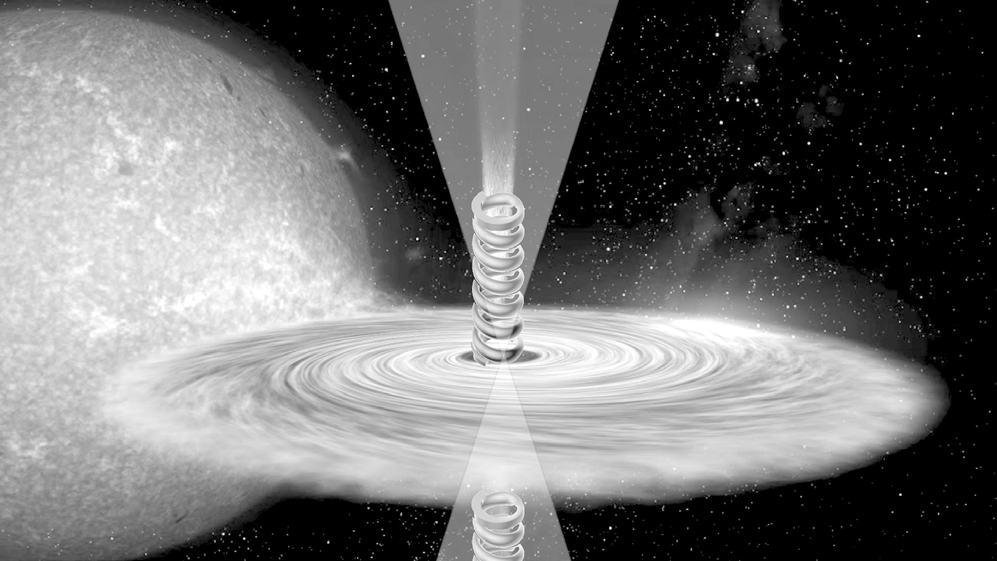
As stated initially, our research is built on numerous assumptions. We now present our final assumption: Not only does stardust emerge from the black hole in two opposite directions, but we also hypothesize that the gravitational force of the collapsing star in another universe, exiting the black hole in two opposite directions.
Electromagnetic Induction
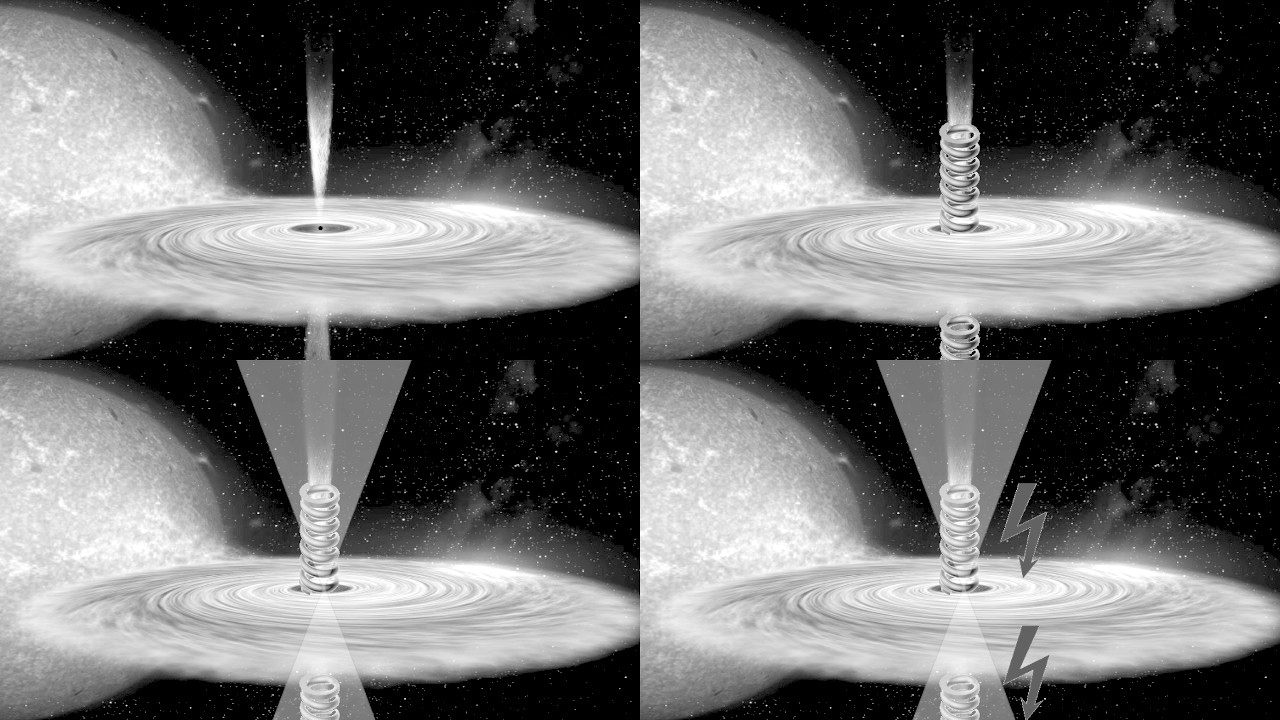
Electromagnetic Induction was first discovered way back in the 1830 by Faraday M [4]. Faraday noticed that when he moved a permanent magnet in and out of a coil or a single loop of wire it induced an Electro Motive Force or emf, in other words a Voltage, and therefore a current was produced. Assuming the validity of our prior assumptions, it follows that, theoretically, an electric current should flow within the stardust coils. The simulation image aims to illustrate this physical scenario, demonstrating the conditions under which a current would flow through the coils (Figure 1). Sequence of Events Detailing the Operation of the Interuniversal Machine: Stardust emerges from the black hole in two opposite directions over millions of years. This stardust accumulates into a large mass, with the black hole’s exit at its center. Initially, a Fiery Hourglass forms as a new star takes shape [5]. Over time, as the mass of stardust solidifies, the physical conditions evolve and change accordingly. The two coils of stardust that come out of the black hole are inside a huge accumulated mass and form solid coils with electrical conductivity. The huge mass that accumulates stands motionless. Current flows through the coils, igniting and burning any combination of combustible materials. At random, when a metal core accumulates in the center of one of the coils, the physical picture changes. An electromagnet with magnetic capabilities is created while the coil continues to heat. All the metallic mass is collected into one mass, the electromagnet pulls metal mixed mass and causes mass rotation of the newly formed sun. In the movement of the sun’s rotation on its axis, one coil is placed along the sun’s rotation and the second coil is failed while the sun rotates around the axis and passes through the center of the first coil and forms a permanent metal core for the resulting electromagnet. In the other universe, the black hole becomes dynamic, spinning relative to the sun on the other side of the universe, at enormous speed due to the time distortion between universes. The collapsing star will collapse faster and disappear within 48 hours but in the other universe where the sun works, the sun will work for millions of years.
Foundational Phase of the Advanced Machine
The foundational phase of our advanced machine is now complete. We have successfully introduced the Interuniversal mechanism responsible for generating the Sun. This machine plays a crucial role in the functioning of the solar system. Building on the description of the mechanism responsible for the formation of the Sun and the generation of solar energy, it is important to note that only the formation process of this stellar engine was initially detailed. However, this engine influences the creation of a comprehensive system—the solar system, encompassing all the planets. While these descriptions currently serve as an illustration, we will later demonstrate that the selected estimates, chosen from numerous failed attempts, are indeed accurate. Proof of their validity will be provided in subsequent sections.
Effects of the Solar Engine on the Sun and the Solar System
The following section continues to describe the effects of the solar engine on the Sun and the planets within the solar system: In this presentation, several enigmatic aspects of the Sun’s functionality are re-examined through a novel perspective:
The existence of the Sun The source of the Sun’s energy The Sun’s magnetic power The magnetic polarity of the Sun The Sun’s rotation around its axis The force responsible for the sun’s equator rotating faster than its poles The extreme heat of the Sun’s corona The force that creates and preserves the inclination of the planets The force that drives the rotation of the planets around their axes The force that drives the rotation of the planets around the Sun The force that preserves the rotation of the planets around the Sun in a disk orbit The force that creates the elliptical motion of the planets Conclusions: The introduction of the “Interuniversal Machine” presents a transformative concept in astrophysics, fundamentally altering our understanding of solar system dynamics and cosmic evolution. Through rigorous validation of hypotheses and careful analysis of evidence, this research establishes the existence of an autonomous mechanism that governs not only the activity of the Sun but also the intricate interactions within our solar system. The discovery underscores the importance of re-examining established astrophysical principles and provides a framework for exploring previously unexplained cosmic phenomena. This study’s exploration of the Interuniversal Machine bridges gaps in our knowledge, offering profound insights into the origins of the universe and the forces that sustain it. The detailed depiction of the machine’s functionality and its implications for solar system mechanics highlights the intricate balance maintained by this mechanism, reinforcing its pivotal role in cosmic stability. Furthermore, the successful validation of foundational assumptions demonstrates the robustness of the research, paving the way for future inquiries into the deeper workings of the universe. The foundational phase of understanding this advanced machine is complete, establishing a new paradigm in the study of solar and planetary dynamics. The subsequent chapters will build upon this groundwork, providing further evidence and refining the theoretical framework to fully elucidate the influence of the Interuniversal Machine on the Sun and the broader solar system.
Methods
Sun Formation Scenario
Electromagnetic Dynamics inside the Sun: Traditional models of solar dynamics attribute the Sun’s energy to nuclear fusion processes in its core, where hydrogen atoms fuse into helium, releasing vast amounts of energy [6]. However, this study introduces a competing theory in which an electromagnetic mechanism within the Sun, powered by the Interuniversal Machine, generates much of the Sun’s energy.
This theory challenges the prevailing fusion model by proposing that stardust, carried through interuniversal forces, forms electromagnetic coils that ignite solar processes. Empirical evidence, such as the increased heat of the Sun’s corona and the periodic reversal of the Sun’s magnetic poles, supports this new model, suggesting that electromagnetic forces—rather than fusion alone—are responsible for many of the Sun’s behaviors.
The Existence of the Sun
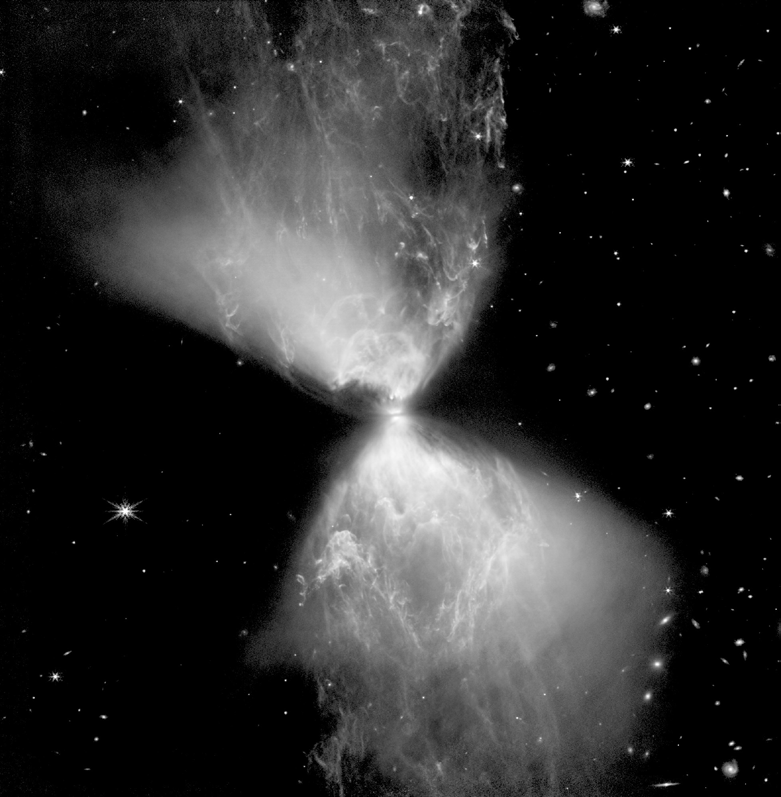
It is indisputable in the scientific world that Pre-Main Sequence Stars (PMS) were formed from star dust. The image that NASA wrote at 11/16/2022: NASA’s Webb Catches Fiery Hourglass as New Star Forms illustrates our presentation. This shows the formation of the sun and its very existence, by stardust coming out from an invisible source and in two opposite directions. This predicted by us already in 2018. Therefore, a presented presentation shows how the sun is produced and its very existence by the mass of a collapsing star in another universe, which passes through a black hole in two opposite directions, illustrates our claim. NASA’s James Webb Space Telescope has revealed the once hidden features of the protostar within the dark cloud L1527, providing insight into the beginnings of a new star. These blazing clouds within the Taurus star-forming region are only visible in infrared light, making it an ideal target for Webb’s NearInfrared Camera (NIRCam). The protostar itself is hidden from view within the “neck” of this hourglass shape. An edge- on protoplanetary disk is seen as a dark line across the middle of the neck. Light from the protostar leaks above and below this disk, illuminating cavities within the surrounding gas and dust (Figure 2). The protostar within the dark cloud L1527, shown in this image from NASA’s James Webb Space Telescope Near-Infrared Camera (NIRCam), is embedded within a cloud of material feeding its growth. Ejections from the star have cleared out cavities above and below it, whose boundaries glow orange and blue in this infrared view. The upper central region displays bubble like shapes due to stellar “burps,” or sporadic ejections. Credits: NASA, ESA, CSA, and STScI. Image processing: J. De-Pasquale, A. Pagan, and A. Koekemoer (STScI).
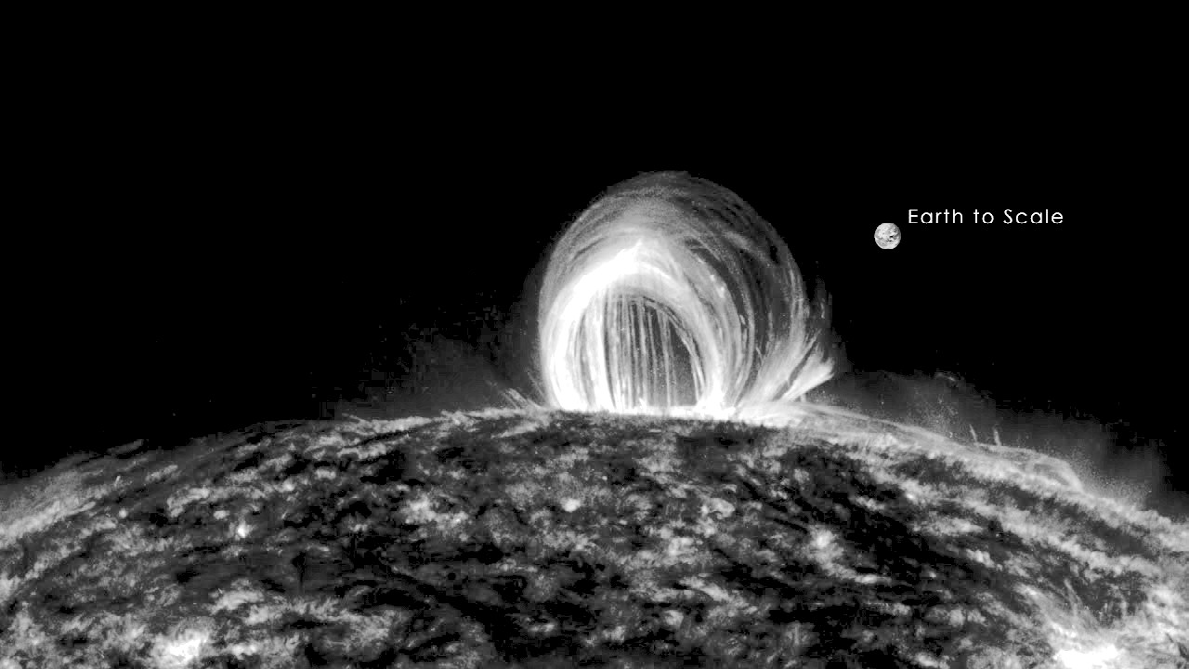
Fiery Looping Rain on the Sun: On July 19, 2012, an eruption occurred on the sun that produced all three. A moderately powerful solar flare exploded on the sun’s lower right hand limb, sending out light and radiation. Next came a CME, which shot off to the right out into space. And then, the sun treated viewers to one of its dazzling magnetic displays – a phenomenon known as coronal rain (Figure 3).
According to us, we see stardust coming out of a black hole, in two opposite directions (Figure 4).
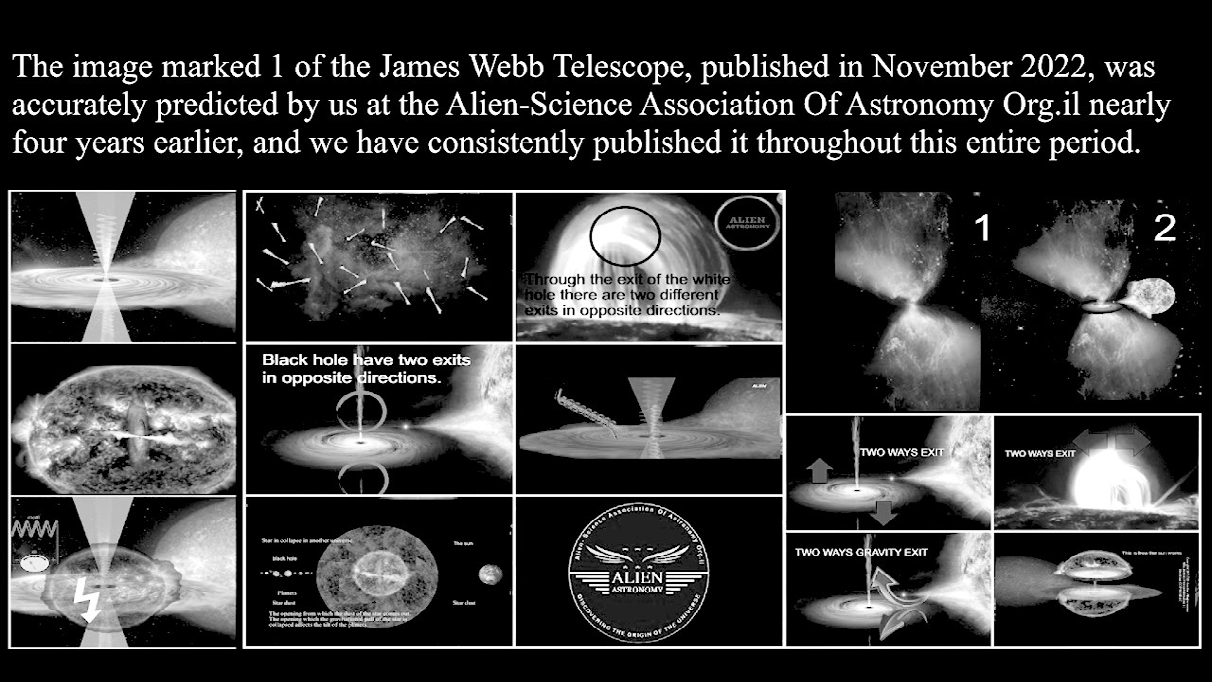
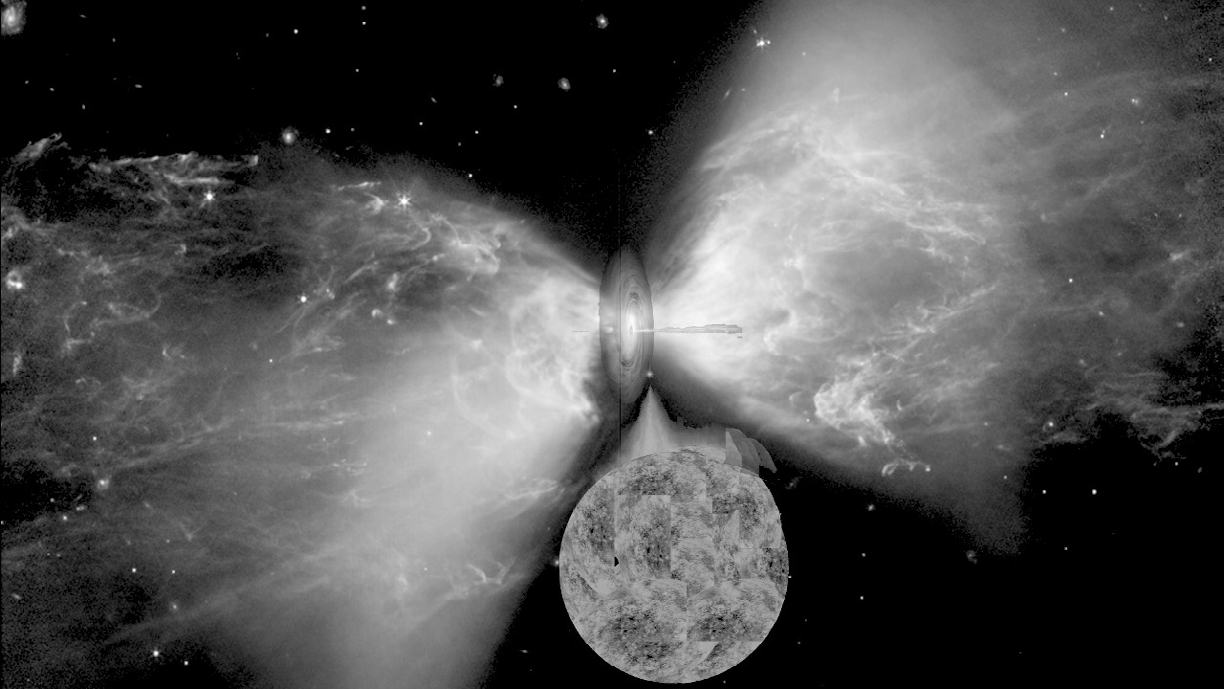
Following the basic assumptions, we claim in this illustration (Figure 5): These hypotheses were initially formulated and published by the author as at from October 2018 and routinely since then. On November 16, 2022, validation of our claims was achieved with the James Webb Space Telescope capturing an authentic image supporting our findings. Temporary Conclusion Scenario: The formation of the sun results from star dust that comes out of a black hole, in two opposite directions. The Source of the Sun’s Energy: Natural Mechanism for Electric Voltage Generation: By examining the collapse of a star in another universe, we identify a natural mechanism that functions as an electric voltage generator, creating electrical energy within the sun. The process can be outlined as follows. Thesis Presentation and Phenomenological Analysis of Solar System Dynamics: In this section, we propose a thesis that serves as both a singular and necessary conclusion derived from all observable phenomena within the solar system. This conclusion is indispensable for the existence of the sun and the solar system in their known forms. Stardust Ejection from a Black Hole: The mass of the collapsing star enters in a rotational into the black hole event horizon. It is only natural for mass to spiral out of the black hole. Because of the massive time distortion between universes the mass that comes out of the black hole is in the form of star dust. Stardust is ejected in a circular way from a black hole in two opposite directions. This exit forms a spiral shape, which is composed of star dust that contains many materials, including metals and which form a coil with electrical conductivity. Formation of an Electrically in the coils: The gravity of the collapsing star, which passes through the black hole’s opening in two opposites direction hits the rotating coils of stardust, generates electricity in the coils. This is how an electricity generator works: a magnet that passes over a coil causes an electric current in the coil (Figure 6).
Generation of an Electromagnet
The generation of an electromagnet in the context of astrophysical phenomena is a complex and fascinating process. Here, we explore a scenario where the formation of an electromagnet occurs randomly, leading to the permanent generation of solar energy. Accretion and Heating: As stardust accumulates, a current begins to flow through coils formed by the metallic components of the dust. This current generates heat as long as the metallic continuity is maintained. Combustion Initiation Ignition of Combustible Materials: The heat from the coils ignites any material within the stardust whose components are capable of combustion.
Formation of Electromagnetic Properties Electromagnet Structure: At random, a metallic lump accumulates at the center of one of the coils through which an electric current flows, initiating a series of processes. The accumulated metallic lump, combined with the electric current, forms the structure of an electromagnet, resulting in the emergence of electromagnetic properties. Metal Concentration: Metals within the stardust are drawn to the positive pole of the electromagnet, which is positioned at the exit of the black hole. This concentration increases as the electromagnet intensifies. Mass pulling and Rotation: The electromagnet attracts surrounding mass, causing it to rotate around the axis of the forming per-stellar cluster.
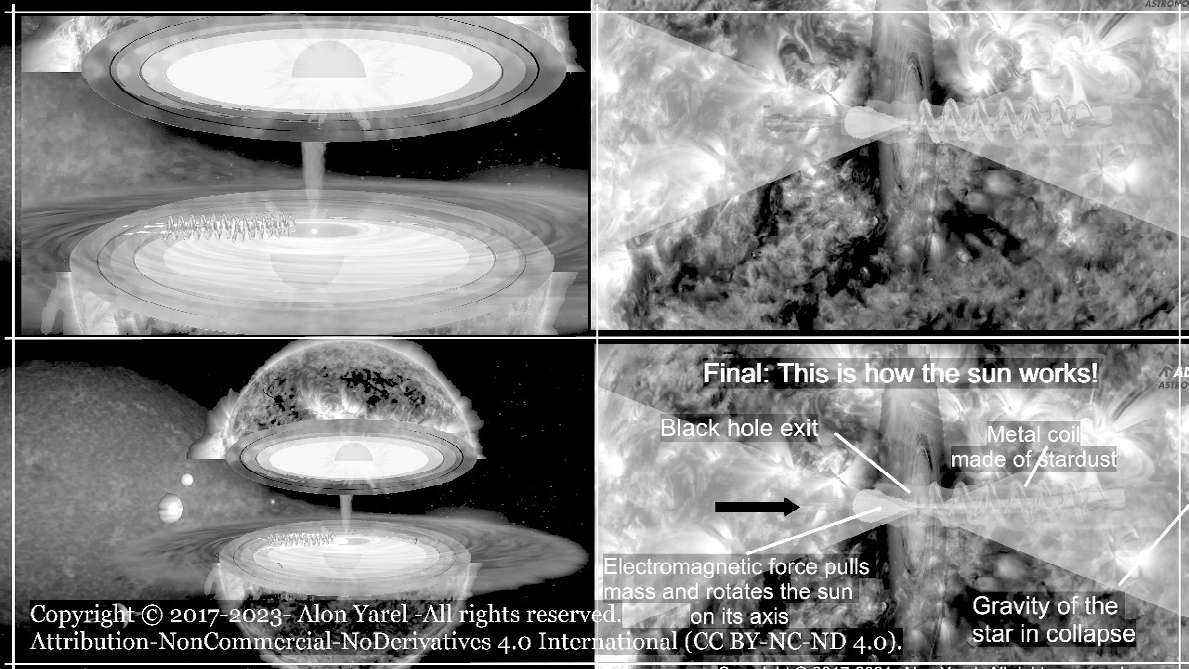
Formation of Continuous Metallic Coil: The stardust coil aligns itself along the black hole’s exit, positioned on the rotational axis of the protostar, and transforms into a continuous metallic coil. Interruption and Core Formation: The rotation of the per- stellar cluster around its axis disrupts the path of a second coil, which passes through the center of the initial coil, forming a fixed metallic core for the electromagnet. Electromagnet Creation: This process results in the creation of an electromagnet capable of generating the phenomena associated with the solar system. Pre-star Ignition: The heating of the coil leads to the ignition of the pre-star. Electromagnetic Radiation: This scenario creates electromagnetic radiation, which results in the corona heat being 300 times hotter than the surface heat. Sun Formation: The electromagnet continues to attract the metal-mixed mass, causing the protostar to spin on its axis, which eventually leads to the protostar becoming a sun.
This scenario illustrates the intricate interplay of electromagnetic forces and celestial mechanics in the generation of solar energy (Figure 7).
Results
As a result of this process, various forms of energy are produced within the sun, contributing to its overall energy output. Some of these energy forms have been empirically validated, while others are theoretically derived from the described phenomenon. Forms of Energy within the Sun: A Detailed Examination Thermal Energy of the Coil: The passage of an electric current through the coil generates heat energy, resulting in the coil heating up. This thermal energy is a direct consequence of the electrical resistance encountered by the current. The heated coil contributes to the overall temperature within the sun and plays a role in initiating further energy generating processes. Nuclear Fission Energy: Empirical measurements indicate signs of nuclear fission occurring within the sun. The black hole simulation, V404 Cygni, which demonstrates the emission of gases, provides substantial imperative evidence for nuclear fission at the core of the sun’s activity. This process involves the significant amount of gases are emitted as a result of this activity. Nuclear Fusion Energy: The heat generated by the coil initiates nuclear fusion processes within the sun, which are well-documented. In nuclear fusion, light atomic nuclei combine to form heavier nuclei, releasing vast amounts of energy. While the prevailing assumption has been that nuclear fusion alone accounts for the sun’s energy output, it is now concluded that nuclear fusion is not the primary source of the sun’s heat but rather a result of other processes contributing to solar energy.
Electromagnetic Energy: Electromagnetic Induction and Solar Mechanics
Since Faraday M [7] discovery of electromagnetic induction, scientists have utilized these principles to explain a variety of astrophysical phenomena, including solar flares, magnetic storms, and the Sun’s magnetic polarity reversals. Electromagnetic forces are a central component of stellar dynamics, with charged particles in the Sun creating complex magnetic fields that govern solar activity [8].
This study extends the application of electromagnetic induction to a cosmic scale, suggesting that the Sun’s core contains an electromagnetic engine powered by interuniversal stardust coils. This novel integrates Faraday’s
Law of Induction with recent observations of black hole emissions to propose that these electromagnetic processes drive the Sun’s activity [7]. Electromagnetic Energy: As a result of the formation of the electromagnet inside the sun, magnetic phenomena appear: the phenomena: generates the rotation of the sun around the axis, generates the power of the black hole which causes the accelerated collapse of the star in another universe, explains the increased magnetism of the sun, explain the polarity of the sun. Assuming the possibility of evaluation, that electromagnetic microwave radiation is the one that causes the corona heat, and also causes other phenomena in our solar system, which will be detailed. The energy of the electromagnet comes from an electric current that passes through a coil that wraps around the metal core. Corona Electromagnetic Radiation: The electromagnetic spectrum is a range of wavelengths of electromagnetic radiation. From long to short wavelength, the EM spectrum includes radio waves, microwaves, infrared, visible light, ultraviolet, x-rays and gamma rays. Corona Tremendous Temperature: Known in science, that the temperature outside a heat source cannot exceed the temperature of the heat source itself. However, in the case of the Sun, the surface temperature is approximately 5000 degrees Celsius, while the corona’s temperature reaches an astounding 1.5 million degrees Celsius. Although it remains unproven yet that microwaves electromagnetic radiation forces alone generate the corona’s heat, dynamic microwaves electromagnetic induction provides a plausible explanation for this anomaly, wherein the surface temperature is significantly lower than that of the corona. This apparent paradox suggests the presence of a dynamic microwaves heat source responsible for the corona’s temperature being 300 times greater than that of the Sun’s surface. A plausible candidate for this dynamic heat source is a microwave mechanism. Although direct measurements are still lacking, it is hypothesized that the electromagnet microwaves within the Sun generate microwave radiation. Such a mechanism could theoretically produce substantial heat in the surrounding region while maintaining a significantly lower temperature within the electromagnet itself.
Conclusion on Electromagnetic Energy: Although precise measurements have not yet to confirm that the electromagnetic power emitted by the sun operates at microwave frequencies sufficient to generate the heat of the corona, dynamic electromagnetic induction remains the most plausible explanation for this anomalous phenomenon. The very existence of an electromagnet within the sun shows a highly probable conclusion is that electromagnetic microwaves energy is responsible for generating the heat of the sun’s corona.
Conclusions
The scenario presented outlines a novel perspective on the formation and energy dynamics of the Sun, grounded in the hypothesis that stardust emerging from a black hole plays a crucial role in these processes. The evidence provided, including NASA’s observations and simulations, supports the claim that the Sun’s formation is intricately linked to the ejection of material from a collapsing star in another universe. This scenario challenges traditional views, offering a compelling explanation for the Sun’s existence and the source of its energy. The chapter’s analysis of solar energy sources further elaborates on the mechanisms by which the Sun generates its immense power. The proposed natural mechanism for electric voltage generation within the Sun provides a coherent framework for understanding the interplay of stardust, electromagnetism, and nuclear processes. The outlined sequence of events leading to the creation of an electromagnet within the Sun offers a plausible explanation for various solar phenomena, including the Sun’s rotation, magnetic properties, and the extreme heat of its corona. The chapter concludes by emphasizing the diversity of energy forms within the Sun, including thermal energy, nuclear fission and fusion energy, and electromagnetic energy. These energies are not only vital to the Sun’s function but also have significant implications for understanding the broader dynamics of our solar system. The detailed examination of these processes underscores the importance of rethinking established astrophysical concepts in light of this new evidence, paving the way for further exploration and validation in future research.
Introduction of the Interuniversal Machine
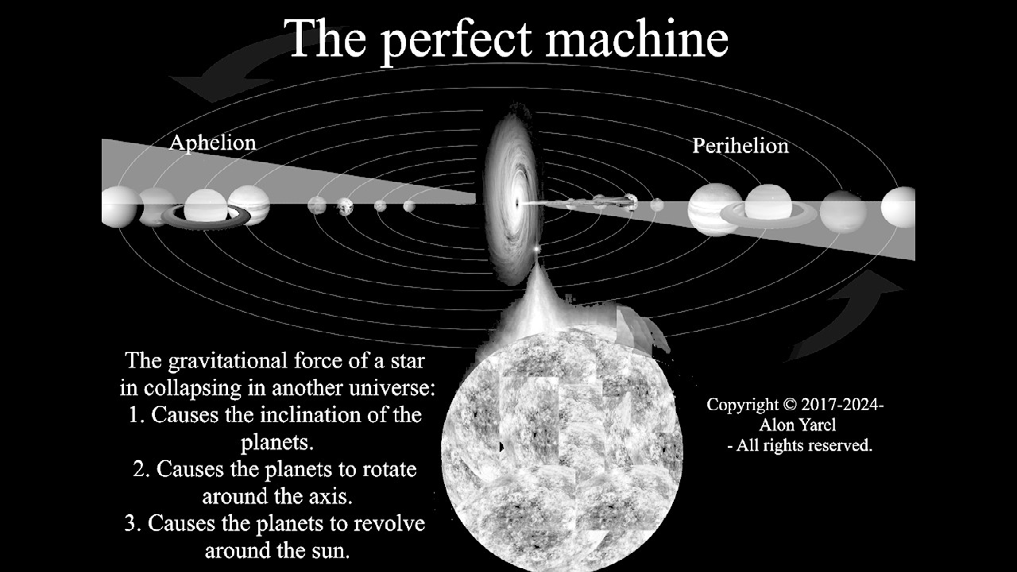
In this chapter we will introduce the Interuniversal Machine. Below is a presentation image of the Interuniversal machine. This presentation shows how the Interuniversal
machine performs in addition to creating the sun and producing solar energy, it also performs the phenomena of the solar system: A. The inclination of planets. B. The rotation of planets around their axes. C. The rotation of planets around the sun. D. The stabilization of planets’ rotational orbits around the sun in a disk-like formation (Figure 8).
The Interuniversal Phenomenon: Challenging the Big Bang
Recent astronomical observations, including those from NASA’s GRACE mission and the James Webb Space Telescope (JWST), have provided new data that challenges traditional cosmological models. This study introduces the idea that black holes may act as interuniversal gateways, ejecting stardust into our universe, which accumulates and forms stellar bodies. The current literature, including Hawking’s [9] work on black holes and radiation, does not account for such interuniversal phenomena, but this project aims to address that gap by proposing a radical mechanism for solar system dynamics through the Interuniversal Machine.
The observed stardust emission from the black hole v404 Cygni, along with NASA’s fiery hourglass image, is compelling evidence that supports this theory. While these phenomena have traditionally been interpreted through the lens of known astrophysical processes, this research posits that they are evidence of interuniversal exchange and solar formation driven by forces previously unknown.
The Force that Createsa Preserves the Inclination of the Planets
Black Hole Phenomena and Interuniversal Time Distortion: The idea that black holes serve as cosmic singularities where time and space distort is well-established [10]. Yet, the concept of time distortion between universes as described in this research is unprecedented in the current literature. The v404 Cygni black hole, for example, has been observed ejecting gas in two directions, resembling the pattern of stardust spirals emerging from a black hole as described in this study. While these observations have been analyzed through traditional astrophysical lenses, the proposed Interuniversal Machine offers a new explanation: these ejections are the result of a collapsing star in one universe passing through a black hole and creating stardust in another. The time distortion inherent in this process—where events transpiring over two days in one universe span millions of years in another—adds complexity to our understanding of black holes and their role in cosmic evolution. Gravitational Dynamics in Multiverse Collapse: This chapter serves as the cornerstone of our study. Several estimates rely on the existence of the gravitational force from a collapsing star in the other universe, which passes through a black hole and emerges in two opposing directions.
Hypothesis and Evidence
Our hypothesis asserts the presence of a gravitational force emanating from the Sun that has yet to be characterized by science. NASA’s GRACE mission, an award-winning initiative, has revolutionized our understanding of Earth’s gravitational forces and the Earth system. The Gravity Recovery and Climate Experiment (GRACE) mission involved two spacecraft flying in tandem around Earth to monitor critical changes in the planet’s water bodies, ice sheets, and solid mass. These spacecraft detected “seasonal gravity changes,” indicating that the gravitational force G varies between summer and winter. NASA attributed these changes to the gravitational effects of winter rains and subterranean water flow. However, our interpretation suggests that these seasonal variations in gravity are influenced by the gravitational force of a collapsing star. We propose that this external force modulates Earth’s gravity in relation to the seasons. This gravitational force, that we wish to present now, is the same gravitational force that ignites the electric current in the coil within the sun.
Inclination of the Earth
Now, we will present the evidence supporting our primary hypothesis regarding the existence of a gravitational force of a collapsing star in another universe, which sustains the sun’s activity and causes the earth to tilt. This evidence hinges on the inclination of the Earth. We observe that Earth’s tilt is not natural, as a natural tilt would not vary in speed or cease motion. In contrast, Earth’s tilt does accelerate, decelerate, and even come to a stop for four days, twice a year.
| Jan | Feb | Mar | Apr | May | Jun | |
|---|---|---|---|---|---|---|
| 1 | 23.1S | 17.3S | 7.8S | N 4.3 | 14.9N | 22.0N |
| 2 | 22.9S | 17.1S | 7.4S | 4.7 | 15.2N | 22.1N |
| 3 | 22.9S | 16.8S | 7.0S | N 5.1 | 15.5N | 22.2N |
| 4 | 22.8S | 16.5S | 6.6S | N 5.5 | 15.8N | 22.3N |
| 5 | 22.7S | 16.2S | 6.3S | N 5.8 | 16.1N | 22.5N |
| 6 | 22.6S | 15.8S | 5.8S | N 6.2 | 16.4N | 22.6N |
| 7 | 22.4S | 15.6S | 5.5S | N 6.6 | 16.6N | 22.7N |
| 8 | 22.3S | 15.2S | 5.1S | N 7.0 | 16.9N | 22.8N |
| 9 | 22.2S | 14.8S | 4.7S | N 7.3 | 17.2N | 22.9N |
| 10 | 22.1S | 14.6S | 4.3S | N 7.7 | 17.4N | 23.0N |
| 11 | 21.9S | 14.3S | 3.9S | N 8.1 | 17.7N | 23.0N |
| 12 | 21.8S | 13.9S | 3.5S | N 8.5 | 18.0N | 23.1N |
| 13 | 21.6S | 13.6S | 3.1S | N 8.8 | 18.2N | 23.2N |
| 14 | 21.5S | 13.3S | 2.8S | N 9.2 | 18.5N | 23.2N |
| 15 | 21.3S | 12.9S | 2.3S | N 9.5 | 18.7N | 23.3N |
| 16 | S 21.1 | 12.6S | 2.0S | N 9.9 | 19.0N | 23.3N |
| 17 | 20.9S | 12.2S | 1.6S | 10.3N | 19.2N | 23.3N |
| 18 | 20.7S | 11.8S | 1.2S | 10.6N | 19.4N | 23.4N |
| 19 | 20.5S | 11.6S | 0.8S | 10.9N | 19.6N | 23.4N |
| 20 | 20.3S | 11.2S | 0.4S | 11.3N | 19.8N | 23.5N |
| 21 | 20.1S | 10.8S | 0 | 11.6N | 20.1N | 23.5N |
| 22 | 19.8S | 10.5S | 0.4N | 12.0N | 20.3N | 23.5N |
| 23 | 19.6S | 10.1S | 0.8N | 12.3N | 20.4N | 23.5N |
| 24 | 19.4S | 9.7S | 1.2N | 12.4N | 20.6N | 23.4N |
| 25 | 19.2S | 9.4S | 1.6N | 13.0N | 20.8N | 23.4N |
| 26 | 18.8S | 9.0S | 2.0N | 13.3N | 21.0N | 23.4N |
| 27 | 18.6S | 8.6S | 2.6N | 13.6N | 21.2N | 23.3N |
| 28 | 18.4S | 8.3S | 2.8N | 14.0N | 21.4N | 23.3N |
| 29 | 18.1S | 8.0S | 3.1N | 14.3N | 21.5N | 23.2N |
| 30 | 17.8S | - | 3.5N | 14.6N | 21.6N | 23.2N |
| 31 | 17.6S | - | 3.8N | - | 21.8N | - |
Table 1: Mean values of the Sun’s declination for the four-year leap year cycle.
| July | Aug | Sep | Oct | Nov | Dec | |
|---|---|---|---|---|---|---|
| 1 | 23.1N | 18.1N | 8.5N | 2.9S | 14.2S | 21.7S |
| 2 | 23.1N | 17.9N | 8.1N | 3.3S | 14.6S | 21.8S |
| 3 | 23.0N | 17.6N | 7.8N | 3.7S | 14.8S | 22.0S |
| 4 | 22.9N | 17.4N | 7.4N | 4.1S | 15.2S | 22.1S |
| 5 | 22.8N | 17.1N | 7.0N | 4.5S | 15.5S | 22.3S |
| 6 | 22.7N | 16.8N | 6.6N | 4.8S | 15.8S | 22.4S |
| 7 | 22.6N | 16.6N | 6.3N | 5.3S | 16.1S | 22.5S |
| 8 | 22.5N | 16.3N | 5.9N | 5.6S | 16.4S | 22.6S |
| 9 | 22.5N | 16.0N | 5.5N | 6.0S | 16.6S | 22.7S |
| 10 | 22.3N | 15.7N | 5.1N | 6.4S | 16.9S | 22.8S |
| 11 | 22.2N | 15.4N | 4.8N | 6.8S | 17.2S | 22.9S |
| 12 | 22.1N | 15.1N | 4.4N | 7.1S | 17.5S | 23.0S |
| 13 | 21.9N | 14.8N | 4.0N | 7.5S | 17.8S | 23.1S |
| 14 | 21.8N | 14.5N | 3.6N | 7,9S | 18.1S | 23.1S |
| 15 | 21.6N | 14.2N | 3.3N | 8.3S | 18.3S | 23.2S |
| 16 | .21 5N | 13.9N | 2.8N | 8.6S | 18.6S | 23.3S |
| 17 | 21.3N | 13.6N | 2.5N | 9.0S | 18.8S | 23.3S |
| 18 | N 21.1 | 13.3N | 2.1N | 9.4S | 19.1S | 23.3S |
| 19 | 20.9N | 13.0N | 1.7N | 9.7S | 19.3S | 23.4S |
| 20 | 20.8N | 12.6N | 1.3N | 10.1S | 19.6S | 23.4S |
| 21 | 20.6N | 12.3N | 0.9N | 10.5S | 19.8S | 23.5S |
| 22 | 20.4N | 12.0N | 0.5N | 10.8S | 20.0S | 23.5S |
| 23 | 20.2N | 11.6N | 0.1N | 11.2S | 20.2S | 23.4S |
| 24 | 20.0N | 11.3N | 0.2S | 11.5S | 20.4S | 23.4S |
| 25 | 19.8N | 10.9N | 0.6S | 11.8S | 20.6S | 23.4S |
| 26 | 19.6N | 10.6N | 1.0S | 12.2S | 20.8S | 23.4S |
| 27 | 19.3N | 10.3N | 1.4S | 12.6S | 21.0S | 23.3S |
| 28 | 19.1 | 9.9N | 1.8S | 12.9S | 21.2S | 23.3S |
| 29 | 18.9N | 9.6N | 2.1S | 13.2S | 21.3S | 23.2S |
| 30 | 18.6N | 9.3N | 2.6S | 13.6S | 21.5S | 23.2S |
| 31 | 18.4N | 8.8N | - | 13.8S | - | 23.1S |
Table 2: Mean values of the Sun’s declination for the four-year leap year cycle.
Formulas and Data
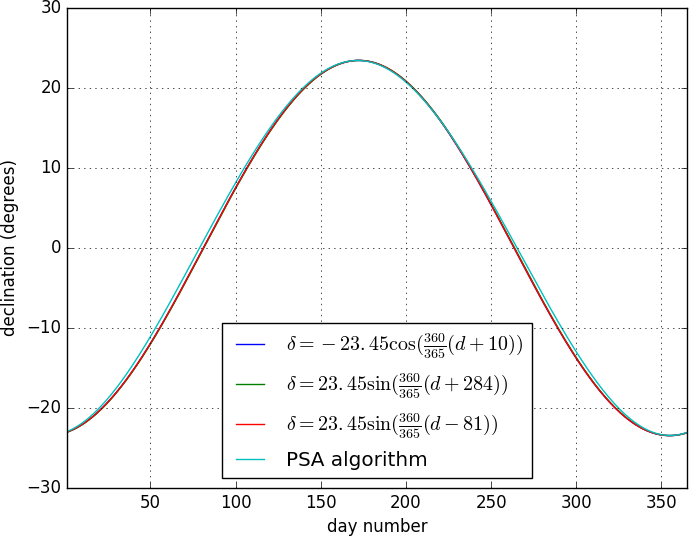
According to Figure 9, Tables 1 & 2 we see that the inclination of the earth is dynamic.
According to Newton’s first law, an object remains at rest or moves in a straight line at constant speed unless acted upon by an external force. However, the provided graph and table of Earth’s inclination demonstrate that this tilt is dynamic.
The data show that Earth’s inclination experiences periods of acceleration and deceleration, and even halts completely for four days, twice a year. This behavior contradicts the concept of perpetual motion, which implies continuous movement in an undisturbed system. • Conclusion: The inclination of the earth is not natural.
| Annual values of Earth’s inclination | |||||||||||||||
|---|---|---|---|---|---|---|---|---|---|---|---|---|---|---|---|
| 351 | 23.39- | 301 | 14.02- | 251 | 5.1 | 201 | 20.68 | 151 | 21.86 | 101 | 7.81 | 51 | 11.66 | 1 | 23.03 |
| 352 | 23.41- | 302 | 14.34 | 252 | 4.71 | 202 | 20.49 | 152 | 22 | 102 | 8.19 | 52 | 11.31- | 2 | 22.95 |
| 353 | 23.43- | 303 | 14.66 | 253 | 4.31 | 203 | 20.29 | 153 | 22.14 | 103 | 8.57 | 53 | 10.95- | 3 | 22.86- |
| 354 | 23.44- | 304 | 14.97 | 254 | 3.91 | 204 | 20.08 | 154 | 22.27 | 104 | 8.95 | 54 | 10.60- | 4 | 22.77- |
| 355 | 23.45- | 305 | 15.28 | 255 | 3.51 | 205 | 19.87 | 155 | 22.39 | 105 | 9.32 | 55 | 10.23- | 5 | 22.67- |
| 356 | 23.44- | 306 | 15.59 | 256 | 3.11 | 206 | 19.65 | 156 | 22.51 | 106 | 9.69 | 56 | 9.87- | 6 | 22.56- |
| 357 | 23.43- | 307 | 15.89 | 257 | 2.71 | 207 | 19.43 | 157 | 22.62 | 107 | 10.1 | 57 | 9.50- | 7 | 22.45 |
| 358 | 23.41- | 308 | 16.18 | 258 | 2.31 | 208 | 19.2 | 158 | 22.72 | 108 | 10.4 | 58 | 9.13- | 8 | 22.33- |
| 359 | 23.39- | 309 | 16.47 | 259 | 1.91 | 209 | 18.97 | 159 | 22.81 | 109 | 10.8 | 59 | 8.76- | 9 | 22.20- |
| 360 | 23.36- | 310 | 16.75 | 260 | 1.51 | 210 | 18.73 | 160 | 22.9 | 110 | 11.1 | 60 | 8.38- | 10 | 22.07- |
| 361 | 23.32- | 311 | 17.03 | 261 | 1.1 | 211 | 18.48 | 161 | 22.99 | 111 | 11.5 | 61 | 8.00- | 11 | 21.93- |
| 362 | 23.28- | 312 | 17.31 | 262 | 0.7 | 212 | 18.23 | 162 | 23.06 | 112 | 11.8 | 62 | 7.62- | 12 | 21.78- |
| 363 | 23.22- | 313 | 17.58 | 263 | 0.3 | 213 | 17.97 | 163 | 23.13 | 113 | 12.2 | 63 | 7.24- | 13 | 21.63- |
| 364 | 23.17- | 314 | 17.84 | 264 | 0.1 | 214 | 17.71 | 164 | 23.2 | 114 | 12.5 | 64 | 6.86- | 14 | 21.47- |
| 365 | 23.10- | 315 | 18.1 | 265 | 0.5 | 215 | 17.44 | 165 | 23.25 | 115 | 12.9 | 65 | 6.47- | 15 | 21.31- |
| 316 | 18.36 | 266 | 0.9 | 216 | 17.17 | 166 | 23.3 | 116 | 13.2 | 66 | 6.08- | 16 | 21.14- | ||
| 317 | 18.6 | 267 | 1.31 | 217 | 16.89 | 167 | 23.34 | 117 | 13.5 | 67 | 5.69- | 17 | 20.96- | ||
| 318 | 18.85 | 268 | 1.71 | 218 | 16.61 | 168 | 23.37 | 118 | 13.9 | 68 | 5.30- | 18 | 20.77- | ||
| 319 | 19.08 | 269 | 2.11 | 219 | 16.33 | 169 | 23.4 | 119 | 14.2 | 69 | 4.90- | 19 | 20.58- | ||
| 320 | 19.32 | 270 | 2.51 | 220 | 16.03 | 170 | 23.42 | 120 | 14.5 | 70 | 4.51- | 20 | 20.39- | ||
| 321 | 19.54 | 271 | 2.91 | 221 | 15.74 | 171 | 23.44 | 121 | 14.8 | 71 | 4.11- | 21 | 20.18- | ||
| 322 | 19.76 | 272 | 3.31 | 222 | 15.43 | 172 | 23.44 | 122 | 15.1 | 72 | 3.71- | 22 | 19.98- | ||
| 323 | 19.98 | 273 | 3.71 | 223 | 15.13 | 173 | 23.44 | 123 | 15.4 | 73 | 3.31- | 23 | 19.76- | ||
| 324 | 2018 | 274 | 4.11 | 224 | 14.82 | 174 | 23.44 | 124 | 15.7 | 74 | 2.91- | 24 | 19.54- | ||
| 325 | 20.39 | 275 | 4.51 | 225 | 14.5 | 175 | 23.42 | 125 | 16 | 75 | 2.51- | 25 | 19.32- | ||
| 326 | 20.58 | 276 | 4.9 | 226 | 14.18 | 176 | 23.4 | 126 | 16.3 | 76 | 2.11- | 26 | 19.08 | ||
| 327 | 20.77 | 277 | 5.30- | 227 | 13.86 | 177 | 23.38 | 127 | 16.6 | 77 | 1.71- | 27 | 18.85- | ||
| 328 | 20.96 | 278 | 5.69 | 228 | 13.53 | 178 | 23.34 | 128 | 16.9 | 78 | 1.31- | 28 | 18.60- | ||
| 329 | 21.14 | 279 | 6.08 | 229 | 13.2 | 179 | 23.3 | 129 | 17.2 | 79 | 0.9 | 29 | 18.36 | ||
| 330 | 21.31 | 280 | 6.47 | 230 | 12.87 | 180 | 23.25 | 130 | 17.4 | 80 | 0.5 | 30 | 18.10- | ||
| 331 | 21.47 | 281 | 6.86 | 231 | 12.55 | 181 | 23.01 | 131 | 17.7 | 81 | 0.10- | 31 | 17.84- | ||
| 332 | 21.63 | 282 | 7.24 | 232 | 12.18 | 182 | 23.13 | 132 | 18 | 82 | 0.3 | 32 | 17.58 | ||
| 333 | 21.78 | 283 | 7.62 | 233 | 11.84 | 183 | 23.06 | 133 | 18.2 | 83 | 0.7 | 33 | 17.31 | ||
| 334 | 21.93 | 284 | 8 | 234 | 11.49 | 184 | 22.99 | 134 | 18.5 | 84 | 1.1 | 34 | 17.03- | ||
| 335 | 22.07 | 285 | 8.38 | 235 | 11.13 | 185 | 22.9 | 135 | 18.7 | 85 | 1.51 | 35 | 16.75- | ||
| 336 | 22.2 | 286 | 8.76 | 236 | 10.78 | 186 | 22.81 | 136 | 19 | 86 | 1.91 | 36 | 16.47- | ||
| 337 | 22.33 | 287 | 9.13 | 237 | 10.42 | 187 | 22.72 | 137 | 19.2 | 87 | 2.31 | 37 | 16.18- | ||
| 338 | 22.45 | 288 | 9.5 | 238 | 10.05 | 188 | 22.62 | 138 | 19.4 | 88 | 2.71 | 38 | 15.89 | ||
| 339 | 22.56 | 289 | 9.87 | 239 | 9.69 | 189 | 22.51 | 139 | 19.7 | 89 | 3.11 | 39 | 15.59- | ||
| 340 | 22.67 | 290 | 0.23 | 240 | 9.32 | 190 | 22.39 | 140 | 19.9 | 90 | 3.51 | 40 | 15.28- | ||
| 341 | 22.77 | 291 | 10.6 | 241 | 8.95 | 191 | 22.27 | 141 | 20.1 | 91 | 3.91 | 41 | 14.97- | ||
| 342 | 22.86 | 292 | 10.95 | 242 | 8.57 | 192 | 22.14 | 142 | 20.3 | 92 | 4.31 | 42 | 14.66- | ||
| 343 | 22.95 | 293 | 11.31 | 243 | 8.19 | 193 | 22 | 143 | 20.5 | 93 | 4.71 | 43 | 14.34- | ||
| 344 | 23.03 | 294 | 11.66 | 244 | 7.81 | 194 | 21.86 | 144 | 20.7 | 94 | 5.1 | 44 | 14.02- | ||
| 345 | 23.1 | 295 | 12.01 | 245 | 7.43 | 195 | 21.71 | 145 | 20.9 | 95 | 5.49 | 45 | 13.07- | ||
| 346 | 23.17 | 296 | 12.35- | 246 | 7.05 | 196 | 21.55 | 146 | 21.1 | 96 | 5.89 | 46 | 13.37- | ||
| 347 | 23.22 | 297 | 12.7 | 247 | 6.66 | 197 | 21.39 | 147 | 21.2 | 97 | 6.28 | 47 | 13.03- | ||
| 348 | 23.28 | 298 | 13.03 | 248 | 6.28 | 198 | 21.22 | 148 | 21.4 | 98 | 6.66 | 48 | 12.70- | ||
| 349 | 23.32 | 299 | 13.37 | 249 | 5.89 | 199 | 21.05 | 149 | 21.6 | 99 | 7.05 | 49 | 12.35 | ||
| 350 | 23.36 | 300 | 13.7 | 250 | 5.49 | 200 | 21.87 | 150 | 21.7 | 100 | 7.43 | 50 | 12.01- |
Table 3: Annual values of Earth’s inclination, calculated.
External Forces Influencing Earth’s Inclination: Hence, we conclude that an unknown force accelerates, decelerates, and even halts Earth’s inclination for four days, twice a year. This raises a critical question: What external force is acting upon Earth to account for this phenomenon? More specifically, what external force acts on Earth to produce the precise variations in inclination observed in the attached graph?. Gravitational Force from a Collapsing Star Gravitational Influences on Planetary Motion: Newtonian mechanics and Kepler’s laws [11] of planetary motion have long been accepted as the framework for understanding how planets move within the solar system. Newton’s theory of gravitation has been refined by Einstein’s general theory of relativity, which better explains gravitational anomalies, such as the perihelion precession of Mercury [1].
However, this study challenges the assumption that gravity alone governs planetary inclinations and rotations.
It posits that the gravitational force of a collapsing star in another universe, passing through a black hole, exerts a dynamic torque on planets, influencing both their axial rotations and their orbital paths. The seasonal gravity variations measured by NASA’s GRACE mission Zou Z, et al. [12] suggest that planetary motion may be more dynamic and influenced by external forces than previously thought. This finding aligns with the hypothesis that interuniversal forces act on our solar system, reshaping conventional models of gravity.
According to our Study
According to our study, there is a gravitational force from a collapsing star in another universe that acts in two opposite directions and causes Earth’s inclination, as depicted in the image (Figure 10).
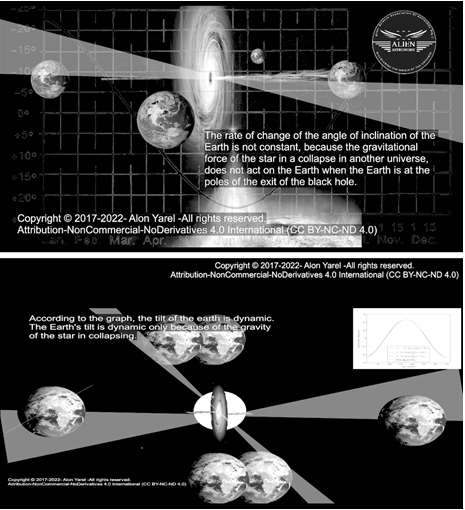
This claim is substantiated by the logical conclusion that when Earth is at the poles of the black-hole exit, the gravitational force of the collapsing star from the other universe ceases to act on Earth. Consequently, we observe a complete halt in Earth’s inclination for about four days, twice a year in the table. Furthermore, we see an acceleration in Earth’s inclination when half of Earth is exposed to the gravitational force of the collapsing star. Notably, because it is a black hole exit, Earth’s exposure angle to the gravitational force does not instantly maximize, as indicated by the graph. It takes several days for Earth to fully enter the region where the star’s gravitational influence is entirely active.
Evidence from GRACE Spacecraft.
By incorporating measurements from the GRACE spacecraft, which demonstrate seasonal gravitational changes on Earth, this evidence becomes even more compelling. Thus, the combined data from the presentation by the Alien-Science Association of Astronomy Org.il, the attached proof, and other presentations provide conclusive evidence of the existence of gravitational force from the collapsing star in another universe.
Reflection of the Collapsing Star’s Gravity
We should have observed an acceleration followed by a deceleration of Earth’s axial tilt during each half of its orbit around the Sun. This expectation arises from the spherical structure of the collapsing star. Specifically, the entire hemisphere of Earth should have been exposed to the rising and falling gravitational influence of the collapsing star in the other universe, resulting in this pattern of acceleration and deceleration.
According to the attached graph, the active periods fall between days 30 to 130 and 210 to 310. However, contrary to expectations, the Earth’s tilt shows an initial acceleration followed by a continuous increase in both halves of its orbit around the Sun. This indicates that Earth does not experience a decelerating phase at any point in its half-revolution around the Sun.
This observation points to a phenomenon of gravitational reflection between black holes in another universe, which is only now being revealed. The initial explanation that Earth’s inclination causes only half of the planet to experience the collapsing star’s gravitational force in each half-orbit is incorrect.
The Earth’s inclination graph presents the situation differently. Indeed, in each half of Earth’s orbit around the Sun, only half of the planet is exposed to the gravitational pull of the collapsing star. However, like Earth, half of its gravitational influence is also exposed to the collapsing star in the other universe. This means that during each half-orbit, Earth and the collapsing star are mutually exposed to only half of each other’s gravitational force.
In conclusion, the Earth’s inclination graph acts as a reflection of the collapsing star in the other universe. The magnified and reversed inclination in each hemisphere of Earth illustrates that only half of the star’s gravitational force is experienced during the collapse. This also confirms the Earth’s inclination graph and aligns with measurements of seasonal gravitational changes on Earth.
Earth’s Inclination Stabilization
- The gravitational force of the collapsing star, as illustrated in the figures below, exerts a pooling force on the poles of planets, including Earth, in opposite directions. During the summer, this force draws the Earth’s north pole towards the sun, while in winter, it draws the south pole towards the sun.
- We have already explained that the Earth’s inclination halts when the planet aligns with the poles of the black hole. However, the gravity of the star in collapse acting on the north and south poles contribute to stabilizing the Earth’s axial tilt. Consequently, this dynamic interplay results in the stabilization of the Earth’s inclination (Figure 11).
• Conclusion: The gravitational force from the collapsing star in another universe creates and stabilizes Earth’s inclination.
The Rotation of Planets around Their Axis
For many generations, the rotation of planets around their axis has been considered a natural phenomenon. While our study did not initially aim to explore this topic, the observed characteristics of the gravity of the collapsing star compelled us to investigate further. Having established that the Earth experiences an increasing gravitational influence from the collapsing star, specifically in the hemisphere aligned with the poles due to the reflection of only the ascending portion of the star, it is now evident that this gravitational force generates a rotational torque on the Earth.
The Effect of the Gravity of the Collapsing Star on the Earth
We discussed the gravitational influence of a collapsing star in another universe, describing it as a uniform force acting on the Earth’s poles that causes its tilt. However, we did not characterize this force.
We need to examine the processes affecting Earth as it transitions into and out of the gravitational field of the collapsing star. In this chapter, we will characterize these forces in detail and analyze how, in addition to causing the Earth’s tilt, this gravitational force also induces rotation around the Earth’s axis and creates its orbit around the Sun. First, we must reveal the gravitational characteristics of the collapsing star and then we can accurately analyze its effect on the Earth’s poles.
Gravitational Characteristics of the Collapsing Star
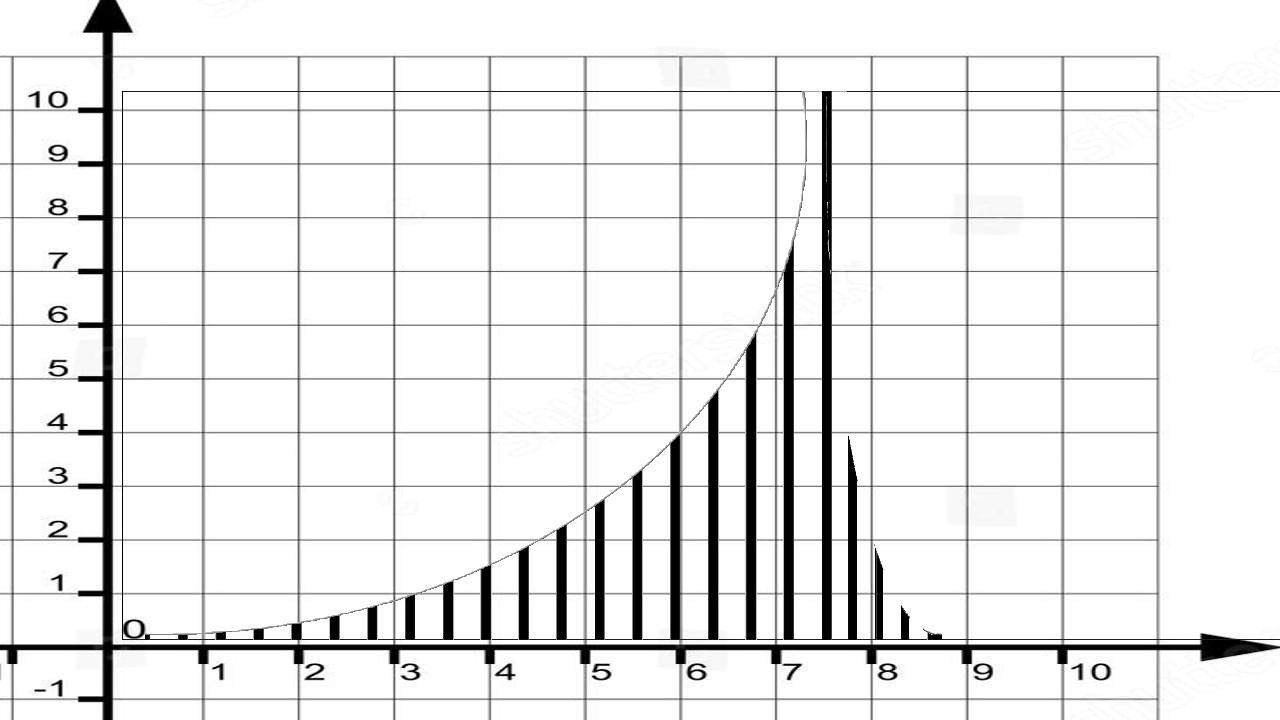
As we saw in the previous chapter, according to the graph and table of Earth’s inclination, the gravitational force of the collapsing star on Earth is not constant. It depends on the angle of exposure to the gravitational force of the collapsing star through the opening of the black hole while Earth orbits the Sun. During the first half of Earth’s orbit around the Sun, the gravitational force acts on the northern hemisphere. During the second half, the gravitational force acts on the southern hemisphere. The assumption is that the collapsing star is spherical, so the gravitational force facing Earth’s poles must be dynamic.
Illustration and Analysis
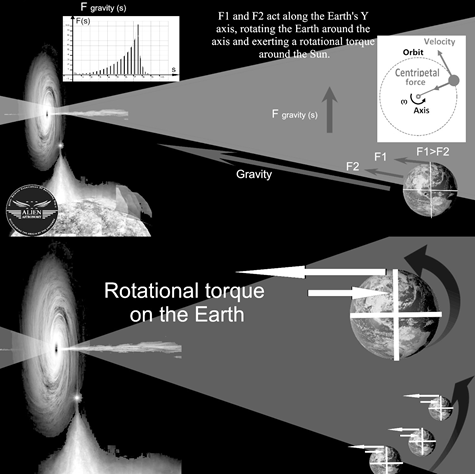
Here is a graph illustrating the variation in gravitational force that Earth experiences during each half-year orbit (Figure 12):
Earth’s Entry into the Gravitational Field of the Collapsing Star
Upon entering the gravitational field of a collapsing star, the north side of the Earth experiences a rotational torque force, acting like a propeller or rotor. The collapsing star’s gravitational influence increases over time, with the side facing the Earth’s axis of rotation around the Sun experiencing a greater force increases. The scenario repeats when Earth is on the opposite side of the Sun. As the south side of the Earth enters the gravitational field of the collapsing star, a rotational torque force acts upon it. The increasing gravitational force from the star affects the side facing Earth’s axis of rotation around the Sun more intensely. This force induces rotational torque on Earth’s self-rotation. At its closest point to the Sun, the perihelion distance of 147.1 million km, Earth reaches its fastest orbital speed of 30,286 km/s. Conversely, at its furthest point, the aphelion distance of 152.1 million km, Earth’s orbital speed decreases to 29,291 km/s.
These speed measurement data, which show changes in the speed of the Earth’s rotation around the Sun, realizing our claim that the Earth’s speed rotation around the Sun is not natural and supports the principles of the presentation. • Conclusion: The gravitational force of the collapsing star rotates the Earth on its axis.
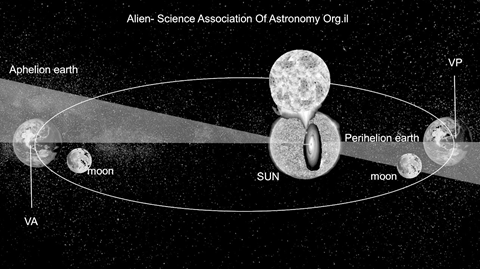
The Forces Influencing Earth’s Rotation around the Sun: For many generations, the revolution of planets around the sun has been considered a natural phenomenon. The fact that the Earth at its closest point to the Sun, the perihelion distance of 147.1 million km, Earth reaches its fastest orbital speed of 30,286 km/s. Conversely, at its furthest point, the aphelion distance of 152.1 million km, Earth’s orbital speed decreases to 29,291 km/s, aroused our suspicion. While our study did not initially aim to explore this topic, the observed characteristics of the gravity of the collapsing star compelled us to investigate further.
Gravitational Influence on Planetary Orbits
The force that rotates the planets around the sun is the same force that rotates the earth around its axis and causes the earth to tilt. It is the same force that ignites the flow of electric current in the coil of the electromagnet inside the sun. It is the gravitational force of the collapsing star in another universe, which passes through the opening of the black hole and in two opposite directions.
Description of the Forces that Drive the Rotation of the Planets around the Sun: The Proposed Scenario: the torque exerted on the Earth by the collapsing star is a dynamic increase, which causes the rotation around the Sun to accelerate. When the collapsing star’s gravity acts on the Earth’s North Pole, a torque force rotates the Earth on its axis. This same torque propels the Earth in the direction of its orbit around the Sun. When the gravitational force of the collapsing star acts on the South Pole, a torque similarly rotates the Earth on its axis. However, the same torque that accelerated the rotation of the Earth when acting on the North Pole behaves differently when acting on the South Pole. Earth at its closest point to the Sun, the perihelion distance of 147.1 million km, the Earth reaches its fastest orbital speed of 30.286 km/s. At its furthest point, the aphelion distance of 152.1 million km, the Earth’s orbital speed decreases to 29.291 km/s, demonstrating another phenomenon. In order to explain the new phenomenon here, it is necessary to first explain Kepler’s first law regarding the elliptical motion of all the planets, which also turns out to be an unnatural phenomenon. Elliptical Motion of Planets around the Sun: It appears that there is a driving force behind the elliptical motion of the planets.
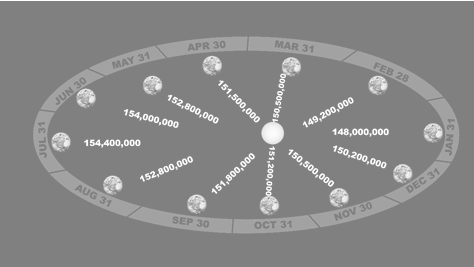
- Kepler’s First Law
- Kepler’s First Law: each planet’s orbit about the Sun is an ellipse. The Sun’s center is always located at one focus of the orbital ellipse. The Sun is at one focus. The planet follows the ellipse in its orbit, meaning that the planet to Sun distance is constantly changing as the planet goes around its orbit (Figure 15).
- We do not doubt Kepler’s conclusion that planets move in elliptical orbits. We dispute the statement that “The reason for this is due to the nature of gravity and motion. When a planet is closer to the sun, it moves faster because the sun’s gravitational pull is stronger. Conversely, when the planet is further away, it moves slower because the gravitational pull is weaker. This variation in speed as the planet moves around its orbit causes the orbit to be an ellipse rather than a perfect circle.” The claim is that the reason is different.
Electromagnetic Influence on the Rotation of the Planets Around the Sun
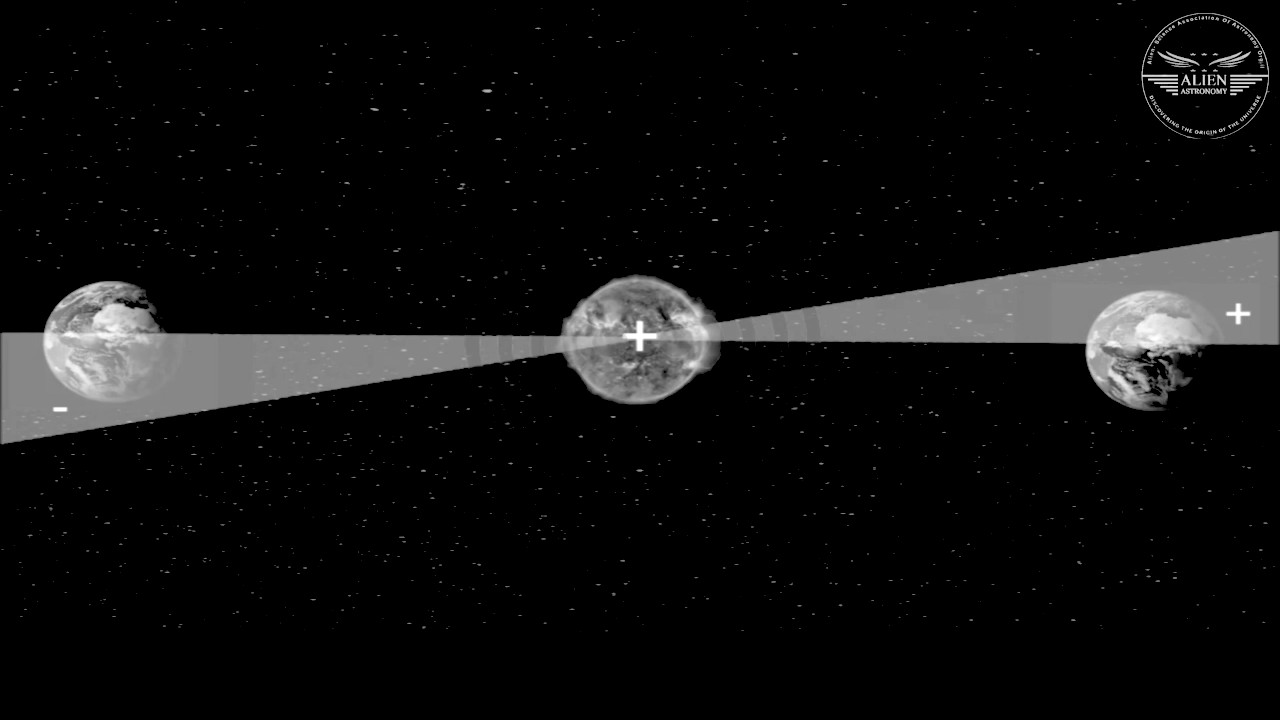
According to our research, the presence of an electromagnet within the Sun exerts an electromagnetic force from both sides of the black hole, resulting in magnetic phenomena. This electromagnetic force generates a positive polarity regularly. The magnetic force influences the Earth’s magnetic poles, contributing to the elliptical orbits of the planets. When the Earth’s north pole, with a positive polarity, tilts towards the Sun, which also has a positive polarity, the magnetic repulsion causes the Earth to move away from the Sun. Conversely, when the Earth’s south pole, with a negative polarity, tilts towards the Sun’s positive polarity, the magnetic attraction causes the Earth to move closer to the Sun. This interaction explains the elliptical motion of the Earth and other planets around the Sun (Figure 16).
• Conclusion Elliptical motion of the planets is due to the presence of an electromagnet with a permanent positive magnetic polarity within the Sun, combined with the magnetism of the planets during their inclination towards the Sun, which together cause the elliptical motion Back to the Description of the Forces that Drive the Rotation of the Planets around the Sun: After understanding that the elliptical motion of the planets is due to the presence of an electromagnet with a permanent positive magnetic polarity within the Sun, combined with the magnetism of the planets during their inclination towards the Sun, which together cause the elliptical motion, we can proceed. We will primarily focus on the scenario where Earth’s magnetic north pole, which is the geographic North Pole, is inclined towards the Sun. This inclination, with a magnetic positive charge, creates a repelling force between them.
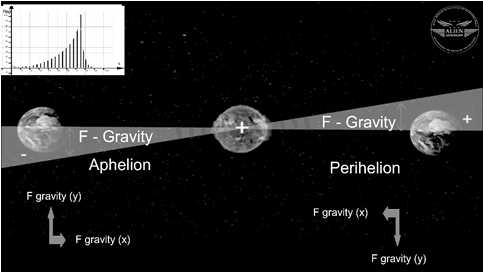
Description of the Forces that Drive the Rotation of the Planets around the Sun: As previously mentioned, when the gravitational force of the collapsing star acts on the Earth’s North Pole, it generates a torque that rotates the Earth on its axis, tilts the Earth, and induces a rotational torque around the Sun. What significantly contributes to this gravitational torque force, and further proves its existence, is the Earth’s inclination, with its positive magnetic pole, to align towards the Sun’s black hole exit, which also has a positive magnetic polarity. In this configuration, the gravitational force of the collapsing star acts on the Earth’s North Pole quadrant, pulling and rotating it, while the positive magnetic forces of the Earth and the electromagnet repel each other. This interaction results in the Earth’s rotational orbit around the Sun and accelerates its orbital speed. At this point, the gravitational force of the collapsing star acts on the Earth’s North Pole quadrant, pulling and rotating it, while the positive magnetic force of the Earth and the positive magnetic force of the electromagnet repel each other along the axis, maintaining a rotational orbit around the Sun. Thus, one attractive force (the gravitational force of the collapsing star) and one repulsive force (the magnetic interaction between the Earth and the Sun) together cause the acceleration of the Earth’s rotation on its axis and its orbit around the Sun. On the opposite side of the Sun, the situation is different. When the collapsing star’s gravity acts on a quarter of the Earth’s South Pole, a torque force of the collapsing star’s gravity rotates the Earth on its axis, causing it to tilt. This force remains unchanged. However, because the Earth’s South Pole, with its negative magnetic polarity, is tilted towards the Sun, which has a positive magnetic polarity, an additional attractive force occurs. The gravitational force of the collapsing star pulls the South Pole, while the South Pole tilts towards the Sun, and the electromagnet also pulls the Earth in South Pole. In this case, there is no rotational torque at all. There is only the normal torque force of the gravity of collapsing star without any assistance from the electromagnet inside the Sun.
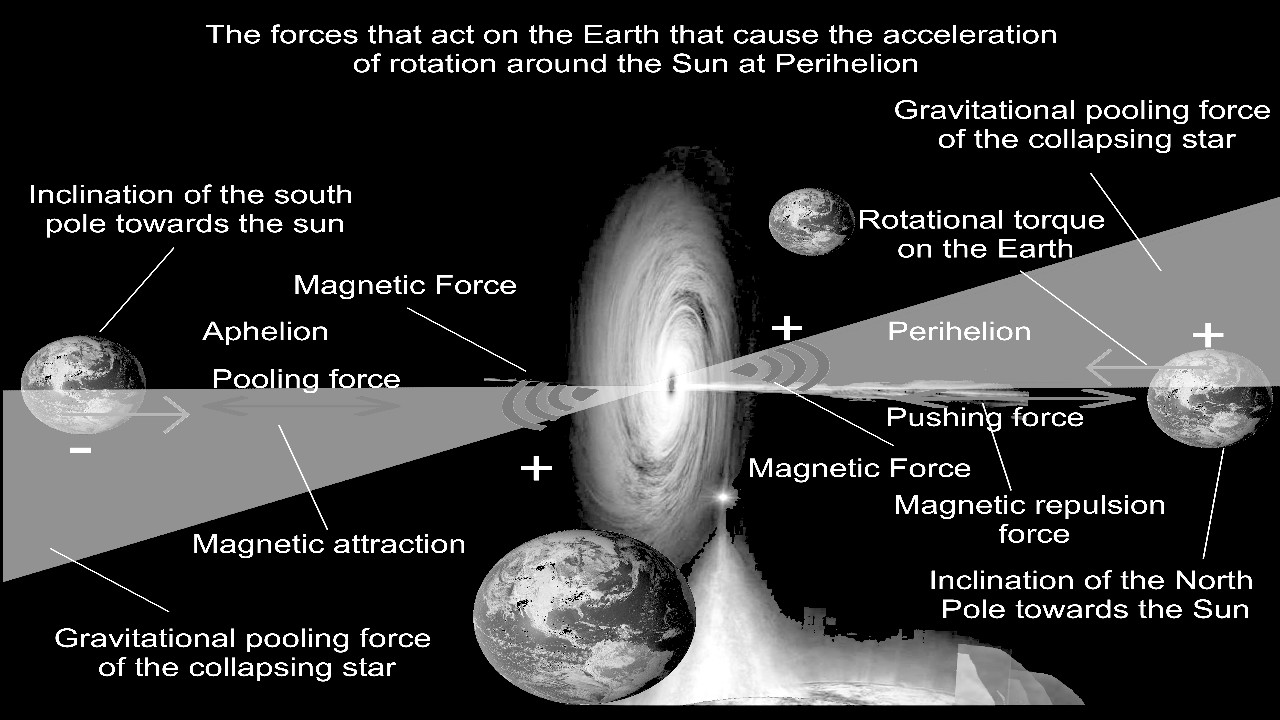
• Conclusion: The rotation of planets around the Sun is driven by a combination of forces, primarily magnetism and gravity. Various forces interact, with some pulling on one side of Earth while others push. The gravitational force of the collapsing star, along with its dynamic characteristics, significantly contributes to Earth’s rotation around the Sun. However, the electromagnetic force at perihelion significantly contributes to Earth’s rotational torque around the Sun. Although many conclusions lack direct empirical results, they are founded on previously established stages, some of which have been proved. These conclusions are substantiated by earlier evidence (Figure 15).
The gravitational force of the collapsing star, which also acts in the Y axis, is a central force in stabilizing the motion of the planets in a disk-like orbit.
The Magnetic Force of the Sun’s Internal Electromagnet Stabilizes Earth’s Circumferential Motion Due To Earth’s Metallic Nature: Magnetic force is an attraction force that occurs between two charged particles or iron-containing objects. It can be either an attraction or repulsion based on the ionic charge of the object. Objects with the same electrical charge repel each other while opposite charges attract each other.
The Metallic Structure of Earth That Stabilizes Its Orbit Around the Sun in a Disk-Like Formation: Based on current scientific understanding, Earth’s composition is approximately 50% iron, with iron constituting about 30% and magnesium around 15%. Aluminum is also present in significant quantities, while other metals exist in trace amounts. Given this composition and the fact that metals are attracted to the center of a magnetic force, it can be inferred that the magnetic force acting on Earth plays a role in stabilizing its orbit around the Sun’s electromagnetic center.
Conclusions: The chapter “Introduction of the Interuniversal Machine” explores the intricate dynamics of the forces governing planetary motion, specifically focusing on the gravitational influence of a collapsing star from another universe. The conclusions drawn from this chapter are as follows: Inclination of the Earth: The Earth’s inclination is not a natural phenomenon but is influenced by an external gravitational force originating from a collapsing star in another universe. The evidence, including seasonal variations in Earth’s gravity and the dynamic nature of its tilt, supports the hypothesis that this external force modulates Earth’s inclination and stabilizes it. Rotation of Planets around Their Axes: The gravitational force from the collapsing star not only influences Earth’s tilt but also generates a rotational torque, which causes the Earth to rotate around its axis. This torque is a direct result of the varying gravitational influence as Earth moves through different parts of its orbit around the Sun. Planetary Orbits Around the Sun: The elliptical orbits of planets around the Sun are influenced by a combination of gravitational and electromagnetic forces. The gravitational pull from the collapsing star and the electromagnetic properties of the Sun interact to create and maintain the elliptical motion of planets, challenging traditional explanations based solely on gravitational forces. Stabilization of Planetary Orbits: The stabilization of planetary orbits in a disk-like formation around the Sun is attributed to three key forces: the gravitational influence of the collapsing star, the electromagnetic force of the Sun’s
internal magnetism, and the magnetic properties of the planets themselves. These forces collectively ensure the stability and consistency of planetary orbits. Overall, this chapter substantiates the role of an external, interuniversal gravitational force in shaping and maintaining the dynamics of our solar system, challenging conventional understandings of planetary motion.
Here is a table (Table 3) which describes a comparison of old and new concepts.
Conclusions: The research presented across the chapters explores revolutionary concepts in astrophysics, offering transformative insights into the dynamics of the solar system and the universe at large. The introduction of the “Interuniversal Machine” challenges established astrophysical principles by proposing an autonomous mechanism that governs solar activity and the complex interactions within our solar system. This concept lays the groundwork for understanding the balance and stability maintained by this mechanism, emphasizing the necessity of re-examining traditional cosmic models.
The examination of the Sun’s formation and energy dynamics, rooted in the hypothesis of stardust emerging from a black hole, presents a compelling alternative to conventional theories. The evidence provided supports the idea that the Sun’s formation and the generation of its immense power are intricately linked to the ejection of material from a collapsing star in another universe. This novel perspective on the Sun’s energy sources and the mechanisms driving solar phenomena necessitates a reassessment of existing astrophysical concepts.
Furthermore, the exploration of the forces governing planetary motion, particularly the influence of a collapsing star from another universe, reveals the external gravitational factors that shape the Earth’s inclination, planetary rotation, and the elliptical orbits around the Sun. This analysis highlights the interplay of gravitational and electromagnetic forces in stabilizing planetary orbits, challenging traditional explanations that rely solely on gravity.
| Phenomenon | An Old Concept | Proof of an Old Concept | A New Concept | Proof of a New Concept | How is the New Concept Better? |
|---|---|---|---|---|---|
| 1. Presence of Sun’s Mass | Stardust originating from the Big Bang | A wide range of empirical evidence. | The Sun’s mass comes from another universe as stardust ejected from a black hole in two opposite directions. | NASA’s Webb catches fiery hourglass as a new star forms. | Suggests an interuniversal origin of the Sun’s mass, offering a new perspective on stellar formation processes. |
| 2. Source of Solar Energy | Nuclear fusion | Evidence of the existence of nuclear fusion. | The Sun’s heat source is a natural. Electromagnet inside the Sun, created in an interuniversal process. | An electromagnet inside the Sun causes solar heat phenomena, including nuclear fusion. | Introduces the concept of an interuniversal electromagnet as a source of solar energy, expanding on traditional nuclear fusion. |
| 3. Corona Heat Temperature | The dynamo principle in the Sun generates the coronal loop structures. | Observations confirming the existence of coronal loops. | Electromagnetic radiation inside the Sun creates microwaves, causing the corona’s heat. | A chain of events leads to this conclusion, though no direct evidence exists. | Proposes a novel explanation for coronal heating, suggesting microwave radiation from an internal electromagnet. |
| 4. Rotation of the Sun Around its Axis | A movement that began when the Sun was nebulous. | An electromagnet inside the Sun pulls a metal-saturated mass, causing the Sun to rotate | A chain of events leads to this conclusion, though no direct evidence exists. | Introduces a magnetic influence as the driver of the Sun’s axial rotation. | |
| 5. Rotation of the Sun’s Equator Faster than Poles | Still in research, no results yet. | Still in research. | The electromagnet inside the Sun attracts a metal-saturated mass, causing the Sun’s equator to rotate faster than the poles. | A chain of events leads to this conclusion, though no direct evidence exists. | Suggests an electromagnetic mechanism for differential rotation within the Sun. |
| 6. Magnetic Polarity of the Sun | Solar Dynamo | Measurements confirm the existence of the Sun’s magnetic polarity. | An electromagnet within the Sun causes magnetic properties, resulting in the Sun’s magnetic polarity. | Measurements confirm the existence of the Sun’s magnetic polarity. | Provides an alternative explanation for the Sun’s magnetic polarity involving internal electromagnetism. |
| 7. Magnetism of the Sun | Movement of charged particles creates magnetic fields. | Measurements confirm the existence of increased magnetism from the Sun. | A combination of components: the electromagnet transmits its properties throughout the Sun, affecting magnetism. | Measurements confirm the existence of increased magnetism from the Sun. | Offers a comprehensive view of solar magnetism, incorporating interuniversal forces and internal electromagnetism. |
| 8. Sun’s Magnetic Field Flip | Not fully understood by scientists. | Measurements confirm the flip of the Sun’s polarity. | Vibrations of a black hole’s accretion discs cause the Sun’s polarity to change every 11 years. | A chain of events suggests this possibility, though no direct proof exists yet. | Proposes an interuniversal cause for the Sun’s magnetic field flip linked to black hole dynamics. |
| 9. Inclination of the Planets | Defined as a natural inclination. | Dynamic gravitational forces from a collapsing star cause a constant increase in gravity at Earth’s poles, leading to a tilt. | 1. Earth tilt dynamics. 2. Stopping the Earth’s tilt for 4 days, twice a year. 3. Seasonal gravity changes estimated from GRACE data. | Provides a dynamic interuniversal explanation for planetary inclination, challenging the traditional notion of natural inclination. | |
| 10. Dynamic Inclination of the Earth | Ignoring the phenomenon. | Measurements and calculations confirm Earth’s dynamic inclination. | Gravitational forces from a collapsing star reflected through a black hole cause Earth’s increasing inclination. | Measurements and calculations confirm Earth’s dynamic inclination. | Suggests an interuniversal gravitational influence on Earth’s inclination. |
| 11. Stabilization of Planetary Inclination | Stabilization is considered natural. | Gravitational forces from a collapsing star also stabilize Earth’s inclination. | Empirical evidence supports this. | Introduces the concept of interuniversal forces playing a role in stabilizing planetary inclination. | |
| 12. Rotation of Planets Around Their Axis | A movement that began when the solar system was nebulous. | The gravitational force of a collapsing star, combined with solar electromagnetism and Earth’s magnetic polarity, rotates planets. | Empirical evidence, including dynamic results of seasonal gravity changes on Earth, as measured by GRACE data. | Provides a comprehensive explanation for planetary rotation involving multiple forces, including interuniversal dynamics. | |
| 13. Rotation of Planets Around the Sun | A movement that began when the solar system was nebulous. | The gravitational force of a collapsing star, solar electromagnetism, planetary magnetic polarity, and metallic structure cause planetary orbits. | Empirical evidence, including dynamic results of seasonal gravity changes on Earth, as measured by GRACE data. | Suggests a multifaceted origin for planetary orbits involving universal and interuniversal forces. | |
| 14. Disk-like Orbit of Planets Around the Sun | A movement that began when the solar system was nebulous. | Assessments of nebula material collapsing and flattening into a disk. | Gravitational forces from a collapsing star, reflected through a black hole, stabilize planets’ disk-like orbits. | Empirical evidence supports this. | Proposes an interuniversal mechanism stabilizing the disk-like orbits of planets. |
| 15. Stabilization of Disk-like Orbits | Unknown. | Gravitational forces from a collapsing star, reflected through a black hole, stabilize planets’ disk-like orbits. | Empirical evidence supports this. | Introduces an external force as responsible for the stability of planetary orbits, beyond traditional gravitational models. | |
| 16. Origin of the Universe | The Big Bang | A wide range of empirical evidence. | Universe originated from the collapse of a star in another universe. | Empirical evidence supports this. | Challenges the Big Bang theory with an alternative origin based on stellar collapse. |
| 17. Interpretation of Kepler’s First Law | The fundamental movement of objects around the Sun is a natural ellipse. | Perfectly circular planetary orbits are unlikely due to the presence of other planets. | Electromagnetic forces inside the Sun, combined with planetary polarity during their inclination, create elliptical orbits. | Empirical evidence supports this. | Provides a nuanced interpretation of Kepler’s law, incorporating electromagnetic influences on planetary motion. |
| 18. Immense Gravity of a Black Hole | Black holes contain enormous mass within a tiny volume. | Descriptions exist, but the source of the gravity remains unknown. | The enormous gravitational force of black holes is due to the existence of an electromagnet inside the Sun, on the other side of the black hole. | Empirical evidence supports this. | Suggests a novel source for the immense gravity of black holes, linked to solar electromagnetism. |
Table 4: Comparison of Old and New Concepts.
Proof by contradiction: Mathematical model for Proof by contradiction In logic, proof by contradiction is a form of proof that establishes the truth or the validity of a proposition, by showing that assuming the proposition to be false leads to a contradiction. Although it is quite freely used in mathematical proofs, not every school of mathematical thought accepts this kind of nonconstructive proof as universally valid. More broadly, proof by contradiction is any form of argument that establishes a statement by arriving at a contradiction, even when the initial assumption is not the negation of the statement to be proved. In this general sense, proof by contradiction is also known as indirect proof, proof by assuming the opposite, and reduction ad impossible. To prove by contradiction that the inclination of the Earth is not natural, we can follow the standard structure of a proof by contradiction. We’ll assume that the Earth’s tilt is natural and show that this assumption leads to a contradiction based on the given information and physical laws. The contradiction will demonstrate that the tilt is indeed not natural, and we can then explore the alternative explanation involving the gravitational force of a collapsing star. To make the argument more rigorous, let’s incorporate a mathematical model that describes the natural motion of the Earth’s tilt and how the observed dynamic behavior contradicts this model. We’ll then use this model to strengthen the proof by contradiction.
Proposition: P: The inclination of the Earth is not natural. Assumption (Negation of P): Assume that ¬P: The inclination of the Earth is natural.
Mathematical Model of Natural Motion According to Newton’s first law, a natural motion should follow a uniform trajectory unless acted upon by an external force. If the Earth’s tilt were natural, it could be modeled by a constant angular velocity. Let’s define: • ( )t θ : The inclination angle of the Earth’s tilt at time t.
• ω : The constant angular velocity of the tilt.
• 0 θ : The initial inclination angle at t = 0.
In a natural state, the tilt angle ( )t θ should evolve according to the equation:
( ) 0 t t θ θ ω = +
This equation implies that the tilt increases (or decreases) linearly with time if the motion is natural, with no acceleration or deceleration.
Observed Dynamics of Earth’s Tilt However, observational data show that the Earth’s tilt behaves dynamically:
Acceleration/Deceleration: The tilt does not increase or decrease uniformly; instead, it accelerates and decelerates. Periodic Stopping: The tilt angle stops twice a year, meaning that d dt θ at certain points, which is not consistent with a constant ω .
Let’s express this mathematically: The observed tilt angle ( ) obs t θ could be modeled by a more complex function, such as:
( ) ( ) ( ) ' 0 sin obs t t t A t θ θ ω ω φ = + + +
Where:
- ( )t ω is a time-dependent angular velocity (not constant).
- A and ' ω are amplitude and frequency parameters, representing the periodic variation.
- θφ is the phase constant. This function introduces a sinusoidal term that captures the acceleration, deceleration, and stopping observed in the Earth’s tilt.
Deriving the Contradiction
The assumption ¬P implies that the natural tilt should follow the linear model ( ) 0 t t θ θ ω = + . However, observational data suggest that the tilt follows a more complex, non-linear model involving periodic variation:
( ) ( ) obs t t θ θ ≠
The discrepancy between the expected linear behavior of a natural tilt and the observed non-linear, dynamic behavior contradicts the assumption that the tilt is natural.
Conclusion
Since assuming that the Earth’s tilt is natural leads to a contradiction with the mathematical model of natural motion, we conclude that ¬P is false. Therefore, P: The inclination of the Earth is not natural must be true.
Alternative Explanation (Gravitational Force of a Collapsing Star)
Given that the Earth’s tilt is not natural, the observed dynamic behavior could be explained by an external force, such as the gravitational influence of a collapsing star. This force could introduce the observed periodic variation, as described by the sinusoidal component in the model.
Thus, the contradiction not only proves that the Earth’s tilt is not natural but also supports the hypothesis that an external gravitational force, such as that from a collapsing star, is responsible for the dynamic nature of the Earth’s inclination.
References
-
Einstein A (1915) The Theory of General Relativity.
-
Penrose R (2010) Cycles of Time: An Extraordinary New View of the Universe. Bodley Head.
-
NASA GRACE Mission Team. (2017) Seasonal gravity changes and dynamic tilt variations of Earth. Geophysical Research Letters 44(5): 12-19.
-
Faraday M (1831) Electromagnetic induction and the creation of electric fields. Proceedings of the Royal Institution 4(2): 115-129.
-
NASA (2022) Fiery hourglass as new star forms in L1527. NASA James Webb Space Telescope Observations.
-
Bethe HA (1939) Energy Production in Stars. Physical Review 55(5): 434-456.
-
Faraday M (1831) Electromagnetic Induction and its Applications. Magnetic Effects of Electric Current.
-
Priest E, Forbes T (2000) Magnetic Reconnection: MHD Theory and Applications. Cambridge University Press.
-
Hawking S (1974) Black holes and the emergence of stellar systems. Nature 248: 30-34.
-
Hawking S (1974) Black Hole Explosions. Nature 248: 30-31.
-
Zou Z, Li H, Luo Z, Xing L (2021) Seasonal gravity changes estimated from GRACE data. Geodesy and Geodynamics 1(1): 57-63.
-
Kepler J (1609) Astronomia Nova. Electromagnetic influences and the elliptical orbit of planets. Prague Press.
- Early Universe: Hadronic Crystals Coherent Micro Gravitational Wave Emitters PHYSICS Part II
- The Solar System Constraint Maze: A Scientific Dead-End Revealing the Interuniversal Machine
- Assessment of Radiofrequency Radiation from 2G and 3G Mobile Phone Handsets
- Early Universe Magneto-Gravitational Coupling Genesis Physics: Part I
- Falsifiability of the Classical Law of Gravitation and Unveiling the Time-temperature Entanglement of the Universe
- Origin of Ancient Civilisations The Southern Hemisphere’ Scenario