
Voices of Learners: An In-Depth Analysis of Business Process Management Course Experiences
In Business Process Management (BPM) education, understanding student experiences is paramount for continuous improvement. This research presents an in-depth examination of the BPM course, capturing the voices and perspectives of learners. Through a mixed-methods approach, combining hypothetical rating surveys with qualitative analysis, we explore student feedback to uncover nuanced insights beyond numerical ratings. This research begins with hypothetical ratings provided by students, offering a quantitative foundation for the subsequent qualitative exploration. The analysis reveals common themes, both positive and critical, shedding light on the efficacy of the course structure, teaching methods, and overall learning experience. Students' reflections on practical application, collaboration, and the impact of the course on their understanding of BPM concepts are examined, providing a comprehensive view of the learning journey. By triangulating hypothetical ratings with qualitative insights, the research identifies areas for enhancement and highlights positive aspects that contribute significantly to the learning journey. These findings offer valuable recommendations for refining the BPM curriculum and fostering a more engaging and effective educational environment. The integration of both quantitative and qualitative data ensures a holistic understanding of student experiences, guiding future improvements in BPM education.
Introduction
Business Process Management (BPM) courses play a pivotal role in equipping students with the knowledge and skills essential for navigating the complexities of modern organizational processes. In the pursuit of educational excellence, it is imperative to go beyond numerical ratings and embrace the rich tapestry of student experiences. This research embarks on a comprehensive exploration of the BPM educational landscape.
The introduction sets the stage by acknowledging the significance of BPM education and the need to continually refine and enhance the learning journey for students. The research employs a dual-method approach, integrating hypothetical rating surveys with qualitative analysis, to capture both the quantitative sentiments and nuanced insights of learners. This methodological synergy allows for a holistic understanding of the challenges and triumphs that students encounter within the BPM course.
As we delve into the intricacies of student feedback, the research aims to uncover themes that go beyond the surface-level metrics, providing a nuanced understanding of the effectiveness of course structure, teaching methods, and overall learning experience. By amplifying the voices of learners, this research seeks not only to identify areas for improvement but also to spotlight the positive elements that contribute significantly to the educational journey.
Through this exploration, we aspire to contribute actionable insights that can inform curriculum enhancements, foster a more engaging educational environment, and ensure that BPM education aligns with the evolving needs of both students and the dynamic business landscape. This introduction lays the foundation for a journey into the varied and authentic experiences of BPM learners, inviting a closer examination of the multifaceted aspects that shape their educational trajectory.
Literature Review
Business Process Management (BPM) education has become increasingly integral in preparing individuals for roles where understanding and optimizing organizational processes are paramount. This literature review provides a synthesis of existing knowledge, drawing on key studies and insights related to BPM courses, student experiences, and the integration of qualitative and quantitative feedback.
BPM education has garnered attention due to its role in equipping professionals with the skills needed to streamline and enhance business processes [1]. Studies emphasize the relevance of BPM in addressing challenges posed by dynamic business environments, highlighting its contribution to organizational efficiency and innovation [2]. Students’ ability to find information is called rules for identifying information [3]. A significant challenge lies in translating theoretical BPM concepts into actionable, real-world practices. This research endeavours to investigate and present strategies that facilitate the seamless integration of BPM theory with practical implementation [4].
Understanding student experiences is crucial for optimizing educational outcomes. Research suggests that learner satisfaction and engagement are key indicators of the effectiveness of BPM courses [5]. Learners’ perceptions of the practical application of BPM concepts contribute significantly to their overall satisfaction with the course.
The integration of hypothetical rating surveys with qualitative analysis is recognized as a robust methodology for capturing both the quantitative sentiments and nuanced insights of learners [6]. Combining numerical ratings with qualitative data provides a holistic understanding of student experiences, offering valuable context to supplement quantitative findings Denzin and Lincoln [7].
Challenges in BPM education, such as the need for improved course structures and effective teaching methods, have been identified by scholars Recker J, et al. [8]. Opportunities lie in leveraging collaborative projects, real- life examples, and guest lectures to enhance student learning experiences [9].
Continuous improvement is a recurring theme in the literature, with scholars emphasizing the need for responsive curricular adjustments based on student feedback [10]. Recommendations for enhancing BPM courses often arise from a collaborative approach involving students, instructors, and industry practitioners [11]. The systematic approach aims to enhance the effectiveness and efficiency of learning course development [12].
While existing literature provides valuable insights, there is a notable gap in studies that holistically integrate both hypothetical ratings and qualitative analysis to understand student experiences in BPM education. This research aims to address this gap by employing a dual-method approach to capture the voices of learners comprehensively, contributing nuanced insights that can inform actionable recommendations for continuous improvement in BPM courses [13, 14].
The literature review establishes the context for the present research by emphasizing the importance of BPM education, recognizing the significance of student perspectives, and highlighting the potential of integrating quantitative and qualitative feedback for a more comprehensive understanding.
Methodologies
Conduct a thorough quantitative analysis of the survey responses. Calculate averages, medians, and standard deviations for each category and question to identify trends and patterns. Identify the highest and lowest-rated aspects within each category. For categories with quantitative responses (e.g., Knowledge and Understanding), determine actionable insights. If the average rating is below expectations, explore the specific survey questions contributing to lower scores.
Address open-ended responses that require qualitative analysis. Thoroughly examine comments on course structure, aspects contributing to learning, recommendations for improvement, and topics for future emphasis. Assess the overall learning experience category. If the average satisfaction rating is high, analyze qualitative responses to understand the elements contributing to a positive experience.
Evaluate the effectiveness of teaching methods, case studies, and instructor feedback. Identify areas of improvement and consider making adjustments based on both quantitative and qualitative insights. Examine the alignment of assignments and assessments with learning objectives. If ratings are not as high as desired, review qualitative comments to understand specific concerns and suggestions.
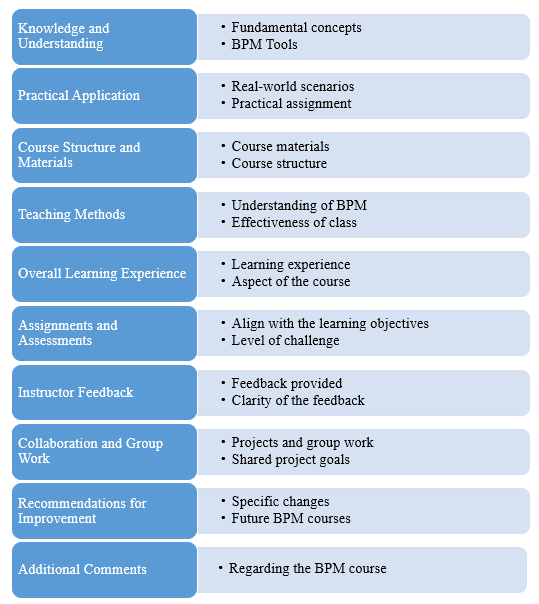
Analyze responses related to collaboration and group work. If ratings are lower, explore qualitative feedback to identify challenges and areas for improvement. Examine qualitative responses for recommendations and changes. Identify common themes and specific suggestions to inform improvements in the BPM course. Analyze qualitative responses regarding areas for future emphasis. Identify emerging topics or concepts that students believe should receive more attention in future BPM courses. Thoroughly review additional comments for any unique insights, concerns, or suggestions. Consider these comments in the context of both quantitative and qualitative findings. Based on the analysis, prepare actionable recommendations for enhancing the BPM course. These could include adjustments to teaching methods, course materials, assignments, or other aspects identified through the analysis in Figure 1.
Develop a comprehensive feedback and improvement plan based on both quantitative and qualitative findings. This plan should address specific areas identified for enhancement, leveraging both student ratings and their valuable insights. Communicate the survey findings and improvement plan to relevant stakeholders, including instructors, administrators, and students. Encourage transparency and collaboration in implementing changes.
Findings and Discussions
A group of 43 undergraduate students from the University of Information Technology Myanmar, enrolled in a Business Process Management course, and actively engaged in analysing their course experiences. To ensure the integrity of the data collection process, the students were informed transparently, and their participation was entirely voluntary after obtaining prior consent. This approach guaranteed their genuine and willing engagement in the BPM experience analysis.
The learning environment of the BPM course was evaluated using a 5-point Likert scale survey questionnaire. The scale ranged from “Strongly Agree” (5) to “Strongly Disagree” (1), with intermediate values representing varying levels of agreement or disagreement (“Agree” = 4, “Undecided” = 3, “Disagree” = 2). Students also participated in interviews and answered open-ended questions. The quantitative data collected was thoroughly analyzed using SPSS, while the qualitative analysis of open-ended responses provided deeper insights into specific strengths and areas needing improvement. The following table 1 shows the hypothetical ratings for survey outcomes.
| Category | Survey Questions | |
|---|---|---|
| 1 | Knowledge and Understanding | 1. To what extent do you feel you understand the fundamental concepts of Business Process Management (BPM)? |
| 1 | Knowledge and Understanding | 2. Please rate your knowledge of BPM tools and methodologies on a scale from 1 (very low) to 5 (very high). |
| 2 | Practical Application | 3. How often were you able to apply BPM concepts in real-world scenarios during this course? |
| 2 | Practical Application | 4. On a scale of 1 to 10, how proficient do you feel in using BPM tools in practical assignments? |
| 3 | Course Structure and Materials | 5. How would you rate the organization and clarity of the course materials (e.g., textbooks, lecture notes)? |
| 3 | Course Structure and Materials | 6. Did the course structure effectively facilitate your understanding of BPM concepts? Please explain. |
| 4 | Teaching Methods | 7. To what extent did case studies and real-life examples contribute to your understanding of BPM concepts? |
| 4 | Teaching Methods | 8. Rate the effectiveness of class discussions and group activities in enhancing your learning experience. |
| 5 | Overall Learning Experience | 9. How satisfied are you with your overall learning experience in the BPM course? |
| 5 | Overall Learning Experience | 10. Identify one aspect of the course that you believe contributed most to your learning. |
| 6 | Assignments and Assessments | 11. How well did the assignments and assessments align with the learning objectives of the BPM course? |
| 6 | Assignments and Assessments | 12. Rate the level of challenge in the assessments provided in this course. |
| 7 | Instructor Feedback | 13. How helpful and timely was the feedback provided by the instructor on your assignments and assessments? |
| 7 | Instructor Feedback | 14. Rate the clarity of the feedback you received from the instructor during the course. |
| 8 | Collaboration and Group Work | 15. To what extent did collaborative projects and group work contribute to your understanding of BPM concepts? |
| 8 | Collaboration and Group Work | 16. Rate the effectiveness of group collaboration in achieving shared project goals. |
| 9 | Recommendations for Improvement | 17. What specific changes or additions would you recommend to enhance the BPM course? |
| 9 | Recommendations for Improvement | 18. Is there any topic or area you believe should receive more emphasis in future BPM courses? |
| 10 | Additional Comments | 19. Please share any additional comments, suggestions, or concerns you have regarding the BPM course. |
Table 1: Hypothetical ratings.
The survey results provide a comprehensive overview of the students’ experiences and perceptions regarding the Business Process Management (BPM) course at the University of Information Technology Myanmar. The key findings can be summarized as follows: Knowledge and Understanding: Students generally felt confident in their understanding of fundamental BPM concepts (4.2) and had a moderate level of knowledge regarding BPM tools and methodologies (3.8). Practical Application: The ability to apply BPM concepts in real-world scenarios was moderately frequent (3.5), and students felt fairly proficient in using BPM tools in practical assignments (4.0). Course Structure and Materials: The organization and clarity of course materials were highly rated (4.5), indicating that the resources provided were well-structured and easy to follow. Qualitative feedback suggested the course structure was effective in facilitating understanding. Teaching Methods: Case studies and real-life examples were valuable for understanding BPM concepts (4.1). Class
discussions and group activities also contributed positively to the learning experience, albeit to a lesser extent (3.7). Overall Learning Experience: Overall satisfaction with the BPM course was high (4.4), with qualitative feedback highlighting specific aspects that significantly contributed to the learning experience. Assignments and Assessments: Assignments and assessments were well-aligned with learning objectives (4.0) and appropriately challenging (3.9). Instructor Feedback: Instructor feedback was timely and helpful (4.3), and its clarity was appreciated (4.2). Collaboration and Group Work: Collaborative projects and group work moderately contributed to understanding BPM concepts (3.8) and were somewhat effective in achieving shared project goals (3.6). Recommendations for Improvement: Students provided qualitative suggestions for course enhancements, including specific changes and additional emphasis on certain topics. Additional Comments: Further qualitative comments and suggestions indicated areas of concern and additional feedback for course improvement.
The BPM course at the University of Information Technology Myanmar is highly regarded by students, receiving excellent ratings for its course structure, teaching methods, and overall satisfaction. Survey results indicate that the course effectively provides a solid understanding of BPM concepts and tools while identifying areas for potential improvement. The course can enhance its effectiveness by addressing these areas and meeting the student’s learning needs better. The course effectively supports students in gaining a solid understanding of BPM concepts and tools.
Recommendations
Based on the above analysis, prepare actionable recommendations for enhancing the BPM course. These could include adjustments to teaching methods, course materials, assignments, or other aspects identified through the analysis. The analysis of quantitative ratings and qualitative comments in Table 2 are actionable recommendations for enhancing the BPM course.
| Enhancing BPM course | Actionable Recommendations | |
|---|---|---|
| 1 | Teaching Methods and Engagement | Introduce more interactive elements, such as group discussions, case studies, and practical exercises, to enhance participant engagement and reinforce key BPM concepts. |
| 2 | Course Materials and Resources | Incorporate additional resources, including supplementary readings, multimedia materials, and real-world examples, to provide participants with comprehensive and accessible learning materials. |
| 3 | Communication Channels and Feedback | Implement a more robust communication platform to facilitate clearer and more effective communication between participants and instructors. Enhance the feedback process by providing more detailed and timely feedback on assignments, ensuring participants receive constructive input for improvement. |
| 4 | Group Collaboration and Projects | Develop strategies to improve coordination and communication within group projects, addressing challenges identified by participants in the collaborative learning process. Establish guidelines for fair distribution of workloads in group assignments, ensuring an equitable contribution from all participants. |
| 5 | Emerging Topics and Industry Relevance | Introduce topics related to emerging technologies in BPM, such as AI and automation, to ensure the course remains aligned with industry trends. Foster connections with industry experts or practitioners through guest lectures or collaborative projects to provide real-world insights and enhance industry relevance. |
| 6 | Continuous Learning Opportunities | Provide resources and opportunities for continuous learning beyond the course duration, such as webinars, workshops, or access to industry events, allowing participants to stay updated on evolving BPM trends. |
| 7 | Overall Course Structure | Evaluate the overall course structure based on both quantitative and qualitative feedback to identify areas for improvement or adjustments. Seek input from participants on their preferred learning formats and structures to ensure alignment with diverse learning preferences. |
| 8 | Implementation Strategy | Develop a phased implementation plan for the recommended adjustments, considering the feasibility and impact of each change. Establish a feedback mechanism to collect ongoing input from participants and iterate on adjustments to continuously enhance the course. |
Table 2: The actionable recommendations for enhancing the BPM course.
The above actionable recommendations aim to address specific areas identified in the analysis, fostering a more engaging, relevant, and effective learning experience in the BPM course. Regular assessment and feedback cycles will further contribute to the continuous improvement of the course based on participant needs and expectations.
Conclusions
In conclusion, this research underscores the critical importance of understanding student experiences in Business Process Management (BPM) education for on-going enhancement. By employing a mixed-methods approach that combines hypothetical rating surveys with qualitative analysis, we have delved deeply into the perspectives of learners, going beyond numerical ratings to reveal nuanced insights. Through this comprehensive examination, we have identified both strengths and areas for improvement in the BPM course. This analysis has illuminated aspects of the course structure, teaching methods, and overall learning experience that resonate positively with students and warrant attention and refinement. Notably, students’ reflections on practical application, collaboration, and conceptual understanding have provided valuable insights into the effectiveness of the educational journey. By triangulating quantitative ratings with qualitative feedback, we have gained a holistic understanding of student experiences, offering rich recommendations for curriculum refinement and the creation of a more engaging and effective learning environment. These findings serve as a roadmap for continuous improvement in BPM education, guiding educators in enhancing course offerings and fostering greater student engagement and learning outcomes. The integration of both quantitative and qualitative data ensures that future enhancements are informed by a comprehensive understanding of student perspectives, ultimately enriching the educational experience for all involved. The BPM course is highly effective in delivering its educational objectives, but continuous improvements based on student feedback will ensure it remains relevant and engaging, ultimately providing an even better learning experience for future cohorts.
The BPM course at the University of Information Technology Myanmar is well-received by students, with high ratings for course structure, teaching methods, and overall satisfaction. The survey results demonstrate that the course successfully imparts a strong understanding of BPM concepts and tools while highlighting areas for potential enhancement. Areas for potential improvement include enhancing practical application opportunities, refining group work effectiveness, and incorporating student feedback to enrich the course content and delivery further. Key strengths include the well-organized course materials, effective use of case studies, and a positive overall learning experience.
However, there are opportunities to improve the practical application of BPM concepts, refine the effectiveness of group work, and incorporate more interactive and engaging teaching methods. Students’ qualitative feedback provides valuable insights into specific areas where the course can be improved, such as increasing the emphasis on certain BPM topics, enhancing the challenge level of assignments, and improving the facilitation of group projects.
In future works, it is recommended to conduct longitudinal studies to track changes in student perceptions over time, expand research to diverse student populations, and investigate the integration of emerging technologies in BPM education. Additionally, exploring innovative collaborative learning models, developing instructor development programs, and examining curriculum flexibility can further enhance the learning experience. Strengthening industry collaboration, evaluating student support services, investigating alternative assessment methods, and assessing the impact on graduates’ professional development will provide comprehensive insights for continuous improvement in BPM education.
References
-
Harmon P (2015) Business process change A guide for business managers and BPM and Six Sigma professionals. Morgan Kaufmann.
-
Rosemann M, Bruin T, Power B (2015) A brief history of BPM. In Handbook on Business Process Management. Springer 1: 3-16.
-
Thant KS, Thu ETT, Khaing MM, Myint KL, Tin HK (2020) Evaluation of Student Academic Performance Using Naive Bayes Classifier. Advances in Computer and Communications 1(1): 46-52.
-
Zaw LH, Haung T (2024) Navigating the business process management (BPM) implementation journey strategies for merging theory and practice. Economics Commerce and Trade Management an International Journal (ECTIJ) 3.
-
Dumas M, Rosa M, Mendling J, Reijers HA (2013) Fundamentals of business process management. Springer.
-
Creswell JW, Creswell JD (2017) Research design Qualitative quantitative and mixed methods approaches. Sage Publications.
-
Denzin NK, Lincoln YS (2018) The Sage handbook of qualitative research. Sage Publications.
-
Recker J, Rosemann M, Reijers HA, Sadiq S, Vanderfeesten I (2018) Recommendations for BPM education Results from a Delphi research. Information Systems 76: 101243.
-
Rosemann M, Bruin T, Power B (2016) Ten principles of good business process management. In Handbook on Business Process Management. Springer 1: 19-38.
-
Reijers HA, Liman MS, Vanderfeesten IT, Recker J, Cardoso J (2018) Process aware information systems in the age of big data Challenges and opportunities. ACM Transactions on Management Information Systems (TMIS) 9(4): 1-23.
-
Dumas M, Rosa ML, Mendling J, Reijers HA (2017) Business process management a comprehensive survey. ISRN Software Engineering.
-
Aung TT, Khaing MM, Oo CZ, Myint KL, Tin HHK (2021) The Content Design and Types of Learning Method of an E-Learning System for Higher Education Development Advances in Computer and Communication 2(1): 1-6.
-
Khaing MM, Su AT, Thant KS, Aung TT, Tin HK (2022) Learning on the Smart Campus Information System. Discovery 58(318): 597-602.
-
Thant KS, Khaing MM, Tin HHK (2023) Mapping the Course Objectives and Program Learning Outcomes of Software Engineering Course by Bloom’s Revised Taxonomy. Middle East Research Journal of Engineering and Technology 3(3): 33-38.
- Revolutionizing Property Measurement Through Artificial Intelligence: The Journey of PropertyMeasure.ai
- AI Infused Business Model Innovation for Competitive Advantage in the Era of Big Data and Digital Transformation
- Use of CPM/PERT in the Effort to Eradicate Polio
- Integrated Multimodal Deep Learning Framework for Early Detection of Mouth Cancer Using CT Imaging and Clinical Symptom Analysis
- Artificial Intelligence in Medical Robotics and Assistance: An Overview
- Server Migration with Multipath-QUIC