
Artificial Intelligence Versus India’s Sustainable Agriculture System: An Overview
As global challenges of population development, climate variation, and resource insufficiency exaggerate, the agricultural landscape is at a serious juncture. Sustainable farming arises as a transformative explanation to discourse these challenges by making the most of crop yields in precise environments. This model shift necessitates the amalgamation of the most advanced technologies, with Artificial Intelligence (AI) at the forefront. This overview provides a wide-ranging exploration of the role of AI in sustainable farming, investigating its latent, challenges, and prospects. The article also reveals the current state of AI applications, encircling machine learning, computer vision, the Internet of Things (IoT), and robotics, in heightening resource usage, automating tasks, and upgrading decision making. It recognizes gaps in research, highlighting the need for optimized AI models, interdisciplinary collaboration, and ultimately expansion of reasonable AI in agriculture. The inferences encompass beyond efficiency gains, considering economic feasibility, declined environmental impact, and augmented food security. This overview offers new insights into developing a strong platform exploring certain avenues for future research, aiming to direct the amalgamation of AI technologies in sustainable farming for a resilient and sustainable future in the area of agriculture.
Keywords: Agricultural Innovation; Agricultural Technology; Artificial Intelligence (AI); Environmental Sustainability; Sustainable Farming
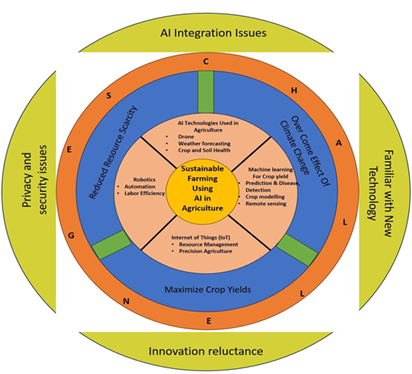
Graphical Abstract
Abbreviations
AI: Artificial Intelligence; IoT: Internet of Things; GPS: global locating system; IIT: Indian Institute of Technology; ENN: Ensemble Neural Networks; UAV: Unmanned Aerial Vehicle; CIP: Cleaning in Place; HSI: Hue-Saturation-Intensity; NIT: National Institute of Technology.
Introduction
Vision-based intelligent systems have made an approach to practically each aspect of modern human life. These systems combine computer vision, artificial intelligence (AI), and machine learning technologies and allow machines to mimic human visual and cognitive abilities to make informed decisions about the task at hand [1, 2, 3, 4]. Computer vision technology is used to process and interpret visual information from the surrounding environment while the artificial intelligence (AI) technologies along with machine learning algorithms are used for recognizing patterns and predicting actions [5]. These intelligent systems improve performance through learning over time. Automated vision-based systems have revolutionized every industry since the late 20th century. Research on machines with the ability to interpret visual information started during 1950s. An example of one of the earliest intelligent machines is Shakey, a ground breaking robot developed at Stanford Research Institute in the late 1960s. 1970s witnessed the origination of optical character recognition technology [5]. In 1980s and 1990s, focus shifted on the application of machine learning techniques in the development of vision- based intelligent systems. However, these initial systems remained comparatively elementary, based mostly on rule- based approaches [5]. With the advancement in powerful computing resources and computer vision techniques like object recognition and image segmentation in 2000s, and advent of deep neural networks in 2010s, performance of vision-based systems has increased significantly [6]. The intersection of the vision-based intelligent systems and robotics domains give rise to novel smart machines that have the ability to perceive and interact with their environment and perform tasks in a manner similar to humans.
There are numerous challenges for implementing intelligent systems in the agricultural sector considering the widely increasing world population, declining arable land, and shortage of labour force. Pest damage as well as complex and unpredictable environment also add to the challenges faced by farmers [7]. Farmers need a variety of information to make necessary decisions about the crops. Traditionally, this is done by physically monitoring the plants by the farmers at various times of crop development making it a cumbersome process requiring great focus and expertise. Subjective process of crop data extraction can be standardized by replacing manual extraction by automated systems based on latest AI and computer vision technologies. The focus of the present-day research in the agricultural sector is the development of intelligent and automated vision-guided systems that can replace manual processes and are more precise and accurate and free from human error factors [7]. A vision-guided intelligent system must be able to gather relevant information without human intervention consequently reducing labour cost. With the data about the current growth stage of the crop, such a system can be helpful for the timely and precise application of fertilizers and targeted spraying of insecticides/herbicides for better plant health and quality of produce thus increasing environmental sustainability and food security [8]. A vision- guided intelligent system will also help in tracking the growth stages of the crop and making timely decisions about harvest for better yield.
As a prime producer of products like rice, wheat, cotton, sugar, and dairy products, India’s agricultural organization is crucial not only to itself, but also to the rest of the globe. For India, agriculture is critical. Approximately 58% of its population depends on agriculture for its livelihood, and the country has the second largest agricultural land area in the world. However, India’s agriculture system is facing serious challenges. More efficient crop yield is necessary to continue feeding India’s 1.4 billion people. Climate change disrupts our agricultural systems, and at the same time, unsustainable farming practices exacerbate climate change through significant greenhouse gas emissions, water usage and deforestation. Without change, food and environmental systems across the world are at risk. The present editorial is apprehended under following heads:
Agricultural Sustainability
According to the Google blog, two teams at Google, Anthro Krishi and Google Partner Innovation, are leveraging AI to tackle this challenge, aligned with Google’s AI Principles. The teams’ goal is to progress agricultural sustainability, beginning with India. The team is working on a whole body of AI-powered technologies to organize and utilize India’s agricultural data, the most foundational of which is developing a unified ‘Landscape understanding’.
Landscape understanding leverages satellite imagery and ML to draw boundaries between field, the basic unit of agriculture and essential in creative meaningful insights. With field segments established, the model can determine the acreage of farm fields, forest and woodland areas, and can identify irrigation structures like farm wells and dug ponds to build tools for drought preparedness.
Landscape Observation
The research team is also developing “landscape monitoring” models, which provide a more detailed picture of an individual field’s current performance and future needs. Future landscape monitoring models would be able to determine data like crop type, field size, distance to water and a crop’s last sow or harvest date. The team also hopes to provide in-depth data about farm pond- information like water availability over the past month, year, or three years would be critical in establishing water security and drought management strategies.
Farming Lifespan
The impression of AI on agriculture is apparent transversely several phases of the farming lifespan. In technologically perfect farming, AI-powered technologies facilitate farmers to evaluate soul health, adjust irrigation, and modify fertilizer treatment based on crop necessities. Crop observation and disease diagnosis signify another interest where AI is creating significant inroads. By manipulating AI algorithms on satellite unary and drone data, farmers can display crop health in real-time, empowering early detection of diseases and pest invasions. The capability to interfere promptly augments crop resilience, minimizes damage, and lessens the dependence on chemical interferences. AI also plays a pivotal role in adjusting water usage, a critical apprehension in water-scarce regions. AI-powered systems evaluate climatic data, soil moisture levels and crop water necessities to optimize irrigation plans. The ultimate outcome is lessening in water wastage, augmented water uses efficacy and improved crop yields.
Technologies in Agriculture
In India, remote access microgrid power farming powered by IoT, and artificial intelligence is gradually getting underway. Farmers are given access to facilities by Indian government agencies like C-DAC with the goal of advancing agriculture. With the rising need for agricultural products over time, new technologies must be adopted. Information technology breakthroughs have led to greater crop output over time, which has produced field yield seeds. Throughout the 20th century, heavy crop production was greatly influenced by the usage of computers. Artificial intelligence will undoubtedly be involved in the coming decades. It is a truth that artificial intelligence presents opportunities to boost agricultural output, reduce waste, and raise farmer incomes. All these fields benefit greatly from artificial intelligence, which keeps “agriculture as a service” from becoming a vulnerable market niche. There are eight primary domains in which cognition is used:
- The Internet of Things (IoT) drove growth
- Work on insights based on images
- Creation of blends that work well for agricultural goods
- Increase in the monitoring of crop health
- Providing farmers the tools they need to utilize irrigation to the fullest
- Adopting technology initiatives in agriculture that can support itself
- Aiming correctly for enterprise marketing, value-added product development and production
- Recognizing which way the market is heading.
As a consequence of these worthwhile practices, the agricultural industry in India can certainly tend towards upgradation. Thus, technologies, particularly, artificial intelligence-based ones, are mandatory to be developed and brought in practice.
In agriculture, the need for data-driven framing and predictive analytics is a guiding following the COVID-19 pandemic. The proprietors of agro-businesses and framers are proactively using AI and machine learning framework- supported precision farming techniques. By eliminating the element of guesswork, these frameworks help farmers manage their crops and livestock by managing a supply chain, estimating yield, and evaluating risks [9]. From seed identification to harvest, block-chain technology provides a transparent supply chain in a variety of agricultural areas. In terms of technical features, education, regulations, and regulatory frameworks, it will increase the appeal of the farmers and systems.
Wastewater Sustainability in Agriculture
Water Treatment has been one of the major issues we talk about, either pharmaceutical or Food and Beverage industry. The treated water in these industries is Once again used for activities like Fishpond, Gardening and CIP (Cleaning in Place). So, there is no lack of water in these industries, a small portion of this treated water can be used for agricultural activities like drip irrigation, and major drought affected areas of our country by integrating concepts of Generative AI in which can help farmers and the entire Agriculture sector for Meeting SDGs (Sustainability Development Goals) in future and as well as more efficient use of treated water for Farming purpose.
Agricultural Technology Adoption Challenges
Recently, the Indian government’s Niti Aayog released a discussion paper [10]. It sees applications of artificial intelligence to major fields like industrialization and agriculture. Farmers now have access to information regarding soil quality, when to plant, how to use herbicides, where pests are found, and other details thanks to sophisticated agricultural machinery and artificial intelligence. India could see a new agricultural revolution if we were to create an intelligent system that could counsel farmers on various best practices. That potential scenario does, however, face significant challenges. Capacity expansion and cost-cutting strategies are used throughout the supply chain, which may be detrimental to the majority of Indian farmers. Adopting built-in intelligence-based technologies, as follows, in the agriculture industry presents several problems despite their distinct advantages [11]:
- System and technological reliability
- Information security and acceptability
- Data storage, privacy, and utilization
- Social acknowledgement and approval
- The utilization of trustworthy information, accessibility and live release
- Cost-effectiveness (Training and use ease)
- Unethical parties involved. The overall demands placed on agriculture worldwide are growing due to the fallout from (COVID-19). Technological developments in agriculture and marketing contribute to global economic expansion and the lockdown that is currently in place. Using predictive methodologies, it also led to disruptions in the food supply chain.
Data Monitoring of Water Used in Agriculture and Farming
While talking about sustainability Goals there is a need for pollution monitoring AI integrated Software as not all types of water is fit for farming and irrigation purposes as there might still exist some hazardous mixtures present in water and these Generative AI software might help in monitoring of such type of crucial data as directed by the pollution control board of India. The modern agricultural AI based technologies like Techniques such as hydroponics, aquaponics, aeroponics are currently underway [12] (Table 1), though there is still scope of transformation in view of precision of the techniques and agricultural upgradation.
AI Technology in Pest Control and Management
There is substantial literature on the adoption of agricultural technology in India. This literature varies widely by the type of agricultural technologies, crops, natural resources, and specific situations, such as the management of pests and diseases. Use of Generative AI in Agriculture might improve decision making process and Lead to higher yield by eliminating the pests and rodents [13].
| pH | Chemical Oxygen Demand (COD) | Biochemical oxygen Demand (BOD) | Total Suspended Particles (TSS) | Oil and Grease |
|---|---|---|---|---|
| 6.5 – 8.5 | < 250 | < 30 PPM | < 100 PPM | < 10 PPM |
Table 1: Certain AI based physico-chemical parameters in practice for agriculture.
Models of Artificial Intelligence in Agriculture
Across the world, integrated technologies are developing to increase agricultural productivity, seed quality, soil monitoring, climate forecasting, agricultural analysis, markets, and distribution networks. Agricultural productivity can be increased using machine learning, data eco-systems, cloud computing infrastructure, and the Internet of Things (IoT). We can concentrate on the advancement of the digital agriculture industry. For this, concentrate on effective pest control, efficient harvesting, effective chemical application, efficient irrigation, and efficient farming. The current agriculture supply chain operates much more efficiently thanks to automated irrigation powered by artificial intelligence. With the rise in food demand, so did the percentage of freshwater resources required. Thus, intelligent irrigation, water level, soil temperature, nutrient content, and weather forecasting are all impacted by artificial intelligence [14].
Artificial intelligence’s machine learning and soft computing techniques can be applied to the model-building process. By applying the methods to plant growth photos and videos, we may create intelligence models. Across the globe, built-in intelligence is extensively utilized in drone cameras, satellite imagery, data processing, monitoring and management systems for diverse agricultural activities, disease and pest identification, weather forecasts, and fertilizer application schedules. A subfield of artificial intelligence uses machine learning to forecast when to harvest, how long a product will last, and how to apply chemical sprays correctly. Bananas grown on the same soil on the same day have variable harvest times and weights, for instance. Even with uniform fertilizer application, this may still occur. These issues are solvable by technical analysis. When used for farming and harvesting, robots and intelligent machinery can save a tonne of money by eliminating the need for agricultural laborers. Determine which seeds are available for the next round of seed germination and blossoming using a machine learning framework for Indian farmers. To distribute to the farmers, for instance, a machine learning system must work with numerous seed banks in India. The soil composition, availability, market, and meteorological factors of that farming location are taken into consideration while suggesting seeds’ quantity and quality both.
Drastic Increase in Productivity but Cost as a Hill with AI
Although AI has revealed beneficial results in terms of increasing productivity and generating higher returns, but high cost of AI based systems has still been a major concern in agricultural sectors as not all farmers can install AI systems for better production and results. Lack of widespread technical-how might be one of the reasons that leads to unawareness of such beneficial technologies for farmers [15].
Agriculture as an Astronomical Service Sector
Agriculture is one of the largest operating service sectors across the globe. Mainstream of people make their living in agricultural and related service sectors. According to second advanced estimates for the year 2022-23 the India’s total foodgrain is expected to reach around 3235.54 lakh tonnes followed by higher pulse production [16].
Smart Irrigation Technology using AI
The technology of smart irrigation is developed to increase the production without the involvement of large amount of manpower by detecting level of water, temperature of soil, nutrient content and weather forecasting [17]. For example, in 2017 they developed an automated robotic model for detection of moisture content and temperature. They also developed an automated irrigation system with Arduino for reducing manpower [18].
Other Smart Automated AI systems for Irrigation
An efficient and automated irrigation system was innovated in last decade only by developing remote sensors using the technology of Aurdino that can increase the production up to 40%, was successfully [19]. Followed by this worthwhile system, another automated irrigation system was delivered in which sensors were built for various purposes like soil moisture sensor to detect the moisture content in soil and temperature sensor for better crop growth [20].
Crop Yield Prediction
Crop yield prediction is one of the most vital subjects in precision agriculture and is indispensable for yield mapping, yield estimating, matching crop supply with demand, and crop management to upsurge productivity. The recognized technique combined soil data and crop growth parameters derived from satellite photography to make a more precise prediction. An approach was successfully developed to distinguish tomatoes using electromagnetic fields (EM) and remotely sensed red, green, and blue (RGB) images taken by an unmanned aerial vehicle (UAV) [21]. For the purpose of predicting the rice production process Su Y, et al. [22] developed a method based on SVM and fundamental geographic data collected from meteorological stations in China. Eventually, a broader technique for predicting agricultural yields was suggested by different research tools [23]. The tactic is predicated on using ensemble neural networks (ENN) to analyze agronomic data that was produced over a prolonged period (1997-2014). The study’s regional prognoses are focused on assisting farmers in evading supply and demand mismatches in the market, which are brought on or exacerbated by crop caliber.
Key Domains where AI Can Help Agriculture
IoT-driven development: Large amounts of organized and unstructured data are produced daily by the internet of things (IoT). These have to do with historical patterns specifics, information on soil, fresh studies, rains, plague, drone, pictures from a camera, etc. This combined knowledge can be detected by cognitive IOT solutions. Measuring the soil: Intelligent data fusion is branded by two technologies: remote sensing and proximity sensing. One practical application of this high-resolution data is soil testing. While sensors must be mounted in satellite or aircraft systems for remote sensing, very close-range or soil- contact sensors are mandatory for proximity sensing. This helps describe the soil in a particular area based on the dirt under the surface. Generation of image-based insight: Images from drones can help in field research, tracking crops, field scanning and other farm obligations. They can be combined with IOT and computer vision technology to promise rapid action from farmers. In fact, real-time weather alerts for farmers will be generated using these streams. Crop disease detection: Images of several crops are taken in white/UV-A light using computer vision technology. Following that, growers could arrange the product into various stacks prior to bringing it to market. The segmentation of leaf pictures into regions for successive diagnosis is confirmed by image pre-processing. Such a wonderful technique can more distinctly categorize pests. Optimal blend of agricultural products: Farmers can obtain assistance from cognitive computing regarding the easiest crops and seeds to plant liable on a number of factors, including soil quality, forecasted weather, seed variety, and pest activity in a specific area. The direction is further tailored depending on the requirements of the farm, the environment, and prior successes. Artificial intelligence has the potential to consider external basics including industry trends, expenses, and client wants. Plant health monitoring: Along with hyperspectral imaging and 3D laser scanning, remote sensing techniques are mandatory to build crop metrics across thousands of acres. It might bring about a radical alteration in the way farmers manage their croplands in terms of resources and time. Throughout the course of a crop’s life, this system will monitor it and, if any reports are generated, will identify irregularities. ICRISAT developed an app that uses AI to produce. Microsoft Cortana’s Intelligence Suite and Power Business Intelligence power the application. The technology in the Cortana Intelligence Suite aids to upsurge the value of data by converting it into easily actionable forms. With the use of this technology, the app will be able to predict the weather more precisely and advise nearby farmers on the best time to plant their seeds weather models and data on local crop yield and rainfall. Improving crop productivity: Traditional agricultural knowledge has become outdated as a consequence of climate change, predominantly in the area of weather pattern prediction that determines seasonal farming practices. Utilizing AI to support predictive analysis could be very advantageous for farmers. Finding the right crops to plant in a climate-controlled environment and using the accurate sowing technique could aid boost output and cut expenses. Tracking soil quality: Together with favourable weather, the key to getting the most yields is having healthy soil, which includes an adequate amount of moisture and nutrients. Distributed soil monitoring using image recognition and deep learning models can be used to identify problems and take corrective action to restore soil health. AI models are developed using a variety of inputs, including historical monsoon data, photographs of nearby farms, agricultural yield statistics, soil health histories, and more.
In addition to helping farmers plan tasks linked to crop development, soil regeneration, irrigation, and other associated tasks, these models offer vital information about farms.
AI Bots for Agriculture
AI-powered agricultural bots assist farmers in discovering more efficient manners to keep weeds out of their crops. This aids in resolving the labour trouble as well. AI bots can harvest plants more recurrently and more quickly than humans in the agricultural industry. It uses computer vision to aid monitor and spray the weed. Artificial intelligence can assist farmers protect their crops from weeds in an effectual manner.
The development of a vision-based weed documentation system under natural daylight is currently in practice and revealing very interesting outcome [24]. In the Hue- Saturation-Intensity (HSI) shading space (GAHSI), a region for the detection of open-air field weeds was produced via hereditary calculation. It makes use of absurd situations like radiant and shady, and these lightning conditions were mosaiced to find out if GAHSI could be used when these two borders are displayed simultaneously to determine the location of a region in the field in shading space. They developed as a result of the GAHSI providing proof of the presence and separability of such a location. The GAHSI execution was determined by contrasting the GAHSI- portioned image with a similar hand-sectioned reference image. In this case, the GAHSI produced a similar result were employed in order to carry out intra-row weeding and promote weed witling. The usage of agricultural robots for weed suppression and the development of strategies for controlling robot postures were disclosed by Nakai and Yamada in the context of uneven rice-growing fields [25].
Predictive Analytics
A number of environmental factors, including weather and climate variation, can be controlled and predicted using machine learning algorithms. Augmented yields and less crop damages are now probable for farmers thanks to the development of sophisticated sensors and imaging competences. Sun H, et al. [26] exhibited that it is practicable to use a continuous kinematic (RTK) global locating system (GPS) to subsequently define the area of transplanted column crops. A transplant for favourable scenario vegetable harvest, equipped with an RTK GPS receiver, plant, trend, and odometry sensors, as well as an on-board data lumberjack, was used for field transplant mapping during planting. The findings of the field test revealed that 95% of the predicted plant areas were within 5.1 cm of their actual areas, with a mean error of 2 cm between the plant map regions predicted by the planting data and the missed areas after planting. Sonaa G, et al. [27] compiled a multispectral UAV overview to guide soil and harvest for precision agriculture applications. Foremost issues include insufficient irrigation systems, rising temperatures, groundwater density, food shortage and waste, and many more have been addressed by agriculture. Farming is still at a budding stage when it comes to handling practical glitches faced by farmers and using automated decision making and predictive solutions to address them. Applications are prerequisite to be more vigorous in order to explore the vast scope of AI in agriculture.
Use of AI In Agricultural Operations and Lean Manufacturing
In search of Zero errors during farming and Irrigation Process we might seek potential help from lean sigma using generative AI that might enhance and maximize productivity, optimization of resource allocation and better crop yields with zero defects and decreased errors. Zero error in terms of crop production or crop failure consequent to rainfall or lack of suitable quality required as per market requirements. These minor errors are responsible for stop or slowdown of crop production [28]. Fundamentally, limitations in policy-related facilities as well as input, supply, operations factors need to be free from all defects by amalgamation of Generative AI based Lean Manufacturing and Sigma Six Methodologies. This includes the following steps: (i) Recognizing the potential risks while crop production; (ii) Defining the Problem; (iii) Measuring the risks while production and irrigation; (iv) Analysing the given problem by decision making tool with help of generative AI model and creating a statistical model; (v) Improving quality measures and RMPM (Raw material and packaging); (vi) Controlling the level of risks and errors by establishing critical control points during production and providing a long-term solution for this brainstorming concern.
Challenges of Artificial Intelligence based Agricultural Research
One of the key obstacles we face is the approach to conducting artificial intelligence research in our nation. In India, the focus of current research and development efforts is primarily on prestigious institutions like the Indian Institute of Technology (IIT) and the National Institute of Technology (NIT). In this field, a community of 50 to 75 individuals collaborates. However, due to the limited workforce size, they struggle to make significant advancements. Consequently, India falls considerably behind in producing top-tier results in advanced and smart computation. Space constraints, limited resources, administrative hurdles, research methodology limitations, inadequate computing facilities, and lack of high-quality data interpretation have been identified as significant challenges impacting India’s artificial intelligence research. The boost in Digital India’s budget to US $477 million in 2018 for the expansion of artificial intelligence research was a positive initial move. Despite the availability of these funds, tackling institutional weaknesses remains a significant challenge. It is not clear how public agricultural universities and research institutes will benefit from such allocation. Applications within the Indian agricultural sector must expand, with a focus on bringing technologies to the grassroots level. All stakeholders should benefit from the situation. Technologies must not be confined to laboratories; they should be deployed and tested in real-world settings. Recommendation systems will aid in assisting consumers and farmers in effectively recognizing the entire supply chain, leading to mutual benefits for both parties. By implementing artificial intelligence into various stages of farming, we have the potential to enter a prosperous era of abundant agricultural resources. Achieving this goal requires the advancement of multiple research methods as a smart agriculture system. For better yield in agriculture, it is recommended to:
- Provide more funding for projects related to research and development in the field of agricultural artificial intelligence.
- Putting into practice large-scale AI expert advice strategies units for application and research.
- Have an efficient equipment assessment system with artificial intelligence and associated techniques
- Practice boost communication at all levels with all stakeholders within the supply chain.
- Availing funding for research initiatives in agro- education.
- Allowing a comprehensive system architecture for quick and easy scalability in context to modifications in the water, climate, and labor availability, i.e., implementing a foundation for SoS.
- Creating coherent, adaptable, and safe systems.
- Recognize the creative and clever methods that occur in different agricultural universities, as well as their effect on farming.
- Comprehend the term “agricultural computer” on an experimental basis in view of examining the interaction between artificial intelligence and sub-sectors within the agricultural domain.
- Implement a comprehensive, multi-dimensional research approach in agriculture.
Conclusion and Future Perspective
According to Google, field data is keys to unlocking the potential of India’s agricultural power with a deep and accurate understanding of field performance and ever- changing environmental conditions, farmers can reduce land and water waste while increasing their crop yield. However, the impact of these insights extends well beyond individual farmers and empower India’s entire agricultural ecosystem. With more information on farm performance and needs, agricultural loans become more accessible and state governments can support several farming districts at scale. This information also supports India’s rapidly growing agricultural technology industry, as new technologies are developed to make farming practices more efficient and sustainable future in the area of agriculture.
Acknowledgement
The authors are grateful to the Chairman Mr. Pawan Singh Chauhan, Vice Chairman Mr. Piyush Singh Chauhan and the Board of Directors of S.R. Institute of Management and Technology, Lucknow, U.P., India for providing the necessary facilities for accomplishing the present piece of work.
References
-
Mishra S, Tiwari AM (2024) Current trends of artificial intelligence in biotechnology. Open Access J Data Sci Artificial Int 2(1): 1-4.
-
Xu Y, Xin L, Cao X, Huang C, Liu E, et al. (2021) Artificial intelligence: A powerful paradigm for scientific research. The Innovation 2(4): 100179.
-
Sarker IH (2021) Machine learning: Algorithms, real- world applications and research directions. Sn Comput Sci 2.
-
Mishra S (2024) Artificial intelligence versus food processing and manufacturing sector: An editorial. J Data Sci Artificial Int 2(1): 1-4.
-
Ghazal S, Munir A, Qureshi WS (2024) Computer vision in smart agriculture and precision farming: Techniques and applications. Artificial Intell Agriculture 13: 64-83.
-
Gupta A, Anpalagan A, Guan L, Khwaja AS (2021) Deep learning for object detection and scene perception in self-driving cars: Survey, challenges and open issues. Array 10: 1-20.
-
Sparrow R, Howard M, Degeling C (2021) Managing the risks of artificial intelligence in agriculture. NJAS: Impact in Agricultural and Life Sci 93(1): 172-196.
-
Wei H, Xu W, Kang B, Eisner R, Muleka A, et al. (2024) Irrigation with artificial intelligence: Problems, premises, promises. Hum-Cent Intell Syst 4: 187-205.
-
Saxena A, Suna T, Saha D (2020) Application of artificial intelligence in Indian agriculture. RCA Alumni Association, India.
-
Tanay M (2019) Role of digital and AI technologies in Indian agriculture: Potential and way forward. NITI Aayog.
-
Lal MB, Ramasubramanian V, Arora A, Marwaha S, Parsad R (2019) Era of artificial intelligence: Prospects for Indian agriculture. Krishi 69(3): 1-5.
-
Wang N, Zhang N, Wang M (2006) Wireless sensors in agriculture and food industry - recent development and future perspective. Computer and Electron Agric 50: 1-14.
-
Joshi P, Kishore A, Pandey D, Wani S (2019) Helping farmers to use optimal inputs: Lessons from soil health cards in Bhoochetana experiment. In: Chandra Babu S, et al. (Eds.), Agricultural extension reforms in South Asia: Status, challenges and policy options Chapter 8 USA pp: 167-176.
-
Liakos K, Busato P, Moshou D, Pearson S, Bochtis D (2018) Machine learning in agriculture: A review, Sensors in Agriculture 18: 2674.
-
Santiteerakul S, Sopadang A, Tippayawong KY, Tamvimol K (2020) The role of smart technology in sustainable agriculture: a case study of wangree plant factory. Sustainability 12: 1-13.
-
(2023) Ministry of Agriculture & Farmers Welfare. Agriwelfare.
-
Kumar G (2014) Research paper on water irrigation by using wireless sensor network. In: Journal of Scientific Engineering and Technology. IEERT Conference Paper pp: 123-125.
-
Jha K, Doshi A, Patel P, Shah M (2019) A comprehensive review on automation in agriculture using artificial intelligence. Artificial Intelligence in Agriculture 2: 1-12.
-
Savitha M, UmaMaheshwari OP (2018) Smart crop field irrigation in IOT architecture using sensors. Int J Adv Res Comput Sci 9(1): 302-306.
-
Varatharajalu K, Ramprabu J (2018) Wireless irrigation system via phone call & SMS. Inter J Eng Adv Technol 8(2S): 397-401.
-
Senthilnath J, Dokania A, Kandukuri M, Ramesh KN, Anand G, et al. (2016) Detection of tomatoes using spectralspatial methods in remotely sensed RGB images captured by UAV. Biosyst Eng 146: 16-32.
-
Su Y, Xu H, Yan L (2017) Support vector machine-based open crop model (SBO CM): Case of rice production in China. Saudi J Biol Sci 24(3): 537-547.
-
Kung HY, Kuo TH, Chen CH, Tsai PY (2016) Accuracy analysis mechanism for agriculture data using the ensemble neural network method. Sustainability 8: 735.
-
Norremark M, Griepentrog HW (2004) Analysis and definition of the close-to-crop area in relation to robotic weeding. 6th EWRS Workshop on Physical and Cultural Weed Control pp: 127-140.
-
Nakai S, Yamada Y (2014) Development of a weed suppression robot for rice cultivation: Weed suppression and posture control. Int J Electrical, Elect Comm Eng 8(12): 1658-1662.
-
Sun H, Slaughter DC, Ruiz MP, Gliever C, Upadhyaya SK, et al. (2010) RTK GPS mapping of transplanted row crops. Comput Electron Agric 71(1): 32-37.
-
Sonaa G, Passonia D, Pintoa L, Pagliaria D, Masseroni D, et al. (2016) UAV multispectral survey to map soil and crop for precision farming applications. The Int Archives of the Photogrammetry, Remote Sensing and Spatial Information Sci pp: 1-7.
-
Shetty P, Manorama K, Murugan M, Hiremath M (2014) Innovations that shaped Indian agriculture-Then and now. Indian J Sci Technol 7(8): 1176-1182.
- Revolutionizing Property Measurement Through Artificial Intelligence: The Journey of PropertyMeasure.ai
- AI Infused Business Model Innovation for Competitive Advantage in the Era of Big Data and Digital Transformation
- Use of CPM/PERT in the Effort to Eradicate Polio
- Integrated Multimodal Deep Learning Framework for Early Detection of Mouth Cancer Using CT Imaging and Clinical Symptom Analysis
- Artificial Intelligence in Medical Robotics and Assistance: An Overview
- Server Migration with Multipath-QUIC