
Zirconia Based Crowns for Esthetic Rehabilitation of Severely Discolored Teeth
According to studies, the smile is the first contact in human relationship. With the "media smile" in our society today, esthetic concerns of our patients are increasing. In our article a 38-year female patient consults for an esthetically compromised smile due to discolored upper anterior teeth and she requests anesthetic smile rehabilitation. Incisive, canines and premolars were restored with CAD/CAM zirconia based ceramic crowns.
Ben Moussa A* Chakroun M, Hadyaoui D, Nouira Z and Cherif M
of Monastir, Tunisia, E-mail: benmoussa_anissa@yahoo.fr
canines and premolars were restored with CAD/CAM zirconia based ceramic crowns.
Keywords: Zirconia; Discolored Teeth; Esthetic
Introduction
The rehabilitation of an unaesthetic smile in the anterior maxilla’s is always a clinical challenge, especially when an improper shape and size, old restorations, and unaesthetic shading are present [1]. Decision-making is a fundamental aspect of clinicaldentistry. Advances in technology and trends towards more conservative technologies have broadened the options available to patients and dentists, increasing the range of choices and opportunities to restore teeth [2]. Porcelain veneers have been shown to be a good conservative and aesthetic treatment option. Howeverthey do have limitations, such as important discolorations or extended carious lesions, in similar situations full coverage crowns should be indicated [3]. All-ceramic crowns have been used over the last four decades as an alternative for porcelain- fused-to-metal crowns to overcome their aesthetic limitations. All-ceramic crowns can be made from different types of ceramics and not all ceramic types have the same physical and esthetic proprieties [4]. Currently, high translucency zirconia is an option worth considering for restorations stained to be aesthetically superior and serve patient well for years [5].
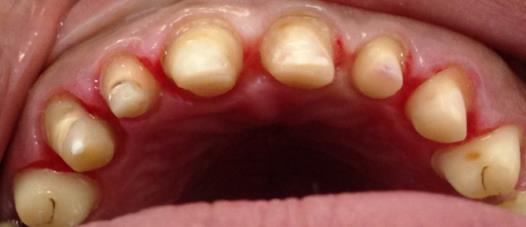
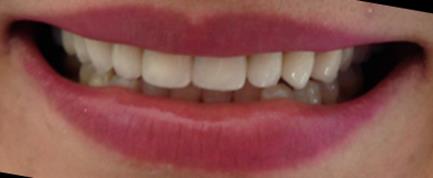
A 38-year healthy female patient presented for restoring her maxillary teeth at the fixed prostheses department of dental clinicof Monastir. She complained about anterior dental discoloration and asked for anesthetic smile. Intra oral examination showed cervical decay with significant substance loss, the central incisors and the right lateral incisor have been filled with a composite resin dating since three years (Figures 1 & 2).
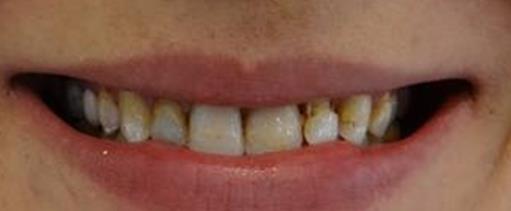
Figure1: Extra oral view Initial smile.
![Figure 2: Intra oral view. The dental substance loses important as well as unfavorable occlusal context presented by a deep bite. Therefore, veneers cannot be indicated. Ceramic crows were indicated for maxillary incisors, canines and first premolars, since we need to extend the preparation in the sulcusto cover all the discolored abutment, zirconia crowns were indicated. The preparations needed to be extended in the sulcus to cover all the discolored abutment, zirconia crowns were indicated. The optical behavior of the zirconia systems evaluated is different from the human dentin. Such difference should be taken into consideration to achieve a highly esthetic restoration with a natural appearance [6]. Teeth preparation was done with appropriate instrumentation and a temporary prosthesis was bonded (Figure 3 & 4). Prostheses were fabricated using indirect CAD/CAM technique. Zirconia infrastructure was tried and the space left to the feldspathic ceramic was verified (Figure 5). Esthetic and occlusion relationship were checked and the crowns were seated after ceramic glazing (Figure 6).](/fulltextimages/283/fig_2.jpeg)
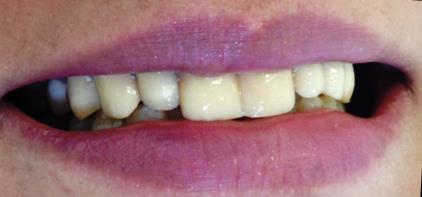
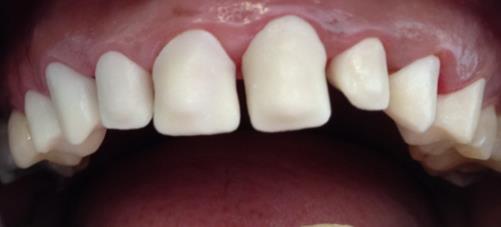
Figure 2: Intra oral view. The dental substance loses important as well as unfavorable occlusal context presented by a deep bite. Therefore, veneers cannot be indicated. Ceramic crows were indicated for maxillary incisors, canines and first premolars, since we need to extend the preparation in the sulcusto cover all the discolored abutment, zirconia crowns were indicated. The preparations needed to be extended in the sulcus to cover all the discolored abutment, zirconia crowns were indicated. The optical behavior of the zirconia systems evaluated is different from the human dentin. Such difference should be taken into consideration to achieve a highly esthetic restoration with a natural appearance [6]. Teeth preparation was done with appropriate instrumentation and a temporary prosthesis was bonded (Figure 3 & 4). Prostheses were fabricated using indirect CAD/CAM technique. Zirconia infrastructure was tried and the space left to the feldspathic ceramic was verified (Figure 5). Esthetic and occlusion relationship were checked and the crowns were seated after ceramic glazing (Figure 6).
Discussion
Extensive and cervical tooth decay as well as defective and significant resin restorations, exclude the indication of veneers in favor of all ceramic crowns.In case of severe discoloration and subgingival margin, zirconia crowns are suitable alternative. Zirconia-based tooth-supported crowns showed promising clinical results restoring anterior teeth [7, 8, 9, 10]. CAD/CAM technology in the manufacture of Zirconia has become a reality in dental practice that demonstrate important physical and mechanical properties of high strength, adequate fracture toughness, biocompatibility and esthetics outcomes [11, 12]. Many factors can affect the final result, such as occlusal relationship and/or the presence of parafunctions like bruxism and clenching, that may engender significant overloading where it is necessary to give a due care to occlusion control [13]. In addition, effect of surface treatment on the performance of all- ceramic restorations is highly important, because occlusal adjustment resulting in rough surfaces before cementation is very common [14]. However, the initial strength and survival rate of a dental Y-TZP ceramic material to fatigue testing was found to be highly dependent upon surface preparation more sothanexposure to various hydrothermal exposure conditions [15]. It is thus necessary to adjust occlusion before glazing to compromise the surface roughness of ceramic. In case of subgingival margin, it is difficult to manage bonding procedure where it is necessary to choose a resin based cementation.
Conclusion
Esthetic demand of patients is widely increasing mainly in case of esthetically compromised anterior maxillary teeth by the presence of defective restorations. Full coverage Zirconia crowns are currently a suitable solution in case of discolorations and subgingival tooth decay.
References
-
Miranda ME, Olivieri KA, Rigolin FJ, de Vasconcellos AA (2016) Esthetic Challenges in Rehabilitating the Anterior Maxilla: A Case Report. Oper Dent 41(1): 2- 7.
-
Ali Z, Eliyas S, Vere JW (2015) Choosing the Right Dental Material and MakingSense of the Options: Evidence and ClinicalRecommendations. Eur J Prosthodont Restor Dent 23(3): P150-62.
-
Basil Mizrahi Porcelain Veneers: Techniques And Precautions. International Dentistry Sa 9(6): 6-16.
-
Canadian Agency for Drugs and Technologies in Health (2015) Porcelain-Fused-to-Metal Crowns versus All-ceramic Crowns: A Review of the Clinical and Cost-Effectiveness.
-
Dangra Z, Gandhewar M (2014) The Use of Newer High Translucency Zirconia in Aesthetic Zone. Case Reports in Dentistry 2014: 3.
-
Pecho OE, Ghinea R, Ionescu AM, Cardona JC, Della Bona A, et al. (2015) Optical behavior of dental zirconia and dentin analyzed by Kubelka–Munk theory. Dent Mater 31(1): 60-67.
-
lrfan Ahmad (2002) Restitution of maxillary anterior aesthetics with all-ceramic components. International Dental Journal 52(1): 47-56.
-
Monaco C, Caldari M, Scotti R (2015) Clinical evaluation of tooth-supported zirconia-based fixed dental prostheses: a retrospective cohort study from the AIOP clinical research group. Int J Prosthodont 28(3): 236-238.
-
Rinke S, Lange K, Roediger M, Gersdorff N (2015) Risk factors for technical and biological complications with zirconia single crowns. Clin Oral Investig 19(8): 1999-2006.
-
Larsson C, Wennerberg A (2014) The clinical success of zirconia-based crowns: a systematic review. Int J Prosthodont 27(1): 33-43.
-
Mazaro JV, de Mello CC, Zavanelli AC, Santiago JF, Amoroso, et al. (2014) An esthetics rehabilitation with computer-aided design/ computer-aided manufacturing technology. J Contemp Dent Pract 1: 15(4).
-
Manicone PF, Rossi Iommetti P, Raffaelli L (2007) An overview of zirconia ceramics: Basic properties and clinical applications. J dent 35(11): 819-826.
-
Dupont N, Koenig V, Vanheusden A, Mainjot A (2014) Failure of zirconia-based prostheses on naturalteeth and implants: focus on risk factors. Rev Med Liege 69: 66-71.
-
Schmitter M, Lotze G, Bömicke W, Rues S (2015) Influence of surface treatment on the in-vitro fracture resistance of zirconia-based all-ceramic anterior crowns. Academy of Dental Materials 31(12): 1552-1560.
-
Oblak C, Verdenik I, Swain MV, Kosmac T (2014) Survival-rate analysis of surface treated dental zirconia (Y-TZP) ceramics. J Mater Sci Mater Med 25(10): 2255-2264.
- Diagnosis and Management of Mental Nerve Paresthesia Secondary to Apical Periodontitis of Mandibular Second Premolar: A CBCT Based Case Report
- A Randomized, Double Blinded Clinical Trial to Compare the Effect of Oral Premedication (Diclofenac Potassium or Dexamethasone) on Post-Operative Pain Following Pulpectomy
- Modified Lip Repositioning Technique for the Management of Excessive Gingival Display
- Integral Role of Non-Dental Providers and Fluoride Dissemination
- Root Canal Treatment Rate in Deciduous Teeth Among 6-Year- Olds in the Era of Discontinuing Water Fluoridation - Historical Cohort Study
- The Impact of the Notch1 on the Migratory Capacity and the Expression of E-Cadherin and CyclinD1 in Ameloblastoma Cells