
Identification of Gender, Age, and Blood Group from a Tooth
Introduction: Through the ages, odontological examinations have been a critical determinant in the search of human identity. Data in the form of age, gender, and blood group might provide vital clues in such investigations. Hence, it is important to gather as much data as possible using less tissue. The purpose of this study was to determine age, gender and ABO blood group of individual from a single tooth. Materials and Methods: The study sample consisted of twenty teeth divided into four groups under different environmental conditions and time. The teeth were sectioned longitudinally in the buccolingual plane along the midline. Longitudinal ground sections of each tooth were prepared for age determination from cemental lines. Pulp removed was divided into two halves thereafter sex and blood group was determined. Results: A strong positive correlation was found between the estimated age and actual age of the study groups. Moreover, there was no significant difference between the actual and determined sex and blood group of the study groups. Conclusion: Although age, sex, and blood group are more reliably determined in freshly extracted teeth, these variables may be of significant help in identification even after a period of 6 weeks post-extraction.
Introduction
Human identification is one of the most challenging subjects that human has been confronted with [1]. Dental age estimation makes use of morphological, radiographic, histological, and biochemical methods to examine age- dependent changes in teeth [2]. It has been hypothesized that the incremental lines in the tooth cementum can be used as a marker more reliable than any other morphological or histological traits in the human skeleton.
Gender identification has evolved over time. The amelogenin gene is a discrete and major constituent, unique to the developing enamel and contains high concentrations of proline, glutamine, leucine, and histidine. The gene structure of this protein has been demonstrated, and it is confirmed that there are two amelogenin genes, one on the X chromosome and the other on the Y-chromosome in humans. The amelogenin gene is a single copy gene, homologs of which are located on Xp22.1–Xp22.3 and Yp 11 [3]. The difference in the pattern of these two genes is sufficient enough to be used as a sensitive sex determinant.
In addition to the gender and age, the identification of blood group can increase the possibility of a positive match manifolds. Blood grouping from absorption-elution procedure devised by Vittorio Siracusa in 1923 is now employed in all forensic laboratories [4]. The distribution of ABO substances from the pulp cavity wall to the dentin edge and to the enamel gradually decreases because of fewer possibilities of diffusion of antigens from both blood and saliva. The infusion sedimentation theory describes the infusion of water-soluble antigens from saliva into the tooth tissue [5].
Hence, in this study an attempt was made to extract maximum information from the teeth as this might help in forensics when there is an absence of data for the identification of an individual. The aim and objective of the present study were to identify gender, age, and blood group from a tooth of individual from a single tooth.
Materials and Methods
The study sample consisted of twenty teeth divided into four groups under different environmental conditions and time. A double blind method was adopted to prevent the bias. Ethical clearance from the Institutional Ethical Committee was obtained. Subjects were informed prior to the study and informed consent was taken. Blood group identification was done during the routine hematology prior to extraction. The age of individuals (when the tooth was extracted) ranged from 18 to 60 years. Those teeth were extracted having periodontal disease or indicated by orthodontic or prosthetic reasons. The extracted teeth were kept to study under the different serial numbers. The information on age, gender, and blood group kept secret.
The extracted teeth were divided into four groups after getting it cleaned under running water for 5 min to remove blood, saliva, and debris attached. Thereafter, the teeth were sectioned longitudinally in the buccolingual plane along the midline. A groove was made by a double- sided diamond disc mounted on a straight micromotor hand piece under continuous saline irrigation and then split using a hammer and chisel. The pulp was removed using a sterile spoon excavator for each sample to avoid contamination. The removed pulp was placed on a sterile glass slab and cut into half. Half of the pulp was kept in a sterile test tube containing normal saline for the blood group determination by absorption-elution method [6]. Other half of the pulp was stored in T.E. buffer and subjected to gender determination using amelogenin protein as a marker in PCR technique [7]. In the present study, AMEL gene marker was used for gender identification. Washing was done for each sample using cold saline solution by centrifuging it at 3000 rpm for 5 minutes. Then two drops of fresh saline were added to the sample, and the test tubes were heated in a water bath at a temperature of 50–55°C for 10 min to elude the antibodies. A drop of 0.5% red cell suspension of known blood group A, B and O was freshly prepared and immediately put into respective test tubes. To enhance agglutination the incubation was done of samples at 37°C for30 minutes followed by centrifugation at 1500– 2000rpm for one minute. Whether the RBC agglutinate or not it was tested by gentle shaking of the test tube, macroscopically and microscopically at a magnification of ×4.
Age was determined using cementum incremental lines, one-half of the sectioned teeth grounded using Arkansas's stone to prepare longitudinal ground sections, which were examined under light microscope as described by Stott, et al. [8]. The counting of cementum lines was made according to Kagerer & Grupe [9] under an optical microscope where an observer had his scores confirmed by two other independent members (control observers). Each observer performed count in the region with the best visualization of the cementum lines. By adding the average age of eruption in years (for each tooth presented) in the counted number of incremental lines, the chronological age of the individual was obtained. E = n + t: Where, estimated age (E) = number of incremental lines (n) + eruption age of the tooth (t). The results were later correlated with the initially captured data for age gender and blood group.
Data collected was tabulated in an excel sheet, under the guidance of statistician. Data was analyzed using IBM SPSS. Statistics Windows, Version 20.0. (Armonk, NY: IBM Corp) for the generation of descriptive and inferential statistics. Pearson's correlation coefficient was used to check the correlation between known and estimated ages from cemental lines.
Results
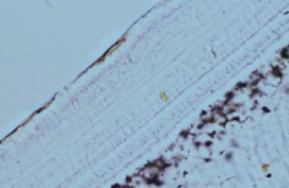
Cemental incremental lines were counted to check the correlation between known and estimated ages within the four groups as shown in Figure 1. The correlation coefficient (r) showed a high degree of correlation with statistical significance between the known and estimated ages among all the four groups Table 1.
| Groups | r | p value | ||||||
|---|---|---|---|---|---|---|---|---|
| I | 0.96 | <0.01* | ||||||
| II | 0.94 | <0.01* | ||||||
| III | 0.97 | <0.01* | ||||||
| IV | 0.93 | <0.01* |
Table 1: Pearson's correlation coefficient between the known and estimated ages among the groups.
*: statistically significant, r: Pearson's correlation coefficient Table 1: Pearson's correlation coefficient between the known and estimated ages among the groups.
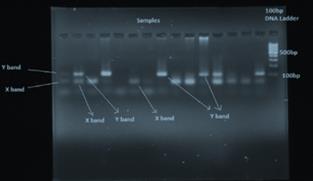
Gender determination was done with PCR method as shown in figure 2 which showed 100% accuracy in Group I, 87% accuracy in Group II, 75% in Group III, and 85% in Group IV Table 2. When the difference between the groups was compared using chi square test, it was found to be statistically insignificant as p>0.05.
| Accuracy (%) | |||||||
|---|---|---|---|---|---|---|---|
| Group | s | Age determination | Gender determination | Blood group determination | |||
| I | 100 | 100 | 100 | ||||
| II | 100 | 87 | 100 | ||||
| III | 100 | 75 | 65 | ||||
| IV | 100 | 85 | 74 | ||||
| p value | 1 | 0.068 | 0.02* |
Table 2: Accuracy of results of all the three parameters among the predetermined four groups.
*: statistically significant Table 2: Accuracy of results of all the three parameters among the predetermined four groups.
The determination of blood group Figure 2 was done with 100% accuracy in Group I and Group II, while Group III shows an accuracy of 65% and Group IV shows an accuracy of 74% [table 2]. When the difference between the groups was compared using chi square test, it was found to be statistically significant as p<0.05.
Discussion
In the present study, a cellular cementum in the longitudinal sections was used to calculate incremental lines as it is clearer because of the absence of cementocytes. The age was determined with an age accuracy of 100% in all the groups showing a high degree of correlation between the known and estimated ages among all the four groups suggesting the precision of the procedure. These results are in accordance with the studies conducted by Dias, et al. [10] and Amit K Nayar, et al. [11].
The age estimation from teeth subjected to adverse environmental conditions or those studied after a reasonable time period were comparable to those from those in standard conditions. This indicated that the procedure may be reliably used in a variety of disaster situations.
Gender determination from the pulp tissue in the present study, showed high specificity using PCR technique in all the samples, and there is no significant effect of time or environmental conditions (water) on the gender determination from the pulp. The identification of the pattern of the AMEL gene on the X- and Y- chromosomes has been proved to be a sensitive test for gender determination. Moreover, there was no significant change in specificity of the test even after submerging the teeth to environmental conditions for 6 weeks. This study highlights the use of pulp as a source of DNA for gender determination, as well as the sensitivity of the PCR technique. Our results were in accordance to the study done by Sivagami, et al. [12]. In the present study, the results show that the PCR-based method is a sensitive technique for gender determination, which can be done with a complete specificity even in adverse environmental condition or after prolong period of time.
The third parameter, i.e., blood group determination showed 100% accuracy of blood group determination from pulp after 2 days of extraction in normal environmental condition and under the saline water in group I. These findings are in accordance to the study done by Smeet, et al. [13] and Inamdar, et al. [14] who also showed highly accurate results in blood determination of individuals from the pulp of the extracted teeth.
Conclusion
The present study concludes that even though age, gender, and blood group are more reliably determined in freshly extracted teeth, these variables may be of significant help in identification even after a period of 6 weeks post-extraction. The authors of present study hope that attempt in extracting maximum information from a single tooth will be of advantage to community in disaster circumstances.
References
-
Reddy LV (2011) Lip prints: An overview of forensic dentistry. J Adv Dent Res 2: 17-20.
-
Shafer WG, Hine MK, Levy BM (2006) Safer's Textbook of Oral Pathology. In: Rajendran R, Sivapathasundharam B, (Eds.), 6th(Edn.), Elsevier, Delhi.
-
Sasaki S, Shimokawa H (1995) The amelogenin gene. Int J Dev Biol 39(1): 127-133.
-
Kind SS (1960) Absorption-elution grouping of dried blood smears. Nature 185: 397-398.
-
Lele MV, Malvekar AG, Dang AH, Madiwale MS (1977) Detection of ABH blood group substances in human dental pulp. J Indian Acad Forensic Sci 16: 2-3.
-
Shetty M, Premalatha K (2010) ABO blood grouping from tooth material. J Indian Acad Forensic Med 32(4): 336-338.
-
Mannucci A, Sullivan KM, Ivanov PL, Gill P (1994) Forensic application of a rapid and quantitative DNA sex test by amplification of the X-Y homologous gene amelogenin. Int J Legal Med 106(4): 190-193.
-
Stott GG, Sis RF, Levy BM (1982) Cemental annulation as an age criterion in forensic dentistry. J Dent Res 61(6): 814-817.
-
Kagerer P, Grupe G (2001) Age-at-death diagnosis and determination of life-history parameters by incremental lines in human dental cementum as an identification aid. Forensic Sci Int 118(1): 75-82.
-
Dias PE, Beaini TL, Melani RF (2010) Age estimation from dental cementum incremental lines and periodontal disease. J Forensic Odontostomatol 28(1): 13-21.
-
Nayar AK, Parhar S, Thind G, Sharma A, Sharma D (2017) Determination of age, sex, and blood group from a single tooth. J Forensic Dent Sci 9(1): 10-14.
-
Sivagami AV, Rao AR, Varshney U (2000) A simple and cost-effective method for preparing DNA from the hard tooth tissue, and its use in polymerase chain reaction amplification of amelogenin gene segment for sex determination in an Indian population. Forensic Sci Int 110(2): 107-115.
-
Smeets B, van de Voorde H, Hooft P (1991) ABO bloodgrouping on tooth material. Forensic Sci Int 50(2): 277-284.
-
Inamdar P, Praveen Kumar, Kavitha R, Mirajkar AM, Venkatesh Sangeetha P (2011) Teeth-hidden treasure of blood group. Indian J Forensic Med Pathol 4: 113- 118.
- Diagnosis and Management of Mental Nerve Paresthesia Secondary to Apical Periodontitis of Mandibular Second Premolar: A CBCT Based Case Report
- A Randomized, Double Blinded Clinical Trial to Compare the Effect of Oral Premedication (Diclofenac Potassium or Dexamethasone) on Post-Operative Pain Following Pulpectomy
- Modified Lip Repositioning Technique for the Management of Excessive Gingival Display
- Integral Role of Non-Dental Providers and Fluoride Dissemination
- Root Canal Treatment Rate in Deciduous Teeth Among 6-Year- Olds in the Era of Discontinuing Water Fluoridation - Historical Cohort Study
- The Impact of the Notch1 on the Migratory Capacity and the Expression of E-Cadherin and CyclinD1 in Ameloblastoma Cells