
Mandibular Fracture Prevention Associated With Impaction
Rarely Iatrogenic fracture of the mandible occur either immediately or after the removal of impacted teeth but it can occur as a severe complication of oral surgery. Though mandibular fracture can occur in association with any impacted tooth but many reports suggested that these fractures is due to the removal of third molars. Hence all preventive measures and predisposing factor that reduce the risk for this serious complication should be known to the clinician. In this article we discuss about prevention of mandibular fracture of deeply impacted tooth removal and use of miniplates to prevent mandibular fracture.
Introduction
The most common procedure in oral surgery is the removal of impacted tooth which can be accompanied by variety of complications [1]. The severe and the major complication associated with difficult surgical extractions in the lower arch is immediate or late fracture of mandible which are reported with incidence ranging from 0.0034% to 0.0075% and highly associated with the removal of third molar [1, 2, 3, 4, 5, 6]. In many cases it was advocated that surgeon’s role and surgical approach is primarily important so before surgery, clinician has to inform the patient about the possible risks of the procedure. Moreover, surgeons has to consider all preventive measures carefully and have to evaluate potential complications of surgical removal against the potential benefits before surgery [2, 7] (Figure 1).
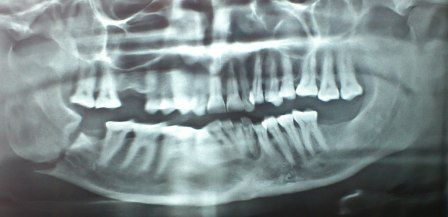
The present article describes to avoid iatrogenic mandibular fracture in patients with deeply impacted tooth by prophylactic plating.
Discussion
Causes of Fracture
Rarely fracture of mandible is due to the removal of impacted tooth but it can occur as a severe complication during or after the surgery and the reasons for this undesirable complication are multi-factorial [1, 2]. It can be associated with age, gender, deep inclusion, tooth ankylosis, anatomic abnormalities, pathologic processes, systemic diseases related to bone metabolism and iatrogenic factors [1, 2, 3, 8].
Reduced bone elasticity, bone atrophy, risk of osteoporosis and potential of tooth ankylosis in older age group weakens the mandible so higher rate of fracture might be expected. Gender of the patient was reported another factor affecting the occurrence of fractures and men reported to have a greater risk due to increased masticatory forces and increased risk of trauma [1, 3]. Although pathologic processes easily diminish the strength of bone such as a large cyst or a tumor [2].
The major factors that identify the difficulty of the surgery is the deep inclusion [2, 7]. The strength of mandible is impaired during the surgical removal of deeply impacted tooth because the volume of bone that needs to be removed so to extract the tooth [1, 9]. Various factors causing postoperative fractures were documented but there were many contrary opinions also such as, Al-Belasy, et al. claimed that late mandibular fracture does not get affected by masticatory forces [10]. Fuselier, et al. advocated that the increase in the risk of mandibular fracture is also not related by the degree of impaction [11]. Despite all the different opinions, all preventive measures should be considered before the surgery if there is a predisposing factor for mandibular fracture.
Intra-operative mandibular fractures caused by difficult surgical extractions can be prevented by minimizing bone removal and doing sectioning of tooth or mass instead, use of correct instrumentation and uncontrolled excessive force should be avoided by the clinician [1, 4]. Additionally, a good method to prevent postoperative fractures is prophylactic use of miniplates during the surgery. Though there are few case reports about its use in prevention of fractures but the use of miniplates to treat the fracture of jaws is largely documented [4, 12, 13].
Preventive Measures for Fracture
Preventive measures should be considered before the surgery when preoperative radiograph of the impacted tooth showed that the tooth was deeply impacted and distance between the apex of the tooth and inferior border of the mandible was insufficient [2, 9]. Hence, prophylactic plating was preferred to prevent possible complication.
Sencimen, et al. recommended a safe treatment procedure in a deeply positioned lower third molar i.e, sagittal split osteotomy technique which provides wide access to the operative field and decreases bone loss thus prevents a possible jaw fracture [7]. In order to prevent the occurrence of a mandibular angle fracture, it may be recommended the fixation of miniplate pre or post extraction to reduce the incidence of fracture. Hence with the use of miniplates a rigid internal fixation was obtained and all forces like tension, compression, torsion and shearing can be neutralized and immediate function of mandible can be utilized without any complications [14, 15].
Conclusion
In this article it is describe that the mandibular fracture occur in association with any impacted tooth can be prevented by using titanium miniplates. Besides the advantages the need for a second operation to remove the miniplates is a disadvantage of this procedure. The role of surgeon is very important for the planning and implementation of surgical treatment of deeply impacted teeth. Evaluation of clinical and radiological should be done meticulously and patients who are identified as having high risk of mandibular fracture, preventive measures must be taken.
References
-
Bodner L, Brennan PA, McLeod NM (2011) Characteristic of iatrogenic mandibular fractures associated with tooth removal: review and analysis of 189 cases. Br J Oral Maxillofac Surg 49(7): 567-572.
-
Zhang Q, Ouyang K, Zhang Z, He J, Piao Z (2012) Iatrogenic mandibular fracture associated with third molar removal-A case report and preventive measures recommended. Journal of Oral and Maxillofacial Surgery, Medicine and Pathology 24(4): 204-207.
-
Ethunandan M, Shanahan D, Patel M (2012) Iatrogenic mandibular fractures following removal of impacted third molars: An analysis of 130 cases. Br Dent J 212(4): 179-184.
-
Pippi R, Solidani M, Broglia S, Cristalli MP (2010) Prevention of mandibular fractures caused by difficult surgical extractions: Report of a borderline case. J Oral Maxillofac Surg 68(5): 1162-1165.
-
Perry PA, Goldberg MH (2000) Late mandibular fracture after third molar surgery: a survey of Connecticut oral and maxillofacial surgeons. J Oral Maxillofac Surg 58(8): 858-861.
-
Libersa P, Roze D, Cachart T, Libersa JC (2002) Immediate and late mandibular fractures after third molar removal. J Oral Maxillofac Surg 60(2): 163-166.
-
Sencimen M, Varol A, Gülses A, Altug AH (2009) Extraction of a deeply impacted lower third molar by saggital split osteotomy. Oral Surg Oral Med Oral Pathol Oral RadiolEndod 108(5): 36-38.
-
Renton T, Smeeton N, McGurk M (2001) Factors predictive of difficulty of mandibular first molar surgery. Brit Dent J 190(11): 607-610.
-
Komerik N, Karaduman AI (2006) Mandibular fracture 2 weeks after third molar extraction. Dent Traumatol 22(1): 53-55.
-
Al Belasy FA, Tozoglu S, Ertas U (2009) Mastication and late mandibular fracture after surgery of impacted third molars associated with no gross pathology. J Oral Maxillofac Surg 67(4): 856-861.
-
Fuselier JC, Ellis EE, Dodson TB (2002) Do mandibular third molars alter the risk of angle fracture?. Oral Maxillofac Surg 60(5): 514-516.
-
Widmark G, Kahmberg KE (1991) Use of miniplates in the treatment of jaw fractures. Swed Dent J 15(6): 265- 270.
-
Sauerbier S, Schön R, Otten JE, Schmelzeisen R, Gutwald R (2008) The development of plate osteosynthesis for the treatment of fractures of the mandibular body. A literature review. J Craniomaxillofac Surg 36(5): 251- 259.
-
Lazow SK, Tarlo I (2009) Mandible Fracture: Transoral 2.0-mm Locking Miniplate plus 1 Week Maxillomandibular Fixation. Atlas Oral Maxillofacial SurgClin North Am 17(1): 27-34.
-
Ribeiro PD, Vago TM, da Silva WS, Padovan LEM, Tiossi R (2018) Mandibular angle fractures treated with a single miniplate without postoperative maxillomandibular fixation: a retrospective evaluation of 50 patients. Cranio 36(4): 234-242.
- Diagnosis and Management of Mental Nerve Paresthesia Secondary to Apical Periodontitis of Mandibular Second Premolar: A CBCT Based Case Report
- A Randomized, Double Blinded Clinical Trial to Compare the Effect of Oral Premedication (Diclofenac Potassium or Dexamethasone) on Post-Operative Pain Following Pulpectomy
- Modified Lip Repositioning Technique for the Management of Excessive Gingival Display
- Integral Role of Non-Dental Providers and Fluoride Dissemination
- Root Canal Treatment Rate in Deciduous Teeth Among 6-Year- Olds in the Era of Discontinuing Water Fluoridation - Historical Cohort Study
- The Impact of the Notch1 on the Migratory Capacity and the Expression of E-Cadherin and CyclinD1 in Ameloblastoma Cells