
The Psychosocial Impact on the Dental Aesthetics of Missing Anterior Teeth Patients: A Questionnaire Study
Objective: This study was conducted to report and analyze patients' attitudes towards dental aesthetics. Material and methods: A survey was conducted based on an original questionnaire containing 16 questions. The questionnaires were distributed online or directly listed on paper, to the patients of the Department of Dental Prosthetics, Faculty of Dentistry from Cluj-Napoca. Results: A significant percentage of participants (80.2%) consider that the group of teeth that most influences the dento-facial aesthetics are the central incisors. Among a total of 641 respondents 76.3% were females and 23.7 % males and 85% come from urban areas. Conclusion: The central incisors play a key role, essential in oral rehabilitation.
Introduction
A nice look is a letter of recommendation. Over time, it has been observed in most situations that the first impression matters, both behavioral and aesthetic. This first impact that the appearance has, especially the appearance of the smile, tends to be kept in the memory of those around for an indefinite period. The perfect image promoted by the internet, has a major impact on the behavior and thinking of society, changing the perception of what we call “beautiful”. This has led to a growing demand for cosmetic treatments from the public [1].
The importance of an attractive smile in dentofacial esthetics and the implication that any alteration can provoke anxiety both socially and psychologically has been much debated. Studies indicate that individuals with an attractive facial appearance are more socially acceptable, more desirable as friends and partners, and are able to enter the labor market more easily [2, 3, 4].
Dental appearance is one of the integral components of facial beauty, being considered a requirement among some professional groups [5]. Although the rules laid down for defining facial appearance are not the same for all nationalities, extreme deviations are considered unacceptable [6].
According to the World Health Organization (WHO) definition of quality of life, oral health is not only the absence of oral disease and dysfunction, but also its influence on the subject’s social life and self-confidence [7].
This study was conducted to report and analyze patients’ attitudes towards dental aesthetics, while tracking the impact that the frontal area (especially the central incisor) has on attitudes and practices with social and psychological potential that can affect individual confidence.
Material and Methods
To achieve the objectives of this study, a survey was conducted based on an original questionnaire containing 16 questions. The questionnaires were distributed online or directly listed on paper, to the patients of the Department of Dental Prosthetics, Faculty of Dentistry from Cluj- Napoca. Respondents were asked to complete and return the questionnaire immediately. All returned questionnaires were coded and entered into Google Forms. The results were expressed numerically and as a percentage, using the Excel spreadsheet.
Results
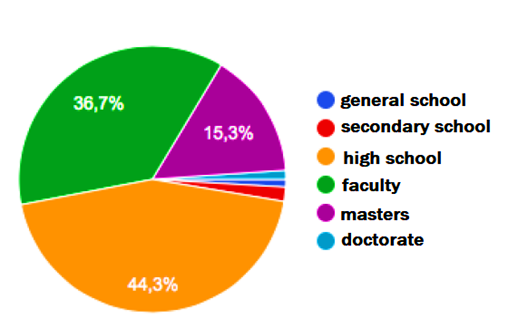
Among a total of 641 respondents 76.3% were females and 23.7 % males. Educational training varies from high school graduates to doctoral students, with a majority of those whose last form of education was high school (Figure 1). A percentage of 85% come from urban areas.
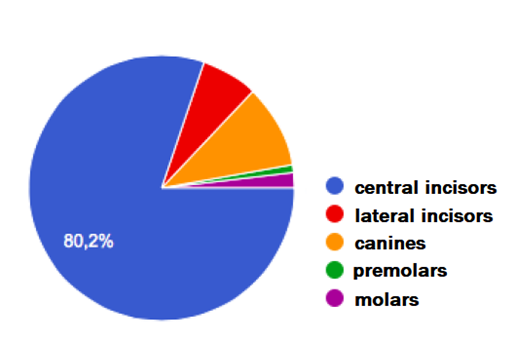
A significant percentage of participants (80.2%) consider that the group of teeth that most influences the dento-facial aesthetics are the central incisors (Figure 2).
Participants reported the presence of physiognomic fillings in the frontal area, in a proportion of 5% (58 participants), a lower proportion compared to those who accuse caries.
Question number 5 regarding the level of satisfaction of the participants with their own smile, has as variants of answers “much”, “very much”, “quite little” and “not at all”. Of the 641 participants, 497 admit that they are satisfied with their own smile.
The perception of the participants and the way they behave towards their smile can be found in Table 1.
| Yes | No | |||
|---|---|---|---|---|
| Nr % | Nr % | |||
| Do you feel comfortable smiling? | 527 | 82% | 114 | 17.80% |
| Do you tend to hide your teeth when you smile / talk? | 111 | 17.30% | 530 | 82.70% |
| Are you happy with the current color of your teeth? | 344 | 53.70% | 297 | 46.30% |
| If you have prosthetic works, are there any unsightly edges? | 58 | 28% | 149 | 71.90% |
Table 1: Patients’ perception of their own smile.
Participants were asked what would improve in terms of their smile, and the answers are shown in Table 2.
| Teeth color | 54.30% | 348 |
|---|---|---|
| Teeth shape | 20% | 128 |
| Teeth alignment | 28% | 274 |
| Replacement of prosthetic works / unsightly fillings | 11.50% | 74 |
| I would improve nothing | 13.30% | 85 |
Table 2: What would patients improve to their own smile.
Discussion
The study presents patients’ perceptions of aspects related to their own image of the smile and their correlation with the social and psychological well-being of individuals. A study in the literature associates patients with carious lesions or dyschromia in the teeth with a low level of social and psychological adaptation. They suggested that individuals, for whom oral health is of some importance, are more likely to use the dental aspect as a basis for judging psychological adjustment and intellectual competence [8].
It was observed that the self-assessments of the dental aspect seemed to be negative for the participants with a depressive state compared to the other groups, the depressive illness is associated with low self-confidence [9, 10, 11].
Figure eleven presents the importance of the central incisor for the dento-facial aesthetics, an extremely important aspect in its prosthetic rehabilitation.
The results show that a larger number of participants feel comfortable when they smile, compared to those who say they are happy with their smile. Also, an even larger number of respondents than the groups mentioned above, do not tend to hide their teeth when talking / smiling. This is probably associated with the majority proportion of the young age group (20-30 years), which has a need for assertion and increased confidence.
In Table 2 we find the improvements that the participants would bring to their smile. First of all, we notice that the percentage of those who would not improve anything is very small, which shows a major concern for the dental appearance. In general, patients are satisfied with the appearance of their teeth, but a significant percentage (54.3%) would change their tooth color.
The alignment of the teeth is, as a frequency, immediately following the color, in the options presented in Table 2, regarding the correction of dental aesthetics. Indeed, the presence of malocclusion in the frontal area can have a negative effect on emotional and social well-being [12, 13].
Seventy four patients stated that they were dissatisfied with the existing fillings or prosthetic restorations, and from the data mentioned above 58 accused unsightly edges of the prosthetic crowns and 51 non-physiognomic fillings.
Beauty is subjective and valued differently, depending on nationality, culture and ethnicity. Likewise, the beauty of a smile can be perceived differently by the doctor and the patient. The results of this study guide the clinician to the patient’s aesthetic expectations, allowing the physician to provide individualized treatment that meets the patient’s aesthetic requirements.
Conclusion
The self-perceived image of dental aesthetics can remarkably affect the social and psychological well-being of patients, which is reflected in their behavior and can affect their self-confidence. In shaping the ideal appearance, the central incisors play a key role, essential in oral rehabilitation.
Author Contributions: The authors contributed equally to this work
References
-
Morley J, Eubank J (2001) Macroesthetic elements of smile design. J Am Dent Assoc 132(1): 39-45.
-
Sobral MC, Crusoé Rebello IM, Machado AW (2019) Does the presence of maxillary central incisor edge asymmetry influence the perception of dentofacial esthetics in video analysis? Angle Orthod 89(5): 775-780.
-
Van Der Geld P, Oosterveld P, Van Heck G, Kuijpers Jactman AM (2007) Smile attractiveness self-perception and influence on personality. Angle Orthod 77(5): 759- 765.
-
Pithon MM, Nascimento CC, Barbosa GCG, Coqueiro RS (2014) Do dental esthetics have any influence on finding a job? Am J Orthod Dentofacial Orthop 146(4): 423-429.
-
Jenny J, Proshek J (1986) Visibility and prestige of occupations and the importance of dental appearance. J Can Dent Assoc 52(12): 987-989.
-
Cons NC, Jenny J, Kohout FJ (1983) Perceptions of occlusal conditions in Australia, the german democratic republic and United States of America. Int Dent J 33(2): 200-206.
-
(1995) The World Health Organization Quality of Life assessment (WHOQOL): position paper from the World Health Organization. Soc Sci Med 41(10): 1403-1409.
-
Newton TN, Prabhu N, Robinson PG (2003) The impact of dental appearance on the appraisal of personal characteristics. Int J Prosthodont 16(4): 429-434.
-
Forna N, Ifteni G, Mocanu C, Scutariu M, Antohe ME (2008) Tratat de protetica Clinica si terapia edentatiei partial intinse.
-
Bratu D, Bratu E, Antonie S (2008) Restaurarea edentațiilor parțiale prin proteze mobilizabile, Editura medicală, București.
-
https://dentagama.com/news/what-is-the-difference- between-hyperdontia-hypodontia-oligodontia- anodontia [cited on 21.05.2020].
-
Barlean LM, Aungurencei A, Aungurencei O, Scutariu MM, Balcos C, et al. (2015) Latex Glove Allergy Among Dentists in Iasi, Romania. Revista de Chimie 66 (11): 1877-1880.
-
Locker D (2004) Oral health and quality of life. Oral Health Prev Dent 1: 247-253.
- Diagnosis and Management of Mental Nerve Paresthesia Secondary to Apical Periodontitis of Mandibular Second Premolar: A CBCT Based Case Report
- A Randomized, Double Blinded Clinical Trial to Compare the Effect of Oral Premedication (Diclofenac Potassium or Dexamethasone) on Post-Operative Pain Following Pulpectomy
- Modified Lip Repositioning Technique for the Management of Excessive Gingival Display
- Integral Role of Non-Dental Providers and Fluoride Dissemination
- Root Canal Treatment Rate in Deciduous Teeth Among 6-Year- Olds in the Era of Discontinuing Water Fluoridation - Historical Cohort Study
- The Impact of the Notch1 on the Migratory Capacity and the Expression of E-Cadherin and CyclinD1 in Ameloblastoma Cells