
Editorial- Targeting Immunometabolism for Generating Innovative Therapies for Cancer
Introduction
We had detailed alterations in metabolism in remarkable depth inclusive of macrophage polarization, SIRT signalling pathway, in type 2 Diabetes mellitus (T2DM), targeting PI3K/ PTEN/ AKT signalling pathways in treatment of germ cell tumors besides in generation of oocyte, MAPK/ERK Along with Hippo/MST signalling for cancers, PD1/PDL1 pathways in ovarian cancers and tecemotide therapy for non- small lung cancer (NSCLC), by targeting mucin, PI3K/ AKT/ mTOR signalling in T2DM treatment by SGLT2 inhibitors and autophagy role in details. Recently we reviewed what are ‘’the modes implicated in the targeting of immunometabolism in cancer to form an innovative approach [1].
It has been observed that the immune cells in tumor microenvironment (TME) have metabolic susceptibility. Thereby the query arises how to revert this to rectify the killing capability of immune cells. What is the manner we can hamper growth of cancer cells. It has been acknowledged that PI3K /Akt/ mTOR [phosphatidyl inositol 3 – kinase (PI3K) / protein kinase B (AKT); mammalian target of rapamycin (mTOR)] signalling and LKB1-AMPK [liver kinase B 1- 5’ adenosine monophosphate (AMP) activated protein kinase] signalling pathway portray the hub of signalling pathways in immunometabolism and immunity, one needs to find the manner these signalling pathways control immunometabolism and what are the plausible observations of immunometablic checkpoints for improvement of anticancer therapies. It has been observed that the immune cell tumor microenvironment (TME) have metabolic susceptibility. Thereby the query arises how to revert this to rectify the killing capability of immune cells. What is the manner we can hamper growth of cancer cells. It has been acknowledged that PI3K /Akt/ mTOR signalling and LKB1- AMPK signalling pathway portray the hub of signalling pathways in immunometabolism and immunity, one needs to find the manner these signalling pathways control immunometabolism and what are the plausible observations of immunometablic checkpoints for improvementof anticancer therapies.
It was observed in a recent invention that cytotoxic immune cells have the capability of reprogramming dominant metabolism of tumor cells, thus reverting the variability in TME advantageous for immune cells. Poznanski [2] demonstrated that natural Killer (NK) cells having Warburg metabolism in addition to flexibility of substrates apart from leading to sustenance of adaptability of metabolic effect, further significantly escalated the tumor demise causing capability during adverse TME situations [2]. Basically we detailed how PI3K /Akt/ mTOR signalling (LKB1-AMPK) signalling pathways influence immunometabolism. Over activation of PI3K / AKT / mTOR in cancer apparently is a promising target. Rapid activation of the PI3K takes place on receiving of an upstream signal stimulus impacting a cascade of downstream targets inclusive of AKT, mTOR, glycogen synthase kinase 3 β (GSK3 β), ATP citrate lyase ( ACLY) etc, conducting parts by escalating anabolism as well as diminishing catabolism (Figure 1).
Since PI3K signalling has the maximum significant part in cellular metabolism, attaining insight regarding PI3K controlled metabolic reprogramming yield provision of understanding regarding cancer therapeutic plausibility of the hampering agents of pathway [3].
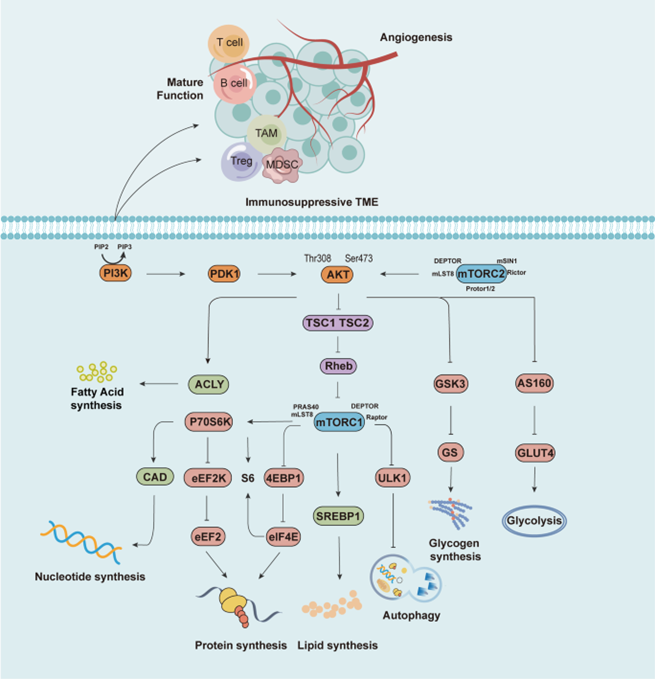
Dependent on PI3K structure like Type IA PI3K catalytic subunit is inclusive of 3 proteins, p110α, p110β along with p110δ in addition to Type IB PI3K catalytic subunit, p110γ [4], various hampering agents inclusive of Bayers developed Copansilib which targets p110α along with p110δ arriving last, however has been recommended for recurrent follicular lymphoma in 2017 [5]. Furthermore, Duvelisib portrays a p110δ along with p110γ hampering agent which was introduced in 2018. PI3K hampering agents that are subtype particular are highlighted in this research conundrum, basically alpelisib, a PI3K hampering agent got introduced in 2019. Idelalisib, portrays a p110δ hampering agent meant for chronic lymphatic leukaemia introduced in 2014 in addition to myriad of agents in clinical studies. In particular PI3K hampering agent’s impact efficacy 1) in view of absence of PI3K δ along with PI3Kγ is correlated with dysfunctional immune reactions as well as Bcell generation; hampering of signalling from Bcell receptors might be utilized in Bcell lymphoma. 2) Certain studies have utilized PI3K hampering agents IPI-549, as well as Silyminin for targeting tumor associated fibroblasts for influencing anticancer actions, the manner corroborated by significant declined Treg as well as MDSC, in addition to repression of angiogenesis as well as generation of collagen in tumor tissues. 3) Acknowledged that p110δ is dominant in the immunorepressive working of Treg as well as MDSC the manner detailed earlier, the p110δ hampering agents might aid in generating positive immune milieu along with facilitate cytotoxic T cell reactions. In toto the dependence of regulatory immune cells over the PI3K pathway might be getting treatment utilizing PI3K hampering agents for the liberation of immunorepression as well as restoration of CD8+T cell actions.
AKT influences the immune system in 2 main manners 1) the Akt pathway controls the activation phenotype of macrophages in addition to modulate macrophage reactions by inflammatory along with metabolic signalling [6]. Categorization of macrophages is done into M1 as well as M2 kinds [7]. M1 kind macrophages are implicated in positive immune reactions in addition to carry out immune surveillance working. Compared to, weak antigen presenting capability along with liberated cell factors factor of M2 kind macrophages modulate immune repression, where AKT might work. AKT works in conferring protection in controlling the evolution of the memory CD8+T cells reactions.
Akin to that, at present allosteric AKT hampering agents in clinical trials for instance MK-2206, BAY1125976 along with miransertib and ATP competitively hampering agents for instance capivasertib along with ipatasertib. A natural product obtained from the Brassica vegetables, 3 chloroacetylindoles illustrated a corroborated non- competitive AKT1 in addition to AKT2, hampering agent, validated for the repression of colorectal cancer cell growth stimulating apoptosis in vivo, as well as in vitro. Evavold [8], conducted a new study, where they observed mTORC1 facilitated gasdermin D modulated inflammatory cell demise by regulating ROS generation by mitochondria [8].
Glycogen synthase kinase 3 (GSK3) further portrays a downstream target of AKT. Cichocki F [9], displayed that in the presence of GSK3 hampering agent CHIR99021, the generation of tumor necrosis factor alpha(TNF-α) as well as interferon-γ (IFN-γ) by NK cells was significantly escalated, which increased NK cytotoxicity, adding fuel for immunotherapy of cancer [9]. Additionally, scientific workers have further illustrated that down regulation of GSK-3 expression utilizing siRNA hampering or hampering of GSK- 3 expression with small molecule hampering agents both downregulate PD-1 quantities to accelerate the capability of CD8+ T cells in bringing about demise of cancer cells [10]. Likewise Bempedoic acidhampers ATP citrate lyase (ACLY), a key hp enzyme in FA hp generation.
As per the region of effects, AMPK activators get categorized into direct activators along with indirect activators. Usually cross talking of direct activators occur directly with particular AMPK subunits to lead to activation of AMPK by altering its form for instance aminoimidazole-4 carboxamide-riboside(AICAR) in addition to thienopyridone (A-769662). Indirect activators portray variable modulators that possess the capacity of indirectly activating AMPK by disrupting ATP generation or calcium accrual, basically originating from plants for instance resveratrol, curcumin as well as metformin. Acknowledged the complicated association amongst AMPK in addition to cancer AMPK activators presently are concentrating on preclinical as well as clinical studies on the treatment of obesity, T2DM as well as Non-alcoholic fatty liver disease (NAFLD) in addition to CVD. Various Immunometablic Check Points Observations from the immune checkpoints have yielded newer targets regarding cancer treatment in addition to have illustrated that in melanoma as well as non-small cell lung cancer (NSCLC) [11]. Nevertheless, just a practically negligible proportion of the patients have illustrated significant effectiveness. With acquisition of greater insight in reference to mechanistic modes of tumor metabolism resistance to immune checkpoint treatment might arise from tumor cell stimulated decontrolling of immune cell metabolism that results in immunorepression [12]. Therefore it might be of benefit to utilize metabolic pathways for obtaining tumor cell demise or reverting the metabolic susceptibility of tumor cells for targeting cancer. The recently displayed immunometablic checkpoints having significant probability might yield innovative understanding regarding antitumor treatments. Further immune checkpoints like Indoleamine 2, 3-dioxygenase 1(IDO), Interleukin-4 i1(IL-4I1) Acyl CoenzymeA: cholesterol-acetyltransferase (ACAT), Sirtuins and Methylene tetrahydrofolate dehydrogenase (MTHFD2) hampering agents are getting generated like IDO hampering agents navaximod, epacadostat, linrodostat, indoximod used as immunomodulator effectsalone/combined with other antitumor treatments. Further corollary is generating Tumour-reactive plasma cells (TRPCs) [13] & Neoantigens
(NeoAgs) and vaccine [14].
References
-
Kaur KK, Allahbadia GN, Singh M (2024) The mechanistic modes of Targeting immunometabolism in cancer: An innovative strategy: A narrative review. GSC Advanced Research and Reviews 20(1): 1-24.
-
Poznanski SM, Singh K, Ritche TM, Aguilar JA, Fan IY, et al. (2021) Metabolic flexibility determines NK Cells functional fate in the tumor microenvironment. Cell Metab 33(6): 1205-1220.
-
Su R, Shao Y, Huang M, Liu D, Yu H, et al. (2024) Immunometabolism in cancer: basic mechanisms and new targeting strategy. Cell Death Discov 10(1): 236.
-
Munoz J, Follows GA, Nastoupli LJ (2021) Copansilib for the treatment of malignant lymphoma: Clinical experience and future perspectives. Target Oncol 16(3): 295-308.
-
Park JH, Pyun WY, Park HW (2020) Cancer metabolism: phenotype, signalling and therapeutic targets. Cells 9(10): 2308.
-
Vergadi E, Leronymaki E, Lyroni K, Vaporidi K, Tsatsanis C (2017) Akt signalling pathway in macrophage polarization andM1/M2 polarization. JImmunol 198(3): 1006-1014.
-
Kaur KK, Allahbadia GN, Singh M (2022) An update of use of therapeutic targeting of macrophage polarization status in the treatment of obesity induced insulin resistance, chronic inflammation and type 2 diabetes mellitus-a narrative review. World Journal of Advance Healthcare Research 7(1): 1-18.
-
Evavold CL, Hafner-Bratkovic I, Devant P, D’Andrea JM, Ngwa EM, et al. (2021) Control of gasdermin D oligomerization and Pyroptosis by Ragulator-Rag- mTORC1 pathway. Cell 184(17): 4495-4511.
-
Cichocki F, Valamehr M, Bjordahl R, Zhang B, Rezner B, et al. (2017) GSK3 inhibition drives maturation of NK cells and their anti tumor activity . Cancer Res 77(20): 5664- 5675.
-
Taylor A, Harker JA, Chanthong K, Stevenson PG, Zuniga EI, et al. (2016) Glycogen synthase kinase 3 inactivatIon drives Tbet mediated downregulation of co receptor PD1 to enhance cytotoxic CD8+T cells response . Immunity 44(2): 274-286.
-
Giannone G, Ghisoni E, Genta S, Scotto G, Turinetti V, et al. (2020) Immunometabolism and microenvironment in cancer: key players in immunotherapy. Int J Mol Sci 21(12): 4414.
-
Weng CY, Kao CX Chang TS, Huang YH (2021) Immunometabolism: the role of cancer niche in immune checkpoint inhibitor resistance. Int J Mol Sci 22(3): 1258.
-
Chen P, Chu Y, Liu R (2024) Tumor reactive plasma cells in antitumor immunity: current insights and future prospects. Immunother Advances 4(1): itae003.
-
Kumari K, Singh A, Chaudhary A, Kumar Singh R, Shankar A, et al. (2024) Neoantigen identification and dendritic cell based vaccines for lung cancer immunotherapy. Vaccines (Basel) 12(5): 498.
- Shaping Healthy Futures: Pediatric Endocrine Breakthroughs of 2025
- Precision Medicine in Obesity: Customizing Treatment for 2025
- The Thyroid Revolution: How 2025 is Redefining Hormone Health
- Current Knowledge of Chickenpox
- Correlation of Preinjection Values of Gonadotropins and Estradiol Level with Clinical and Radiologic Evidence of Sufficient Pubertal Suppression in Girls with Central Precocious Puberty
- Correlation of Preinjection Values of Gonadotropins and Estradiol Level with Clinical and Radiologic Evidence of Sufficient Pubertal Suppression in Girls with Central Precocious Puberty