
Trends of Contraceptive Usage among Women in Tertiary Hospital in Nnewi, Nigeria: A Five-Year Retrospective Cross- Sectional Study
Background: Maternal and infant mortality can be reduced with use of contraceptives which protects against unplanned pregnancies, high parity and high fertility and ensuring proper spacing between child births. Nigeria’s fertility rate is high, with 5.7 children per woman while the contraceptive prevalence rate is low, with a rate of 15%. Studying the trend will provide information on the uptake of diverse contraception approaches and provide information for counseling. Objective: To determine the trend and preferred methods of contraceptive usage among patients who attend the family planning clinic at Nnamdi Azikiwe University Teaching Hospital (NAUTH) Nnewi, Nigeria. Method: This is a retrospective cross-sectional study involving collection of data from the family planning register of women who attended family planning clinic at Nnamdi Azikiwe University Teaching Hospital (NAUTH), Nnewi, Nigeria, from 1st April 2014 to 1st March 2019. The information obtained from the case files were socio-demographic data such as the age and parity including the contraceptive methods, and yearly uptakes. The data obtained were analysed using statistical package SPSS version 26. Result: The total number of deliveries at the study center in the studied period was 3457, while the total number of contraceptive methods used was 578, giving an overall contraceptive prevalence rate of 16.7%. The prevalence rate showed a rise from 15.7% in 2014/2015 to as high as 19.1% in 2018/2019. The age group with most of the women from the study was 30 to 34 (29.2%) years. Majority of the women (251; 43.4%) used sub-dermal implants, 219 (37.9%) women used intrauterine contraceptive device (CUT380A), and this was followed by 96 (16.6%) women that used injectable hormonal contraceptive. We also observed an increase in preference for use of hormonal contraceptive methods (implants) as compared to the non hormonal methods (CUT380A). Conclusion: The trend so far, shows a rise in contraceptive use with the sub-dermal implants in the study center, with a notable improvement in the prevalence of contraceptive use within the last 5 years of the study. There is need for health information on the use of contraceptives to improve the uptake.
Introduction
By year 2030, the total world population is anticipated to reach 8.5 billion, 9.7 billion by year 2050 and then 11.2 billion by year 2100 for which much of this growth occurs in Sub-Saharan Africa [1]. It is estimated that about 123 million couples in low and middle-income countries do not use any form of contraceptive despite the need to space or limit their childbearing [2]. In low and middle-income countries, unplanned pregnancies pose a major health risk to women of the reproductive age [3, 4, 5]. Nigeria has the second highest number of maternal deaths in the world and accounts for 14% of global burden of maternal mortality [6], with 20%-40% of about 60,000 maternal deaths per year, attributable to unsafe abortion [7]. Proper and effective use of contraceptives is an effective and substantial tool in decreasing the frequency of unplanned pregnancies, unsafe abortion and high risk pregnancies, thus improving maternal and child health in low and middle-income countries [6].
It has been shown that fertility levels are inversely proportional to the contraceptive prevalence, such that in countries where contraceptive usage is low, the fertility rate is high [8]. This pattern is seen in Nigeria with a high fertility rate of 5.7 children per woman and a low contraceptive prevalence rate of 15% [9]. The low prevalence of contraceptive usage in Nigeria and in the Sub-Saharan region of Africa is due to factors which include; sociocultural, religious, political, economic and demographic factors [8]. Also, supply-related factors can limit contraceptive usage, such as; donor dependence, poor-quality services, gaps in logistics supply chain and scarcity of skilled and knowledgeable health personnel to provide adequate family planning services [10].
The common contraceptive choices of women at the family planning clinic of NAUTH, Nnewi, Nigeria within the period under review included intrauterine contraceptive device (CUT380A), injectable hormonal contraception, sub- dermal implants (jadelle, implanon and nexplanon), oral contraceptive pills and bilateral tubal ligation (BTL). The contraceptive methods are given to the women at affordable and subsidized prices.
This study was conducted to determine the trend and the preferred method of contraception among women accessing family planning care at NAUTH, Nnewi Nigeria.
Methods
Study Design
A retrospective cross-sectional comparative study.
Study Population
The study was conducted among women who had visited the family planning clinic for contraceptive services during the period under review.
Study Site
Gynaecological theater and gynaecological ward of Nnamdi Azikiwe University Teaching Hospital, Nnewi, Nigeria. This hospital has many consultant obstetricians, trainee doctors (registrars and senior registrars) and ancillary medical staff. It is a training center for medical post-graduate studies in Nigeria. It is a government‐funded referral center for maternal and newborn care. It provides comprehensive emergency and elective gynecological care, and serves as major referral center for gynecological services in south-eastern Nigeria.
Eligibility Criteria
Inclusion criteria
This included women that underwent family planning procedures (from 1st April 2014 to 31st May 2019).
Exclusion Criteria
Women who were pregnant and cases of missing or incomplete data were also excluded from the study.
Sample Size Determination
The sample size was an all population based study.
Sample Technique
Non-random sampling approach. All available case files were examined.
Study Outcome Measures
Yearly contraceptive methods, uptake rates, types of contraceptives, and parity distribution.
Procedures Involved
The patients’ case records were retrieved from the hospitals’ medical record department. Information obtained from the family planning records of the hospital included age, parity and contraceptive choices of the participants who attended the clinic and yearly uptakes.
The contraceptive methods offered at the clinic through the course of the study period including copper T intrauterine device, implants, oral pills, injectable methods, bilateral tubal ligation and male sterilization were obtained. The patients’ socio-demographic characteristics included age, parity and other information such as contraceptive type. Completed forms were then assessed by a data coordinator for completeness and accuracy before being entered into the Excel spread sheet by the data entry and management team.
Statistical Analysis
The cleaned data were exported to Statistical Package for Social Sciences (SPSS) version 26 (IBM Corp., Armonk, NY, USA) for analysis. The data was expressed as frequencies, percentages, mean and standard deviation. Data of the contraceptive usage was done using the test of proportion and chi-square test or t-test was applied for significance considering a p-value less than 0.05 as statistically significant.
Ethical Approval
The study was approved by the Ethics Review Board of the hospital (reference number: 0161/10/2022; date of approval: 26th October, 2022). The study was conducted according to the Helsinki declarations on ethical principles for medical research involving human subjects.
Result
The total number of deliveries at the study center in the studied period was 3457, while the total number of contraceptive used (for all methods) was 578, giving an overall contraceptive prevalence rate of 16.7%. There was a rise in the prevalence of contraceptives during the study period, showing a rise from 15.7% in 2014/2015 to as high as 19.1% in 2018/2019. The use of contraceptive methods increased steadily from a total of 94 in the 2014/2015 year to 137 in the 2018/2019 year. This is illustrated in Table 1.
The parity distribution and age distribution of the contraceptive methods are shown in Tables 2 and 3 respectively. The age range of the clients was from 20 to 44 years. The predominant age range of women was 30 to 34 years (29.2%), followed by 35 to 39 years (26.1%). The most used contraceptive method was the implant (43.4%), followed by the intrauterine contraceptive device (37.9%), then the injectables (16.6%). The least used methods were the oral contraceptive pills (1.6%) and bilateral tubal ligation (0.5%). The levels of parity varied, with 89 (15.4%) women primiparous and 489 (84.6%) multiparous. There were 173 (30.0%) grand multiparous women.
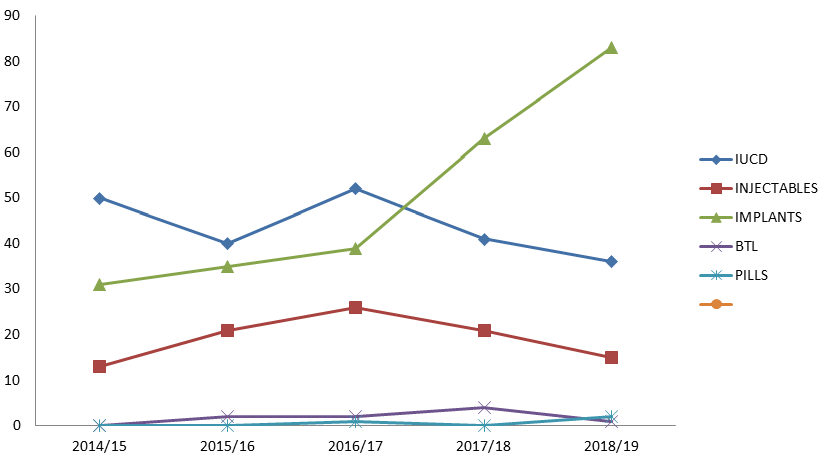
The yearly pattern of contraceptive choices made by the women is represented in Table 4 and Figure 1. There was a notable change in trend of contraceptive methods use, with the hormonal long acting reversible method (implant), being the most commonly used method over the non-hormonal method (CUT380A) in the last 2 years of the study.
| Year | Deliveries | Contraceptive Use | Prevalence |
|---|---|---|---|
| 2014/2015 | 598 | 94 | 15.70% |
| 2015/2016 | 638 | 98 | 15.40% |
| 2016/2017 | 740 | 120 | 16.20% |
| 2017/2018 | 765 | 129 | 16.90% |
| 2018/2019 | 716 | 137 | 19.10% |
| Total | 3457 | 578 | 16.70% |
Table 1: Prevalence rate of contraceptive use over 5 year study period.
| Parity | Frequency | % |
|---|---|---|
| 1 | 89 | 15 |
| 2-4 | 316 | 55 |
| ≥ 5 | 173 | 30 |
Table 2: Parity distribution of patients.
| Year | IUCD | Injectable | Implant | Pill | Btl | Total |
|---|---|---|---|---|---|---|
| 2014/15 | 50 | 13 | 31 | 0 | 0 | 94 (16.3%) |
| 2015/16 | 40 | 21 | 35 | 2 | 0 | 98 (16.9%) |
| 2016/17 | 52 | 26 | 39 | 2 | 1 | 120 (20.8%) |
| 2017/18 | 41 | 21 | 63 | 4 | 0 | 129 (22.3%) |
| 2018/19 | 36 | 15 | 83 | 1 | 2 | 137 (23.7%) |
| TOTAL | 219 | 96 | 251 | 9 | 3 | 578 |
| Age Group | IUCD | Injectable | Implant | Pill | Btl | Total (%) |
| 20-24 | 38 | 5 | 44 | 1 | 0 | 88(15.2%) |
| 25-29 | 35 | 12 | 41 | 3 | 0 | 91(15.8%) |
| 30-34 | 64 | 28 | 74 | 3 | 0 | 169(29.2%) |
| 35-39 | 55 | 30 | 63 | 2 | 1 | 151(26.1%) |
| 40-44 | 27 | 21 | 29 | 0 | 2 | 79(13.7%) |
| Total (%) | 219 (37.9%) | 96 (16.6%) | 251(43.4%) | 9(1.6%) | 3(0.5%) | 578(100%) |
Table 3: Yearly pattern of contraceptive methods used.
Discussion
The prevalence rate of contraceptive use is linked to maternal mortality rate, as studies have shown that countries in which contraceptive prevalence is low, have a high maternal mortality rate [9, 11], as it reduces family size, therefore minimizing the complications of grand multiparity and abortion. The overall contraceptive prevalence in this study was 16.7%, which is low. This was lower than what was found in a previous study by Dinwoke, et al (21.7%) in Nigeria [12]. This suggests that there is still an unmet need for contraception, especially in postpartum women [7]. Cultural barriers, religion, cost of the method, husband/partner’s refusal, fear of possible side effects and misinformation have been identified as factors contributing to low usage of family planning services [13]. However, there was a rise in the prevalence rate of contraceptive use from 15.7% in 2014\2015 year to 19.1% in the 2018/2019 year, during the study period, which could be due to an increasing demand for contraceptive use among women.
The study showed that the sub-dermal implants were the most commonly used contraceptive method amongst women attending the family planning clinic in NAUTH, Nnewi during the 5 year study period, with 43.4%. This is similar to the studies done in Lagos (46.3%) [14] and Makurdi, Nigeria (54.4%) [2] which showed preference for implants. This however was in contrast to some similar studies done in Nigeria; for instance, injectables were commoner in studies done in Kaduna [10] and Kano, [8] while intrauterine contraceptive device was commoner in studies done in Enugu [15] and Ekiti [7]. The reason for the choice of implants may be due to their long acting nature and the fact that they do not require repeated hospital visits. Also subdermal implants in the last 2 years of the study was noted to have gained preference over other contraceptive methods, possibly due to better knowledge of the contraceptive method of participants’ population within the study area. This contraceptive method may be fulfilling an unmet need for a long-term reversible method of contraception for women who have achieved their desired family size but for fear of the unknown do not want sterilization. The combined oral contraceptive pill (1.6%) and bilateral tubal ligation (0.5%) were the least used from findings in the study. This may be due to the problem of pill burden and the fear that there may be need for future pregnancy in the event of death of their children respectively.
The age group with majority of women from the study was 30 to 34 (29.2%) years. A similar finding was seen in Kaduna [16] in Nigeria with the commonest age group of 30 to 34 years constituting 28% of clients who had a form of contraceptive done. The second commonest age group was 35 to 39 (26.1%) years. Women aged 25 to 39 years made use of contraceptive methods more readily than the women at the extremes of the age groups in this study. This is not surprising as they are within the prime of the reproductive age range. They preferred long lasting contraceptive methods like intrauterine contraceptive device, injectables, implants and BTL. Multiparous women constituted the majority (84.6%) clients.
The use of contraceptive methods can help in prevention of unwanted pregnancy and subsequent abortions. If more women engage in contraceptive use, there will be a significant reduction in unwanted pregnancies and abortions which in turn would lead to a reduction maternal mortality. This can be achieved with proper counseling and education to encourage women on contraceptive usage and eradication of myths associated with contraceptive usage by increasing global access to information, communication and technology [17, 18].
The main strength of this study is that, to the best of our knowledge, this is the updated study in the study hospital on the contraceptive usage. There are a few limitations in our study findings. Our study population is small because of short duration of study. Further studies with longer time frame could harvest more significant results. Also, as the study was done at a tertiary care referral center, there may have been a bias with regard to the higher incidence of a particular contraceptive usage.
Conclusion
In conclusion, this study has shown that there is a rising trend in contraceptive use with the sub-dermal implant at Nnamdi Azikiwe University Teaching Hospital, Nnewi, Nigeria. The prevalence is still low however there is a notable increase with the study period. Continued efforts should be made to improve utilization of these services through public enlightenment by use of mass media, on the benefits of family planning.
Acknowledgements
The authors would like to thank all the patients whose data were used in the study. We also thank all the staff of the hospitals involved in this study.
Author Contributions
All the authors were involved in the overall conceptual design and implementation of the project, and overall revision of the manuscript. CBO, OCO, CGO, JCN, and COE contributed to data collection, analysis, and manuscript writing. BUO, SON, EAE, CCO and NLO were involved in the writing of this manuscript and overall revision. The authors read, approved the final manuscript, and agreed to be accountable for all aspects of the work.
Disclosure Statement for Publication
All authors have made substantial contributions to conception and design of the study, or acquisition of data, or analysis and interpretation of data; drafting the article or revising it critically for important intellectual content; and final approval of the version submitted. This manuscript has not been submitted for publication in another journal.
Declaration of Conflicting Interests
The author(s) declared no potential conflicts of interest with respect to the research, authorship, and/or publication of this article.
Funding
The author(s) received no financial support for the research, authorship, and/or publication of this article.
Ethical Approval and Consent to Participate
The study was approved by the Ethics Review Board of the hospital (Reference number: 0161/10/2022; date of approval: 26th October, 2022). Informed consent was not sought for the present study because it was a retrospective study of cases. The waiver for the consent was taken from the Institutional Review Board.
References
-
United Nations Department of Economic and Social Affairs (2017) World population prospects: Key findings & advance tables.
-
Hembah-hilekaan SK, Ojabo AO, Onyemocho A, Onche PE, Maanongun MT, et al. (2018) Trends in Contraceptive Choices among Women Attending the Family Planning Clinic in a Nigerian Tertiary Hospital in Makurdi, Nigeria. J Reprod Heal Contracept 3(2): 1-5.
-
Agyemang J, Newton S, Nkrumah I, Tsoka-Gwegweni JM, Cumber SN, et al. (2019) Contraceptive use and associated factors among sexually active female adolescents in Atwima Kwanwoma District, Ashanti region-Ghana. Pan Afr Med J 32: 182.
-
Thulaseedharan JV (2018) Contraceptive use and preferences of young married women in Kerala, India. Open access J Contracept 9(1): 1-10.
-
Nsubuga H, Sekandi JN, Sempeera H, Makumbi FE (2016) Contraceptive use, knowledge, attitude, perceptions and sexual behavior among female University students in Uganda : a cross-sectional survey. BMC Womens Health 16: 1-11.
-
Kana MA, Tagurum YO, Hassan ZI, Afolanranmi TO, Ogbeyi GO, et al. (2016) Prevalence and determinants of contraceptive use in rural Northeastern Nigeria : Results of a mixed qualitative and quantitative assessment. Annals of Nigerian Medicine 10(1): 3-10.
-
Olaleye AO, Akintayo AA, Adewoyin YO, Olaleye AO (2014) Utilization of family planning services in a Nigerian tertiary hospital: a six year review. Trop J Obstet Gynaecol 31(2): 7-15.
-
Muhammad Z, Maimuna D (2014) Contraceptive trend in a tertiary facility in North Western Nigeria: A 10-year review. J Basic Clin Sci 11(2): 99-103.
-
Austin A (2015) Unmet contraceptive need among married Nigerian women : an examination of trends and drivers. Contraception 91(1): 31-38.
-
Taingson MC, Adze JA, Bature SB, Durosinlorun AM, Caleb M, et al. (2017) Trend of modern contraceptive uptake and its predictors among women accessing family planning service in a tertiary hospital in Northwestern Nigeria, 2000-2014. Trop J Obstet Gynaecol 34(3): 201- 206.
-
Egede JO, Onoh RC, Umeora J, Benedict I, Lawani LO, et al. (2015) Contraceptive prevalence and preference in a cohort of south – east Nigerian women. Patient Prefer Adherence 9: 707-714.
-
Dinwoke VO, Okafor CI, Eke A (2015) Intrauterine contraceptive device acceptors in Nnamdi Azikiwe University Teaching Hospital, Nnewi, Southeastern Nigeria-A 5 year review. Trop J Med Res 18(2): 68.
-
Muanda M, Ndongo PG, Taub LD, Bertrand JT (2016) Barriers to Modern Contraceptive Use in Kinshasa, DRC. PLos One 11(12): 1-13.
-
Okunade KS, Daramola E, Ajepe A, Sekumade A (2016) A 3-year review of the pattern of contraceptive use among women attending the family planning clinic of a University Teaching Hospital in Lagos, Nigeria. African J Med Heal Sci 15(2): 69-73.
-
Udealor PC, Ezeome IV, Ugwu EO (2018) Contraceptive Acceptance Pattern and Trend in a Tertiary Hospital in Nigeria. Int J Med Heal Dev 22(2): 113-118.
-
Amina M, Joel A, Stephen B, Amina A, Caleb M, et al. (2017) Pattern of contraception among prior female users in a tertiary hospital in Northern Nigeria. Res J Women’s Heal 4(1): 4.
-
Ugboaja JO, Oguejiofor CB, Oranu EO, Igwegbe AO (2018) Assessing the Influence of Mass Media on Contraceptive Use in Nigeria : A Secondary Analysis of 2013 Nigerian National Demographic and Health Survey. Niger J Gen Pract 16(2): 39-44.
-
Murugesan A, Sundaram R, Muthusamy M (2016) Awareness, attitude and practice of contraception among antenatal women in a tertiary care hospital- a cross sectional study. Int J Reprod Contracept Obs Gynecol 5(8): 2507-2510.
- Postpartum Maternal Mental Health - A Narrative Review
- Beta HCG in Cervico-Vaginal Secretion as a Predictor of Preterm Delivery
- Successful Management of Mid Trimester Foetal Death with Major Placenta Previa by Expectant Management Followed by Induction of Labour
- To Evaluate the Expression of Egr2 Gene in Term Low Birth Weight Newborns
- Impact of Maternal Obesity on Maternal and Foetal Outcomes: A Prospective Cohort Study from Northern India
- ‘’Benefit of Pulsatile GnRH Therapy in Treatment of Functional Hypothalamic Amenorrhea (FHA) and Congenital Hypogonadotropic Hypogonadism(CHH) in Infertile Patients Over Canonical Gonadotropins with IVF –A Short Communication’’