
Severe Eyelid Skin Injury after a Long Surgery: The Impact of Adhesive Materials
A 75 year old patient who had a long lasting cardiac bypass surgery was consulted to the department of ophthalmology from the intensive care unit with abrasions and hemorrhage on the both eyelids. The adhesive tape used for occluding the eye was consisted of acrylate adhesive with a soft (nonwoven) cloth backing material. The findings were found to be consistent with the medical adhesive related skin injury (MARSI). Although MARSI is observed very frequently and its mild clinical findings can make it an underestimated clinical condition, it might very rarely cause serious skin related problems as in our case. To prevent encountering serious skin injuries after general anesthesia, it might be better to prefer silicone material rather than acrylate adhesive material for the occlusion of eyes. In conclusion, here we report severe MARSI case after general anesthesia to emphasize the broad spectrum of this condition.
Introduction
Adhesive tapes are widely used in medical practice for various reasons such as affixing of medical devices, dressings etc on the skin, occlusion of the eyelids during anesthesia or the eyelids of the patients in intensive care units (ICU). Despite its frequent use, it can cause a wide range of irritating results on the skin which was termed as medical adhesive related skin injury (MARSI). Here we report a 75 year old case who developed eyelid abrasion with hemorrhage probably due to adhesive tape which was used for occlusion of the eyelids during general anesthesia [1].
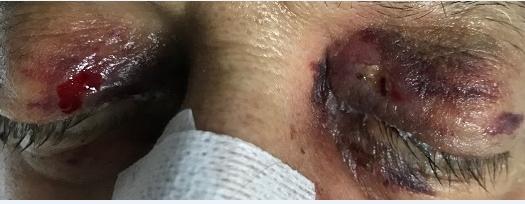
A 75 year old male patient was consulted to the department of ophthalmology in our faculty. He was in the intensive care unit after three-vessel cardiac bypass surgery together with intraaortic baloon pump operation. After 7 hour long surgery he had developed periorbital ecchymosis and upper and lower eyelid abrasion with hemorrhage. The operation team of the cardiac surgery realized the problem at the end of the surgery after removing the adhesive tape. Questioning his medical history revealed that he had diabetes mellitus and hypertension for 30 years, coronary artery disease for 10 years. He had smoked 15 pack-years and quitted smoking 10 years ago. He was using oral metformin, perindopril, metoprolol, atorvastatin and isosorbide mononitrate. His preoperative biochemical and complete blood evaluation had resulted as normal. During his bedside examination, he was unconscious and his pupils were round and reactive to light. Ophthalmological examination revealed that ecchymosis on the upper and lower eyelids at both sides were present. There were approximately 1x1 cm abrasion on the right upper eyelid, 2.5 cm long abrasion on the left upper eyelid and 1,5 cm long abrasion on the left lower eyelid (Figure 1). On all of the abrasions, oozing hemorrhage was seen. Ocular surface was seen normal bilaterally. He was prescribed occlusion with eye patches, fusidic acid 2 % ointment twice daily during the dressing of the wound.
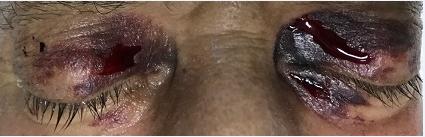
Figure 1: Oozing hemorrhages and ecchymosis are observed just after having removed the adhesive tape. After one week of treatment he was still in the ICU and the examination was done at the bedside. Development of crusts was observed on the eyelids at the areas of abrasion with a regular treatment; however, abrasion on the right upper eyelid started bleeding during the dressing procedure. One day after the last examination the patient died due to a cardiac arrest.
Discussion
A medical adhesive is any product used to approximate wound edges or to stabilize an external device such as tape, dressing, catheter, electrode, pouch, or patch onto the skin. Medical adhesives, although being used widely, can cause serious skin injuries and MARSI is a prevalent but under recognized clinical problem. MARSI is any type of problem in which erythema and/or other manifestation of cutaneous abnormality such as a vesicle, bulla, erosion or tear persists for 30 minutes or more after adhesive removal. MARSI is thought to develop in several forms; skin (epidermal) stripping, tension injury or blister, skin tear, irritant contact dermatitis, allergic dermatitis, maceration and folliculitis [2]. In our case there were abrasions on the eyelids which seemed close to skin tear defined by McNichol, et al. However we also observed oozing hemorrhage on the lesions which made us think that the lesion could be categorized as abrasions [1]. There are several categories of medical adhesives with different designs and materials. The anatomy of a medical adhesive include three or four different layers; backing layer, adhesive layer, primer layer for bonding between backing and adhesive and some of them also have release coating for unwind [1]. The material was found to be related with the skin injury rate; for example, rigid tape backings can lead to injury if there is skin movement in areas where there is great movements such as on joints [3]. Types of backings include paper or a paper blend, plastic, silk (woven polyester), soft (nonwoven) cloth, traditional cloth, or foam and/or elastic. Types of adhesives include acrylates, silicones, hydrogels, hydrocolloids, and polyurethanes, natural-rubber latex based or zinc oxide based materials. In our case, the cardiovascular surgery team preferred acrylate adhesive with a soft (nonwoven) cloth backing material. Since it was a severe injury, the surgical nurse might have removed the medical adhesive powerfully and combining this great force with the rigid backing material might be a definition for this catastrophic result. MARSI was found to be related with some intrinsic and extrinsic risk factors [1]. Most importantly Konya et al. observed that old people tend to have greater risk for MARSI and they also found that the most frequent concomitant disease was cerebrovascular diseases followed by pressure injuries and cardiovascular diseases [4]. Certain medications were also showed to be related with MARSI including anti-coagulants. Old age, anti- coagulant usage and concomitant cardiovascular disease of our case might also be related with this catastrophic result [5]. In their study Zeng et al. compared the use of two different adhesive materials (silicone vs. acrylate) on the eyelids of the patients under anesthesia. They found that the use of silicone adhesive material resulted with a greater patient satisfaction and lesser skin injury. Thus, silicone rather than acrylate seems to be a safer option for the occlusion of eyelids during anesthesia [6].
Conclusion
In conclusion, MARSI is a serious condition which should always be taken into consideration for a better healthcare. In this report, we presented a 75 year old case with a severe skin injury that had concomitant cardiovascular disease together with the use of anticoagulant. We suggest that during anesthesia silicone adhesive materials should be used for the occlusion of the eyelids and the medical adhesive should be removed slowly with a great attention to prevent the occurrence of MARSI. Financial Disclosures: The authors have no financial or proprietary interest to disclose. Conflict of interest: The authors declare that there is no conflict of interest that could be perceived as prejudicing the impartiality of the research reported.
References
-
McNichol L, Lund C, Rosen T, Gray M (2013) Medical adhesives and patient safety: state of the science: consensus statements for the assessment, prevention, and treatment of adhesive-related skin injuries. Orthop Nurs 32(5): 267-281.
-
Farris MK, Petty M, Hamilton J, Walters SA, Flynn MA (2015) Medical Adhesive-Related Skin Injury Prevalence among Adult Acute Care Patients: A Single-Center Observational Study. J Wound Ostomy Cont Nurs 42(6): 589-598.
-
Grove GL, Zerweck CR, Houser TP, Smith GE, Koski NI (2015) A Randomized and Controlled Comparison of Gentleness of 2 Medical Adhesive Tapes in Healthy Human Subjects. J Wound Ostomy Cont Nurs 40(1): 51-59.
-
Konya C, Sanada H, Sugama J, Okuwa M, Kamatani Y, et al. (2010) Skin injuries caused by medical adhesive tape in older people and associated factors. J Clin Nurs 19(9-10): 1236-1242.
-
Sibbald RG, Orsted HL, Coutts PM, Keast DH (2007) Best Practice Recommendations for Preparing the Wound Bed: update 2006. Adv Skin Wound Care 20(7): 390-405.
-
Zeng LA, Lie SA, Chong SY (2016) Comparison of Medical Adhesive Tapes in Patients at Risk of Facial Skin Trauma under Anesthesia. Anesthesiol Res Pract 2016: 4878246.
- Screening of Hospital Staff During World Glaucoma Week in a Tertiary Eye Care Centre
- Angioid Streaks with Macular Neovascularization: Clinical Insights from Two Cases
- Giant Kissing Naevus: An Oculoplastic Challenge
- Why Freedom of Vision Should Not Cost the Freedom of Feeling - LASIK in the Climate of Change
- Asymmetric Optic Nerve with Small Disc and Large Cup: A Rare and Challenging Case of Unilateral Optic Nerve Hypoplasia
- Large Angle Exotropia in a Child: A Case Report