
Topic – Recurrent Pterygium with Symblepharon – A Case Report
Recurrent pterygium is usually more aggressive in nature and can lead to complications such as symblepharon. Here we present a case of recurrent pterygium with symblepharon that was managed by complete removal of pterygium, intraoperative mitomycin c application and fornix formation.
Introduction
Pterygium is a triangular, wing-shaped, degenerative, fibrovascular, hyperplastic proliferative tissue actively growing from the conjunctival limbal area onto the cornea. It is commonly seen in areas near the equator and at high altitudes; ultraviolet radiation being a risk factor. It can be primary or recurrent with latter being more aggressive. Recurrence after pterygium surgery is a challenging situation as it is associated with more complications. The progression of pterygium can lead to changes in astigmatism, refractive error and involvement of visual axis can lead to decreased vision. They can lead to scarring of ocular surface, symblepharon, chronic inflammation and dry eyes [1, 2]. Symblepharon is the adhesion of palpebral conjunctiva and bulbar conjunctiva/cornea and can lead to diplopia and restricted ocular motility. Treatment of recurrent pterygium associated with symblepharon requires complete removal of scar tissue, formation of fornices and suppression of fibrosis with the help of adjuvants [3].
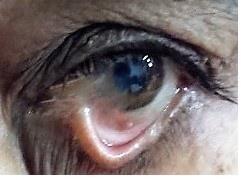
A 45 year old lady presented to the ophthalmology department with complaint of a recurrent growth after pterygium surgery in left eye. She had a previous simple excision of pterygium one year back. There was no history of any systemic illness, blepharitis, allergy, or dry eye disease. On examination, she had a visual acuity of 6/9 in the right eye and 6/60 in the left eye. She had a fleshy recurrent nasal pterygium that involved the papillary area with a partial symblepharon of the lower lid (Figure 1). Lower punctum was spared but medial one-third of the conjunctival fornix was obliterated. Ocular movements in abduction and elevation were restricted. Patient was planned for surgery. Informed consent was taken. Under local peribulbar anaesthesia, 4-0 silk traction suture at medial third of lower lid margin was placed for better exposure. Pterygium excision was done from the cornea and sclera. A 8-0 nylon traction suture was placed at the exposed bare sclera for better exposure.
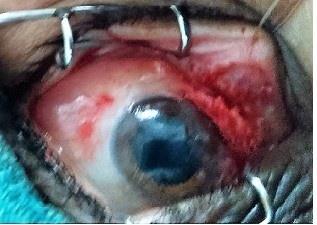
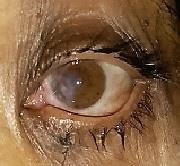
The subconjunctival fibrosed tissue was dissected and excised as much as possible. Any adhesions were removed while preserving the conjunctiva (Figure 2). Sponges soaked in 0.02% mitomycin c was kept in fornix and bare sclera for 2 minutes and then subsequently washed with copious saline irrigation. The edges of remaining bulbar conjunctiva were sutured to the sclera while the residual conjunctival defect was kept bare. Fornix forming suture were placed in the lower medial quadrant with silicone tube on the skin surface to avoid skin erosion. A bandage contact lens (BCL) was placed at the end of the surgery. Postoperatively, she was placed on 6-hourly topical loteprednol eye drops and 8-hourly Ofloxacin eye drops for four weeks. There was marked recovery of extraocular muscle motility but visual acuity remained unchanged due persistent corneal opacities (Figure 3). Sutures and BCL was removed after 2 weeks. There has been no complication or recurrence of pterygium since then, up to six months after the surgery. Postoperatively, cosmesis had improved.
Discussion
Treatment of recurrent pterygium is challenging as not only are they difficult to remove but are also associated with marked scarring and adherence. Conjunctival, conjunctival- limbal grafts, amniotic membranes with or without adjuvants have been used to prevent recurrence [4, 5].
Simple pterygium excision or conjunctival grafts are not enough as it does not take care of further fibrous tissue growth or reproliferation. Antimetabolites such as 5-fluorouracil (5FU) and mitomycin C (MMC) have antifibrotic effects and both intraoperative and postoperative application of these drugs have been shown to be useful for the treatment of pterygium [6].
The technique described above is relatively easy and less time consuming. It does not require conjunctival graft or amniotic membrane and is not associated with any graft related complications like edema, dehiscence granuloma etc. Moreover, the conjunctiva of the patient is preserved. Amniotic membrane transplantation carries a small risk of transmission of infection [7, 8].
Mitomycin c has been associated with serious complications like scleral necrosis, cataract, epithelial defect but proper technique and excluding patients with any contraindications can minimize them [9]. Postoperatively bandage contact lenses provide relief from pain and irritation from sutures. Also, they promote epithelisation and healing [10].
Conclusion
Intraoperative Mitomycin c application after symblepharonlysis in recurrent pterygium with partial symblepharon is a cost effective treatment option as it is simpler and inexpensive.
References
-
Saw SM, Tan D (1999) Pterygium: prevalence, demography and risk factors. Ophthalmic Epidemiol 6(3): 219-228.
-
Pterygium and conjunctival Degenerations (2008) In: Yanoff M, Duker JS (Eds.), Yanoff & Duker Ophthalmology. 3rd (Edn.), St. Louis, Mo: Mosby Inc.
-
Kaufman SC, Jacobs DS, Lee WB, Deng SX, Rosenblatt MI, et al. (2013) Options and adjuvants in surgery for pterygium: a report by the American Academy of Ophthalmology. Ophthalmology 120(1): 201-208.
-
Monden Y, Fumi Hotokezaka, Ryoji Yamakawa (2018) Recurrent pterygium treatment using mitomycin C, double amniotic membrane transplantation, and a large conjunctival flap. Int Med Case Rep J 11: 47-52.
-
Shimazaki J, Shinozaki N, Tsubota K (1998) Transplantation of amniotic membrane and limbal autograft for patients with recurrent pterygium associated with symblepharon. Br J Ophthalmol 82(3): 235-240.
-
Isyaku Mohammed (2013) Pre- and intraoperative mitomycin C for recurrent pterygium associated with symblepharon. Clin Ophthalmol 7: 199-202.
-
Gelareh S Noureddin, Sonia N Yeung (2016) The use of dry amniotic membrane in pterygium surgery Clin Ophthalmol 10: 705-712.
-
Rahman I, Said DG, Maharajan VS, Dua HS (2009) Amniotic membrane in ophthalmology: indications and limitations. Eye (Lond) 23(10): 1954-1961.
-
Raiskup F, Solomon A, Landau D, Ilsar M, Frucht-Pery J (2004) Mitomycin C for pterygium: long term evaluation. Br J Ophthalmol 88(11): 1425-1428.
-
Chen D, Lian Y, Li J, Ma Y, Shen M, et al. (2014) Monitor corneal epithelial healing under bandage contact lens using ultrahigh-resolution optical coherence tomography after pterygium surgery. Eye Contact Lens 40(3): 175-180.
- Screening of Hospital Staff During World Glaucoma Week in a Tertiary Eye Care Centre
- Angioid Streaks with Macular Neovascularization: Clinical Insights from Two Cases
- Giant Kissing Naevus: An Oculoplastic Challenge
- Why Freedom of Vision Should Not Cost the Freedom of Feeling - LASIK in the Climate of Change
- Asymmetric Optic Nerve with Small Disc and Large Cup: A Rare and Challenging Case of Unilateral Optic Nerve Hypoplasia
- Large Angle Exotropia in a Child: A Case Report