
Pattern of Eye Diseases in Dhaka City District Level and Village Areas in Bangladesh
Background: Ocular morbid conditions are responsible for partial or total blindness. Ocular morbidities by its sheer magnitude form an enormous problem, not only in human suffering, but also in terms of economic loss and social burden. Objective: The aim of this study is to determine the pattern of eye Diseases. Methods: This was a cross sectional study. This study was done in Dhaka city, different districts of Dhaka Division and different Upazilla of Dhaka district. From these three sites 3124 patients were randomly selected. All the members of a family were cross-examined and then diseased individuals were isolated for detail history taking and clinical assessment. Results: The results revealed that 3124 study subjects were had ocular morbidity. Common ocular morbidity was 1153 had Refractive error (36.9%), 105 had Cataract, 15(0.5) had Glaucoma, 63(2.0) had Chronic Dacryocystitis, 14(0.4) had Pterygium, 6(0.2) had Diabetic Retinopathy, 56(0.2) had Retinitis pigmentosa and 1763 (56.4) others. Males were more affected as compared to females. It was observed that as the age increases the prevalence of ocular morbidity increases. Conclusion: The leading cause of eye diseases in this study was Refractive error, Cataract, Glaucoma, Chronic Dacryocystitis, Pterygium, Diabetic Retinopathy, Retinitis pigmentosa and others etc.
Introduction
The pattern of eye diseases differs in developing and developed countries and often in communities. Ocular morbidity is considered as one of most under diagnosed and undertreated public health problems in many developing nations especially in Asia [1, 2, 3]. The people with visual impairment in the world estimated to 285 million, out of which 39 million blind and 246 million having low vision [4, 5]. Various reports have highlighted the fact that 80% of global burden of visual impairment can be prevented, treated or cured. Globally, the leading causes of blindness are a cataract, uncorrected refractive errors, glaucoma and age- related macular degeneration. Other major causes include Corneal opacities, Diabetic retinopathy, Blinding trachoma.8 Even in India, preventable and treatable causes like cataract (62.6%), refractive error (19.70%), still contribute to more than 80% preventable blindness [6]. Factors which strongly influence the occurrence and burden and pattern of ocular diseases in a particular community include age structure of the population, socioeconomic conditions, Educational status, occupational profile and environmental conditions etc., Healthcare system related factors like access, quality, financing etc., also strongly influence the impact of these morbidities [7]. The World health organization advocates eye outreach program as one of the main means of achieving the vision 2020 target. Lower socioeconomic status and the long distance to the nearest eye care facility are some of the reasons that mitigate rural dweller from utilizing available eye care services thereby leading to an increase in the number of preventable blindness in developing countries [8].
Worldwide eye disease prevalence varies from one geographic location to another, and various factors are responsible including age, sex, occupation, lifestyle, socioeconomic status, hygiene, custom and traditions, etc. Topalov in 1984 reported a high prevalence of infectious eye diseases among the tropical population because of environmental factors such as low humidity, dust, sunlight, and rainfall compare to temperate region of the world [9]. Most patients with eye diseases first present to the general practitioner who may have limited knowledge of ophthalmic practice. Some disease conditions are treated correctly, while others are either misdiagnosed or wrongly treated with unwanted complications. Less than 50% of such patients get timely referral to an eye specialist. Eye diseases constitute one of the commonest problems presenting to the general practice clinic (10-21%) and could have significant socioeconomic consequence. A study of the pattern of eye diseases in an environment where students are predominant is critical because while some eye conditions are just causes of ocular morbidity, others invariably lead to blindness. Again, while some conditions such as refractive errors and cataract are treatable others like measles and vitamin A deficiency are largely preventable [10]. Bangladesh is a densely populated country where more than 80% people are living in rural areas. Every day, a large number of patients are attending outpatient departments of different hospitals. In the past, the services were limited for a few common diseases only [11]. But now, speciality services are extending from Medical College Hospitals to Thana Health Cornplexes [12, 13]. However, ophthalmic service is still in a rudimentary stage of development. Even no substantial data is available regarding the prevalence of blindness in the country. According to International Agency for the Prevention of Blindness (IAPB) report the prevalence of blindness in Bangladesh is 2020 [14]. Unfortunately, very little work has been done in this aspect. Available data are ambiguous as no comprehensive community survey has been accomplished till to-date; it is also observed that in thana health complexes as well as in district hospitals information about ophthalmic patients is not properly recorded for which compilation of patients data by Bangladesh Bureau of Statistics remained incomplete. So there is a need to have a comprehensive study in this regard. The aim of this study is to determine the pattern of eye diseases in and to compare the findings with previous studies in the same environment. It is hoped that this study will show the trend of ocular morbidities in our environment and help to provide basic data for planning and provision of adequate eye care services, appropriate treatment, and intervention for these diseases.
Materials
This study was done in Dhaka city, different districts of Dhaka Division and different Upazilla of Dhaka district over the period of 2008 to 2014. From these three sites 3124 patients were randomly selected. The starting point was a household which had been randomly selected. Two doctors from each site volunteered to help in this painstaking work. Equipments used were an anaeroid sphygmomanometer, a thermometer, a stethoscope, a measuring tape. Torchlight, a tonometer, an ophthalmoscope and vision charts. A printed data sheet was filled up for each household. Diseased individuals were isolated for detail history taking and clinical assessment. Clinical diagnosis was made and noted in the data sheet. Ophthalmic patients were classified into eight groups on the basis of diagnostic possibility at community level. Besides seven common known diseases, there was a category called ‘others’. The data thus obtained were processed manually and analysed. A mini electronic calculator was used for these purposes.
Results
Total 3124 patients were suffering from different eye diseases. Highest number of patients was found in rural area of Dhaka division. Table 1 shows total number of male patients was 1623(52.0) and female 1501(48.0%). Cases of cataract and Refractive error were found in all the sample areas and the highest number were found in Dhaka city (Figure 1).
| Sex | Number of patients | Percentage |
|---|---|---|
| Male | 1623 | 52 |
| Female | 1501 | 48 |
Table 1: Distribution of the study patients by sex (n=3124).
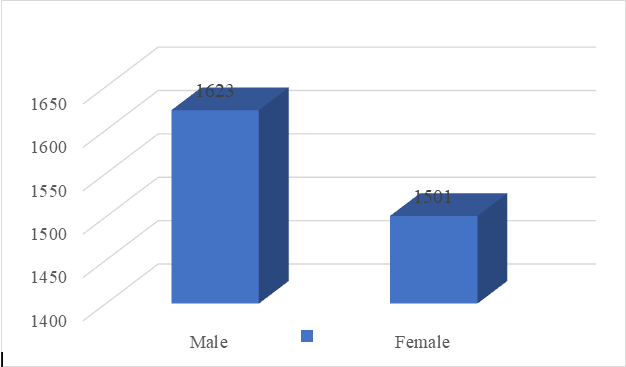
Table 2 shows the distribution of eye diseases on the basis of age and sex. It was observed that at highest number 523(16.75) of patients belonged to age group of 11 to 20 years. In the paediatric age group refractive error and others groups of eye diseases was the major condition. In the age group of 41-50 years the main diseases as Refractive error and above 60 it was the cataract.
| Number of patients | Percentage | |
|---|---|---|
| 10 | 335 | 10.7 |
| 11-20 | 523 | 16.7 |
| 21-30 | 452 | 14.5 |
| 31-40 | 518 | 16.6 |
| 41-50 | 509 | 16.3 |
| 51-60 | 383 | 12.3 |
| 61-70 | 274 | 8.8 |
| 71-80 | 105 | 3.4 |
| 81-90 | 22 | 0.7 |
| >90 | 3 | 0.1 |
| Mean±SD | 36.6±20.58 | |
| Range (Min-Max) | 0.1-96 | |
Table 2: Distribution of the study patients by age (n=3124).
Table 3 shows the distribution of eye diseases, among the total eye patients, 1153 had Refractive error (36.9%), 105(3.4) had Cataract, 15(0.5) had Glaucoma, 63(2.0) had Chronic Dacryocystitis, 14(0.4) had Pterygium, 6(0.2) had Diabetic Retinopathy, 5(0.2) had Retinitis pigmentosa and 1763 (56.4) others.
| Diseases | Number of Patients | Percentage |
|---|---|---|
| Refractive error | 1153 | 36.9 |
| Cataract | 105 | 3.4 |
| Glaucoma | 15 | 0.5 |
| Chronic Dacryocystitis | 63 | 2 |
| Pterygium | 14 | 0.4 |
| Diabetic Retinopathy | 6 | 0.2 |
| Retinitis pigmentosa | 5 | 0.2 |
| Others | 1763 | 56.4 |
Table 3: Distribution of the study patients by diseases (n=3124).
| Diseases | Number of Patients | Percentage |
|---|---|---|
| Refractive error | 1153 | 36.9 |
| Cataract | 105 | 3.4 |
| Glaucoma | 15 | 0.5 |
| Chronic Dacryocystitis | 63 | 2 |
| Pterygium | 14 | 0.4 |
| Diabetic Retinopathy | 6 | 0.2 |
| Retinitis pigmentosa | 5 | 0.2 |
| Others | 1763 | 56.4 |
Table 4: Distribution of the study patients by Area (n=3124).
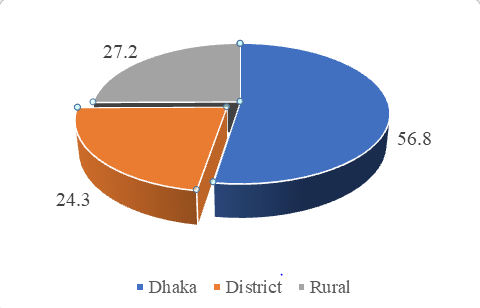
Tables 4 & 5 shows Cases of cataract and Refractive error were found in all the sample areas and the highest number were found in rural area and Dhaka city respectively (Figure 2).
| Diseases | ||||||||||||||||
|---|---|---|---|---|---|---|---|---|---|---|---|---|---|---|---|---|
| Refractive error | Cataract | Glaucoma | Chronic Dacryocystitis | Pterygium | Diabetic Retinopathy | Retinitis pigmentosa | Others | |||||||||
| Male | Female | Male | Female | Male | Female | Male | Female | Male | Female | Male | Female | Male | Female | Male | Female | |
| n | n | n | n | n | n | n | n | n | N | n | n | n | n | n | n | |
| Age | ||||||||||||||||
| 10 | 30 | 29 | 0 | 2 | 1 | 0 | 2 | 0 | 0 | 0 | 0 | 0 | 0 | 0 | 152 | 119 |
| 11 – 20 | 87 | 124 | 2 | 3 | 1 | 1 | 0 | 2 | 2 | 0 | 1 | 0 | 0 | 0 | 168 | 132 |
| 21 – 30 | 61 | 82 | 2 | 2 | 0 | 1 | 4 | 13 | 1 | 2 | 0 | 0 | 0 | 1 | 158 | 125 |
| 31 – 40 | 96 | 166 | 5 | 3 | 1 | 2 | 3 | 9 | 1 | 0 | 0 | 0 | 1 | 0 | 135 | 96 |
| 41 – 50 | 141 | 132 | 10 | 9 | 1 | 1 | 2 | 8 | 0 | 0 | 0 | 0 | 1 | 1 | 125 | 78 |
| 51 – 60 | 76 | 66 | 15 | 10 | 3 | 1 | 1 | 7 | 1 | 3 | 0 | 2 | 0 | 0 | 102 | 96 |
| 61 – 70 | 29 | 19 | 11 | 19 | 1 | 1 | 1 | 6 | 2 | 0 | 3 | 0 | 0 | 1 | 104 | 77 |
| 71 – 80 | 4 | 8 | 6 | 2 | 0 | 0 | 2 | 2 | 2 | 0 | 0 | 0 | 0 | 0 | 47 | 32 |
| 81 – 90 | 2 | 0 | 1 | 3 | 0 | 0 | 1 | 0 | 0 | 0 | 0 | 0 | 0 | 0 | 12 | 3 |
| >90 | 1 | 0 | 0 | 0 | 0 | 0 | 0 | 0 | 0 | 0 | 0 | 0 | 0 | 0 | 2 | 0 |
| Total | 527 | 626 | 52 | 53 | 8 | 7 | 16 | 47 | 9 | 5 | 4 | 2 | 2 | 3 | 1005 | 758 |
Table 5: Distribution of eye diseases according to age and sex (n=3124).
Discussion
This study reveals that in a rural community more population was affected with different diseases indicating an alarming situation in the context of public health problem. The number of ophthalmic patients was also significantly high’ Comparative country data are very scanty’ It may however be useful to compare the burden of eye diseases with those of other regional countries. In the present study, the prevalence of ocular morbidity, sociodemographic factors and other individual factors association with ocular morbidity were more or less similar to the other studies. Refractive error was the leading cause (36.9%) of visual impairment in the present study population. This is similar to the study of Shrote VK, et al. [15] the contribution of refractive error 26.15% as a major cause of the visual impairment Marmamula S, et al. [16] reports that, refractive errors were the leading cause and the major cause of the blindness was cataract Sehgal RK, et al. [17] in the paediatric age group Refractive error and others groups of eye diseases was the major condition, In the age group of 41-50 years the main diseases as Refractive error and above 60 it was the cataract According to the same author, Cataract was also most prevalent in the age group of 51-70 years (19.3%) and second major contribution in ocular morbidities occupied by this Cataract [18, 19]. In the present study the second major cause of the visual impairment was cataract and then follows, Glaucoma,
63(2.0), Chronic Dacryocystitis, 14(0.4) Pterygium, 6(0.2) Diabetic Retinopathy, 56(0.2) Retinitis pigmentosa and 1763 (56.4) others etc. [17]. Reported that there were 36.10% people belonged to elderly with refractive error and 22.48% with Cataract. More or less similar results were observed by Singh, et al. (25.8%) who found 40.8% participants with refractive error present in rural central India. Although the odds of ocular morbidity presence were high in males, it was not statistically significant (p>0.05) [20]. In another study by Thiagalingam S, et al. [21] reported that the association between age and refractive error was significant with an increase in age by 10 years 51% increase observed. Our study findings were similar to previous studies as the odds of having ocular morbidity in above 60 years age group was 24 times comparing to below 45 years. In the case of gender also males were the more risk facing compare with females and the association shown was statistically significant. Cases of cataract and Refractive error were found in all the sample areas and the highest number were found in rural area and Dhaka city respectively.
Limitation of the Study
The study was conducted with small sample size and done in a selected area from Dhaka city and Dhaka District, which may not be adequate to represents the total population. No ophthalmoscopy, tonometry, slit lamp examination or refraction were carried out therefore diseases of vitreous, retina, optic nerve could not be detected. Mild glaucoma, mild diseases of cornea, anterior chamber, iris may also have been missed. The sample was taken purposively, so there may be a chance of bias which can influence the result.
Conclusion
The leading cause eye disease in this study was refractive error, Cataract, Glaucoma, Chronic Dacryocystitis, Pterygium, Diabetic Retinopathy, Retinitis pigmentosa and others etc. The pattern of disease vary with age and sex and similar with other study.
Recommendations
Screening and early referral of population in need of specialized ophthalmic care should be emphasized. Campaigns for public awareness regarding surgical correction for cataract correction for refractive errors should be strengthened. Early and prompt treatment of ocular morbid conditions should be emphasized. Health education should be imparted to community regarding healthy eye care practices, causes, preventive measures, and appropriate treatment of ocular morbid conditions hygiene regarding eye, diet rich in vitamin A and vitamin A prophylaxis program (specially to the mothers of under-fives).
References
-
Paudel P, Ramson P, Naduvilath T, Wilson D, Phuong HT, et al. (2014) Prevalence of vision impairment and refractive error in school children in Ba Ria-Vung Tau province, Vietnam. Clin Exp Ophthalmol 42(3): 217-226.
-
Edussuriya K, Sennanayake S, Senaratne T, Marshall D, Sullivan T, et al. (2009) The prevalence and causes of visual impairment in central Sri Lanka the Kandy Eye study. Ophthalmology 116(1): 52-56.
-
Katibeh M, Pakravan M, Yaseri M, Pakbin M, Soleimanizad R (2015) Prevalence and Causes of Visual Impairment and Blindness in Central Iran; The Yazd Eye Study. J Ophthalmic Vis Res 10(3): 279-285.
-
Mariot SP (2010) Global data on visual impairments 2010. World Health Organization.
-
Resnikoff S, Pascolini D, Etyaale D, Kocur I, Pararajasegaram R, et al. (2004) Global data on visual impairment in the year 2002. Bull World Health Organ 82(11): 844-851.
-
(2017) National Programme for Control of Blindness.
-
Lawrence JM (2014) Pattern of ocular findings among patients aged 40 years and above attending eye clinic at Juba teaching hospital in Southern Sudan. University of Nairobi.
-
Ajaiyeoba AI, Isawumi MA, Adeoye AO, Oluleye ST (2006) Prevalence and causes of eye diseases amongst students in south-western Nigeria. Annals of African Medicine 5(4): 197-203.
-
Adio AO, Alikor A, Awoyesuku E (2011) Survey of pediatric ophthalmic diagnoses in a teaching hospital in Nigeria. Niger J Med 20(1): 105-108.
-
(1999) Report of WHO/IAPB scientific meeting, Hyderabad, India. World Health Organization.
-
De KN (1920) In: A History of the Charitable Dispensaries in the District Mymensingh. Revised Edition. Calcutta Bengal Secretariat Press.
-
Second Five Year Plan of Bangladesh: XVII-9.
-
Fourth Five Year Plan of Bangladesh. XI-6.
-
Maltchouk IF (1981) Data of Blindness Prevalence and Causes throughout the World. Geneva: World Health Organization.
-
Shrote VK, Thakr SS, Lanjewar AG, Brahmapurkar KP, Khakse GM (2012) Ocular Morbid Conditions in the Rural Area of Central India. International Journal of Collaborative Research on Internal Medicine & Public Health 4(9): 1692-1702.
-
Marmamula S, Narsaiah S, Shekhar K, Khanna RC (2013) Visual impairment among weaving communities in Prakasam district in South India. PLoS One 8(2): 55924.
-
Sehgal RK, Garg R, Anand S, Dhot PS, Singhal P (2016) A study of the morbidity profile of geriatric patients in rural areas of Ghaziabad, Uttar Pradesh. Int J Med Sci Public Health 5(2): 176-180.
-
Puri DS (2013) Pattern and Distribution of Ocular Morbidity in Patients Visiting the Field Practice Area of Tertiary Care Hospital of North India. J Biomed Pharml Res 2(2): 42-46.
-
Mehari ZA, Yimer AW (2013) Prevalence of refractive errors among schoolchildren in rural central Ethiopia. Clin Exp Optom 96(1): 65-69.
-
Katibeh M, Pakravan M, Yaseri M, Pakbin M, Soleimanizad R (2015) Prevalence and Causes of Visual Impairment and Blindness in Central Iran; The Yazd Eye Study. J Ophthalmic Vis Res 10(3): 279-285.
-
Thiagalingam S, Cumming R, Mitchell P (2002) Factors associated with undercorrected refractive errors in an older population: the Blue Mountains Eye Study. Br J Ophthalmol 86(9): 1041-1045.
- Screening of Hospital Staff During World Glaucoma Week in a Tertiary Eye Care Centre
- Angioid Streaks with Macular Neovascularization: Clinical Insights from Two Cases
- Giant Kissing Naevus: An Oculoplastic Challenge
- Why Freedom of Vision Should Not Cost the Freedom of Feeling - LASIK in the Climate of Change
- Asymmetric Optic Nerve with Small Disc and Large Cup: A Rare and Challenging Case of Unilateral Optic Nerve Hypoplasia
- Large Angle Exotropia in a Child: A Case Report