
Solar Eclipse Induced Retinopathy: A Case Report
Purpose: To report a case of solar eclipse induced retinopathy. Case Report: A 19 years old male presented to Chittagong Eye Infirmary and Training Complex with a 4-day history of bilateral central scotoma following 10-15 minutes of direct sun-gazing during the solar eclipse on 26th December 2019. On general examination, he was of normal built and height for his age. Upon ocular examination, his BCVA was 6/9 in both eyes. Slit-lamp microscopic examination showed clear cornea in both eyes. Pupils of both eyes were round, regular and reacting. Lens was clear in both eyes. Fundus examination revealed discrete yellow lesions at the fovea of both eyes. Optical coherence tomography scanning showed corresponding retinal pigment epithelial defects in both eyes. The patient was managed conservatively with regular follow-up and counseling was done regarding guarded visual prognosis. Conclusion: Observing a solar eclipse directly can cause permanent eye damage hence public awareness of the dangers should be encouraged.
Shally Biswas1*, Umme Salma Akbar1 and Wahid Alam2
Introduction
The human eye is exposed to ultraviolet B (280-315 nm), ultraviolet A(315-380 nm) and visible light(380-780 nm) [1]. With a meiosis of 2mm, a 30-second exposure to sunlight leads to the production of heat at a rate of 70 calories/sq.cm/ minute, which is more than enough to produce a severe retinopathy experimentally. Patients with solar retinopathy classically have a history of sun exposure through religious ritual participation [2], solar eclipse viewing without proper precautions [3, 4], sunbathing [5] or from mental disturbances via drug intoxication or schizophrenia [6]. It occurs primarily through a photo-oxidative pathway rather than by direct thermal injury [7].
A 19 years old male presented to Chittagong eye infirmary and Training complex with a 4-day history of bilateral central scotoma following 10-15 minutes of direct sun-gazing during the solar eclipse on 26th December 2019. On general examination, he was of normal built and height for his age. Upon ocular examination, his BCVA was 6/9 in both eyes. Slit-lamp microscopic examination showed clear cornea in both eyes. Pupils of both eyes were round, regular and reacting. Lens was clear in both eyes. Fundus examination revealed discrete yellow lesions at the fovea of both eyes. Optical coherence tomography (OCT) scanning showed corresponding retinal pigment epithelial defects in both eyes. Based on the clinical and OCT findings, a diagnosis of solar eclipse induced retinopathy was confirmed. The patient was managed conservatively and was advised regular follow-up every 3 months and counseling was done regarding guarded visual prognosis. The patient’s vision did not improve over the next 2 follow ups with conservative management and central RPE defects persisted. He was then lost to follow-up (Figures 1 & 2).
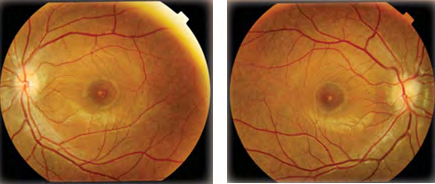
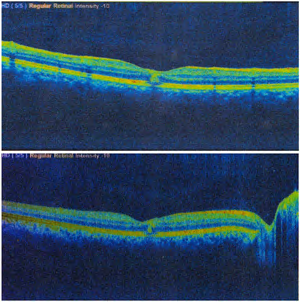
Discussion
The classic solar retinopathy is caused by the photochemical and thermal effects of ultraviolet radiation on retinal cells, especially in the outer retina and retinal pigment epithelium (RPE). Symptoms can start a few hours after direct observation of the sun, and in most cases a bilateral involvement, although asymmetrically with variable visual acuity. This pathology is caused by direct or indirect solar observation, mainly during the occurrence of a solar eclipse [8, 9, 10, 11].
The extent of retinal damage is dependent upon the intensity and duration of solar exposure. Solar observation more than 90 seconds exceeds threshold of retinal damage [12]. The common presenting symptoms of solar retinopathy include decreased visual acuity, metamorphopsia, micropsia, photophobia, after image, scotoma, and headache [13, 14].
In our case report, the patient presented with retinal damage after exposure to solar eclipse, which is bilateral and with permanent reduction in visual acuity. Das T, et al. [2] reported cases among Punjabis who look at the sun for religious reasons. Pittar (1943) reported one case in an anti- aircraft gunner firing at an enemy plane flying out of the sun, and fighter pilots performing the same maneuver have suffered similar consequences. Irvine (1945) has recalled the case of a seaman “steering into the sun’s eye.” Bates (1920) advocated prolonged sun-gazing as the treatment of myopia, with disastrous results.
The warnings made by Knudtzon (1948) need repeating, especially as they bear on the false sense of protection afforded by dark glasses, red glass filters, smoked glass and overexposed negative films. The only safe way of observing the sun, the method used by astronomers, is to project the sun’s image on to a screen. For the amateur a pin-hole and sheet of matt paper held in the shade behind it would be adequate.
Conclusion
Solar eclipse induced retinopathy is a rare form of eye damage that is a result of toxicity caused by light waves including the excess short-wavelength visible light along with heat damage that comes from near-infrared radiation. Youngsters are particularly vulnerable and they should be aware about the dangers of sun-gazing directly without specific eye gear and protection.
Conflict of Interest: None
References
-
Gass JDM (1997) Stereoscopic Atlas of Macular Diseases: Diagnosis and Treatment. St Louis, MO; Mosby 4: 760- 763.
-
Das T, Nirankari MS, Chaddah MR (1956) Solar chorioretinal burn. Am J Ophthalmol 41(6): 1048-1053.
-
Agarwal LP, Malik SR (1959) Solar retinitis. Br J Ophthalmol 43(6): 366-370.
-
MacFaul PA (1969) Visual prognosis after solar retinopathy. Br J Ophthalmo 53(8): 534-541.
-
Ridgway AE (1967) Solar retinopathy Br Med J 3(5559): 212-214.
-
Anaclerio AM, Wicker HS (1970) Self-induced solar retinopathy by patients in a psychiatric hospital. Am J Ophthalmol 69(5): 731-736.
-
Glickman RD (2011) Ultraviolet phototoxicity to the retina. Eye Contact Lens 37(4): 196-205.
-
Farah ME (2015) Optical coherence tomography: 3rd (Edn.), Rio de Janeiro: Medical Culture: Guanabara Koogan.
-
Stock RA, Savaris SL, Lima Filho EC, Bonamigo EL (2013) Solar retinopathy without abnormal exposure: case report. Arch Bras Ophthalmol 76(2): 118-120.
-
Yang X, Shao D, Ding X, Liang X, Yang J, et al. (2012) Chronic phototoxic maculopathy caused by welding arc in occupational welders. Can J Ophthalmol 47(1): 45-50.
-
Saxena S, Srivastav K, Cheung C, Ng JY, Lai TY (2014) Photoreceptor inner segment ellipsoid band integrity on spectral domain optical coherence tomography. Clinical Ophthalmology 8: 2507-2522.
-
Istock TH (1985) Solar retinopathy: a review of the literature and case report. J Am Optom Assoc 56(5): 374- 382.
-
Yannuzzi LA, Fisher YL, Slakter J, Krueger A (1989) Thesis: Solar retinopathy. Aphotobiologic and geophysical analysis. Retina 9(1): 28-43.
-
Michealides M, Rajendram R, Marshall J, Keightley S (2001) Eclipse retinopathy. Eye 15(2): 148-151.
- Screening of Hospital Staff During World Glaucoma Week in a Tertiary Eye Care Centre
- Angioid Streaks with Macular Neovascularization: Clinical Insights from Two Cases
- Giant Kissing Naevus: An Oculoplastic Challenge
- Why Freedom of Vision Should Not Cost the Freedom of Feeling - LASIK in the Climate of Change
- Asymmetric Optic Nerve with Small Disc and Large Cup: A Rare and Challenging Case of Unilateral Optic Nerve Hypoplasia
- Large Angle Exotropia in a Child: A Case Report