
Psychological Wellbeing in Patients with Glaucoma: A Newer Perspective in Glaucoma Management
Glaucoma is a chronic progressive optic nerve disease with blindness as a potential complication, if left untreated. It is the second leading cause of irreversible blindness worldwide [1]. It is estimated that the number of persons with glaucoma would rise to 111 million by 2040 [2]. Hence, glaucoma accounts for a significant disease burden globally. Unfortunately, due to the silent progression of disease, at the time of the first presentation, significant visual field and retinal nerve fibre layer defects are present in majority of patients.
Background
Glaucoma is a chronic progressive optic nerve disease with blindness as a potential complication, if left untreated. It is the second leading cause of irreversible blindness worldwide [1]. It is estimated that the number of persons with glaucoma would rise to 111 million by 2040 [2]. Hence, glaucoma accounts for a significant disease burden globally. Unfortunately, due to the silent progression of disease, at the time of the first presentation, significant visual field and retinal nerve fibre layer defects are present in majority of patients.
Various studies in the past decade have established the Opinion
negative psychological impact of chronic ocular conditions on quality of life and mental health of the patient. Studies from various parts of the globe have reported similar findings in patients with glaucoma as well [3, 4, 5, 6]. Hence there is a need to address psychosocial problems as a part of holistic approach for glaucoma treatment.
Factors Affecting Quality of Life in Glaucoma
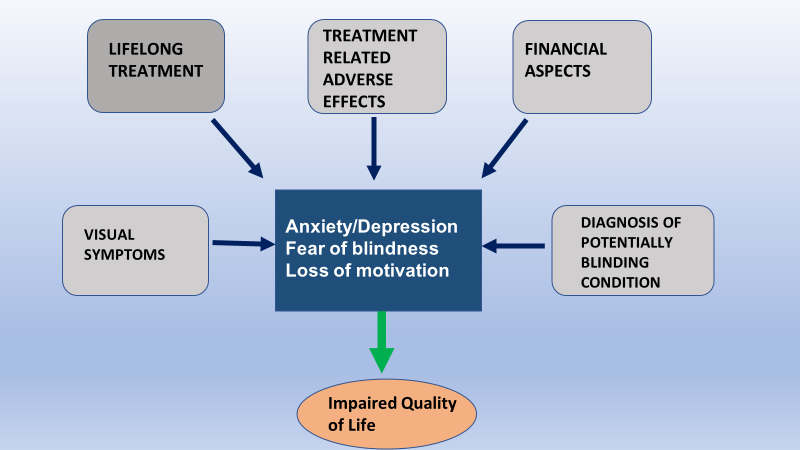
Impairment of quality of life in glaucoma is multifactorial, as demonstrated in Figure 1. Some of these factors are briefly discussed below:
Visual Disability
Irreversible visual field deterioration is an important cause of disability and morbidity associated with glaucoma.
Initially, the disease involves peripheral fields and tends to go unnoticed, till the time it progresses to involve central and paracentral areas. Hence, it is less common for an individual with early glaucoma to present with visual symptoms.
Although, few patients, especially those diagnosed as low tension glaucoma, do present with paracentral scotomas closer to fixation even early in the disease. However, with increasing disease severity, the progressive visual field defects cause impairment in daily functioning, affecting the quality of life. Legal blindness with total dependency may ensue in end stage disease, leading to loss of occupation and inability to complete even routine tasks. Studies have demonstrated a negative association between severity of glaucoma and quality of life [5, 7, 8].
Financial Aspects
Cumulative cost of lifelong glaucoma therapy can cause a financial burden on the patients. A significant proportion of patients reside in middle to low-income countries, with low per capita income and lack of government funded social security schemes, affordability of treatment may be a challenge for them in the long run. Moreover, visual disability can cause loss of occupation and further financial constraints.
Psychological Effect of Diagnosis
Diagnosis of glaucoma can be a stressful experience for the patient. Owing to the potential irreversible blindness, many patients develop negative emotions such as anxiety or depression on mere learning about the diagnosis. Apart from fear of blindness, lifelong use of medications, regular follow ups, changes in routine lifestyle can further aggravate psychological stress. Psychological stress may be partly attributed to lack of awareness about the disease and treatment options among general masses. Patients tend to misinterpret the diagnosis of glaucoma as that of impending blindness. They are usually unaware of the treatment options available, and the fact that the disease progression could be retarded with the use of various medical and surgical modalities. Poor disease comprehension has shown to be negatively associated with psychological health and quality of life scores. As demonstrated in Collaborative Initial Glaucoma Treatment study, majority of patients develop negative emotions on just learning about the diagnosis [9].
Hence it is evident that glaucoma associated psychosocial impairment is multifactorial, and not just caused by loss of visual function alone.
What Needs to Be Done?
Management of glaucoma should be focussed on holistic treatment of the patient and not just the intraocular pressure. Patient counselling at the time of diagnosis and during future follow up visits has an important role to play. Treating clinicians should watch out for any symptoms of mental or psychological distress and psychiatric counselling sought, if needed. Family members of the patient should also be made aware about the disease, its course and management. Vocational and visual rehabilitation therapy for patients with very advanced glaucoma can help in reducing dependence and thereby improving quality of life in such patients.
Conclusion
Patients with glaucoma are at a risk of developing negative psychological emotions at the time of diagnosis or during treatment. Clinicians should be aware of this aspect and a comprehensive approach involving patient education and counselling should be employed as a part of routine glaucoma management.
References
-
Dayal A (2021) Psychosocial aspects of glaucoma. In: Lanza M, et al. (Eds.), Ocular hypertension-the knowns and unknowns. Intech Open, pp: 126.
-
Tham YC, Li X, Wong TY, Quigley HA, Aung T, et al. (2014) Global Prevalence of Glaucoma and Projections of Glaucoma Burden through 2040 A Systematic Review and Meta-Analysis. Ophthalmology 121(11): 2081-2090.
-
Zhang D, Fan Z, Gao X, Huang W, Yang Q, et al. (2018) Illness uncertainty, anxiety and depression in Chinese patients with glaucoma or cataract. Sci Rep 8(1): 11671.
-
Lim NCS, Fan CHJ, Yong MKH, Wong EPY, Yip LWY, et al. (2016) Assessment of Depression, Anxiety, and Quality of Life in Singaporean Patients with Glaucoma. J Glaucoma 25(7): 605-612.
-
Kalyani VKS, Dayal A, Chelerkar V, Deshpande M, Chakma A, et al. (2020) Assessment of psychosocial impact of primary glaucoma and its effect on quality of life of patients in Western India. Indian J Ophthalmol 68(11): 2435-2438.
-
Dayal A, Kalyani VKS, Chelerkar V, Deshpande M (2022) Prevalence of Anxiety and Depression in Patients With Primary Glaucoma in Western India. J Glaucoma 31(1): 37-40.
-
Kumar S, Ichhpujani P, Singh R, Thakur S, Sharma M, et al. (2018) The impact of primary open-angle glaucoma: Quality of life in Indian patients. Indian J Ophthalmol 66(3): 416-419.
-
Sawada H, Fukuchi T, Abe H (2011) Evaluation of the relationship between quality of vision and the visual function index in Japanese glaucoma patients. Graefe’s Arch Clin Exp Ophthalmol 249(11): 1721-1727.
-
Janz NK, Wren PA, Litcher PR, Musch DC, Gillespie BW, et al. (2001) The Collaborative initial glaucoma treatment study: Interim quality of life findings after initial medical or surgical treatment of glaucoma. Ophthalmology 108(11): 1954-1965.
- Screening of Hospital Staff During World Glaucoma Week in a Tertiary Eye Care Centre
- Angioid Streaks with Macular Neovascularization: Clinical Insights from Two Cases
- Giant Kissing Naevus: An Oculoplastic Challenge
- Why Freedom of Vision Should Not Cost the Freedom of Feeling - LASIK in the Climate of Change
- Asymmetric Optic Nerve with Small Disc and Large Cup: A Rare and Challenging Case of Unilateral Optic Nerve Hypoplasia
- Large Angle Exotropia in a Child: A Case Report