
Major Visual Impairment in Special Children
Objective: This study aims to identify the major visual impairment among special children. Methods: This cross-sectional study was conducted among 120 children within 3-15 years of age group at a vision therapy centre between April-June of 2023. Results: Low visual acuity was seen in children who had a development delay of 0.79%. In 15.7% of cases of autism spectrum disorder (ASD), astigmatism was present. Nystagmus was seen in 5.8% of cases of cortical visual impairment (CVI). 9.9% of those with attention-deficit/hyperactivity disorder (ADHD) were unable to both accommodate and converge. In 14.0% of cases, the stereo acuity was poor. Ocular mobility was impaired in 9.1% of developmental delay cases, 14.0% of CVI cases, and 25.6% of ASD cases. Fusion was not performed well by 9.9% of ADHD patients. Suppression and diplopia were present in 25.6% of ASD cases, 14.0% of CVI cases, and 9.1% of developmental delay cases. 7.4% of ADHD patients and 12.4% of CVI patients had photophobia. 9.9% of ADHD patients and 14.0% of CVI patients were unable to perform spatial orientation. Children with developmental delays, ASD, ADHD, and CVI were more likely to be impacted and had abnormal visual function
Introduction
Recently, visual impairment has become a topic in the community. Visual impairment has a significant impact on the quality of life for both historical and younger populations. There are many ways to characterize the severity of a person’s visual impairment. The inability to correct vision to a “normal” level is known as visual impairment [1]. According to a number of studies, children’s brain anomalies are linked to both functional and morphological vision impairment [2].
Low imagination and vision are two of the many causes of visual impairment. Blindness is another. The best approach to evaluate someone’s useful vision is to watch them in certain situations and gauge how well they use their sense of vision. A child’s cognitive, emotional, neurological, and physical development can be impacted by visual impairment, which can also limit their daily activities, experiences, and way of life. The majority of children who suffer from impairments to their imagination also have one or more developmental disorders, such as mental retardation, cerebral palsy, hearing loss, epilepsy, etc. Compared to children with mild visual impairment, children with severe visual impairment are more likely to have brought disabilities [1]. A number of illnesses and conditions can cause visual impairments. Autism spectrum disorder is a neuro-developmental condition that often manifests in the first three years of life and affects a person’s ability to relate to others, communicate, and understand relationships. It is frequently linked to erratic or stereotyped behaviors or habits. Additionally, this disease implies recurrent and restricted behavioral patterns [3]. Cortical visual impairment (CVI) is a neurological disorder characterized by reduced visual responsiveness and effects on the visual cortex. Vision problems associated with cerebral palsy include amblyopia, cortical visual impairment, strabismus, nystagmus, optic atrophy, and refractive errors [4]. Inattention and/or hyperactivity-impulsivity that impairs functioning or development is known as attention- deficit/hyperactivity disorder (ADHD) [5].
To maximize their social and academic performance, a minor visual issue that is lowering their visual clues needs to be identified and remedied as soon as possible. Children who are visually challenged because to congenital or inherited ocular defects benefit from low vision and refraction [6]. Research indicates that the most common causes of visual impairment, as well as the need to raise awareness and prevent it, are astigmatism and amblyopia [7]. Astigmatism and amblyopia were the most frequent causes of visual impairment, and it is thought that amblyopia increases the chance of high ametropia [8]. Premarital genetic counseling, family planning, and the prevention and treatment of certain disorders are also claimed to reduce the amount of visual impairment [9]. Uncorrected refractive error is now frequently cited as the primary cause of visual impairment [10]. It is now essential to ascertain the ocular and visual functioning of youth with various disabilities as well as the treatable and preventative causes of visual impairment [11]. Thus, this study’s primary goal was to examine the most frequent cause of vision impairment and its management.
Methods
This cross sectional study was conducted between April-June of 2023.In this study, under convenient sampling method, a total of 120 children with special needs at a vision therapy centre, within the age range of 3-15 years were taken. Data were collected using data collection form.
Data Collection Form
This study was conducted on special children with cases of visual impairment at a vision therapy center. All respondents supplied written, informed consent and assent form in accordance with the Declaration of Helsinki’s principles, which guided the study’s conduct. A complete medical and ocular history was collected as a result of inquiries. Children who were 3 to 15 years old and receiving visual therapy were classified as special children; children who were older than 15 and adults were excluded. Basic demographic information about the patient, recommended vision therapy, and continued vision therapy were gathered. Every step of the vision therapy process was covered. To achieve good target fixation and convergence, exercises such as the Brock string, jump duction, VTS -4 MCV (RDS), saccadic string, and one foot hopping were employed. Memory, speed, and auditory integration were all improved with the use of computerized perceptual therapy. To enhance vision, perception, tracking, verbal, spatial orientation, and auditory integration, utilize tools such as the Marsden ball, vergence facility, color cues, sanet vision integrater, tachistoscope, and acrylite sheet. Additionally, light therapy called Syntonics was employed. During the course of thirty sessions, patients receiving syntonics treatment were typically made to sit in a darkened room and watch a circle of colored light for 20 minutes at a time. The patient’s visual abilities gradually improved after seeing the light. Enhancing visual and other functional abilities were accomplished by eye-hand coordination exercises, reflex activities, paper crushing and opening, balancing boards, pegboards, finger tapping, ball catching, tracing, floor map and hopping, OKN, walking beam, VMC bat, and dot joining. In order to calculate the gradual improvement in vision and other functional activities, all of the vision therapy data for each condition in special children was gathered. These methods allowed for the collection of these children’s major visual impairments.
Data Analysis
The collected data will be analysed with statistical package for the social sciences (SPSS) 20 version (IBM Corporation, New York, USA). The collected data will be checked for normal distribution using statistical test.
Ethical Considerations
Written permission was obtained for the conduct of the study from an ethics committee of Saveetha college of allied health science (IEC/SCAHS/IRB/2022/March/545) and a health practices and research centre where the study was conducted. Written assent and consent were gained once it was made aware of the research’s goal and the confidentiality of the data that would be collected.
Results
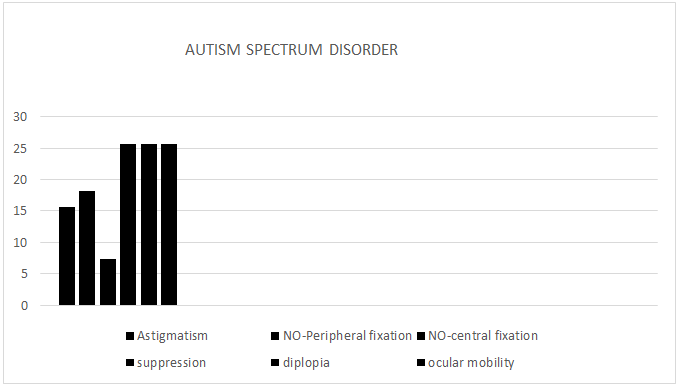
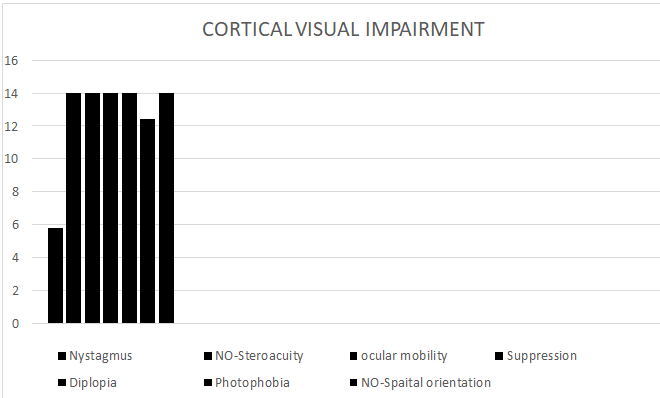
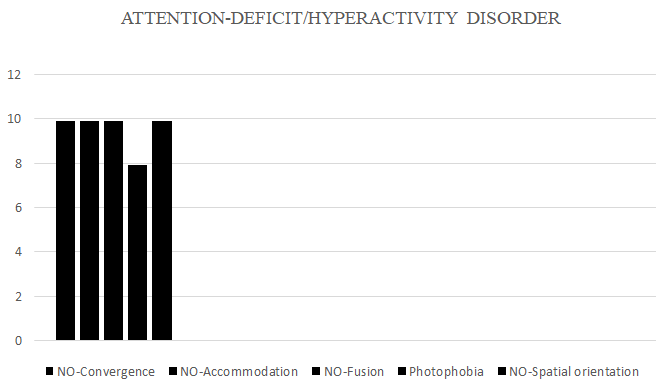
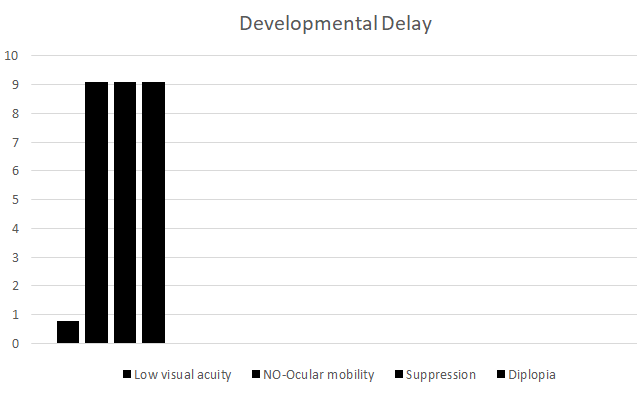
This study discovered that the special kids with development delays (0.79%) had poor visual acuity (Tables 1,2 & Figure 5). In contrast to other disorders, astigmatism was present in 15.7% of ASD cases (Table 2 & Figure 2). 5.8% of CVI had Nystagmus when all conditions were considered for analysis (Table 2 & Figure 3). 18.2% of ASD patients were unable to have peripheral fixation, and 7.4% were unable to have central fixation, as compared to patients with other disorders (Table 2 & Figure 2). 9.9% of ADHD cases that were analyzed under all settings were found to be unable to both converge and accommodate (Table 2 & Figure 4). In contrast to other circumstances, 14.0% of CVI had poor stereo acuity (Table 2 & Figure 3). According to analysis, under all circumstances, 9.1% of developmental delay, 14.0% of CVI, and 25.6% of ASD were unable to execute ocular mobility (Table 2 & Figures 2,3). 9.9% of ADHD patients were unable to conduct fusion when compared to patients with other disorders (Table 2 & Figure 4). After analyzing under all circumstances, it was shown that 9.1% of developmental delays, 14.0% of CVI, and 25.6% of ASD cases had suppression and diplopia (Table 2 & Figures 2,3). When compared to other conditions, photophobia affected 12.4% of CVI and 7.4% of ADHD patients (Table 2 & Figure
4). Analyzed under all circumstances, 9.9% of ADHD and 14.0% of CVI were shown to be unable to conduct spatial orientation (Table 2 & Figure 3,4).
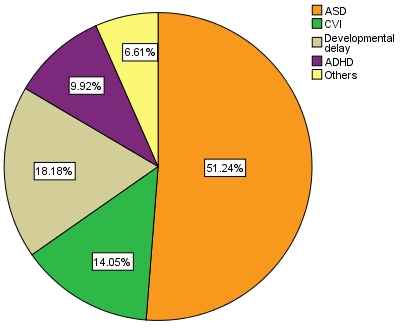
| Classification | Number of Patients | Percentage |
|---|---|---|
| ASD | 62 | 51.2 |
| CVI | 17 | 14 |
| Developmental Delay | 22 | 18.2 |
| ADHD | 12 | 9.9 |
| Others | 8 | 6.6 |
| Total | 121 | 100 |
Table 1: Classification of Patients in various circumstances.
| Factor | ASD | CVI | ADHD | Developmental Delay | |
|---|---|---|---|---|---|
| Astigmaism | 15.70% | 5.80% | 14.10% | 4.10% | Chi square=41.778** |
| P=0.000 | |||||
| Nystagmus | 4.10% | 5.80% | 0.00% | 0.80% | Chi square=80.493** |
| P=0.000 | |||||
| Peripheral Fixation | 18.20% | 9.90% | 4.10% | 3.30% | Chi square=18.771** |
| P=0.001 | |||||
| Central Fixation | 7.40% | 4.10% | 4.10% | 0.80% | Chi square=11.597** |
| P=0.021 | |||||
| Visual Acuity | 0.77% | 0.51% | 0.74% | 0.79% | Chi square=5.629** |
| P=0.000 | |||||
| Convergence | 7.40% | 4.10% | 9.90% | 4.10% | Chi square=39.696** |
| P=0.000 | |||||
| Accommodation | 7.40% | 4.10% | 9.90% | 4.10% | Chi square=38.945** |
| P=0.000 | |||||
| Fusion | 7.40% | 4.10% | 9.90% | 4.10% | Chi square=38.945** |
| P=0.000 | |||||
| Stereoacuity | 7.40% | 14.00% | 9.90% | 9.10% | Chi square=68.049** |
| P=0.000 | |||||
| Suppression | 25.60% | 14.00% | 0.00% | 9.10% | Chi square=36.948** |
| P=0.000 | |||||
| Diplomia | 25.60% | 14.00% | 0.00% | 9.10% | Chi square=29.444** |
| P=0.000 | |||||
| Ocular Mobility | 25.60% | 14.00% | 0.80% | 9.10% | Chi square=31.965** |
| P=0.000 | |||||
| Photophobia | 9.90% | 12.40% | 7.40% | 8.30% | Chi square=33.761** |
| P=0.000 | |||||
| Spartial Orientation | 7.40% | 14.00% | 9.90% | 9.10% | Chi square=60.022** |
| P=0.000 |
Table 2: **Significant at 1% level
Discussion
The primary goal of this study was to determine which visual impairments Special children had. Compared to the general population, children with special needs typically experience a higher incidence of vision problems. Impairment of vision can appear at any age. For kids who struggle with both physical and mental health, this is a major issue. By looking at the following visual function impairments, we can better understand them: binocular coordination (stereo vision), depth perception, eye turns (strabismus), eye focusing (accommodation), lazy eye (amblyopia), near- sightedness (myopia), farsightedness (hyperopia), and visual information processing. Special children are thought to be more susceptible to these problems, such as autism spectrum disorder, a neuro-developmental condition. Cortical visual impairment, visual area defects, amblyopia, nystagmus, optic atrophy, strabismus, and refractive problems are all included in cerebral palsy.
Inattention and/or hyperactivity-impulsivity that interferes with functioning or development is known as attention-deficit/hyperactivity disorder (ADHD). The goal of vision therapy was to improve a child’s visual processing speed, hand-eye coordination, and perceived expertise in areas including eye tracking, concentrating, and eye teaming. This study aimed to determine the primary cause of visual impairment in children with exceptional needs. After analyzing every condition in the study, it was discovered that patients with developmental delays had poor visual acuity. Patients with ASD were thought to be more susceptible to astigmatism when compared to those with other disorders. After analyzing all diseases, it was determined that patients with CVI had a greater incidence of Nystagmus. Patients with ASD were unable to have either central or peripheral fixation, in contrast to those with other disorders. ADHD was not able to accommodate or converge when analyzed under all situations. When compared to other circumstances, CVI was unable to recognize stereo acuity. ASD, CVI, and developmental delay were found to be unable of performing ocular mobility under all situations. In contrast to other disorders, ADHD patients were unable to accomplish fusion. ASD, CVI, and developmental delay were found to be more susceptible to suppression and diplopia when analyzed under all settings. Photophobia was found to be associated with CVI and ADHD when compared to other conditions. Upon analysis under all circumstances, it was shown that CVI and ADHD were unable to recognize spatial orientation. The main finding of this study is that, when compared to all other disorders with different visual issues, the majority of the values are linked to autism spectrum disorder (ASD), with the exception of visual acuity, which is found to be highly correlated with developmental delay. In children with exceptional needs who have major vision impairment, these changes were statistically significant.
According to Woodhouse MJ, et al. [12], refractive error was linked to visual acuity in kids with a range of disorders. It was discovered that there is a correlation between refractive error and visual acuity by comparing the findings with our research. The results aligned with those of our study [13]. According to research by Ursula MD, et al. [14], amblyopia continues to be the main visual impairment. It was seen from a comparison with our study that amblyopia is related to a small number of factors [12]. According to Haddad MA, et al. [13], optic atrophy, cortical visual impairment, toxoplasmic macular retinochoroiditis, retinopathy of prematurity, ocular malformations, congenital cataracts, and degenerative disorders of the retina and macula were the primary causes of visual impairment in the multiple disability group. It was discovered through comparison that the outcomes are meaningless [14]. According to Gurvinder K, et al. [11], strabismus and refractive errors were the most prevalent ocular diseases observed in those kids. Through analysis, it was discovered that refractive error and visual acuity are related. The final outcome was pertinent to our research [15]. Meghomala D, et al. [15] discovered a correlation between refractive error and other ocular-related issues in children with a variety of illnesses. Refractive error and visual acuity were discovered to be related based on the final value. The results matched those of this investigation [11].
Limitations
The study’s limitations were attributed to the uncooperative samples and the parents’ refusal to allow the treatment to continue for the remaining samples.
Conclusion
Special needs children were also visually impacted. The findings indicated that decreased visual acuity was present in exceptional children who were experiencing developmental delays. In contrast to typical children, astigmatic children with ASD were unable to have both peripheral and central fixation. Youngsters with CVI had poor stereo acuity and nystagmus. Convergence, accommodation, and fusion were all impossible for kids with ADHD. In addition to experiencing suppression and diplopia, children with ASD, CVI, and developmental delays were unable to perform ocular mobility. Children suffering from CVI and ADHD were unable to conduct spatial orientation and experienced photophobia. Children who had developmental delays, ASD, ADHD, or CVI were more likely to be impacted, and their visual function was also compromised.
Acknowledgments: The authors desire to thank all the participants in the study.
Funding: The authors obtained no monetary help for the research.
Conflicts of Interest: The authors claim that they’ve no war of interest.
Ethics Committee Approval: This study was approved by Ethics committee of Saveetha College of allied health science. (IEC/SCAHS/IRB/2022/March/545).
References
-
Salomao SR, Cinoto RW, Berezovsky A, Mendieta L, Nakanami CR, et al. (2008) Prevalence and causes of visual impairment in low-middle income school children in Sao Paulo, Brazil Invest Ophthalmol Vis Sci 49(10): 4308-4313.
-
Gronqvist S, Flodmark O, Tornqvist K, Edlund G, Hellstrom (2001) Association between visual impairment and functional and morphological cerebral abnormalities in full-term children. Acta Ophthalmol Scand 79(2): 140- 146.
-
Hallett V, Ronald A, Rijsdijk F, Happe (2010) Association of autistic-like and internalizing traits during childhood: A longitudinal study. American Journal of Psychiatry 167(7): 809-817.
-
Pehere NK, Narasaiah A, Dutton GN (2019) Cerebral visual impairment is a major cause of profound visual impairment in children aged less than 3 years: A study from tertiary eye care center in South India. 67(10): 1544-1547.
-
Rajaprakash M, Leppert ML (2022) Attention-Deficit/ Hyperactivity Disorder Paediatric review 43(3): 135- 147.
-
Shah M, Khan M, Khan MT, Khan MY, Saeed N (2011) Causes of visual impairment in children with low vision. J Coll Physicians Surg Pak 21(2): 88-92.
-
Ghaderi S, Hashemi H, Jafarzadehpur E, Yekta A, Ostadimoghaddam H, et al (2018) The prevalence and causes of visual impairment in seven-year-old children. Clin Exp Optom 101(3): 380-385.
-
Talebnejad MR, Khalili MR, Tajbakhsh Z, Masoumpour MB, Mahdaviazad H, et al (2022) The Prevalence and Causes of Low Vision and Visual Impairment in School- Aged Children: The Shiraz Pediatric Eye Study. J Curr Ophthalmol 34(3): 333-340.
-
Mirdehghan SA, Dehghan MH, Mohammadpour M, Heidari K, Khosravi M (2005) Causes of severe visual impairment and blindness in schools for visually handicapped children in Iran: British journal of ophthalmology 89(5): 612-614.
-
Muma S, Obonyo S (2020) The prevalence and causes of visual impairment among children in Kenya - the Kenya eye study. BMC Ophthalmol 20(1): 399.
-
Kaur G, Thomas S, Jindal M, Bhatti SM (2016) Visual Function and Ocular Status in Children with Disabilities in Special Schools of Northern India. J Clin Diagn Res 10(10): NC01-NC04.
-
Woodhouse JM, Davies N, McAvinchey A, Ryan B (2014) Ocular and visual status among children in special schools in Wales: the burden of unrecognised visual impairment. Archives of disease in childhood 99(6): 500-504.
-
Haddad MA, Sei M, Sampaio MW, Kara-Jose N (2007) Causes of visual impairment in children: a study of 3,210 cases. J Pediatr Ophthalmol Strabismus 44(4): 232-240.
-
Donnelly UM, Stewart NM, Hollinger M (2005) Prevalence and outcomes of childhood visual disorders: Ophthalmic epidemiology 12 (4): 243-250.
-
Das M, Spowart K, Crossley S, Gordon N (2010) Evidence that children with special needs all require visual assessment: Dutton Archives of Disease in Childhood 95(11): 888-892.
- Screening of Hospital Staff During World Glaucoma Week in a Tertiary Eye Care Centre
- Angioid Streaks with Macular Neovascularization: Clinical Insights from Two Cases
- Giant Kissing Naevus: An Oculoplastic Challenge
- Why Freedom of Vision Should Not Cost the Freedom of Feeling - LASIK in the Climate of Change
- Asymmetric Optic Nerve with Small Disc and Large Cup: A Rare and Challenging Case of Unilateral Optic Nerve Hypoplasia
- Large Angle Exotropia in a Child: A Case Report