
Jackson Cross Cylinder
This paper describes about Jackson Cross Cylinder, its technique and JND technique.
Partha Haradhan Chowdhury1* and Brinda Haren Shah2
Jankalyan Samiti Netra Prasikshan Sansthan, Pauri, Affiliated to Uttarakhand State Medical Faculty, Dehradun, India Samiti Netra Prasikshan Sansthan, Pauri, Affiliated to Uttarakhand State Medical Faculty, Dehradun, India Faculty, Dehradun, India, Email: optometrypublish@gmail.com This paper describes about Jackson Cross Cylinder, its technique and JND technique.
Keywords: Jackson Cross Cylinder; JND technique
Introduction
Jackson cross cylinder is an instrument by which we can be able to know: Axis Refinement Power of the cylindrical correction Used for near point testing The procedure of Jackson Cross Cylinder should be followed without fogging. It is a sphero cylinder lens in which plus cylinder is incorporated at the front surface and it is indicated with green sign. Minus cylinder is incorporated at the posterior surface and it is indicated with the red sign [1, 2, 3]. So, according to the JCC power, we should know: A. If, JCC : +/- 0.25 i. +0.25/-0.50 ii. -0.25/+0.50 B. If, JCC: +/- 0.50 i. 0.50/-1.00 ii. -0.50/+1.00 C. If, JCC : +/- 0.75 i. +0.75/-1.50 ii. -0.75/+1.50 D. If, JCC: +/-1.00 i. +1.00/-2.00 ii. -1.00/+2.00 E. If, JCC : +/-1.25 i. +1.25/-2.50 ii. -1.25/+2.50
Technique
By the JCC, we can do axis refinement and power of the cylinder.
I. Axis Refinement
Here, JCC handle is parallel with the correcting lens axis. Eg, RE: -0.50Dcyl *180 LE: -0.50 Dcyl*180 During, Axis Refinement, JCC handle will be placed parallel to the axis of the correcting lens. It means, in this time automatically, JCC axis will be positioned 45 degree and 135 degree compared to the correcting lens axis.
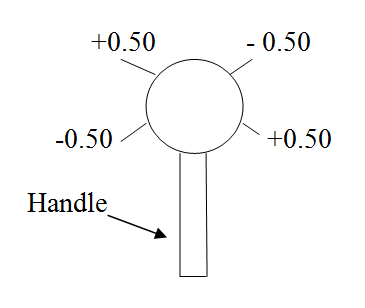
JCC axis is parallel with the axis of the correcting lens.1st time minus axis is parallel and then flip the JCC, plus axis will be parallel.
Just Noticeable Difference
By this technique, we can be able to know which JCC should be used according to high refractive error. JND technique with e.g. Eg. 1 If patient’s visual acuity is 20/200 In this technique, always 10 is divided by 100, i.e. 10/100 After that, if 200 is divided by 100 So, 200/100 = +/- 2.00 D In this case, +/- 2.00 D JCC is used. Eg. 2 If visual acuity of patient is 20/400, At first, 10 is divided by 100 So, 10/100 After that, 400 will be divided by 100 So, 400/100 = +/- 4.00 D In this case, +/- 4.00 D JCC will be used as per the case.
References
-
William J Benjamin (2006) Borish's Clinical Refraction. 2nd (Edn.).
-
Theodore Grosvenor, Theodore P. Grosvenor (2007) Primary Care Optometry, 5th (Edn.).
-
Duke-Elder S, David Abrams (1978) Duke-Elder's Practice of refraction.
- Screening of Hospital Staff During World Glaucoma Week in a Tertiary Eye Care Centre
- Angioid Streaks with Macular Neovascularization: Clinical Insights from Two Cases
- Giant Kissing Naevus: An Oculoplastic Challenge
- Why Freedom of Vision Should Not Cost the Freedom of Feeling - LASIK in the Climate of Change
- Asymmetric Optic Nerve with Small Disc and Large Cup: A Rare and Challenging Case of Unilateral Optic Nerve Hypoplasia
- Large Angle Exotropia in a Child: A Case Report