
Bird-On-Tree Appearance
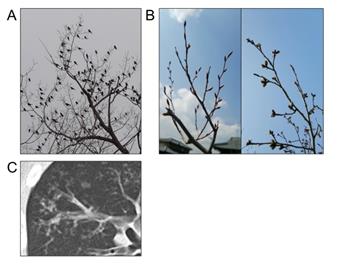
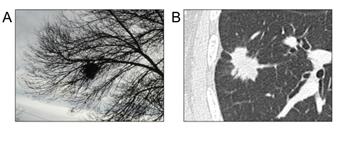
Birds can cause or mediate several pulmonary diseases including psittacosis and hypersensitivity pneumonitis called bird breeder’s lung. “Bud-in-tree†appearance is 2 to 4 mm centrilobular nodules or branching linear structures with more than one contiguous branching site and usually suggests bronchiolitis including diffuse panbronchiolitis and pulmonary infectious diseases such as mycobacterium infections. We here present a novel bird-related finding “bird-on-tree†appearance. In addition, birds can cause a nodule with spiculation called “nestomaâ€. These findings are usually observed only in winter.
Nobuhiro Kanaji*, Nobuyuki Kita, Norimitsu Kadowaki, and Shuji
Bandoh
Respiratory Medicine, Kagawa University, Japan
only in winter.
Keywords: Bird-on-tree; Bud-in-tree; Bird-in-tree; Nestoma; Adenocarcinoma
Main text
Birds can cause or mediate several pulmonary diseases including cryptococcosis, psittacosis, and hypersensitivity pneumonitis called bird breeder’s (fancier’s) lung [1]. “Bud-in-tree” appearance was first reported as a representative finding of pulmonary tuberculosis [2]. This finding is 2 to 4 mm centrilobular nodules or branching linear structures with more than one contiguous branching site and usually suggests bronchiolitis including diffuse panbronchiolitis and pulmonary infectious diseases such as mycobacterium infections although bronchiolar involvement of some neoplasms and aspiration of irritant substances can also show this Opinion pattern [2, 3, 4, 5]. We here present a bird-related finding “bird-on-tree” appearance for the first time (Figure 1). This is a photograph of some birds perching on a tree, which resemble to bud-in-tree appearance on CT. This appearance sometimes disappears very quickly, for example, at time when a person approaches. In addition, birds can cause a nodule with speculation like an adenocarcinoma (Figure 2). This “NESToma” may be benign rather than a subtype of adenocarcinoma. These findings are usually observed only in winter. No treatment is necessary.
References
-
Hargreave FE, Pepys J, Longbottom JL, Wraith DG (1966) Bird breeder's (fancier's) lung. Proc R Soc Med 59(10): 1008.
-
Im JG, Itoh H, Shim YS, Lee JH, Ahn J, et al. (1993) Pulmonary tuberculosis: CT findings--early active disease and sequential change with antituberculous therapy. Radiology 186(3): 653-660.
-
Hatipoğlu ON, Osma E, Manisali M, ucan ES, Balci P, et al. (1996) High resolution computed tomographic findings in pulmonary tuberculosis. Thorax 51(4): 397-402.
-
Aquino SL, Gamsu G, Webb WR, Kee ST (1996) (Tree- in-bud pattern: frequency and significance on thin section CT. J Comput Assist Tomogr 20(4): 594-599.
-
Collins J, Blankenbaker D, Stern EJ (1998) CT patterns of bronchiolar disease: what is "tree-in-bud"? AJR Am J Roentgenol 171: 365-370.
- Bedside Pulmonary Rehabilitation – Mandatory and Cost- Effective Tools
- The Role of Chest Radiology in Traumatic Injuries: A Comprehensive Narrative Review
- Pseudosepsis in Acute Inflammation of the Lung
- An Overview of Lung Injury in Covid-19: Evaluating the Impact of Re-Exposure and Emerging Variants
- Fibreoptic Bronchoscopy-its Role in Pulmonary Medicine-Current Trends in Intensive Care Unit
- Retrospective Study on the Efficacy of Homoeopathic Medicines in the Treatment of Acute Rhinitis