
Somatotypes of Patients with Prostate Adenoma
One of the most common diseases in men in the second period of adulthood, in elderly and old ages is "Benign prostatic hyperplasia (BPH)." Moreover, if at the age of about 40-49 years, it occurs in 11.3% of men, after 80 years it is found in 95.5%. The etiology of prostate adenoma (BPH) exists in the form of hypotheses and it’s in many respects controversial. Objective of the research: to establish the most common somatotype of patients with prostatic adenoma (PA) according to the index of Tanner and Rees-Eysenck body index.
Yu Klimov N*, Andreychikov AV and Vinnik Yu Yu
Krasnoyarsk Regional Clinical Oncology Clinic, Kryzhanovsky, Russia
Clinical Oncology Clinic named after A.I. Kryzhanovsky, Russia, Email: scrubs22@yandex.ru to the index of Tanner and Rees-Eysenck body index.
Keywords: Tanner and Rees-Eysenck body index; Anthropometry; Pyknic Somatotype
Tasks
a. To carry out anthropometry. b. To compare the incidence of somatotypes identified by Tanner and Rees-Eysenck indices in the group of patients with PA and healthy men of the same age [1].
Materials and Methods
We examined 150 patients with morphologically confirmed diagnosis who were operated in the urology departments of Krasnoyarsk hospitals. The patients' age was 61-74 years (mean age 67, 7 ± 1,3). Standard anthropometry was made to all of them in 27 parameters [2, 3, 4] with the calculation of osteometric indices of Rees- Eysenck [4, 5] and Tanner according to the known formulas [2, 3, 6].
Anthropometric data taken from the healthy men of the same age were used as a comparison group [7]. Statistical data management was made using the Student's test and χ2. Differences were considered significant at p <0.05.
Results
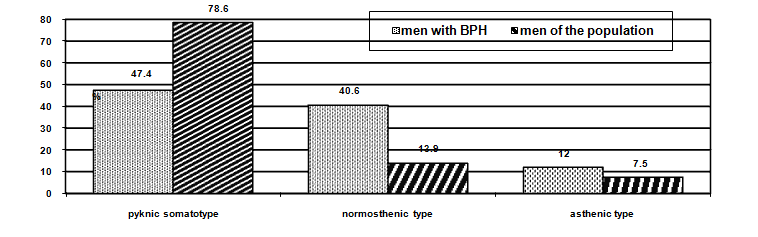
Determination of patient somatotype by Rees-Eysenck index showed that men of pyknic somatotype made up 47,4% (men of the population – 78,6%; Р<0,05), normosthenic type -40,6% (13,9%; Р<0,05), asthenic type - 12% (7,5%; Р<0,05). When comparing the frequency of somatotypes among patients with PA and men of the population there is a significant difference. Patients with BPH are presented in the majority by pyknic and normosthenic types, while among men of the population the pyknic somatotype considerably prevails. Data of these comparisons are shown on Figure 1.
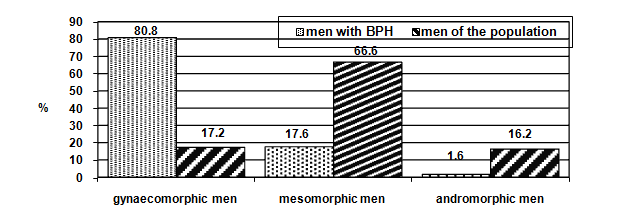
While identifying patient somatotypes by the index of Tanner it was found out that gynaecomorphic men amount 80,8% (men of the population - 17,2%; Р<0,05), mesomorphic ones - 17,6% (66,6%; Р<0,05) and andromorphic group made up only 1,6% (16,2%; Р<0,05).
In comparison with the population values there are striking differences. Gynaecomorphic men are in the majority among the patients and as for the andromorphic men - they are almost absent (Figure 2).
Conclusion
a. Among patients with BPH gynaecomorphic and mesomorphic groups are found predominantly. But gynaecomorphic somatotype is obviously dominating. Consequently, the balance of estrogen / androgen is of direct relevance to the etiology of the disease. We will dare to assume that PA is inherited in the same way, as expression of the gynaecomorphic features of the male constitution.
b. We state that male somatotype is directly related to the development of benign prostatic hyperplasia. References
1. Lopatkin AN (2009) Urology: national leadership.
Moscow, GEOTAR_Medif, pp: 1024.
2. Nikolaev VG, Nikolaeva NN, Sindeeva LV, Nikolaeva
LV (2007) Anthropological examination in clinical practice. Krasnoyarsk, LLC “Verso”, pp: 173.
3. Lukyanova IE, Ovcharenko VA (2008) Anthropology.
Moscow, INFA publ, pp: 240.
4. Nikolaev VG, Sharaykina EP, Sindeeva LV, Efremova
VP, Sapozhnikov VA (2005) Evaluation methods of individual and typological features of human physical development. KrasGMA, pp: 111.
5. Nikolaev VG, Sindeeva LV (2010) The experience of studying the formation of the morphofunctional status of the population in Eastern Siberia. Saratov Journal of Medical Sciences 6(2): 238-241.
6. Tanner D (1968) Growth and constitution of the person: trans. from English. / Harrison D, Uayner D, Tanner D, Barnikot N Human Biology, Moscow, pp: 247-326.
7. Sindeeva LV (2001) Characteristics of physical development parameters of the male population in older age groups. Synopsis of the thesis, Krasnoyarsk, pp: 28.
- Results of 6-Month Follow-Up of Patients After B-Turp and Thulep
- The Effect of Drinking Water with a High Content of Antimony and Arsenic on the Dynamics of their Distribution in the Kidneys and the Renal Excretory Function in Rats
- Effectiveness and Safety of Tansurethral Thulium Laser Enucleation of the Prostate in the Treatment of BPH: Review
- A Systematic Review on Molecular Pathophysiology Involved in Chronic Kidney Disease and the Role of Animal Models in Drug Discovery to Manage in Chronic Kidney Disease - An Update
- Functional Development of Kidneys in Human Ontogenesis
- Testicular Metastasis: Uncommon Prostate Cancer Case Report