
Pattern of Hearing Loss among Patients Attending Otorhinolaryngology Outpatient Department at Kathmandu University Hospital
Background: Hearing loss is a major health problem in developing country including Nepal. The prevalence of disabling hearing loss is greatest in South Asia followed by Asia Pacific and Sub-Saharan Africa. World Health Organization estimates that hearing loss affects over 360 million people worldwide. Objective: To analyze the pattern of hearing loss among patients attending Otorhinolaryngology outpatient department. Methods: This is a retrospective review of data retrieved from the record of Pure Tone Audiomtery (PTA) results from Department of Otorhinolaryngology in Dhulikhel Hospital, Kathmandu university hospital between 1st November 2014 to 31st October 2016.Total 1640 patients with hearing loss, who had undergone PTA were included in the study. The data were tabulated, analyzed and results were expressed in number and percentage.Results: Among 1640 patients with hearing loss, 964 (58.8%) cases were male, 676 (41.2%) were female 688 cases (41.9%) had unilateral involvement whereas 952(58.1%) cases had bilateral involvement. Number of right ear involved was 1321(50.9%) whereas left ear was 1271(49.1%).The commonest type of hearing loss was conductive type i.e. 1270(48.9%). In right ear, 598 cases (45.3%) were conductive, 455(34.4%) were sensorineural and 168(12.3%) were mixed. On left ear 572 (45%) were conductive, 490 (38.6%) were sensorineural and 209 (16.4%) were mixed. Mild hearing loss was seen in 1077 cases (41.6%), moderate in 833 (32.1%), severe in 457(17.6%), Profound in 225(8.7%). Common age group is between 20-30 years is 455(27.7%) and highest number was seen in newar ethnic group with 513 cases (31.3%).Conclusion: From this study we found that the commonest type of hearing loss is conductive and the commonest degree of hearing loss is Mild degree. The ear diseases are common but its diagnosis is usually delayed until the patient aware of their hearing loss. So the preventive measures like awareness programme, early diagnosis and appropriate treatment are needed to improve this situation.
Introduction
The sense of hearing enables to establish contact with each other through language. A person can learn to speak and express himself/herself through hearing. Hearing impairment and its effects are not visible to others, so person with hearing loss suffers in silence. Disabling hearing loss refers to a greater than 40 decibels (dB) hearing loss in the better hearing ear in adults [1, 2]. There are 360 million persons in the world with disabling hearing loss (5.3% of the world’s population) out of which 328 million (91%) of these are adults (183 million males, 145 million females) and 32 (9%) million of these are children. The prevalence of disabling hearing loss for adults and children is greatest in South Asia followed by Asia Pacific and Sub-Saharan Africa [3]. Nepal is a developing country in South Asia and has been listed as one of the least developed nations by United Nations [4]. 2011 (2068) census shows the hearing disability to be 15.45% out of 1.94% total disability in the Nepalese population. 1.48% suffers with a combined hearing loss and vision impairment. Speech problem was seen in 11.5% [5]. Hearing loss may be mild, moderate and severe to profound. It can affect one or both ears. Hearing loss can lead to social isolation and stigma, loneliness, embarrassment, depression, psychiatric disturbance, relationship difficulties, restricted career choices, relatively low earnings and occupational stress [2]. For the diagnosis of hearing loss, PTA is a simple diagnostic tool performed in day to day practice by the audiologists as per referred by the otorhinolaryngologists. Pure Tone Audiogram is easy to perform and gives valuable information regarding type, configuration of hearing loss and further management planning [6].
Method
This is a retrospective review of data retrieved from the record of Pure Tone Audiometry (PTA) results from Department of ENT in Dhulikhel Hospital between 1st November 2014 to 31st of October 2016. Total 1640 patients with hearing loss, who had undergone PTA were included in the study. PTA was performed by single audiologist using Eckstein Bros model 60 audiometer. PTA records of 1640 patients were tabulated and analyzed with MS EXCEL software. The results were expressed in number and percentage. Degree of Hearing loss was measured using WHO classification [1].
Results
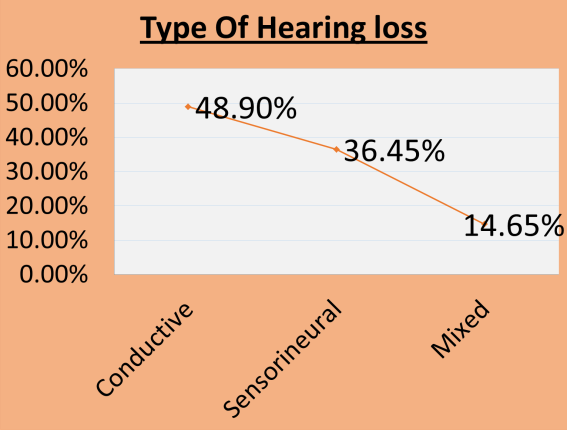
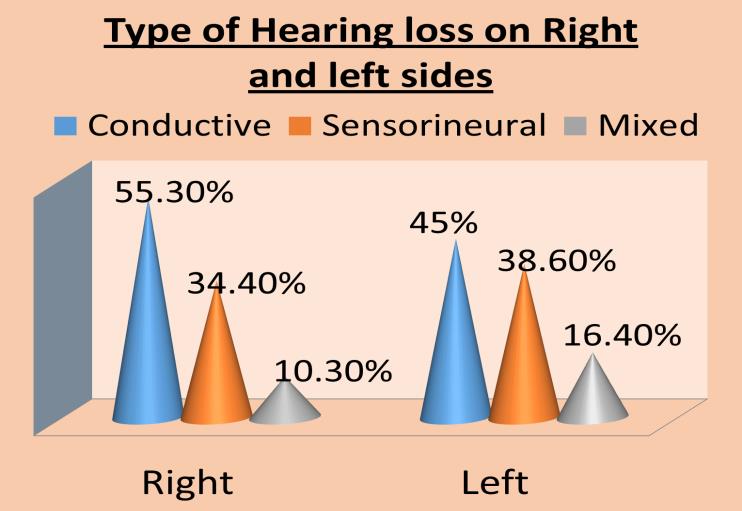
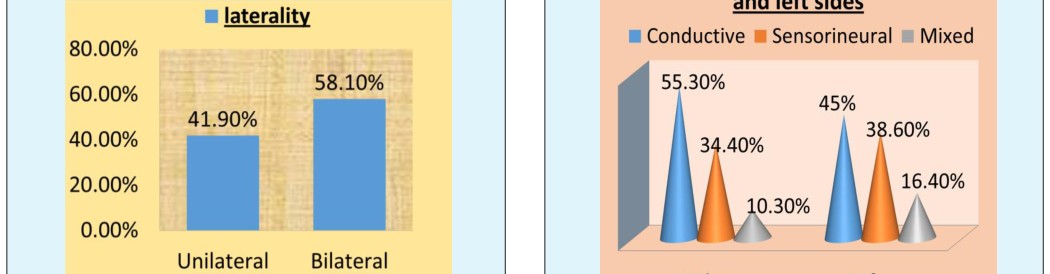
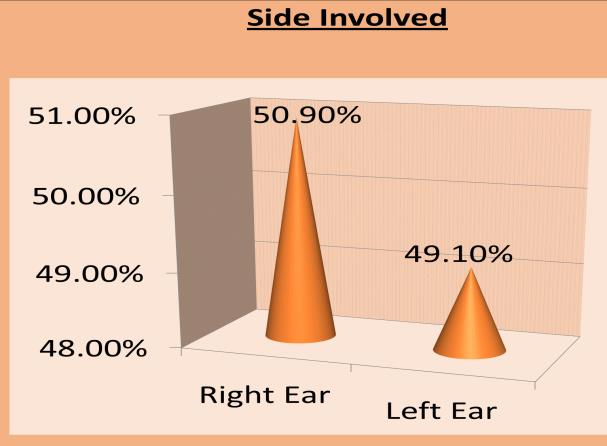
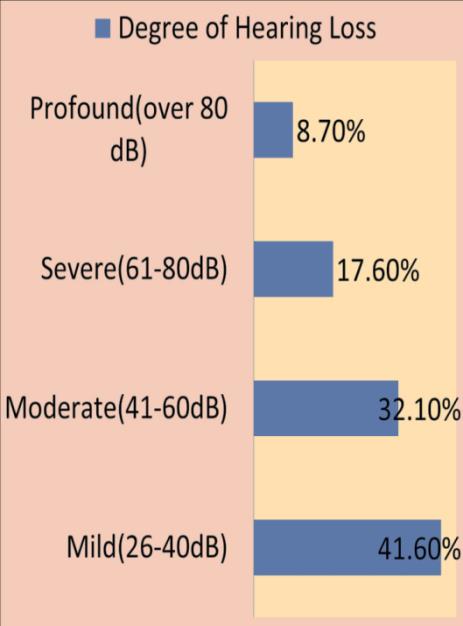
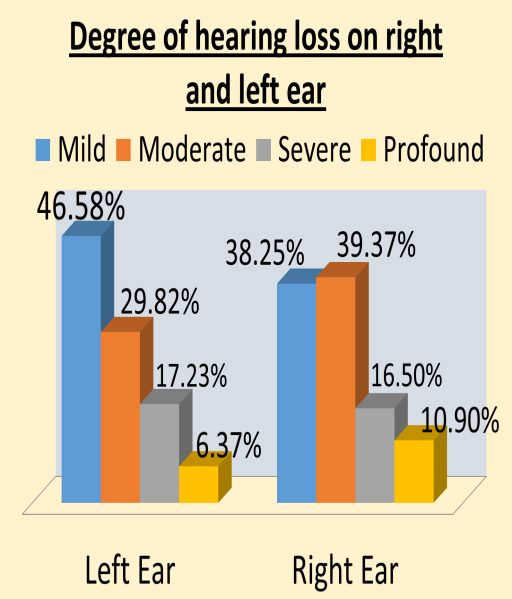
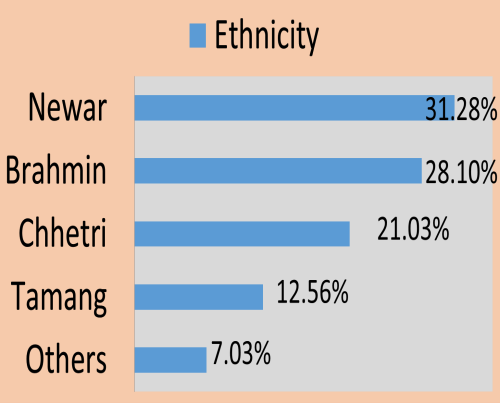
Among 1640 patients with hearing loss, 964 (58.8%) cases were male, 676 (41.2%) were female (Figure 1). 688 cases (41.9%) had unilateral involvement whereas 952(58.1%) cases had bilateral involvement (Figure 2). Number of right ear involved was 1321(50.9%) whereas left ear was 1271(49.1%) (Figure 3). The commonest type of hearing loss was conductive type i.e., 1270(48.9%) followed by sensorineural i.e. 945(36,45%) and mixed Hearing loss is seen in 377(14.65%) patients. In right ear, 598 cases (45.3%) were conductive, 455(34.4%) were sensorineural and 168(12.3%) were mixed (Figure 4). On left ear 572 (45%) were conductive, 490 (38.6%) were sensorineural and 209 (16.4%) were mixed (Figure 5). Mild hearing loss was seen in 1077 cases (41.6%), moderate in 833 (32.1%), severe in 457(17.6%) and profound in 225(8.7%) (Figure 6). On right ear, mild hearing loss was seen in 505 patients (38.23%), moderate was seen in 454 patients (39.37%), severe was seen in 218 patients (16.50%) and profound in 144 patients (10.90%) whereas on left ear mild hearing loss was seen in 592 patients (46.58%), moderate was seen in 279 patients (46.58%), severe was seen in 219(17.23%) and profound in 81(6.37%) (Figure 7). Common age group is between 20-30 years is 455(27.7%) as shown in Table 1. Highest number was seen in Newar ethnic group with 513 cases (31.3%) as shown in Figure 8.
| Age in Years | Number | Percentage | ||||||
|---|---|---|---|---|---|---|---|---|
| 0-10 | 69 | 4.20% | ||||||
| 10-20 | 219 | 13.35% | ||||||
| 20-30 | 455 | 27.74% | ||||||
| 30-40 | 313 | 19.08% | ||||||
| 40-50 | 136 | 8.29% | ||||||
| 50-60 | 167 | 10.18% | ||||||
| 60-70 | 182 | 11.09% | ||||||
| 70-80 | 76 | 4.63% | ||||||
| Above 80 | 23 | 1.44% | ||||||
| Total | 1640 | 100% |
Table 1: Highest number was seen in Newar ethnic group with 513 cases (31.3%) as shown in Figure 8.
Discussion
Hearing loss is a major public health burden in developing countries like Nepal. The prevalence of adult hearing impairment substantially higher in middle and low income countries than high-income countries [7]. WHO estimates 38,000 deaf children are born every year in South East Asian Region [8, 9]. The pattern of hearing loss may vary from community to community, place to place, one geographic region to other and from hospital to hospital. Knowledge of pattern of hearing loss can help health personnel to make the proper diagnosis and treatment as per requirement. Such study helps in timely detection of the disease and treatment, ultimately will help in reducing morbidity and improve quality of life. In the present study, maximum number of patients with hearing loss was seen in age group of 20-30 years and it is 27.74%. The next order was seen in age group of 30-40 and it is 19.08%, followed by 10-20 years which is 13.35%. Lowest incidence was seen in age group of above 80 years which is only 10%.This is in contrast to the study performed by Browning GG, et al. [10] which showed that the prevalence of hearing loss was highest in age group of 61-80 years followed by age group of 41-60 years which is 45.3%. This dissimilarity is due to lack of awareness about hearing impairment especially among elderly. Moreover, most of age related hearing problems are neglected by themselves and family members. In present study, maximum number of hearing loss seen in 20-30 years of age group followed by 30-40 years age group is due to higher level of awareness among patients of these groups. Early visit to hospitals among these age group even after mild hearing loss as these age group constitute working class of people and even slightest loss in hearing power may hamper their work. In addition exposure to sound is more among these groups. In present study, among 1640 patients with hearing loss, 964 (58.8%) were male and 676(41.2%) were female. The male: female ratio is 1.42. The study performed by Mishra, et al. [11] also found the higher incidence in male as compared to female. This finding is in accordance with other studies [12, 13]. The higher prevalence of disease in male has been attributed to their exposure to the outdoor activities and early medical advice seeked as compared to females. In present study bilateral involvement was seen in 58.1% and 41.9% had unilateral involvement. This result is consistent with the findings of studies performed by Quaranta A, Marcincuk MC, et al. [14, 15]. The number of right ear involvement was 50.9% and left ear involvement was 49.1%.This finding is in consistent with findings of Brookhouser PE, et al. [16]. In present study, the commonest type of hearing loss is conductive type 48.9% followed by sensorineural type which is 36.45% and mixed hearing loss is 14.65%. In right ear 54.3% was conductive, 34.4% was sensorineural and 12.3% was mixed. Similarly in left ear, 45% was conducitve, 38.6% was sensorineural and 16.4% was mixed. These findings are similar with that of study performed by Browning GG, et al. [10]. In this study Mild hearing loss was seen in 41.6%, followed by moderate in 32.1%, severe in 17.6% and profound in 8.7%.These findings are similar to that of study performed by Browning GG, et al. [10] The main limitation of our study is of retrospective type and the result will also be better if we correlate the hearing loss with ear disease.
Conclusion
Hearing impairment is one of the major health problems in country like Nepal. The ear diseases attributing to hearing loss are common. But in our context, the diagnosis is usually delayed until certain degree of hearing loss occurs. Improvement in health care delivery system and awareness programs can help in early diagnosis, treatment and rehabilitation of hearing impairment.
References
-
http:www.who.int/mediacentrefactsheet/fs300/en/i ndex.html.
-
Olusanya BO, Neumann KJ, Saunders JE (2014) The global burden of disabling hearing impairment: a call to action. Bull World Health Organ 92(5): 367-373.
-
WHO global estimates on prevalence of hearing loss, (National Report) (2012) Government of Nepal. National Planning Commission Secretariat, Central Bureau of Statistics Kathmandu, Nepal, 1: 1-4.
-
Rabbani SMG, Chowdhury MA, Shumon AM, Yasmeen N, Rashid M, et al. (2014) Pattern and causes of hearing loss among the patients attending in an ENT OPD. AKMMC J 5(2): 9-13.
-
Stevens G, Flaxman S, Brunskill E, Mascarenhas M, Mathers CD (2013) Global and regional hearing impairment prevalence: an analysis of 42 studies in 29 countries. Eur J Public Health 23(1): 146-152.
-
Monerio de Castro Silva I, Feitosa MA (2006) High frequency audiometry in young and older adults when conventional audiometry is normal. Rev Bras Otorhinolaryngol 72(5): 665-672.
-
Nasima A, Pran GD, Alauddin M (2010) Neonatal Hearing Screening. BJO 16(1): 54-59.
-
Browning GG, Gatehouse S (1992) The prevalence of middle ear disease in the adult British population. Clin Otolaryngol Allied Sci 17(4): 317-321.
-
Misra RN, Bhatia ML (1958) Tympanoplasty plastic surgery of the sound conducting apparatus of the ear. Indian J Otolaryngol Head Neck Surg 10(2): 62-83.
-
Kishve SP, Kumar N, Kishve PS, Syed MMA, Kalakoti P (2010) Ear, nose and throat disorders in paediatric patients at a rural hospital in India. AMJ 3(12): 786- 790.
-
Sigdel B, Nepali R (2012) Pattern of ear diseases among paediatric ENT patient: An experience from tertiary care centre, Pokhara, Nepal. J Nepal Paediatr Soc 32(2): 142-145.
-
Ouaranta A, Assennato G (1997) Cause of hearing loss in Italy. Audiological Newsletter 3: 31-33.
-
Marcincuk MC, Roland PS (2002) Geriatric hearing loss and providing appropriate treatment. Geriatrics 57(4): 44,48-50,55,56.
-
Brookhouser PE, Worthigton DW, Kelly WJ (1991) Unilateral hearing loss in children. Laryngoscope 101(12): 1264-1272.
- 4th Branchial Cleft Sinus Anomaly Presenting as Recurrent Thyroid Abscess in A Child: A Case Report
- Parotid Duct Injury Repaired Using an Angiocatheter Stent: A Case Report
- Organization and Functionality of the Referral and Counter-Referral System for ENT Disorders in District Hospitals of N’Djamena, Chad: A Cross-Sectional Analytical Study
- Facial Metastases from a Gastrointestinal Stromal Tumor: A Case Report
- Panorama of Ent Cancers and Literature Review: Epidemiological Profile and Therapeutic Management
- Could Antimicrobial Resistance Prove to Be Both a Threat and an Opportunity for us?