
A Clinicopathological and Microbiological Study of Chronic Otitis Media
Objective: To determine both tubotympanic and atticoantral disease in active chronic otitis media. To identify the microbiological species that cause these two categories, as well as their sensitive medications, by culture and sensitivity testing. Methods: This was a prospective observational cross-sectional study conducted on Fifty Chronic otitis media patients from the Department of Otorhinolaryngology at Jaipur National University during November 2021 to October 2023. An assessment of the clinical presentation and course of Chronic otitis media and analysis of the microbiological etiology of the disease was done. Clinical assessment included history taking, physical examination, and audiometric testing. Microbiological analysis included culture and susceptibility testing and molecular testing. Results: Fifty Chronic otitis media patients were included in the study and studied over the course of two years. There were 22 males and 28 females. The most common bacterial etiologies of Chronic otitis media were Streptococcus pneumoniae, Pseudomonas aeruginosa, and Staphylococcus aureus. A mucopurulent type of discharge was seen in most pseudomonas infections (50%). Acinetobacter (100%) and Staphylococcus (75%) both mostly discharged mucopurulent material. Conclusion: These results provide insight into the management of Chronic otitis media and highlight the importance of proper diagnosis and treatment of the condition.
Materials and Methods
This was a prospective observational cross-sectional study conducted on Fifty COM patients of various genders and ages in the Department of Otorhinolaryngology at Jaipur National University from November 2021 to October 2023. The study was conducted after getting prior approval from institutional ethics committee. Informed consent was obtained from the all patients and were randomly recruited for the research. Demographic data pertaining to age, sex, diagnosis was noted.
Inclusion Criteria
All instances of middle ear discharge lasting longer than three months.
Exclusion Criteria
Conditions that resemble COM includes Otitis externa and Acute otitis media.
History Taking and Examination Criteria
Each patient’s age, sex, residence, and clinical data, including major complaints, duration of symptoms, predisposing factors, and any prior therapy, were recorded on a case record form. The patient’s medical history also included diabetes, hypertension, and Tuberculosis, among others.
Sample Collection
In clinically identified instances of CSOM, ear discharge was collected using aseptic care. The external auditory canal was wiped free of excess discharge. The specimen was then obtained using a sterile swab and forwarded to the Microbiology Department with a request for culture and sensitivity.
Assessment through Direct Smear
A thin smear was prepared on a clean glass slide at the Microbiology Department, and the smear was fixed with 95%
methanol by pouring one or two drops into the smear and letting it sit for at least 2 minutes or until the methanol dried.
The prepared smears were Gram stained and studied using an oil immersion objective to identify the kinds of bacteria present, the number of bacteria, the Gram response, the presence or absence of inflammatory cells, and the percentage of squamous epithelial cells in the sample.
Aerobic Culture
To inoculate blood agar, nutritional agar, and MacConkey agar plates, the discharge was utilized. All the plates were placed in an aerobic environment and heated to 37 degrees Celsius. After 24 hours, 48 hours, and 72 hours, the plates were inspected for signs of development and discarded if no growth was found.
Standard laboratory approaches were applied to identify bacterial pathogens based on their microscopic appearance, staining features, cultural and biochemical properties.
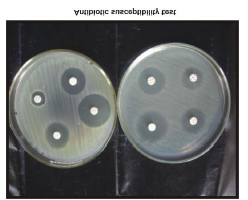
Using the Kirby-Bauer disc effusion technique, the sensitivity of bacterial isolates to frequently used antibiotics was determined. The concentrations of antibiotics used were: A-10 mg, Ak – 30 mg, Cb – 100 mg, Ci – 30mg.
Results
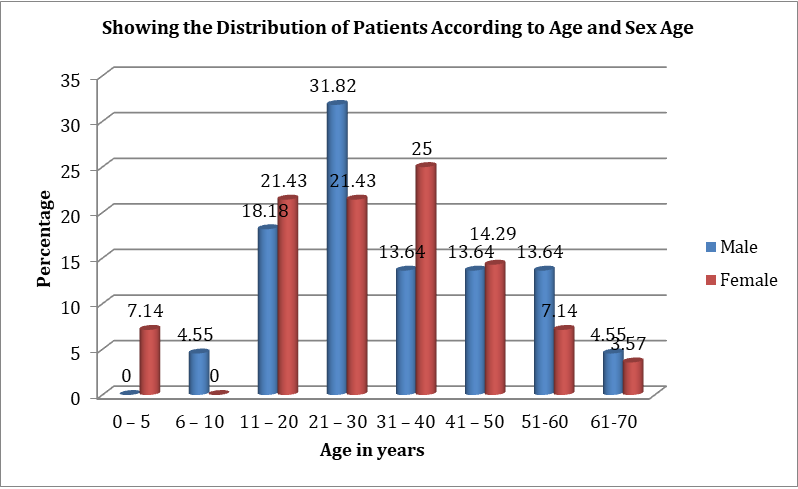
Fifty CSOM patients of various genders and ages were included in the study. There were 22 males and 28 females. 50 cases were chosen at random and studied over the course of two years. Demographic details of patients were illustrated in Table 1.
| Age in year | Male | % | Female | % |
|---|---|---|---|---|
| 0 – 5 | 0 | 0 | 2 | 7.14 |
| 6 – 10 | 1 | 4.55 | 0 | 0 |
| 11 – 20 | 4 | 18.2 | 6 | 21.4 |
| 21 – 30 | 7 | 31.8 | 6 | 21.4 |
| 31 – 40 | 3 | 13.6 | 7 | 25 |
| 41 – 50 | 3 | 13.6 | 4 | 14.3 |
| 51-60 | 3 | 13.6 | 2 | 7.14 |
| 61-70 | 1 | 4.55 | 1 | 3.57 |
| Total | 22 | 100 | 28 | 100 |
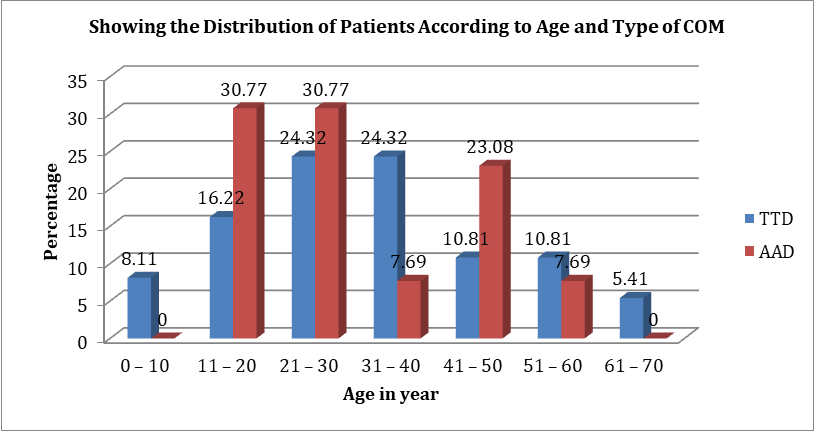
Table 2: Showing the Distribution of Patients According to Age and Sex.
| Age in year | Tubo-tympanic | % | Atticoantral | % |
|---|---|---|---|---|
| 0 – 10 | 3 | 8.11 | 0 | 0 |
| 11 – 20 | 6 | 16.2 | 4 | 30.8 |
| 21 – 30 | 9 | 24.3 | 4 | 30.8 |
| 31 – 40 | 9 | 24.3 | 1 | 7.69 |
| 41 – 50 | 4 | 10.8 | 3 | 23.1 |
| 51 – 60 | 4 | 10.8 | 1 | 7.69 |
| 61 – 70 | 2 | 5.41 | 0 | 0 |
| Total | 37 | 100 | 13 | 100 |
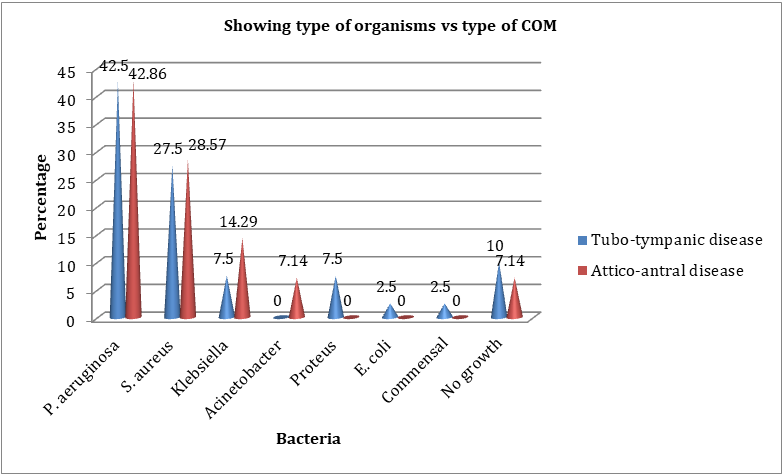
| Bacteria | Tubo-tympanic disease | Percentage | Attico-antral disease | Percentage |
| P. aeruginosa | 17 | 42.5 | 6 | 42.86 |
| S. aureus | 11 | 27.5 | 4 | 28.57 |
| Klebsiella | 3 | 7.5 | 2 | 14.29 |
| Acinetobacter | 0 | 0 | 1 | 7.14 |
| Proteus | 3 | 7.5 | 0 | 0 |
| E. coli | 1 | 2.5 | 0 | 0 |
| Commensal | 1 | 2.5 | 0 | 0 |
| No growth | 4 | 10 | 1 | 7.14 |
| Total | 40 | 100 | 14 | 100 |
Table 3: Showing the Distribution of Patients According to Age and Type of COM.
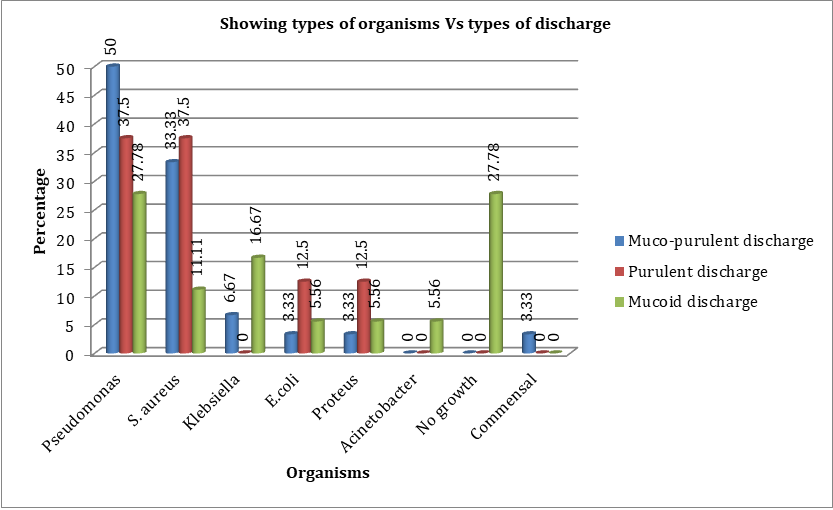
A mucopurulent type of discharge was seen in the majority of pseudomonas infections (50%).
Acinetobacter (100%) and Staphylococcus (75%) both mostly discharged mucopurulent material.
Infection with Klebsiella (66.67%) and E. coli (50%) often resulted in mucoid discharge. It is fascinating to learn that mucoid discharge was present in every case of no growth. The link between bacteria and discharge was evaluated using chi square, and it was shown to be statistically nonsignificant.
Pseudomonas has a high sensitivity to A (84.6), Cb (69.2%), and Ak (65.4%), with a maximum sensitivity to Ci (92.3%). S. aureus has high sensitivity for Ak (75%). Klebsiella has high sensitivity to Ci and A. (both being 83.3%). Acinetobacter has 50% sensitivity to A, Ak, Ci, and Cb. Coagulase negative staphylococcus had 100% sensitivity to Ak and high sensitivity to A. Proteus shown great sensitivity to Ak, Cb (66.7%), as well as 100% sensitivity to Cf and A. Ak, Cf, A caused 100% sensitivity in E. coli.
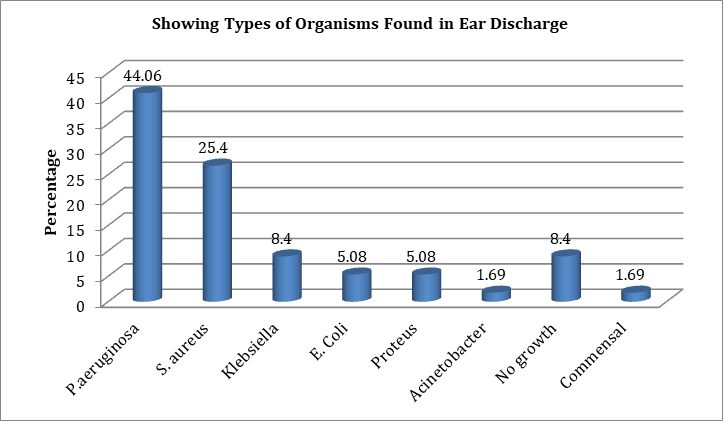
Total number of ears examined – 59 (Table 3)
| Organisms | Number of discharges | Percentage |
|---|---|---|
| P. aeruginosa | 26 | 44.06 |
| S. aureus | 15 | 25.4 |
| Klebsiella | 5 | 8.4 |
| E. Coli | 3 | 5.08 |
| Proteus | 3 | 5.08 |
| Acinetobacter | 1 | 1.69 |
| No growth | 5 | 8.4 |
| Commensal | 1 | 1.69 |
| Total | 59 | 100 |
Table 1: Showing Types of Organisms Found in Ear Discharge.
Some patients had more than one ear discharge, and each one was tested for bacteria separately. P. aeruginosa was found to be the most common bacterial infection (44.06%) among the patients. The least number of bacteria was Acinetobacter (1.69%). It is interesting to know that about 8% of the discharges didn’t have any bacteria. Majority of the infection among the study patients had tubo-tympanic disease (74%). Majority of the organisms were Gram negative organisms (68%) and Gram positive were (27%). 13% of the infection did not have any growth (Table 4).
Discussion
Klebsiella. In addition, a high prevalence of fungal species was also observed. Moreover, the study identified several risk factors, including age, immunosuppression, and chronic illness, that may increase a person’s risk of developing COM. The findings of this study can be used to improve the diagnosis, management, and prevention of COM. Moreover, the results can be used to support the development of new therapies to reduce the burden of this disease (Table 5).
A clinical, pathological and microbiological study of active chronic otitis media was conducted to gain insights into the etiology, pathogenesis, and clinical outcomes of this inflammatory ear condition. Results showed that the most common bacteria isolated from the middle ear fluid were Streptococcus pneumonia, P. aeruginosa, S. aureus, and
| Gram positive organisms | No. | Percentage | Gram Negative organisms | No. | Percentage |
|---|---|---|---|---|---|
| S.aureus | 15 | 93.75 | P.aeruginosa | 23 | 67.65 |
| Acinetobacter | 1 | 6.25 | Klebsiella | 5 | 14.71 |
| - | - | 0 | E. Coli | 3 | 8.82 |
| - | - | 0 | Proteus | 3 | 8.82 |
| Total | 16 | 100 | Total | 34 | 100 |
Table 4: Showing Distribution of Gram Positive and Gram-Negative Organisms.
In the developing world, chronic otitis media is regarded as a significant public health issue, and India is one of the countries with a high prevalence where immediate attention is required. It is a chronic condition that carries the potential of developing permanent consequences and is a significant contributor to avoidable hearing loss in both adults and children. Early microbiological identification promotes efficient therapy since chronic otitis media is a condition that has severe morbidity. Therefore, identifying infections and their pattern of antibiotic sensitivity will aid treating doctors in choosing the proper medications, therefore reducing complications and the emergence of resistance strains (Table 6).
| Organisms | Muco-purulent discharge | % | Purulent discharge | % | Mucoid discharge | % |
|---|---|---|---|---|---|---|
| Pseudomonas | 15 | 50 | 3 | 38 | 5 | 27.8 |
| S. aureus | 10 | 33.3 | 3 | 38 | 2 | 11.1 |
| Klebsiella | 2 | 6.67 | 0 | 0 | 3 | 16.7 |
| E. coli | 1 | 3.33 | 1 | 13 | 1 | 5.56 |
| Proteus | 1 | 3.33 | 1 | 13 | 1 | 5.56 |
| Acinetobacter | 0 | 0 | 0 | 0 | 1 | 5.56 |
| No growth | 0 | 0 | 0 | 0 | 5 | 27.8 |
| Commensal | 1 | 3.33 | 0 | 0 | 0 | 0 |
| Total | 30 | 100 | 8 | 100 | 18 | 100 |
Table 5: Showing Types of Organisms Vs Types of Discharge.
Because the bacteria that cause middle ear infections are becoming less sensitive to antibiotics and their patterns are changing, it has become very important to find the organism that is causing the disease. In this study, the number of people with COM was highest among those aged 11 to 20 (42%), then among those aged 0 to 10 (28%). Poorey V.K. and Iyer A.2’s (2002) study found that the most common age groups were the first and second decades of life, with the 1–10year age group being the most common (46%), which is different from our study [23]. In this study, 68% of the CSOM participants were men and 32% were women. This shows that COM happens in both sexes. The number of men to women was 2.1 to 1, which suggests that men were more common. In the current study, the disease was found to be more common in the low-income group (62%) than in any other group in society. Our study has some limitations, such as a limited sample size.
Conclusion
59 ears were examined out of 50 cases. In the present collection, only aerobic bacteria were isolated. The most prevalent organism isolated was P. aeruginosa, which was found in 26 (44.06%) samples, followed by S. aureus 15 (25.4%), Klebsiella in 5, E. coli in 3, Proteus in 3, and Acinetobacter in 1. Five (8.4%) of the discharge samples exhibited no growth, while one (1.69%) contained commensal. In the modern time of antibiotics, antibiotic resistance is becoming more prevalent. Human ignorance is the most major contributor to the evolution of antibiotic resistance. As soon as symptoms lessen, people cease taking antibiotics prior to the conclusion of treatment, allowing partly resistant microorganisms to thrive. Such conduct should be discouraged, and patients should be instructed to avoid it.
Therefore, it is crucial that each case of COM should be investigated bacteriologically to avoid the use of unnecessary antibiotics. This will undoubtedly aid in getting a dry ear and avoiding difficulties.
Sources of Financial Support
None
Conflict of Interest Statement
The authors declare no conflict of interest.
Ethical Standards
The authors assert that all procedures contributing to this work comply with the ethical standards of the relevant national and institutional guidelines on human experimentation (Indian- GCP, ICH-GCP, ICMR guidelines) and with the Helsinki Declaration of 1975, as revised in 2008.
References
-
Gebre AK (2015) Benefits and Risks of Fluoroquinolones Use In Pediatrics: A Review. International Journal of Life Sciences and Review (IJLSR) 1(5): 169-174.
-
(2019) Continuing education in veterinary practice. 41(7).
-
Yuan Y, Luo Y, Wu C, Zhang W (2022) Prognostic factors of hearing outcome in patients with chronic suppurative otitis media following tympanoplasty: a retrospective cohort study. Annals of Translational Medicine 10(21): 1169.
-
Brown MA, Jabeen M, Bharj G, Hinks TS (2022) Non- typeable Haemophilus influenzae airways infection: the next treatable trait in asthma? European Respiratory Review 31(165): 220008.
-
Yang J, Lyu J, Wang Y, Chen B, Xu J, et al. (2021) Comparison of Endoscopic Cartilage Myringoplasty in Dry and Wet Ears With Chronic Suppurative Otitis Media. Ear Nose & Throat Journal 102(4): NP177-NP182.
-
Pai KK, Omiunu AO, Peddu DK, Au VH, Baredes S, et al. (2022) Tuberculosis of the middle ear: A systematic review. American Journal of Otolaryngology 43(5): 103571.
-
Head K, Chong LY, Bhutta MF, Morris PS, Vijayasekaran S, et al. (2020) Antibiotics versus topical antiseptics for chronic suppurative otitis media. Cochrane Database of Systematic Reviews 2020(1): CD013056.
-
Matta S (2019) Role of High Resolution Computed Tomography Scan of the Temporal Bone in the Assessment of Ossicular Chain Status in Chronic Suppurative Otitis Media. 18(5): 1-3.
-
Siddiqui Y, Indurkar P, Maupachi SS, Ishteyaq A (2022) A Prospective Study of Clinicopathological Correlation in Patients with Chronic Suppurative Otitis Media in Vindhya Region. International Journal of Pharmaceutical and Clinical Research 14(4): 394-400.
-
SM Sc (2019) Master Thesis: Whole blood transcriptomic analysis in ANCA-associated vasculitis. pp: 1-63.
-
Gupta H (2012) Assessment of bacteriology and drug susceptibility in chronic suppurative otitis media in ENT outpatients. Indian Journal of Basic & Applied Medical Research 1(4): 403-408.
-
Indudharan R, Haq JA, Aiyar S (1999) Antibiotics in chronic suppurative otitis media: a bacteriologic study. Annals of Otology, Rhinology & Laryngology 108(5): 440-445.
-
Shariff MEA (2019) Analysis of hearing loss by pure tone audiometry in patients with chronic suppurative otitis media. National Journal of Physiology, Pharmacy and Pharmacology 9(6): 515-518.
-
Kumar D, Manorama S (2020) Intraoperatif status of ossicles in patients of chronic suppurative otitis media: a study of 150 cases. Journal of Dental and Medical Sciences 19(5): 21-24.
-
Wigger C, Leach AJ, Beissbarth J, Oguoma V, Lennox R, et al. (2019) Povidone-iodine ear wash and oral cotrimoxazole for chronic suppurative otitis media in Australian aboriginal children: study protocol for factorial design randomised controlled trial. BMC Pharmacology and Toxicology 20: 46.
-
Singh AK, Verma A (2020) Bacterial culture and antibiotics susceptibility in chronic suppurative otitis media at the secondary care hospital in North India. Europe PMC.
-
Robles-Marhuenda A, Álvarez-Troncoso J, Rodríguez- Pena R, Busca-Arenzana C, López-Granados E, et al. (2020) Chronic granulomatous disease: Single-center Spanish experience. Clin Immunol 211: 108323.
-
Chandrashekharayya SH, Kavitha MM, Handi P, Khavasi P, Doddmani SS, et al. (2014) To study the level of awareness about complications of chronic suppurative otitis media (CSOM) in CSOM patients. Journal of Clinical and Diagnostic Research 8(2): 59-61.
-
Pandey AK, Bhardwaj A, Maithani T, Kaintura M, Anjum F, et al. (2021) Tubercular otitis media: demystifying its nuances and an update on the tenets of emerging perspectives. International Journal of Otorhinolaryngology and Head and Neck Surgery 7(1): 112-120.
-
Wan Draman WN, Md Daud MK, Mohamad H, Hassan SA, Abd Rahman N (2021) Evaluation of the current bacteriological profile and antibiotic sensitivity pattern in chronic suppurative otitis media. Laryngoscope Investigative Otolaryngology 6(6): 1300-1306.
-
Abhilasha S, Viswanatha B (2019) Lateral sinus thrombosis with pneumocephalus: A rare complication of chronic suppurative otitis media. Journal of Otolaryngology-ENT Research 11(3): 166-169.
-
Hadi AA, Khammas AH, Abbas Alsaeed WM (2020) Bacteriological Study of Chronic Suppurative Otitis Media. Diyala Journal of Medicine 19(1): 120-129.
-
Poorey VK, Iyer A (2002) Study of bacterial flora in csom and its clinical significance. Indian J Otolaryngol Head Neck Surg 54(2): 91-95.
- 4th Branchial Cleft Sinus Anomaly Presenting as Recurrent Thyroid Abscess in A Child: A Case Report
- Parotid Duct Injury Repaired Using an Angiocatheter Stent: A Case Report
- Organization and Functionality of the Referral and Counter-Referral System for ENT Disorders in District Hospitals of N’Djamena, Chad: A Cross-Sectional Analytical Study
- Facial Metastases from a Gastrointestinal Stromal Tumor: A Case Report
- Panorama of Ent Cancers and Literature Review: Epidemiological Profile and Therapeutic Management
- Could Antimicrobial Resistance Prove to Be Both a Threat and an Opportunity for us?