
Pioneer Protocol for Monitoring Pesticides in Water, State of São Paulo, Brazil
Pesticides protect crops against pests, but are harmful to human health when ingested through contaminated food and water. While developed countries seek to ban the use of pesticides, developing countries use many of these chemicals, already banned in developed countries. Brazil is the world's largest producer of crops for humans and animals and the state of São Paulo is one of the largest consumers of these chemicals in the country. This research sought to create a methodology for the investigation of pesticides in water, avoiding unnecessary laboratory expenses, aiming at protecting human health.
Introduction
Pesticides destroy pests and weeds and are a widely used tool in agricultural practice in developed and developing countries, reducing losses in rural production. However, excessive use of these pesticides contaminates food leading to possible adverse effects of these chemicals on human health [1].
Many of these chemicals that have been banned by industrialized countries since the end of the 20th century are still used in developing countries [2]. There is epidemiological evidence of a relationship between pesticides and cancer, especially in workers who apply them to crops on a daily basis [3].
The European Union (EU) plans to reduce the global use of chemical pesticides by 50% by 2030 [4]. Brazil is a world leader in the production of food of plant origin, both for human and animal consumption. Agriculture and livestock are fundamental economic activities that maintain the positive balance of its economy. As a result, the registration and use of pesticides in Brazil has grown at an accelerated pace [5]. Antagonistic to the EU, Brazil has approved more pesticides and is the world leader in the use of these chemicals.
The state of São Paulo, Brazil, is the largest consumer of pesticides in the country. Water can be contaminated by these chemicals, exposing populations to risks.
Developing countries do not have a methodological protocol to define which pesticides are potential contaminants in their supply sources, causing unnecessary costs in laboratory analyzes and failures in monitoring. The objective of this research was the application of a pioneering methodology for defines these chemicals.
Methods
The pioneering protocol for monitoring pesticides in water was developed and applied in the state of São Paulo, located in the southeastern region of Brazil, which has an area of 248.209 km² (3.0% of the Brazilian territory) and a population of 44 million inhabitants. It is the most populous and economically richest state [6]. The location of the State of São Paulo is shown in Figure 1.
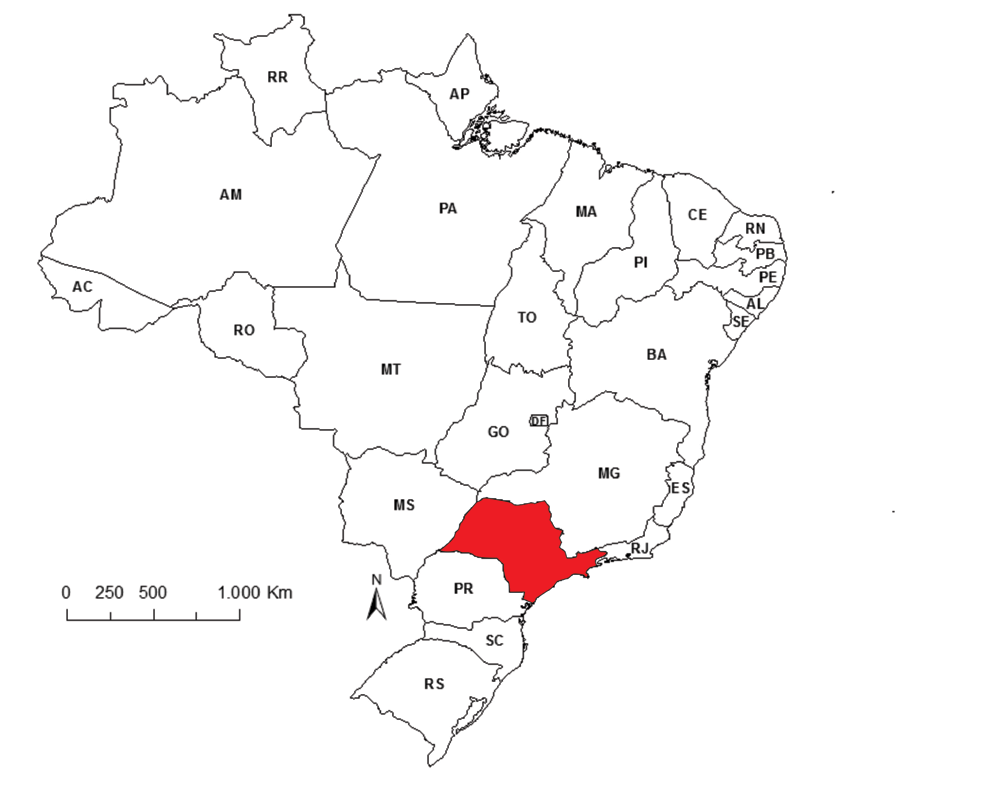
Figure1: State of São Paulo, Brazil
Data Survey
Data available in official Brazilian databases were verified. Based on these data, a methodological protocol was defined and applied in the state of São Paulo, for monitoring pesticides in drinking water, consisting of the steps: 1) Calculation of the semi-annual average of the volumes of the most sold pesticides in the last 5 years; 2) Mapping of river basins, main agricultural crops by basin and agricultural defensives most used in these plantations; 3) Identification of priority pesticides for water contamination; 4) Application of the main pesticide measurement indices in each of them: Groundwater (GUS), Leaching (LEACH) and Priority (PI); 5) Definition of priority pesticides for water monitoring To define priority pesticides, the list of pesticides approved for use in the country was used, with 491 active ingredients. Based on data on agricultural production in the state of São Paulo over a period of 5 years, available on the official website of the state government, the main agricultural crops were listed and the river basins were mapped.
The pesticides approved for commercialization in Brazil and the pesticides used in the main crops in the areas planted in the São Paulo state and therefore with potential for contamination of water basins were investigated.
Taking into account that the potential to find pesticides in bodies of water is influenced by different variables that include the volume of pesticides used, the application form and its behavior in the environment, it was used for the definition of priority pesticides the combination of three indexes: Groundwater Ubiquity Score – GUS, Leaching Index – LEACH and the Priority Index – IP. After the application of these indexes in each pesticide, there were elected the priority pesticides for water monitoring.
Results
Calculation of the semi-annual average of the volumes of the most sold pesticides in the last 5 years: Of the 491 active principles that are authorized for use in Brazil, 371 did not have all the information necessary for the calculation of indexes. There were 120 pesticides with highest sales volume and simultaneously with potential for water contamination were listed.
Mapping of water basins, main agricultural crops per basin and pesticides most used in these plantations and identification of priority pesticides for water contamination. There are 22 water basins. The main crops in terms of planted area in São Paulo state were brachiaria (41.0%), sugar cane (31.0%), and eucalyptus (5.0%), orange (4.0%) and others crops (19.0%). There are 10 main agricultural crops, with sugar cane representing more than 60% of the planted area in the state.
Application of the main pesticide measurement indexes in each one: Groundwater (GUS), Leaching (LEACH) and Priority (PI) and definition of priority pesticides for water monitoring. The results show that the indexes GUS, LEACH and IP prioritization produced a distinct from the pesticides studied, which was expected since they are based on information and different parameters. These results are shown in Table 1.
| Active ingredient | Ranking | GUS | Ranking | LEACH | Ranking | IP |
|---|---|---|---|---|---|---|
| Diuron | 15th | 3, 35E + 00 | 22 nd | 4,54E + 08 | 1st | 10,8 |
| Carbofuran | 12th | 3,49E + 00 | 31st | 5,81E + 07 | 2nd | 10,8 |
| Glyphosate | 48th | 3,17E-01 | 12th | 5,76E+11 | 3th | 10 |
| Atrazine | 7th | 4.40E + 00 | 25th | 1,88E + 08 | 4th | 9 |
| Imazetapir | 1st | 7,67E + 00 | 4th | 2, 91E + 15 | 5th | 8,4 |
| Imidacloprido | 5th | 4,74E + 00 | 6th | 7,74E+14 | 6th | 8,4 |
| Sulfentrazona | 6th | 4,47E + 00 | 8th | 1,57E +12 | 7th | 8,4 |
| Tebutiurom | 3rd | 6,31E + 00 | 16th | 1,69E+10 | 8th | 8 |
| Clorotalonil | 38th | 1,15E + 00 | 52nd | 2,06E + 04 | 9th | 7,9 |
| Acephate | 29th | 1,68E + 00 | 13th | 4,81E +11 | 10th | 7,2 |
| Methamidophos | 52nd | 0.00E + 00 | 19th | 3,54E + 09 | 11th | 7,2 |
| Imazapique | 2nd | 6,44E + 00 | 2nd | 4,26E +15 | 12th | 7,2 |
| Imazapir | 8th | 3, 95E + 00 | 5th | 9,20E +14 | 13th | 7,2 |
| Simazine | 17th | 3.00E + 00 | 29th | 9,08E + 07 | 14th | 7,2 |
| Clomazona | 18th | 2,93E + 00 | 41st | 2,07E + 06 | 15th | 7,2 |
| Cyromazine | 25th | 2,02E + 00 | 14th | 3,22E +11 | 16th | 6,6 |
| Azoxystrobin | 21th | 2,53E + 00 | 10th | 1.40E +12 | 17th | 6,2 |
| Glufosinate-ammonium salt | 33rd | 1,44E + 00 | 3rd | 3,83E +15 | 18th | 6 |
| Methomyl | 9th | 3,93E + 00 | 17th | 1,15E +10 | 19th | 6 |
| Diquate dibromide | 59th | -5,48E + 00 | 18th | 3,82E + 09 | 20th | 6 |
| Prometryn | 10th | 3.80E + 00 | 34th | 1,63E+07 | 21th | 6 |
| Linurom | 26th | 1,97 E +00 | 38th | 3,38E + 06 | 22th | 6 |
| Metolachlor | 23th | 2,45 + 00 | 40th | 2,31E + 06 | 23th | 6 |
| Aldicarb | 44th | 4,88E-01 | 45th | 1,45E + 06 | 24th | 6 |
| Chlorpyrifos | 51th | 4,53E-03 | 58th | 1,69 E+ 02 | 25th | 5,9 |
| Nicossulfurom | 13th | 3,44+ 00 | 1st | 7,03E+19 | 26th | 5,6 |
| Tebuconazole | 20th | 2,78E + 00 | 20th | 1,68E + 09 | 27th | 5,5 |
| Dimetomorfe | 30th | 1,62E + 00 | 27th | 1.40E + 08 | 28th | 5 |
| Quincloraque | 4th | 5,65E + 00 | 37th | 9,38E + 06 | 29th | 5 |
| Alachlor | 22th | 2,45E + 00 | 42nd | 1,67E + 06 | 30th | 5 |
| Endossulfam | 55th | -1,34E-01 | 55th | 4,09E + 03 | 31st | 4,9 |
| Halossulfurom-methyl | 16th | 3,26E + 00 | 7th | 2,24E +12 | 32nd | 4,8 |
| Setoxidim | 27th | 1,97 E +00 | 33rd | 2,33E+ 07 | 33rd | 4,8 |
| Propargito | 58th | -9,82E-01 | 53rd | 1,08E + 04 | 34th | 4,6 |
| Mancozeb | 50th | 6,68E-02 | 35th | 1,57E + 07 | 35th | 4,5 |
| Malathion | 41st | 7,33E-01 | 49th | 4,36E + 05 | 36th | 4,5 |
| Carbaryl | 37th | 1,16E + 00 | 44th | 1,49E + 06 | 37th | 4,4 |
| Dimethoate | 40th | 8,91E-01 | 21th | 5,51E + 08 | 38th | 4,3 |
| Thiophanate-methyl | 54th | 0,00E+00 | 43th | 1,66E+06 | 39th | 4,3 |
| Phosmet | 47th | 3,59E-01 | 50th | 9,27E + 04 | 40th | 4,2 |
| Fenarimol | 14th | 3,41E + 00 | 30th | 9,04E + 07 | 41st | 4,1 |
| Acetamiprido | 32nd | 1,46E + 00 | 39th | 2,81E + 06 | 42nd | 4 |
| Fipronil | 19th | 2,89E + 00 | 23th | 3,34E + 08 | 43th | 3,8 |
| Cresoxim-Methyl | 45th | 4,09E-01 | 47th | 5, 32E + 05 | 44th | 3,4 |
| Metidationa | 42nd | 7.00E- 01 | 48th | 4,88E + 05 | 45th | 3,4 |
| Propanil | 46th | 3,87E-01 | 46th | 6,46E + 05 | 46th | 3,2 |
| Fludioxonil | 31th | 1,59E+00 | 32nd | 3,89E + 07 | 47th | 3,1 |
| Propiconazole | 24th | 2.20E + 00 | 36th | 1,21E+07 | 48th | 3,1 |
| Permethrin | 57th | -8,78E-01 | 57th | 2,10E + 02 | 49th | 2,8 |
| Formetanato hydrochloride | 34th | 1,29E + 00 | 9th | 1,48E+12 | 50th | 2,5 |
| Metiram | 53rd | 0,00E+00 | 24th | 2,12E + 08 | 51th | 2,1 |
| Acibenzolar-S-Methyl | 43th | 5,77E-01 | 54th | 8,48E + 03 | 52nd | 2,1 |
| Cletodim | 39th | 9,23E-01 | 28th | 1,16E + 08 | 53rd | 2 |
| Dissulfotom | 36th | 1.22E + 00 | 56th | 2,88E + 03 | 54th | 1,8 |
| Triflumizol | 35th | 1,23E + 00 | 26th | 1,66E+08 | 55th | 1,6 |
| Amitraz | 56th | -7,14E-01 | 59th | 1,05E + 02 | 56th | 1,4 |
| Profenofós | 49th | 2,10E-01 | 51th | 3,10E + 04 | 57th | 0,9 |
Table1: Values of the indexes calculated and their ratings for the 57 active principles.
Through the application of the indexes in each pesticide, PI index was the most specific and sensitive, as it was the only one that admitted the sales volume for calculation. For water monitoring were defined the main pesticides in São Paulo state.
Discussion
The need to identify priority substances in order to monitor pesticide residues in the environment has been shown to be a major challenge for managing institutions due to the large number of active principles in use, which have specific properties about the behavior in the environment and the effects on human health [7].
Such challenge has been expanded in developing countries, not only as a result of the large number of licensed active principles, but also on grounds of disability public policies of restriction and control of economic and technological resources necessary. This challenge has been extended by these countries as being targets of banned products in developed countries [2, 8].
The Priority Index, which takes into account the volume of pesticides used and information about the methods of implementation may be more suitable for defining priorities of monitoring in surface water bodies by surveillance services of water for human consumption.
The sales volume is an indicator of the amount of pesticides used is a fundamental parameter and in this way, the IP is a more representative index in this case, in particular in developing countries such as Brazil, which do not have adequate information about the volume of pesticides that is effectively used in every culture and also, there are no effective programs of control of the use of pesticides.
Conclusions
In contexts where the volume of sales of pesticides is the main data, the PI index is the best measure. This methodological protocol is relevant especially for developing countries in the definition of pesticide monitoring in springs, avoiding unnecessary laboratory expenses, monitoring risks and protecting health.
References
-
(1994) Journal of Environmental Pathology, Toxicology and Oncology: Official Organ of the International Society for Environmental Toxicology and Cancer 13(3): 151- 161.
-
(1990) Occupational exposures in insecticide application and some pesticides. Presented at IARC Working Group on the evaluation of carcinogenic risks to humans: occupational exposures in inseticide application, Lyon. International Agency for Research on Cancer.
-
Dich J, Zahm SH, Hanberg A, Adami OH (1997) Pesticides and cancer. Cancer Causes Control 8(3): 420-443.
-
Mc Ginley J, Healy MG, Ryan PC, Driscoll HO, Morrison L, et al. (2023) Impact of the historical legacy pesticides on achieving legislative goals in Europe. Science of the total environment. 873: 162312.
-
Silva ACG, Sousa IP, Santos TRM, Valadares MC (2020) Assessing Agricultural Toxicity in Brazil: Advances and Opportunities in the 21st Century. Toxicological Sciences 177(2): 316-324.
-
IBGE (2023) Brazilian Institute of Geography and Statistics.
-
(2011) Denifizione di liste di priorità per i fitofarmaci nella pregettazione Del monitoraggio delle acque di cui al D. Lgs 152/2006 e s.m.i. ISPRA-Istituto Superiore per la protezione e la ricerca ambientale.
-
Perez F, Moreira JC (2003) É veneno ou remédio? Agrotóxicos, saúde e ambiente. Rio de Janeiro. pp: 384.
- Intersecting Epidemics and Climate Vulnerabilities in Conflict- Driven Displacement: Epidemiology, Systemic Challenges, and One Health Gaps in South Sudan
- Advancing Domestic Health Financing for Community Health System Sustainability in South Sudan: The Boma Health Initiative Model (2025–2035)
- Prevalence and Correlates of Post-Exposure Prophylaxis Uptake among Men Who Have Sex with Men in Kisumu County, Kenya
- Medical, Ethical, and Legal Conflicts Surrounding Euthanasia in Argentina. Its Global Implications
- Knowledge and Attitude on Menstrual Hygiene among Adolescent Girls Studying in Secondary Level in Public Schools of Chitwan District, Nepal
- Biological Efficacy of an Adulticide Mixture (clothianidin + deltamethrin) as an Indoor Residual Spray against Adult Anopheles flavirostris in Palawan, the Philippines