
What Does a College Attending Men’s Community Perceive about Transgender Women? - A Non-Experimental Qualitative Study
Aim: To observe, describe and determine the attitude and attractiveness/likeability as a romantic partner/friend of heterosexual men attending one U.S. institution towards transgender women. To describe how do they categorize themselves. Methods: It is a non-experimental qualitative research study. Participants were selected based on both convenience and homogenous snowball sampling. A total of two (2) focus groups consisting of 10 heterosexual males between the ages of 21-29 volunteered for the study. Conducting a focus group was used as our primary data collection method for the study. Each participant was interviewed and engaged in an organized group discussion that was monitored and recorded by the male moderator who was certified to conduct human subject researches through the National Institute of Health (NIH). ATLAS.ti. 8 and SPSS version 25 were used for data analysis. The study is institutional approved. Results: Heterosexual male tend to have a more negative attitude towards Male to Female transgender as compared to Female to male. Homophobia exist amongst heterosexual male and is the major reason they avoid any relationship or association with a transgender woman. Conclusion: The study is aimed to increase the knowledge of transgender women especially in a college/institutional setting. Ultimately, being transgender does not take away from the fact that they are living and breathing humans. Our overall impact for this research is to bring about awareness of the perceptions of heterosexual men towards transgender individuals to promote future research that would break down the barriers of prejudice towards transgender and broaden our overall knowledge of their lifestyle.
Naiya Patel* and Neel Patel
Email: naiya.patel2014@gmail.com; orcid ID- https://orcid.org/0000-0003-4901-0130
themselves.
ATLAS.ti. 8 and SPSS version 25 were used for data analysis. The study is institutional approved.
association with a transgender woman.
broaden our overall knowledge of their lifestyle.
Keywords: Transgender Woman; Heterosexual Men; Transphobia; Public Health
Purpose of Study
Analysts have gained massive ground in comprehension and clarifying sexual preference, or bias against gay, lesbian, and cross-sexual individuals, but less is known about in the elements that fuel bias and victimization of trans people, who are additionally seen as being ‘sexual orientation non-conformists’ [1, 2]. Recent correlational investigations of biased states of mind toward transpeople, now and then called transphobia, have started to fill in the holes of our constrained information [3]. For example, transphobia tends to be more grounded among Hong Kong undergraduates than Canadian school students [3].
Examiners in Poland, and the United Kingdom demonstrate that transphobia is connected with sexual preference, abnormal amounts of religiosity or religious fundamentalism, less contact with trans people or sexual minorities, a conviction that there is not a natural premise to transgendered conduct, sexist dispositions, and more stereotyped opinions about sex parts [4, 5]. In this way, the primary role of our study is to inspect the impacts of sex, and facial appearance of a speculative transgender on heterosexual undergraduate levels of transphobia.
The current study focuses on attitudes of heterosexual men, their perception of masculine and feminine features and how they react if they are informed that the person they are introduced to is a transgender woman. Moreover, the study also focuses on behavioral theories of self- categorization and social cognitive theory which will help understand heterosexual men perception about how they categorize themselves and whom do they view as a model. Numerous individuals see sexual orientation and sex through a dichotomous lens; there are just two genders and only two sexes, and the genders must match with the "right" sexes to be viewed as ordinary.
Theoretical Approach
We Used Two Theories to Understand Prejudice towards Transpeople
Self-Categorization Theory: The Self-categorization theory is a social psychological theory that describes the circumstances under which a person will perceive collections of people (including themselves) as a group, as well as the consequences of perceiving people in group terms. Although the theory is often introduced as an explanation of psychological group formation (which was one of its early goals), it is more accurately thought of as a general analysis of the functioning of categorization processes in social perception and interaction that speaks to issues of individual identity as much as group phenomena [6]. Social Cognition Theory: Social cognitive theory (SCT), used in psychology, education, and communication, holds that portions of an individual's knowledge acquisition can be directly related to observing others within the context of social interactions, experiences, and outside media influences. The theory states that when people observe a model performing a behavior and the consequences of that behavior, they remember the sequence of events and use this information to guide subsequent behaviors. Observing a model can also prompt the viewer to engage in behavior they already learned [7]. In other words, people do not learn new behaviors solely by trying them and either succeeding or failing, but rather, the survival of humanity is dependent upon the replication of the actions of others. Depending on whether people are rewarded or punished for their behavior and the outcome of the behavior, the observer may choose to replicate the behavior modeled.
Relevance
One element and significant issue focused on in this research is the number of hate crimes committed towards trans people. This research can bring awareness to transgender population and culture [8].
Another element that has gotten insufficient consideration in the analysis of mentalities toward transgender people is physical appearance. This is reasonably shocking because spectators can observe that the physical appearance of some trans people, for example, a man who cross-dresses, does not comply with sexual orientation standards [8]. Physical appearance, specifically the face, is one of the primary parts of a man that is noticed, and it serves as a reliable sign for arranging individuals regarding their sex and sexual orientation [9]. For example, facial attraction, for men, relies on having manly attributes, i.e. a long, expansive lower jaw and more purported cheekbones and eyebrow edges and for ladies on having female qualities, for example, fuller lips, larger eyes, and smooth hair and skin [10, 11]. Having the capacity to convincingly show the physical appearance of the sought sex might be critical to a transsexual individual's ability to ‘keep up’ with societal standards [12, 13]. Therefore, physical appearance might be a conceivably intense part in the reactions that transgender people inspire from others, which thus might influence states of mind and cause twisted perceptions toward transgender individuals.
Aim
- To observe, describe and determine the attitude and attractiveness/likeability as romantic partner/friend of heterosexual men attending one U.S. institution towards transgender women.
- To describe how do they categorize themselves.
In the current study, we manipulated the facial appearance of hypothetical male to female (MTF) transgender to be either congruent or incongruent (i.e., a feminine- appearing masculine) with the desired gender. Heterosexual men college students rated the transgender on two dimensions:
Hence, we aim to understand what attitude do heterosexual men have towards transgender women.
Research Design
The idea of this research is to gain insight into the minds of heterosexual males and their view on transgender women through a focus group. We explored the depth of their perception through a non-experimental qualitative research study. The primary waves of measurement that we used for this research study were to observe and document a focus group through a series of questions. This design allowed us to carefully monitor the participants’ behavior and attitudes as they were being questioned and analyzed. Please note that no treatment or intervention was integrated into the study. The research is institutional approved.
Recruitment Methods
Participants were selected based on both convenience and homogenous snowball sampling. Convenience sampling allowed us, to enlist male participants based on availability, access, and profile. After the participants were initially screened, we verified their eligibility to participate. The eligibility requirements were as follows:
- Male
- All race and ethnicity attending institution
- Between the ages of 20-35
- Heterosexual Utilizing homogeneous sampling for this research allowed us to focus on participants with similar backgrounds (i.e., male, institution students), reduced variation and facilitated group interviewing. We encouraged all participants to outreach to other fellow students who meet the requirements that were willing to also participate in the study. As a token of appreciation and willingness to participate, we conducted a raffle of two (2) movie tickets to watch any showings of their choice [14]. After initial approval from campus authority, Flyers for recruitment were posted and distributed throughout the campus.
Sample Size
A total of two (2) focus groups consisting of 10 heterosexual males between the ages of 21-29 volunteered for the study.
Data Collection Method
Conducting a focus group was used as our primary data collection method for the study. Each participant was interviewed and engaged in an organized group discussion that was monitored and recorded by the male moderator who was certified to conduct human subject researches through the National Institute of Health (NIH). We didn’t want to influence the responses of the male participants by involving a female moderator in the room. We also distributed donuts at the beginning of the interview process, as promised in our flyer.
Audio recording participants during the interview helped us to identify who is speaking and allowed us to replay the sessions. Note taking captured certain non- verbal behaviors while viewing the pictures of transgender women that were not picked up when participants were recorded. The focus group guide was developed referring similar studies [8, 15, 16] and manuals for developing focus group guide [17, 18, 19]. The final version of the focus group guide was reviewed and verified by the PhD expert in this field, who has developed similar focus group guides previously.
Analysis Plan
We focused on the frequency distribution for analysis of demographics which was analyzed using SPSS version 25. Qualitative analysis of our data was done by using ATLAS. Ti. Version 8 by using audio record and images used to show focus group.
Results
| Statistics | |||||
|---|---|---|---|---|---|
| Student at LIU | Age | Race | Commuter | ||
| N Valid | 20 | 20 | 20 | 20 | |
| Missing | 0 | 0 | 0 | 0 | |
| Mean | .00 | 22.25 | 2.05 | .2 | |
| Std. Error of Mean | .000 | .676 | .328 | .092 | |
| Median | .00 | 21.05 | 2.00 | .00 | |
| Mode | 0 | 20 | 0 | 0 | |
| Std. Division | .000 | 3.024 | 1.468 | .410 | |
| Minimum | 0 | 19 | 0 | 0 | |
| Maximum | 0 | 28 | 5 | 1 | |
| Sum | 0 | 445 | 41 | 4 |
Table 1: Frequency distribution analyzed in SPSS 25.
Discussion
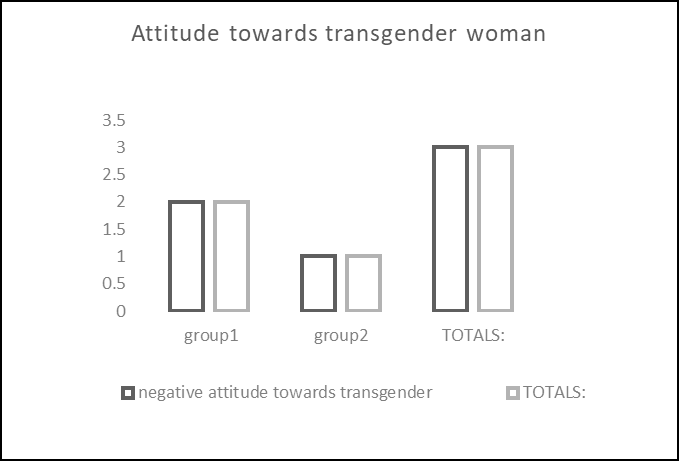
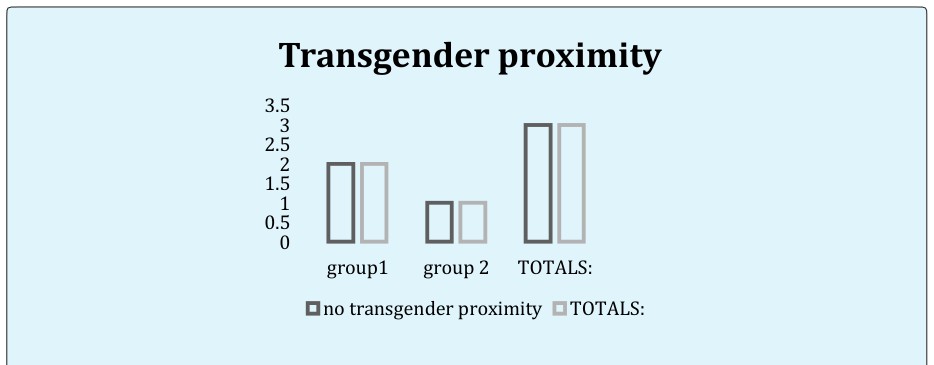
Heterosexual men have a negative attitude towards gender violation. During the focus group sessions, some of the male participants reflected certain non-verbal expressions like frowning, raising eyebrows, while looking at the pictures of some of the well dressed transgender women. They were not informed which of the pictures they have are of a transgender woman. On being asked what features of a woman, in particular, make them attracted towards them, some answered fuller lips, smile, prominent cheekbone, while others mentioned turn offs like fake eyelashes, fake nipples, fake eyebrows, too much longer nails and too much makeup. Through the responses asked for the pictures it was determined, the heterosexual male was able to differentiate a transgender woman from biological through some specific facial features like broad manly face, manly hands, too much make up to recontour the face, facial hair and last but not the least, the pattern of walking. While some of the pictures of a transgender woman appeared as attractive as a biological woman, some of the respondents were not able to differentiate between transgender women and biological women due to fine makeup, hormonal therapy, etc.
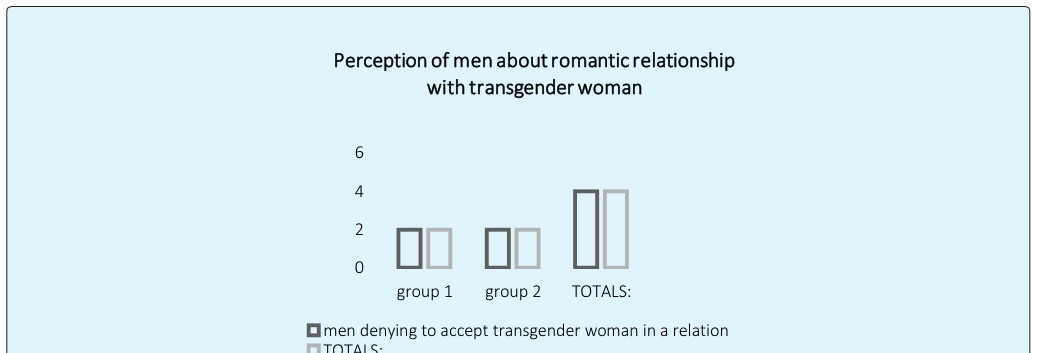
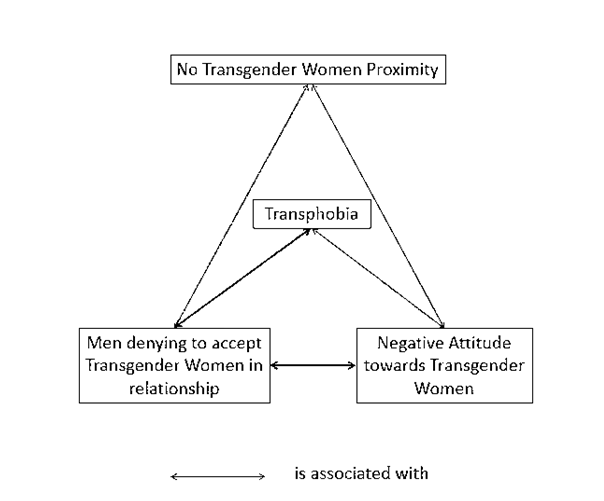
On being asked about involvement in a romantic relationship, some male participants responded assertively about why they would avoid being in any form of relationship with the transgender woman. One of the respondents added about a reality show in which one of the two partners of a romantic relationship, finds out that the other is a transgender woman and stabs the partner violently. On being asked to that respondent if it was ok to do so? The respondent assertively said “of course! Why not? If I were one of the partners, I would have probably done the same thing as it is a form of deception and they feel cheated if the transgender woman at first place would not mention they're true identity.” Other respondents mentioned societal norms and how they would not accept their kid who was born male but would express the feeling to be transformed into a woman. Even if they would want to accept their kid, they would never reveal it to the society as the society divides any human being into only two genders biologically. “Rest other forms like transgender are considered to be a mental illness according to the society.” Through the study, it was determined that Transphobia is evoked in men when Male to Female (MTF) transgender pose a threat to their masculinity. They do not feel ok if some male cross-dresses as a woman and reflects weakness for the rest of the gender society. To them, men are supposed to be comparatively stronger physically as compared to a woman.
Lastly, they feel less homophobic/transphobic in the presence of a Female to Male (FTM) transgender as compared to Male to Female (MTF) transgender.
Strengths and Limitations
Qualitative research is used to gain an understanding of underlying reasons, opinions, and motivations. It is also used to uncover the trends in thought and opinions, and dive deeper into the problem [20]. High validity and a positive rapport between the interviewer and interviewee are examples of our qualitative study. High validity allowed participants to discuss the topic in depth freely, while positive rapport was a simple, yet efficient way of retrieving data on information that cannot be easily observed as mentioned in paper by Harrell & Bradley [17]. Focusing on male of single institutional students as our primary population could be considered as a limitation and a disadvantage of the overall study. Another flaw of this study could be the honesty of the focus group. Other limitations can also include availability and willingness to share thoughts on the perception of the male, as well as cultural differences amongst the group.
Implications of the Study
The study is aimed to increase the knowledge of transgender women especially in a college/institutional setting. Due to the relative lack of information on attitudes toward trans people, many hypotheses have been derived from research on attitudes toward gay men [21]. Clearly, trans people do not easily fit into feminine/masculine dichotomies and they challenge us to understand better the gender diversity that exists among humans [21]. Once the perception/transphobia level is measured one can operate on how heterosexual men feel about transgender women. It will allow for a more precise insight into how insecure heterosexual men feel about their masculinity in the presence of transgender women [8].
The evaluations made by the men will help understand what misconceptions they are carrying in their mind about trans people [8]. It will enhance further literature; where there is little to no research work done on the perception of heterosexual men about transgender women. Using Modern technology as storytelling communication strategy might help raise awareness [22] towards transphobia and transgender women in general.
Institutional Implications
The overall impact our research could promote is some positive changes regarding the perceptions of heterosexual men towards transgender individuals especially a transgender woman. As mentioned earlier, there were quite some fatalities that have occurred against the transgender population. Some of the correlations made regarding the violent actions of the heterosexual men towards these transgender individuals were the concept of transphobia, the limited knowledge that we have on the transgender population, and the prejudice that heterosexual men currently have Kite & Whitley [23]. Although there have been historical changes made towards the protection of transgender individuals, there is a conflict amongst the heterosexual and transgender populations based on some of our existing societal norms, such as the physical/anatomical factors and how we perceive ourselves as men and women. Using flipped classroom teaching technique might help transgender college going population or heterosexual college going men, to open and facilitate discussion [24, 25].
Our overall impact for this research is to bring about awareness of the perceptions of heterosexual men towards transgender individuals to promote future research that would break down the barriers of prejudice towards transgender and broaden our overall knowledge of their lifestyle. Ultimately, being transgender does not take away from the fact that they are living and breathing humans. It's not understood that they are just like any other person; it's the fact that they are not accepted as any other person. There is a big difference between understanding and acceptance and until those two concepts (understanding and acceptance), prejudice and violent acts will be taken towards the transgender population [26]. This research is one of many that will help break down the barriers of prejudice towards the transgender individuals. We are currently focusing on heterosexual men's perceptions of transgender individuals, but we are hoping to spark more awareness and more research such as this amongst all of the existing populations that have prejudicial ideals towards transgender, including heterosexual women, homosexuals, lesbians, and bisexuals. The long-term goal is that our research will help society break down their barrier and leads us closer to equality amongst all sexual orientations. The short-term goal is that we wish that our research becomes a stepping stone for those who wish to take this research even further, to start paving the way towards the long-term goal. The current research could bridge the gap of translation to real world setting through several intervention designs, like classroom setting as mentioned in a paper by Patel N [25]. It would help create awareness for safer learning environment for transgender population [27].
Acknowledgment
Special thanks to my research team Arianna Mann, Jared Halman, Heather Asante and the course professor Dr. Brian Gilchrist who reviewed the Focus group guide particularly alongside guiding through each and every step of the research project.
Ethical Approval
The study was institution approved and was performed as a part of academic requirement. All procedures performed in studies involving human participants were in accordance with the ethical standards of the institutional research committee and with the 1964 Helsinki declaration and its later amendments or comparable ethical standards.
References
-
Blashill A, Powlishta K (2009) The impact of sexual orientation and gender role on evaluations of men. Psychol Men Masculinity 10(2): 160-173.
-
Holmes S, Cahill S (2004) School Experiences of Gay, Lesbian, Bisexual and Transgender Youth. J Gay & Lesbian Issues Educat 1(3): 53-66.
-
Winter S, Webster B, Cheung P (2008) Measuring Hong Kong Undergraduate Students’ Attitudes towards Transpeople. Sex Roles 59(9-10): 670-683.
-
Antoszewski B, Kasielska A, Jedrzejczak M, Kruk- Jeromin J (2007) Knowledge of and attitude toward transsexualism among college students. Sexuality Disability 25(1): 29-35.
-
Tee N, Hegarty P (2006) Predicting opposition to the civil rights of trans persons in the United Kingdom. J Community Appl Social Psychol 16(1): 70-80.
-
Van Lange PA, Kruglanski AW, Higgins ET (2011) Handbook of theories of social psychology. SAGE publications V2.
-
Norman P, Conner M (1996) The role of social cognition models in predicting health behaviours: Future directions. Predicting health behaviour: Research and practice with social cognition models, pp: 197-225.
-
Gerhardstein K, Anderson V (2010) There’s More Than Meets the Eye: Facial Appearance and Evaluations of Transsexual People. Sex Roles 62(5-6): 361-373.
-
Mason M, Cloutier J, Macrae C (2006) On Construing Others: Category and Stereotype Activation from Facial Cues. Social Cognition 24(5): 540-562.
-
Fink B, Penton-Voak I (2002) Evolutionary Psychology of Facial Attractiveness. Current Directions Psychol Sci 11(5): 154-158.
-
Thornhill R, Grammer K (1999) The Body and Face of Woman. Evolution Human Behavior 20(2): 105-120.
-
Kockott G, Fahrner E (1988) Male-to-female and Female-to-male transsexuals: A comparison. Archives Sexual Behavior 17(6): 539-546.
-
Money J, Brennan J (1970) Heterosexual vs. homosexual attitudes: Male partners' perception of the feminine image of male transexuals. J Sex Res 6(3): 193-209.
-
Grant R, Sugarman J (2004) Ethics in Human Subjects Research: Do Incentives Matter? J Med Philosophy 29(6): 717-738.
-
Herek G (1988) Heterosexuals' attitudes toward lesbians and gay men: Correlates and gender differences. J Sex Res 25(4): 451-477.
-
Weinberg M, Williams C (2010) Men Sexually Interested in Transwomen (MSTW): Gendered Embodiment and the Construction of Sexual Desire. J Sex Res 47(4): 374-383.
-
Harrell M, Bradley M (2009) Training Manual: Data Collection Methods.
-
Watjen J, Mitchell R (2012) College Men’s Concerns about Sharing Dormitory Space with a Male-to- Female Transsexual. Sexuality Culture 17(1): 132- 166.
-
Qualitative Data Collection (2018) Methods in Research.
-
DeFranzo S (2018) Difference between qualitative and quantitative research.
-
Roughgarden J (2013) Evolution's Rainbow: Diversity, Gender, and Sexuality in Nature and People, 3rd (Edn.), University of California Press.
-
Patel N, Patel N (2017) Modern technology and its use as storytelling communication strategy in public health. MOJ Public Health 6(3): 00171.
-
Kite, M., & Whitley, B. (1998). Stigma and Sexual Orientation: Understanding Prejudice against Lesbians, Gay Men and Bisexuals. 4th (Edn.), Sage Publications, pp: 39-60.
-
Berić-Stojšić B, Patel N, Blake J, Johnson D (2019) Flipped Classroom Teaching and Learning Pedagogy in the Program Planning, Implementation, and Evaluation Graduate Course: Students’ Experiences.
-
Patel N (2018) Bridging the gap of translation research in public health-from research to real world. MOJ Public Health 7(6): 347-349.
-
Ellis S, Kitzinger C, Wilkinson S (2003) Attitudes Towards Lesbians and Gay Men and Support for Lesbian and Gay Human Rights Among Psychology Students. J Homosexuality 44(1): 121-138.
-
Herek G (2007) Confronting Sexual Stigma and Prejudice: Theory and Practice. J Social Issues 63(4): 905-925.
- Intersecting Epidemics and Climate Vulnerabilities in Conflict- Driven Displacement: Epidemiology, Systemic Challenges, and One Health Gaps in South Sudan
- Advancing Domestic Health Financing for Community Health System Sustainability in South Sudan: The Boma Health Initiative Model (2025–2035)
- Prevalence and Correlates of Post-Exposure Prophylaxis Uptake among Men Who Have Sex with Men in Kisumu County, Kenya
- Medical, Ethical, and Legal Conflicts Surrounding Euthanasia in Argentina. Its Global Implications
- Knowledge and Attitude on Menstrual Hygiene among Adolescent Girls Studying in Secondary Level in Public Schools of Chitwan District, Nepal
- Biological Efficacy of an Adulticide Mixture (clothianidin + deltamethrin) as an Indoor Residual Spray against Adult Anopheles flavirostris in Palawan, the Philippines