
The Multi-Inhibitive Drilling Fluids for Coalbed Methane Formations
In order to control the wellbore stability in the CBM drilling process, the drilling fluid with strong plugging, clay hydration inhibition and anti-collapse properties should be comprehensively considered. The multi-inhibitive CBM drilling fluid was prepared by introducing sodium formate, which is an excellent inhibitor, into the fuzzy ball drilling fluid. Laboratory evaluation experiments showed that the prepared multi-inhibitive CBM drilling fluid based on fuzzy ball and sodium formate, displayed favorable multi-inhibitive properties, not only for its excellent inhibition performance on clay hydration, but also for its strong plugging and anti-collapse abilities. The results showed that the specific surface area and grain size of clay particles were almost unchanged, when the concentration of sodium formate was 30%. Besides, the prepared drilling fluid can effectively plug fractures in coal plugs as the injection pressure increased to more than 20MPa after plugging. Moreover, the uniaxial compressive strength of coal plugs increased by 43.3% after the displacement of the prepared drilling fluid. During field applications in more than 40 CBM wells such as Well-X, Well-Y and so on, the results showed that the prepared multi-inhibitive drilling fluid can successfully maintained the wellbore stability during drilling in CBM wells.
Introduction
Coal bed methane (CBM) is a kind of natural gas stored in the pores of coal seam by adsorption or in Free State [1, 2]. CBM reservoir is with low rock strength but abundant cleavage fissures [3]. Therefore, it is challenge able to keep wellbore stability during drilling in CBM wells, and drilling fluids with strong plugging, clay hydration swell reducing ability and anti-collapse properties should be comprehensively considered [4, 5]. The distribution of rock layers in CBM wells indicate that, clay hydration and swelling can easily occur in the upper clay/shale layer because of the filtration of drilling fluids, which would lead to wellbore instability [6, 7]. In addition, caving and other wellbore instability accidents were usually caused during CBM drilling operations because of the high Young modulus, low ground stress and small broken pressure of the coal seam [8, 9]. Huang W. et al regarded that the main reason for the wellbore instability is the hydration/swelling or dispersion of clay particles in clay/shale formations due to the filtration of drilling fluid into coal fractures [10]. While Qu P. et al believed that the reason for coal seam wellbore instability is caused by fracture expansion [11]. Besides, Dong J. et al considered that drilling brittle and the existence of natural fractures in coal layers is the main factor for borehole collapse [12]. While Liang D. et al held the opinion that down hole tools, mechanical force, snubbing and swabbing pressure can also cause coal seam collapse and result in wellbore instability [13]. In a word, the main reasons for the wellbore instability of CBM are clay hydration/swelling, leakage and borehole sloughing. As a result, it is required that a remarkable CBM drilling fluid should have the multi-inhibitive abilities, such as plugging, clay hydration inhibition, anti-collapse properties and so on. Lv K. et al. have developed the polyol/KCl drilling fluid to solve wellbore instability of CBM wells in Tarim Basin Yiqikeleke area. Zhao X. et al. have considered the organic salt weighting drilling fluid to solve the problem of coal seam cave in the Changbei block of Yulin gas field in Ordos Basin [14, 15]. Huang W. et al. have studied the anti-collapse drilling fluid and coal seam drilling fluid for clay/shale formation and coal seam layer respectively, and it showed that the compressive strength of rock samples was significantly increased. Zuo J. et al. have developed the light weight drilling fluid through optimization experiments of light weight hollow glass microspheres [16, 17]. The density of the developed light weight drilling fluid was reduced by adding hollow glass microspheres with excellent anti-collapse ability in the CBM drilling in Qinnan demonstration plot. Mu H. et al. have studied the application of micro-bubble based drilling fluids in CBM well drilling and it presented good performance in plugging [18]. However, only one or two problems of borehole instability in CBM well drilling such as hydration inhibition, plugging and anti-collapse can be satisfied by one of these fluids. Moreover, most of the fluids has only successfully used in some of the typically CBM areas, and it is needs to be further verified whether it can be commonly used in other situations or not. In previous work, we have studied the anti-collapse mechanism and application of CBM fuzzy-ball drilling fluid [19, 20, 21, 22]. Till now, the CBM fuzzy-ball drilling fluid has been successfully applied in more than 40 CBM wells, it showed that the fuzzy ball drilling fluid can control shale sloughing and hole enlargement, and prevent formation from caving [23, 24]. And it also showed good performance in keeping wellbore stability in CBM drilling [21, 22, 23]. The fuzzy ball drilling fluid was synthesized by cationic, anionic, nonionic surfactant complex and some other special additives. It can be used as an effectively plugging material for different scales of leakage channel due to its shape adaptive ability [19, 20, 21, 22]. Based on the study on shale-control inhibitors, the sources of soluble calcium and potassium, as well as inorganic salts and organic compounds provide shale-control by reducing shale hydration [25, 26]. It is reported that Sodium formate has great advantages in preventing borehole enlargement and heaving or caving while drilling water- sensitive shale [27, 28]. In this paper, sodium formate, which was selected as an inhibitor, was added into the fuzzy ball drilling fluids to prepare the multi-inhibitive CBM drilling fluid.
Laboratory Experiments
Four major additives of fuzzy ball are 1.5 ~ 3.0 % layering agent, 0.5 ~ 1.5 % fuzzy agent, 0.1 ~ 0.2 % nucleating agent, and 0.2 ~ 0.6 % membrane agent. The multi-inhibitive drilling fluid is prepared by adding 0~40% sodium formate into the fuzzy ball drilling fluid. The following are some of the basic parameters of the multi- inhibitive drilling fluid: density, 0.85 ~ 1.25 g/cm3; plastic viscosity, 15 ~ 30 mPa·s; yield point, 7 ~ 15 Pa; YP/PV, 0.5~1.0 Pa/mPa·s; pH, 8 ~ 10. To evaluate the multi- inhibitive capacity of the system for drilling in complicated downhole conditions, the capacity of clay hydration inhibition, plugging and borehole sloughing control of the prepared drilling fluids were tested in this part.
Clay Hydration Swell Reducing Capacity
The shale sample from a borehole in a block was taken for test. According to the X-ray diffraction analysis results, the sample includes 62.8% of clay minerals, among which 76% is illite/montmorillonite mixture and 22% is illite. High content of clay minerals, the hydration and dispersion of illite as well as the hydration and expansion of montmorillonite are the main reasons for borehole instability during drilling in this block. The specific surface area and median grain diameter (D50) of the clay minerals in the multi-inhibitive drilling fluid were tested by laser particle analyzer. The lower the specific surface area and the higher the D50, the stronger inhibitive capacity of the drilling fluid would be. Figure 1 showed the test results of the inhibitive capacity of the prepared drilling fluid with different percentages of sodium formate.
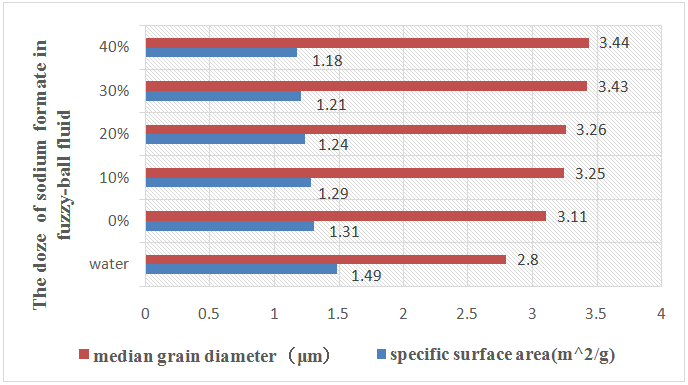
From Figure 1, we can draw three conclusions: compared to water, fuzzy ball drilling fluid is with much stronger inhibitive capacity; when the concentration of the sodium formate in the system increased, the specific surface area decreased and the D50 increased, which indicated a strong inhibitive capacity; when the percentage of the sodium formate in the system increased up to 30%, the value of the specific surface area and the D50 didn’t change any more, which indicated the maximum inhibitive capacity of the prepared drilling fluid in the specified sodium formate concentration. In conclusion, the prepared drilling fluid is with excellent inhibitive capacity. In field operations, the percentage of the sodium formate in the system can be adjusted to realize the optimal inhibitive results of the drilling fluid.
Plugging Capacity
The plugging capacity of the prepared drilling fluid was tested by core flowing experiments. Considering actual formation conditions, the test temperature, initial confining pressure and back pressure were 90 , 20 MPa and 0.5 MPa respectively. The experiment includes three steps. Firstly, displace φ38 mm core plug with fractures by water; secondly, displace the core plug by the multi- inhibitive drilling fluid to plug the fractures; thirdly, test the plugging capacity of the multi-inhibitive drilling fluid by water. Figure 2 showed the change of the injection pressure of water, the multi- inhibitive drilling fluid and the injection pressure of water after plugging versus time.
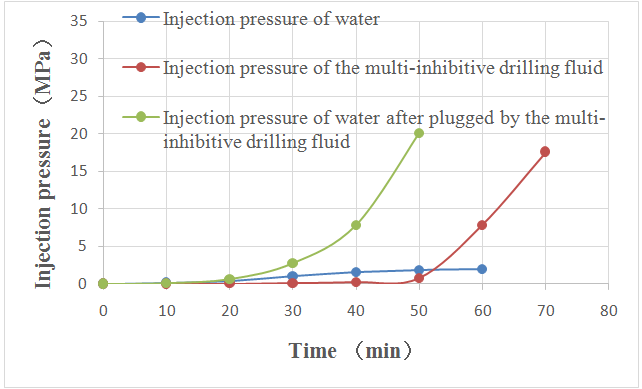
From Figure 2, we can draw the conclusion that, (1) before plugging, water flowed out through the core plug with almost zero injection pressure; (2) during the displacement of the multi-inhibitive drilling fluid, the injection pressure increased sharply at 50 min with no fluid flowing out from the core plug, indicating its excellent plugging capacity; (3) the final injection pressure of water after plugging by the multi-inhibitive drilling fluid is more than 20 MPa with no fluid flowing out from the core plug, it is indicated a strong pressure bearing capacity of the multi-inhibitive drilling fluid. In conclusion, the prepared drilling fluid is with excellent plugging capacity and strong pressure bearing capacity. As the prepared drilling fluid is able to plug fractures in formations effectively, the invasion of external water can thus be controlled. Meanwhile, because of the strong pressure bearing capacity, the transmission of swabbing and snubbing pressure can be effectively plugged. Besides, for reservoirs with adsorbed gas, gas desorption is also inhibited to maintain borehole stability during drilling.
Anti-Collapse Capacity
Sampling from Block B and prepare six 38mm-plug for evaluation. Considering actual formation conditions, the test temperature, initial confining pressure and back pressure were 25℃, 9 MPa and 0.5 MPa respectively. The experiment includes two steps. First, 2 coal plugs were soaked by water and 2 coal plugs by the multi-inhibitive drilling fluid for 1 hour respectively; then, test the uniaxial compressive strength of the 6 coal plugs. The results are shown in Figure 3.
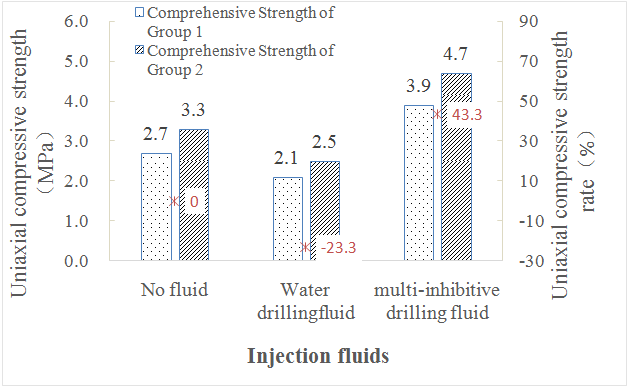
From Figure 3, the uniaxial compressive strength of the coal plugs injected by water(with brine injected)decreased by 23.3%, while the uniaxial compressive strength of the coal plugs after the injection of the multi-inhibitive drilling fluid increased by 43.3%. The main reason is that the micro pores and cracks of the coal plugs were plugged by the fuzzy ball and its adhesion and chemical bonds, leading to an increased rock strength of coal plugs. Therefore, borehole stability can be maintained as the collapse pressure decreased, fracture pressure is increased and the drilling fluid density window is broadened. From the test and evaluation results above, the fuzzy ball is able to plug formation fractures by forming of inner plug, control the invasion of external water, broaden the fluid density window, improve fracture pressure and decrease collapse pressure. By adding organic salt such as sodium formate into the fuzzy ball drilling fluid to improve the inhibitive capacity of the system, the multi- inhibitive drilling fluid is developed.
Field Applications
The multi-inhibitive drilling fluid was applied in more than 40 wells with complicated downhole conditions, such as formations with open fault age, fragile coal, unconsolidated sandstone and brittle shale/clay. Borehole instability problems like mud loss, borehole sloughing, collapsing and shrinkage were successfully controlled.
Application of the Multi-Inhibitive Drilling Fluid in the Well-X Drilling
Well X is a Fishbone well with 2 trunks and 6 branches. In the 3# high rank coal formation, the pressure gradient is 0.38~0.88MPa/100m with soft coal texture and long horizontal interval. During drilling, sandstone/shale and coal appeared alternatively in the sequence of the formations and limestone appeared occasionally. Because of the severe borehole caving during drilling in the coal formation, Well X failed to drill to the designed depth. The multi-inhibitive drilling fluid was applied in the third spudding interval with density 0.96 ~ 1.06 g/cm3, funnel viscosity 38 ~ 48 s/q and yield point 5 ~ 10 Pa. During 13 days drilling, the accumulated measured depth was 4189.49m with an average ROP of 12.65 m/h and coal formation encountering rate of 95%. The borehole stability was effectively maintained with the multi- inhibitive drilling fluid.
Application of the Multi-Inhibitive Drilling Fluid in the Well-Y Drilling
Well Y is a wildcat well with two formation pressure coefficients, 0.55~1 in the Shanxi formation and 0.67~1.03 in the Taiyuan formation. Therefore, lost circulation would occur when the density of the drilling fluid is over 1.03g/cm3, and the well kick would occur if the density of the drilling fluid is lower than 1.0 g/cm3. Well kick occurred in the depth of 450m in the Shiqianfeng formation with polymer drilling fluid. Barite was added into the drilling fluid to increase the density to 1.04 g/cm3 for well killing. Severe borehole sloughing occurred in the depth of 875m and collapse occurred in the depth of 925m with the drilling fluid density of 1.20 g/cm3. Even though the drilling fluid density was increased to 1.2 ~ 1.5 g/cm3, borehole instability problems still cannot be controlled and the drilling also failed to reach the designed depth. Finally, the multi- inhibitive drilling fluid was applied with density 1.02 ~ 1.09 g/cm3, funnel viscosity 47 ~ 68 s/q and yield point 6 ~ 8 Pa. During 12 days of drilling to the depth of 1278m, no drilling accident or problem occurred with an average borehole enlargement ratio of 8.57%.
Application of the Multi-Inhibitive Drilling Fluid in the Well-Z Drilling
Well Z is located on a fault zone. In the top section of the well, shale and unconsolidated sandstone appeared alternatively. Drill pipe sticking occurred in this section as a result of borehole sloughing. In the lower section of the well, the formations are mainly composed of fragmented coal and granulated coal. Drilling in this section is great difficulty because of the high risk of lost circulation and borehole sloughing and collapsing. The multi-inhibitive drilling fluid was applied in Z well with density 1.06 ~ 1.09 g/cm3, funnel viscosity 39 ~ 45 s/q and yield point 7 ~ 13 Pa. During 11 days of horizontal drilling with the length of 1000 m, lost circulation was successfully controlled and borehole stability was maintained in shale, sandstone and coal formations.
Conclusion
- The laboratory test showed that the multi- inhibitive CBM drilling fluid based on fuzzy ball and sodium formate has good performance in plugging, clay hydration swell reducing and collapse preventing;
- The field cases showed that the multi-inhibitive drilling fluid has great ability in keeping the stabilization of borehole in CBM drilling;
- Further research is needed to quantitatively optimize the practical performance of the multi-inhibitive drilling fluid in different formations.
Acknowledgement
This study was financially supported by the National Major S&T Project “Technical demonstration for CBM well drilling and stimulation” (Grant No.2016ZX05064002- 002).
References
-
Luwu Y, Maoyuan S (2001) Peculiarities of China CBM Reservoirs and Their Dictation on CBM Production Technology. Natural Gas Industry 21(6): 17-19.
-
Xiaoqing L, Yishan L, Ruanzhi Q (2009) Development and application status of drilling fluid technology for CBM development in China. Journal of Oil and Gas Technology 31(5): 326-328.
-
Shuangbao L, Fenghai Y, Xinghua W (2007) Present situation of CBM drilling fluid technology. Foreign Oilfield Engineering 8: 27-33.
-
Jianqiang Q, Xiaokang L (2008) Coal reservoir protective measures during CBM drilling. Coal Geology of China 20(3): 67-68.
-
Yifan Z, Deli W, Liu Li (2010) Mechanism analysis on damage to CBM reservoir during drilling. Coal 19(7): 87-88.
-
Chenevert ME, Sharma AK (1993) Permeability and Effective Pore Pressure of Shales. Society of Petroleum Engineers, SPE Drilling & Completion 8(1): 7.
-
Xing-peng J (2012) Study on pressure distribution law and control factors of coalbed methane reservoir in south part of Qinshui Basin. Coal science and Technology 40(2): 116-120.
-
Q Wei, Xiaoming N, Xiaodong Z (2010) The relation between the coal structure combination and the changes in well diameter. Journal of Henan Polytechnic University: Natural Science Edition, 29(2): 162-166.
-
Hongguan W, Jinbang C, Zhu Qingzhong, Biwu C (2014) Fuzzy-ball drilling fluid technology in CBM of multilateral horizontal well Qinping 12-11-3H with six branch holes. Oil Drilling & Production Technology 36(3): 39-41.
-
Wei’an H, Zhengsong Q, Jiafang X, Liangxiang Y (2007) Experimental study on sidewall instability mechanism of oil wells in the western Tuha oilfiled. Acta Petrolei Sinica 28(3): 116-117.
-
Ping Q, Ruichen S (2010) Mechanism of wellbore stability and determination of drilling fluid density window in coalbed methane drilling. Natural Gas Industry 30(10): 64-68.
-
Jian-hui D, Xiaoguo W, Lei Q, Ruichen S, Kailong W (2008) Application of CBM multi-branch horizontal well for drilling technology in Fanzhuang Block. Coal Geology & Exploration 36(4): 21-34.
-
Da-chuan L, Xiao-lin P, Xing-hua X (2002) Particularity of coal collapse and drilling fluid countermeasure. Journal of Southwest Petroleum Institute 24(6): 28-31.
-
Kaihe L, Mingbo S, Zhengsong Q (2006) Drilling techniques for coalbed in Yiqikelike area of Tarim basin[J]. Acta Petrolei Sinica 27(5): 108-111.
-
Xiangyang Z, Hai L, Lei C, Haihai T, Yingchun S (2012) Application of anti-sloughing drilling fluid technology to the long horizontal coalbed interval of Well CB21- 2, Changbei Gas Field. Natural Gas Industry 32(3): 81- 85.
-
Wei’An H, Zhengsong Q, Li Y, Yanqi W, Yongle M, et al. (2013) Instability mechanism of sidewall and anti- sloughing drilling fluid technique for coalbed methane well drilling. Coal Geology & Exploration 41(2): 37-41.
-
Jingluan Z, Hansen S, Weidong Z, Kaihe L (2012) Study and application of light weight drilling fluid applied to coalbed methane development. Journal of China Coal Society 37(5): 815-819.
-
Haiping M, Fawang P, Zhen L (2011) Application of Circulating foam drilling fluid in the coal bed methane drilling. Shandong Coal Technology 3: 19-21.
-
Lihui Z, Biwu C, Zheng Z, Jidan T, Hao S (2016) Anti- collapse mechanism of the CBM fuzzy-ball drilling fluid. Nature Gas Industry 3(2): 152-157.
-
Lihui Z (2011) Application state and prospects of bionic fuzzy-ball drilling fluids for coalbed methane drilling. Oil Drilling & Production Technology (3): 78- 81.
-
Lihui Z, Junying L, Zhichao H, Zongyuan L, Zheng Z (2016) Study on coalbed methane fuzzy ball drilling fluid in complicated coal structure of Mabi Block. Coal Science and Technology (5): 79-83.
-
Lihui Z, Jingbang C, Shuaishuai N, Bin L, Yuwei F, et al. (2016) Temporary plugging diverting test with fuzzy ball fluids in non-water producing coal beds in re- fracturing Well Zheng-X. Drilling Fluid & Completion Fluid (5): 103-108.
-
Lihui Z, Llingchen K, Yuan C, Huiyun W, Zixuan H, et al. (2010) The mechanism for fuzzy-ball working fluids for controlling & killing lost circulation. Chinese Sci Bull 55(35): 4074-4082.
-
Lihui Z, Shangzhi M, Yuan C, Zhongfeng L (2010) Laboratory studies on control coal bed methane formation damage by Fuzzy-Ball based drilling fluids. Journal of China Coal Society (3): 439-442.
-
Lihui Z, Pangfeng W, Xuanqing L, Hao S, Yuwei F, et al. (2016) Laboratory experiments on the effect of KCI concentration on desorption capacity of reservoir rocks. Drilling Fluid & Completion Fluid 33(3): 117- 122.
-
Xiaolin P, Xinshu L, Yanmei L, Lei S, Zhizhong H, et al. (2000) A comparative evaluation for inhibitory property of formates against inorganic salts as drilling fluid additive. Oilfield Chemistry 17 (2): 104- 105.
-
Leliang C, Guijuan W (2003) An over view of formate base drilling and completion fluids system. Drilling Fluid & Completion Fluid 20(1): 31-36.
-
Haihai T, Fan F, Wei L, Yu X, Lei C (2012) Research on Formate drilling fluid system. Advances in Fine Petrochemicals 12(4): 19-22.
- Nigeria’s Vulnerability in the Face of Global Energy Policy
- A Simulation Study of Investigation of Optimum Oil Production Performance by Applying Various Gas Injection Methods in Oil Reservoir
- Characterization of Permo-Triassic Reservoirs through Thermal Maturity Assessment of Westphalian Source Rocks in the Cheshire Basin
- Influence of Microwax on the Rheological and Thermal Behaviour of a Wax Crude Oil
- Real-Time Monitoring and Performance Optimization of Steam Injection in Heavy Oil Reservoirs Using Fiber Optic Sensing and Integrated Predictive Simulation Models
- Rapid On-Site Determination of the Total Petroleum Hydrocarbon Content of Soils by Handheld Fourier Transform Near-Infrared Spectroscopy: Development of a Global, Site- and Scanner- Independent Calibration Model