
Recent Technologies in Mitigating Oil Spill Accidents
Crude oil is a main source of power in the developed nations. Many sectors depend on it such as industry and power generation. Thus the need for crude oil is high. Despite the crude oil is considered non-renewable, a need to explore new sites such as off shore is now very popular. These sites include oil handling under sea level. Thus, an emergency plan should be prepared before dealing with any activity including crude oil or any of its components, examples of such activities as oil refining, storing, transporting, exploring and oil well drilling. These components have severe effects on the environment and its elements. Thus, the new developments and technologies in the response in emergency situationsin the case of oil spill accidents should be followed. This study shows the up to date developments in the field of discovering the oil spill locations, the new technologies in minimizing the harmful effects of spilled oil, and rehabilitation of the contaminated sites in the case of oil spill in water bodies. It is shown that the new developments in mitigating oil spills starts from monitoring the activities that handling crude oil and preparing emergency plans for worst possible scenarios. Following the international laws in dealing with crude oil helps a lot in preventing and mitigating the oil spill accidents. New developments in containing the oil spills are in using booms that are fabricated from high absorbing materials and manufacturing of cleaning agents that has the ability to dissolve the oil and its components (hydrophobic) that helps in removing spilled oil mainly from water. Â
Introduction
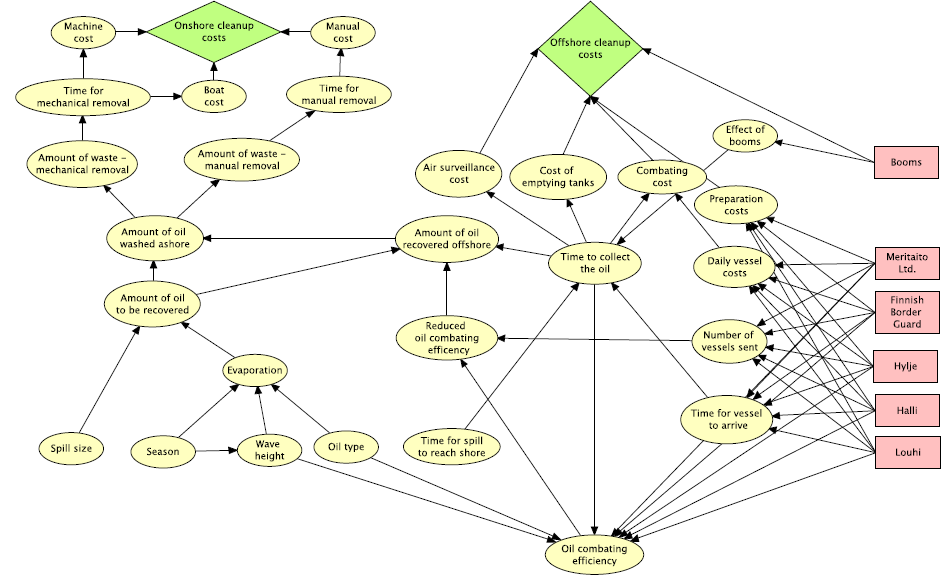
Crude oil exploration, refining, and transportation may have accidents lead to oil spill and cause problems to the environment such as soil and/or water pollution. Currently about a third of the oil consumed worldwide comes from underwater reservoirs where for an average platform, each 30 meters of added depthincreases the incident probability by 8.5% [1]. Oil spill can happen due to maritime traffic, transporting, and storing. In any case the spoil has harmful effects in addition to economic losses based on its value and in the step of rehabilitation. So the early the discovery of the spill the less the harmful effects and economical looses. The oil spilled onto wateris more serious than spills onto soil however, both have same physical changes such as volatilization and transportation [2]. The water conditions such as tide height, speed, wind, salinity and temperature are factors that strongly affect the oil properties and enhance its spread. Thus the fast the discovery of the oil spill location the better the actions to contain it and stop its spread. Then actions to clean up the spilled materials started. Clean up processes depends on the quantity as well as the safe disposal methods. That includes the addition of solidifiers, dispersants, shoreline pretreatment agents, and elasticity modifiers [3] and the safe disposal methods such as incineration [4, 5, 6]. Literature shows that between 1.5 and 10 million tons of oil end up in water bodies [7]. The problem is attributed to sudden spills of greater amounts of oil in restricted water bodies. The problem is escalated if the accidents in sea traffic are added such as periodic discharges of waste oils from ships navigating seas and oceans, periodic pollutions due to cleaning of facilities in the inshore, dumping different forms and types of wastes and hazardous wastes from. Other miscellaneous sources of industrial chemicals and oily substances can enter to the sea and complicate the problem of oil spill if the sewage which originates from the mainland is considered. Literature emphasizes on the economical consequences of oil spill. These consequences include insurance, clean up, and rehabilitation…etc. literature depended on historical data from past oil spills, spill sizes falling in a certain ranges [8, 9]. The costs of clean up of oil spill accidents are based on models [10] these models have many parameters which cannot give a specific cost as these parameters include size, location, methods of clean up, methods of containments, number of boats and ships participated in the clean up and even their number which are classified in to the following criteria utility variables, decision variables, independent variables, conditional variables, figure 1 summarizes the costs based on the model derived [10, 11]. For the importance of oil spill accidents, clean up, and rehabilitation in addition to environmental negative effects and human responsibility many laws are controlling the procedures for crude oil and substances [12]. Some of these laws are Marine environmental protection act of China which is issued by National People’s Congress of China, Maritime traffic safety act of China which is issued by National People’s Congress of China, and Regulations on the collection and used of oil pollution damage compensation fund by ships which is issued by Ministry of Transport of China and Ministry of Finance of China in 2012.
Bani-Hani EH and El Haj Assad M. Recent Technologies in Mitigating Oil Spill Accidents. Pet Petro Chem Eng J 2017, 1(3): 000120.
In addition to some organization such as international tanker owners pollution federation limited (ITOPFL) which is a not-for-profit organization, that have devoted efforts to develop a wide range of technical services to promote effective response in the marine environment to back up our core role of responding to ship-sourced spills. This organization responded to over 750 incidents involving oil or chemical spills worldwide. The next part will introduce most recent technologies first to explore and monitor the oil spill then the most used methods to contain the spill to avoid the spread and then to clean up the site.
Oil Spill Monitoring
The rapid discovery of oil spill in oceans and any open water is very important, as to activate the containment and cleanup process immediately before the situation is going worse. The improvements in numerical methods and computer performance, motivated by supporting economic activities and for safety and security [13]. The use of high-resolution operational models in the field of oil spill pollution are applicable, helping in prevention and during contention and clean-up [14]. Literature [13] presented an operational system that is Algarve operational modeling and monitoring system (SOMA) that has a hydrodynamic and an oil spill models [13]. The system is using several modules (e.g. Hydrodynamic, Water Properties, Oil Properties) and communicating in real time during a simulation a thing makes it a suitable tool for downscaling methodologies [14]. It has two grid levels of increasing resolution. In addition to that it can provide information about water such velocity, salinity and temperature. Thus such a model SOMA was considered a validated operational system with the ability to forecast oil spill trajectories in the SW Iberian coast. Moreover, operational oil spill forecast modeling system improves the oil spill response, But, uncertainty due to predicted data inputs affects the reliability of the forecast result that cause a misdirection in the response plans [15]. To solve such an issue a forecast probability maps are generated and the uncertainty is quantified by comparing the forecast probability maps and simulated or results for the suggested and/or statistic models. After the specific determining of the polluted site the next step is to start the containment steps that require the use of booms which are flexible structures surrounding an oil spill site and anchored to prevent the oil from spreading.
Oil Booms
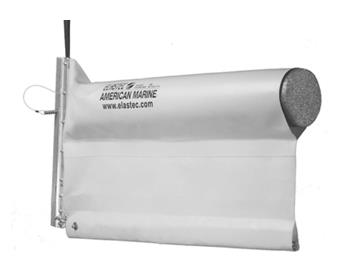
A boom is generally consisted of a floating device (inflatable tube) shown in figure 2 and an immerged flexible skirt. At the bottom of the skirt, a chain permits to weigh vertically on the skirt and to attract the longitudinal tension of it [16]. The floating containment booms can be divided in two groups air boom where the boom is simply bubbles coming out to create a gas wall, and the second type which is classic floating physical containments booms of various types which are floating body (above the water level), underwater boom, longitudinal reinforcement (chain, steel rope, polyester band), and connecting elements for connection and upright position of the floating boom [7]. The materials used for fabrication booms can be rubber or polyvinyl chloride (PVC), by adding thermoplastic polyurethane (TUP) to PVC a PVC/TUP new oil boom which is light weight, highly stable with no inflation system required, has small volume when packed for transport and is simple and quick to deploy with high oil resistivity.
Bani-Hani EH and El Haj Assad M. Recent Technologies in Mitigating Oil Spill Accidents. Pet Petro Chem Eng J 2017, 1(3): 000120.
New Sorbents
In the cleanup stage, any materials with porous structure have the ability to absorb the oil from the water and secure it inside such as sand. However, this material should be suitable to be used in water (hydrophobic). Thus researches are trying to discover optimum materials for this purpose. Most up to date work is reported the hydrophobization of polyester fibrous nonwoven with poly (methylhydro-dimethyl) siloxane copolymers in order to produce water-repellent sorbents for oil spill cleanup [17]. The produced hydrophobic sorbents were characterized and tested for oil sorption in pure oil bath and in the presence of water. The optimal hydrophobic nonwoven yielded maximal sorption capacities equal to 5.52 g/g and 10.03 g/g for dodecane and motor oil uptake, respectively. Centrifugation tests demonstrated a high recycling ability of spent nonwoven sorbents [17]. Another lipophilic substances that have the ability to absorb oil is reported in the literature where Glycerol propoxylate based oil loving sorbents were prepared through bulk polymerization [18]. The structural and thermal features of sorbents are specified. The synthesized gels were employed as absorbents for various organic solvents and oils. The absorption capacity, absorption-desorption kinetics, reusability, and selective removal from an oil/water mixture were also examined.
Discussions
Oil spill mitigation methods depend on very accurate localization of the spill itself. For fast response to avoid the problem of spreading and changing the oil properties which makes it difficult to clean up mainly in cold region and from ice. Characterization of the oil spill is also important to specify the quantities of sorbents and booms as well as the labor participated in clean up. All of these actions are necessary as the economical aspects of cleanup processes depend strongly on them. Most of the recent studies focused on getting clear location of the oil spill and obtaining g clear images of the oil slick. Once the location is specified the mechanical treatment of the oil spill is the first step. Using booms for containment and absorbing the oil. However, these booms have limitations such as the sea should be calm with no high waves, they also have big size to transfer, thus the new development in this regard is focusing on having light and easy foldable with low volume occupancy booms in addition to high absorbing capacities. More efficient methods of cleanup methods are the use of sorbents. New technologies focusing on having high swelling capacity and low cost sorbents with possibility of regeneration of the sorbent for reuse.
Conclusion
Oil transportation via water bodies is cheap route and it will be used on very large scale in addition to inshore exploring of oil. However, accidents may occur and the cost of rehabilitation is high. Thus proper management and following up the recommendations from governmental organizations and nongovernmental organizations for the safest ways of transportation, storing, and handling of the oil and its products are high recommended to prevent accidents and to act very fast in case if any accidents happen.
References
-
Ivshina IB, Kuyukina MS, Krivoruchko AV, Elkin AA, Makarov SO, et al. (2015) Oil spill problems and sustainable response strategies through new technologies. Environ Sci Process Impacts 17(7): 1201-1219.
-
Bani-Hani EH, Al khateeb F, Khanafer K (2015) Analysis of variants within different models of diesel oil volatilization process using various soil materials. Special topics and reviews in porous media: an international journal 6(3): 261-266.
-
Toz AC, Koseoglu B, Sakar C (2016) Marine environment protection: new technologies on oil spill response industry. First international congress on ship and marine technology pp: 1-19.
-
Bani-Hani EH, Hammad M, Matar A, Sedaghat A, Khanafer K (2016) Numerical analysis of the incineration of polychlorinated biphenyl wastes in rotary kilns. J Environ Chem Eng 4: 624-632.
-
Bani-Hani EH, Hammad M, Matar A, Sedaghat A, Khanafer K (2015) Analysis of Polychlorinated Biphenyl Wastes Incineration in Rotary Kilns: Model Development and Validation. International journal of mechanical systems engineering 1: 10. **6.** Bani-Hani EH, El Haj Assad M (2017) Halogenated Wastes Safe Disposal: Polychlorinated biphenyls. International Journal of Petrochemistry and Research 1(2): 76-78. Bani-Hani EH and El Haj Assad M. Recent Technologies in Mitigating Oil Spill Accidents. Pet Petro Chem Eng J 2017, 1(3): 000120.
-
Justin R, Sokovic M (2011) Industrialization of Easy Boom. Archives of Materials Science and Engineering 47(2): 110-116.
-
Psarros G, Skjong R, Vanem E (2011) Risk acceptance criterion for tanker oil spill risk reduction measures. Mar Pollut Bull 62(1): 116-127.
-
Kontovas CA, Psaraftis HN, Ventikos NP (2010) An empirical analysis of IOPCF oil spill cost data. Mar Pollut Bull 60: 1455-1466.
-
Shahriari M, Frost A (2008) Oil spill cleanup cost estimation-Developing a mathematical model for marine environment. Proc Saf Environ Prot 86(3): 189-197.
-
Montewka J, Weckström M, Kujala P (2013) A probabilistic model estimating oil spill clean-up costs – A case study for the Gulf of Finland. Mar Pollut Bull 76(1-2): 61-71.
-
Xiong S, Long H, Tang G, Wan J, Li H (2015) The management in response to marine oil spill from ships in China: A systematic review. Mar Pollut Bull 96(1-2): 7-17.
-
Janeiro J, Neves A, Martins F, Relvas P (2017) Integrating technologies for oil spill response in the SW Iberian coast. Journal of Marine Systems 173: 31- 42.
-
Janeiro J, Zacharioudaki A, Sarhadi, E, Neves A, Martins F (2014) Enhancing the management response to oil spills in the Tuscany archipelago through operational modeling. Mar Pollut Bull 85(2): 574-589.
-
Hou X, Hodges BR, Feng D, Liu Q (2017) Uncertainty quantification and reliability assessment in operational oil spill forecast modeling system. Mar Pollut Bull 116(1-2): 420-433.
-
Muttin F (2016) Oil spill boom modelling by the finite-element method. Water pollution 111: 383-392.
-
Corneliu C, Lucia P, Samoila P, Harabagiu V (2017) Surface hydrophobization of polyester fibers with poly (methylhydro-dimethyl) siloxane copolymers: Experimental design for testing of modified nonwoven materials as oil spill sorbents. Polymer Testing 59: 377-389.
-
Kizil S, Hayal BS (2017) Oil loving hydrophobic gels made from glycerol propoxylate: Efficient and reusable sorbents for oil spill clean-up. J Environ Manage 196: 330-339. Bani-Hani EH and El Haj Assad M. Recent Technologies in Mitigating Oil Spill Accidents. Pet Petro Chem Eng J 2017, 1(3): 000120.
- Nigeria’s Vulnerability in the Face of Global Energy Policy
- A Simulation Study of Investigation of Optimum Oil Production Performance by Applying Various Gas Injection Methods in Oil Reservoir
- Characterization of Permo-Triassic Reservoirs through Thermal Maturity Assessment of Westphalian Source Rocks in the Cheshire Basin
- Influence of Microwax on the Rheological and Thermal Behaviour of a Wax Crude Oil
- Real-Time Monitoring and Performance Optimization of Steam Injection in Heavy Oil Reservoirs Using Fiber Optic Sensing and Integrated Predictive Simulation Models
- Rapid On-Site Determination of the Total Petroleum Hydrocarbon Content of Soils by Handheld Fourier Transform Near-Infrared Spectroscopy: Development of a Global, Site- and Scanner- Independent Calibration Model