
Synthesis and Evaluation of Xanthan-G-Poly (Acrylamide) Co-Polymer for Enhanced Oil Recovery Applications
Xanthan is a natural biopolymer, which grafted with vinyl monomers through typical free radical initiation and applied in enhanced oil recovery (EOR) techniques. Application of xanthan in oil reservoirs suffer from microbial and thermal degradation under harsh petroleum reservoir conditions. In this research, xanthan grafted with poly (acrylamide) polymer in the presence of potassium per sulfate as a water-soluble initiator. Structure determination occurs by different spectroscopic techniques involving (FTIR) spectroscopy and nuclear magnetic resonance (1H-NMR). Assessment of polymer solution rheology occurs as a function of mechanical, chemical and thermal degradation at simulated reservoir conditions. Flooding tests carried out through unconsolidated sand packed model.
Introduction
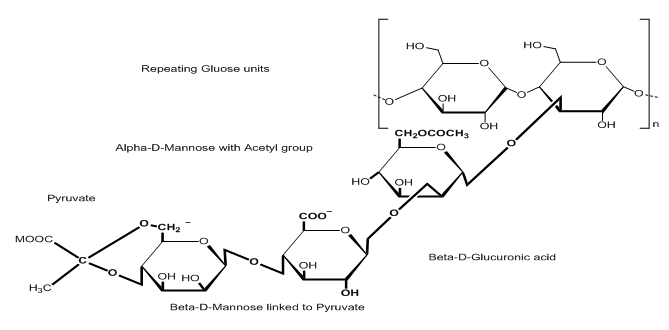
Currently, chemical flooding through sandstone reservoirs acquire more attention due to incremental energy demand [1], and giant residual oil in fossil reservoirs after primary and secondary recovery [2]. Enhanced oil recovery (EOR) by biopolymers including starch and xanthan gum is a promising practice, since they are low-priced, plentiful and environmentally friendly applicants [3, 4, 5, 6, 7, 8]. Xanthan gum is a hetero- polysaccharide macromolecule produced by the microbial action of Xanthomonascampestris through fermentation of glucose or fructose with a protein supplement and an inorganic source of nitrogen. Its main chain as shown in Figure 1 consist of glucose units arranged in a helical structure, where branches fold in, along the backbone. The side chain consists of alpha-D-mannose that contains an acetyl group, beta-D-glucuronic acid, and a beta-D- mannose terminal unit, linked to a pyruvate group. Alternate glucoses have a short, three-sugar branch consisting of a glucuronic acid sandwiched between two mannose units. Thus, the overall repeating structure is a pentasaccharide. The terminal mannose has attached pyruvate group and the mannose adjacent to the main chain may have an acetyl group attached to C6. The glucuronic and pyruvic acid groups give xanthan gum a highly negative charge. The presence of anionic side chains on the xanthan gum molecules enhances hydration, where xanthan gum soluble in cold as well as hot water, and has very high molecular weight (2 - 50 × 106 g/mol). Moreover, xanthan gum is compatible with most surfactants and other injection fluid additives used in tertiary oil recovery formulations due to; 1) Xanthan gum has excellent viscosifying criteria, as it could significantly increase the viscosity of the injected brine at very low concentrations even in high salinity reservoirs; 2) resistant to shear degradation, exhibit pseudo-plastic behavior; 3) stable over large ranges of pH and less sensitive to mechanical shearing, elevated salinity and to divalent ion concentration (hardness) than hydrolyzed polyacrylamides (HPAM) owing to its rigid polysaccharide chains.
Experimental
Materials
Commercial xanthan gum; Acrylamide (AM ≥ 97%); acetone ≥ 97% ethanol ultra-pure; Potassium persulfate (KPS ≥ 99 %). All chemicals supplied by Sigma-Aldrich excluding xanthan purchased from commercial source.
Characterization and Equipment
1H-NMR spectrum carried out with a BrukerEMX420MHz NMR spectrometer after accumulating 32 scans, using D2O as a solvent and tetramethylsilane (TMS) as internal standard. FTIR spectrometric analysis carried with KBr pellets on American FTS-3000 infrared spectrometer in the optical range 400–4000 cm-1. Rheological measurements carried out on Brookfield programmable DV-II+ viscometer. Viscosity of solutions investigated with respect to shear rate, salinity and temperature [1].
Synthesis
In a three-neck 250 ml flask equipped with condenser, thermometer and nitrogen inlet/outlet, 16.9 gm of Acrylamide completely dissolved in 200 ml of deionized water. To this mixture, add 1.6 gm of xanthan gum and 0.491gm of KPS and stir at for 30 minute under nitrogen blanket until complete dissolution. Adjust the temperature at 60 °C, where the polymerization reaction proceed for 10 hours. After cooling, the viscous polymeric gel precipitated by ethanol, then soxhlet extraction with acetone for 24 hour at 60 °C, then crushed and stored on silica gel bed. The chemical reaction illustrated in scheme 1.
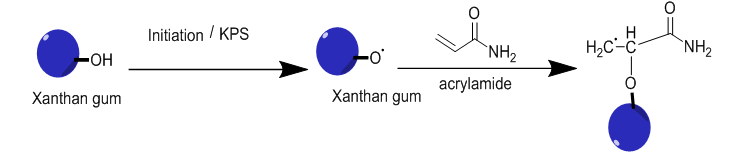
Scheme 1: chemical reaction and macro radical initiation mechanism.
Polymer Flooding through Unconsolidated Sand Packed Model
Flooding runs performed through unconsolidated sand packed linear model, where flooding conditions and model properties stated according to our previous work [1]. Sand cleaned and evacuated regarding to the standard cleaning procedure then saturated with brine solution for 12 days followed by oil soaking, after that, brine flooded until oil cut terminated (i.e. oil cut <1%) [28]. Solution of the prepared copolymer flooded at simulated reservoir temperature of 60 oC, followed by brine flooding until expelled oil ceased in the effluent [29]. Recovered oil quantity calculated on volume foundation.
4000 3500 3000 2500 2000 1500 1000 500 Wave number, cm-1
Structure Spectroscopic Analysis
Infrared spectrum of Xanthan gum (Figure 2) as reported in literature Faria S, de Oliveira Petkowicz CL, de Morais SAL, Terrones MGH, de Resende MM, et al. [30] shows absorption peaks at 3200-3450 cm-1 due to the (O– H) axial deformation and 2850-2950 cm-1 due to symmetric and asymmetric stretching vibrations of (C–H) group in methyl and methylene groups. The bands at 1710 cm-1 due to C=O stretching vibration, while bands near to 1530-1650 cm-1,due to axial deformation of (C-O) of enols. IR spectra of Xanthan-g-polyacrylamide (Figure 2) show characteristic peaks at1459 cm-1 assigned to (C=O) of amide group (O=C-NH2). Absence of vinyl groups characteristic bands indicate that polymerization occurs successfully. Absorption peaks at 3412 cm-1 attributed to the stretching vibrations of (-NH2) group.
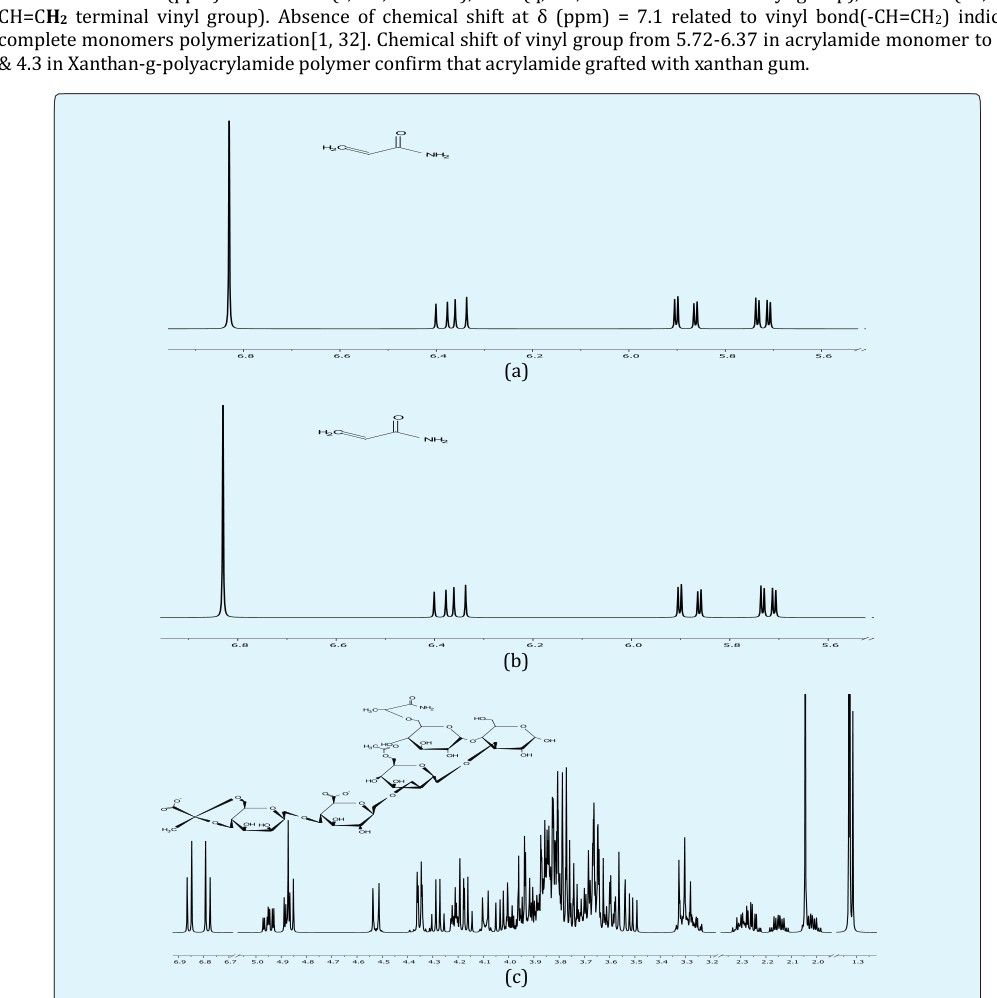
1H-NMR spectrum of Acrylamide monomer (Figure 3a) shows chemical shifts at δ (ppm) = 6.83 (s, 2H, -CONH2); 6.37 (q, 1H, -CH=CH2 terminal vinyl group), 5.72-5.88 (dd, 2H, -CH=CH2 terminal vinyl group). 1H-NMR spectrum of xanthan (Figure 3b) display chemical shifts atδ (ppm) = 1.33 (s, 3H, terminal (-CH3) group of pyruvate); 2.04 (s, 3H, terminal -CH3 group of acetyl group in α-D-mannose); chemical shifts atδ (ppm) = 2.1- 4.9 correspond to (-OH & -CH2) groups of anhydro glucose units of xanthan [31]. The 1H-NMR spectrum of Xanthan-g-polyacrylamide (Figure 3c) display chemical shifts atδ (ppm) = 6.78-6.86 (s, 2H, -CONH2); 6.37 (q, 1H, -CH=CH2 terminal vinyl group), 5.72-5.88 (dd, 2H, - CH=CH2 terminal vinyl group). Absence of chemical shift at δ (ppm) = 7.1 related to vinyl bond(-CH=CH2) indicates complete monomers polymerization[1, 32]. Chemical shift of vinyl group from 5.72-6.37 in acrylamide monomer to 1.32 & 4.3 in Xanthan-g-polyacrylamide polymer confirm that acrylamide grafted with xanthan gum.
Mechanical Degradation
Mechanical degradation of polymer evaluated through studying effect of different shear rates on polymer solution, where shear stress and viscosity versus shear rate reported as shown in Figure 4 [33]. It is obvious that the prepared polymer display shear thinning effect (i.e. pseudo plastic fluids) which is often used by chemical flooding agents [34]. Shear stress calculated through the power law model [35].
$$\Gamma = K \gamma^n$$ (Equation 1)
Where, $(\Gamma)$ shear stress, Pascal; $(\gamma)$ shear rate, $s^{-1}$; $(k)$ is the coefficient of flow consistency, $(Pa \cdot s^{-n})$; and $(n)$ is the flow behavior index [1]. For pseudo plastic fluids, $n$ is typically lower than or equal unity ($n \leq 1$). In this study $(n)$ calculated to be 0.3091. This indicates that the prepared polymer is a pseudo plastic fluid, which is widely implemented in EOR [1, 34]. Moreover, viscosity slightly decrease by shear rate increase.
Thermal Degradation
Hydrolyzed polyacrylamides suffer from thermal degradation at harsh reservoir conditions, so polyacrylamide grafted with xanthan to enhance its thermal stability. In this study, the prepared polymer dissolved in distilled water at concentration of 1.5gL$^{-1}$, then subjected to temperature of 80°C at different shear rates as shown in Figure 6. The viscosity decrease slightly above shear rate of 33.0 s$^{-1}$. This behavior of reasonable thermal stability resort to gelation effect of xanthan by temperature increase [1, 33].
Chemical Degradation
Polymer solutions subjected to high mineral concentrations during flooding process. This leads to chemical degradation of polymer chains. The prepared polymer assessed at salinity of 75,000 ppm as NaCl equivalent at different shear rates as exhibited in Figure 5. It is found that, polymer exhibit reasonable resistance against chemical degradation and this may resort to increasing of hydrodynamic volumes of the prepared polymer in saline solutions [29] which in turn prevents the chain from curling, so viscosity reduction decreases [1].
Flooding Experiments
Flooding tests carried out on linear unconsolidated sand packed model as reported previously at temperature of 60oC at polymer concentrations (1.5 gL-1) [1]. The sand pack saturated firstly with brine followed by oil saturation until water effluent was less than 1%, after that brine flooded until ejected oil cut become less than 1%. At this stage, the recovered oil amount represent primary and secondary oil recovery that, reach to 68% of original oil in place (OOIP). The residual oil amount estimated to be 32% OOIP, and represents tertiary oil recovery. The sand pack flooded with polymer solution at concentration of 1.5 gL-1, until oil cut become less than 1%. The recovered oil amount calculated and estimated to be 18% of OOIP as indicated in Figure 7. The obtained results indicate that the prepared xanthan-g-polyacrylamide polymer can be considered as an EOR applicant due to its gelling effect, which increase aqueous phase viscosity and enhance sweeping efficiency, so increase recovery factor.
Xanthan gum successfully grafted on poly (Acrylamide) polymer through free radical emulsion polymerization. Structure determination proved by spectroscopic analysis. Rheological and solution properties at simulated reservoir conditions including mechanical, chemical and thermal degradation carried out to evaluate the polymer ability as a chemical flooding agent. Flooding tests performed on unconsolidated sand packed model, where the recovery factor reach to 18% of original oil in place (OOIP). Consequently, this polymer can be considered as an effective EOR candidate.
References
-
El-hoshoudy A, Desouky S, Betiha M, Alsabagh A (2016) Use of 1-vinyl imidazole based surfmers for preparation of polyacrylamide–SiO 2 nanocomposite through aza-Michael addition copolymerization reaction for rock wettability alteration. Fuel 170: 161- 175.
-
López OV, Castillo LA, Ninago MD, Ciolino AE, Villar MA (2017) Modified Starches Used as Additives in Enhanced Oil Recovery (EOR). Industrial Applications of Renewable Biomass Products pp: 227-248.
-
Qiao R, Zhu W (2010) Evaluation of modified cationic starch for impeding polymer channeling and in-depth profile control after polymer flooding. Journal of Industrial and Engineering Chemistry 16(2): 278-282.
-
Pei X, Zhai K, Tan Y, Xu K, Lu C (2017) Synthesis of monodisperse starch-polystyrene core-shell nanoparticles via seeded emulsion polymerization without stabilizer. Polymer 108: 78-86.
-
Song H, Zhang S-F, Ma X-C, Wang D-Z, Yang J-Z (2007) Synthesis and application of starch-graft-poly (AM- co-AMPS) by using a complex initiation system of CS- APS. Carbohydrate Polymers 69(1): 189-195.
-
Song H (2010) Synthesis and application of cationic starch graft polymer by using the complex initiation system. Carbohydrate polymers 82(3): 768-771.
-
Wang S, Xu J, Wang Q, Fan X, Yu Y (2017) Preparation and rheological properties of starch-g-poly (butyl acrylate) catalyzed by horseradish peroxidase. Process Biochemistry 59(Part A): 104-110.
-
Xie F, Halley PJ, Avérous L (2012) Rheology to understand and optimize processibility, structures and properties of starch polymeric materials. Progress in Polymer Science 37(4): 595-623.
-
El-Hamshary H, Fouda MM, Moydeen M, El-Newehy MH, Al-Deyab SS (2015) Synthesis and antibacterial of carboxymethyl starch-grafted poly (vinyl imidazole) against some plant pathogens. International journal of biological macromolecules 72: 1466-1472.
-
Kaewtatip K, Tanrattanakul V (2008) Preparation of cassava starch grafted with polystyrene by suspension polymerization. Carbohydrate Polymers 73(4): 647-655.
-
Umar A, Sanagi MM, Salisu A, Ibrahim WAW, Karim KJA (2016) Preparation and characterization of starch grafted with methacrylamide using ammonium persulphate initiator. Materials Letters 185: 173-176.
-
Sorour M, El-Sayed M, El Moneem NA, Talaat H, Shaalan H (2013) Free radical grafting kinetics of acrylamide onto a blend of starch/chitosan/alginate. Carbohydr Polym 98(1): 460-464.
-
Yao K, Wang M (1987) Synthesis of Starch-g- Polyacrylamide for Oilfield Drilling Treatments. Oilfield Chem 4: 175-179.
-
Huang Y, Shen J (1995) Study on thickening ability of starch graft copolymers. Polym Mater Sci Engng 11: 98-102.
-
Zhang LM (2001) A review of starches and their derivatives for oilfield applications in China. Starch 53(9): 401-407.
-
Guo J (1996) Synthesis and performance of heat- resistant and salt-tolerant filtrate loss reducer based on grafted starch. Oilfield Chem 13: 169-171.
-
Guo D, Gao J, Lu K, Xia J (1995) Biodegradable Filtration Loss Controller Based on Starch Graft Copolymer: Synthesis and Properties. Oilfield Chem 12: 165-166.
-
Gao J, Guo D (1995) Preparation of cationic starch graft copolymers as hydration inhibitors. Drilling Fluid and Completion Fluid 12(1): 22-26.
-
Abdollahi M, Varamesh A, Nasiri A (2009) Improvement in the Performance of Potato Starch Used in the Water-Based Drilling Fluid via Its Chemical Modification by Grafting Copolymerization. Iranian Journal Of Polymer Science and Technology 22(4): 251-260.
-
Hu Z, Zhang L (2001) Water-Soluble Grafted Polysaccharides. I. Graft Copolymerization of Starch with Acrylamide and Dimethyldiallylammonium Chloride. Acta Scientiarum Naturalium Universitatis Sunyatseni 40(1): 18.
-
Yang Z, Wu H, Yuan B, Huang M, Yang H, et al. (2014) Synthesis of amphoteric starch-based grafting flocculants for flocculation of both positively and negatively charged colloidal contaminants from water. Chemical Engineering Journal 244: 209-217.
-
Ye-Bang T, Chuan-Yao Y, Ke-Jun Y (1993) Synthesis and laboratory performance of starch- sulfomethylated polyacrylamide graft copolymer as filtrate-loss controller for drilling mud. Oilfield Chemistry 1: 2.
-
MA X, WU X, CAO Y (2004) Synthesis of amphoteric starch-based natural polymer modified flocculant. Acta Scientiarium Naturalium Universitatis Jilinensis, 2.
-
Qin Q, Tang Q, Li Q, He B, Chen H, et al. (2014) Incorporation of H3PO4 into three-dimensional polyacrylamide-graft-starch hydrogel frameworks for robust high-temperature proton exchange membrane fuel cells. International Journal of Hydrogen Energy 39(9): 4447-4458.
-
Zhu B, Ma D, Wang J, Zhang S (2015) Structure and properties of semi-interpenetrating network hydrogel based on starch. Carbohydr Polym 133: 448- 455.
-
El-hoshoudy A, Desouky S, Alsabagh A, Betiha M, MY E-k, et al. (2017) Evaluation of solution and rheological properties for hydrophobically associated polyacrylamide copolymer as a promised enhanced oil recovery candidate. Egyptian Journal of Petroleum 26(3): 779-785.
-
El-hoshoudy A, Desouky S, Elkady M, Alsabagh A, Betiha M, et al. (2017) Hydrophobically associated polymers for wettability alteration and enhanced oil recovery–Article review. Egyptian Journal of Petroleum 26(3): 757-762.
-
Cook BC (2006) Characterization of comb polymer Kypam for enhanced oil recovery. University Of Kansas, pp: 160.
-
Fu J, Qiao R, Zhu L, Zhu W, Hao S (2013) Application of a novel cationic starch in enhanced oil recovery and its adsorption properties. Korean Journal of Chemical Engineering 30(1): 82-86.
-
Faria S, de Oliveira Petkowicz CL, de Morais SAL, Terrones MGH, de Resende MM, et al. (2011) Characterization of xanthan gum produced from sugar cane broth. Carbohydrate Polymers 86(2): 469- 476.
-
Chauhan K, Priya V, Singh P, Chauhan GS, Kumari S, et al. (2015) A green and highly efficient sulfur functionalization of starch. RSC Advances 5(64): 51762-51772.
-
El-hoshoudy A (2018) Quaternary ammonium based surfmer-co-acrylamide polymers for altering carbonate rock wettability during water flooding. Journal of Molecular Liquids 250: 35-43.
-
Ye Z, Feng M, Gou S, Liu M, Huang Z, et al. (2013) Hydrophobically associating acrylamide‐based copolymer for chemically enhanced oil recovery. Journal of Applied Polymer Science 130(4): 2901- 2911.
-
Zhang DL, Liu S, Puerto M, Miller CA, Hirasaki GJ (2006) Wettability alteration and spontaneous imbibition in oil-wet carbonate formations. Journal of Petroleum Science and Engineering 52(1-4): 213-226.
-
Chen Z (2016) Polyacrylamide and its derivatives for oil recovery. Doctoral Dissertations. 2532.
- Nigeria’s Vulnerability in the Face of Global Energy Policy
- A Simulation Study of Investigation of Optimum Oil Production Performance by Applying Various Gas Injection Methods in Oil Reservoir
- Characterization of Permo-Triassic Reservoirs through Thermal Maturity Assessment of Westphalian Source Rocks in the Cheshire Basin
- Influence of Microwax on the Rheological and Thermal Behaviour of a Wax Crude Oil
- Real-Time Monitoring and Performance Optimization of Steam Injection in Heavy Oil Reservoirs Using Fiber Optic Sensing and Integrated Predictive Simulation Models
- Rapid On-Site Determination of the Total Petroleum Hydrocarbon Content of Soils by Handheld Fourier Transform Near-Infrared Spectroscopy: Development of a Global, Site- and Scanner- Independent Calibration Model