
Macroscale Velocity Driven Harvester Using Galfenol
In this paper, a macroscale magnetostrictive velocity driven energy harvester is presented. This harvester has non-vibrating base and the external harmonic force is applied to the tip of the cantilevered harvester by a rotary DC motor. Due to ductility, high stiffness, machinability and suitability for welding, Galfenol is selected as the active material of this harvester. The performance of the presented macroscale harvester in the presence of various magnetic fields, various exciting frequencies and different resistive loads is measured. The harvester shows the highest performance, when it is excited in its natural frequency. The energy density extracted from this harvester is 1535 μW/cm3 in the presence of 2 A current bias across resistive load of 98 Ω. This promising amount of energy density shows that the harvester is a reliable energy source for photovoltaic solar Gilders in cloudy and windy weathers.
Introduction
Nowadays, mechanical harvesters are employed everywhere to increase the efficiency of systems with vibrational sources. Impulse harvesters under the fan’s foot on the sport stadiums and recharging the battery of pacemakers using body motion are good examples to scavenge the energy from dissipated energy. the generated power by vibrational base harvesters seems very low, however, this amount of energy is enough to energize health monitoring systems of mechanical, civil and aerospace structures or any other wireless sensor networks. Most of the vibrational based scavenging sources are electromagnetic [1, 2, 3, 4, 5, 6, 7], electrostatics [8, 9, 10, 11, 12, 13], piezoelectric [14, 15, 16, 17, 18, 19, 20] and magnetostrictive [21, 22, 23] harvesters. Electromagnetic harvesters are suitable for low frequencies (f < 5Hz) ambient applications. Electrostatics needs external voltage source, which is not suitable for compact applications. Although, piezoelectric harvesters are suitable for wide frequency bandwidth, their poor electromechanical coupling coefficient and brittleness of piezolelectric makes piezoelectric material unreliable for long life operation [24, 25, 26]. Magnetostrictie materials have wide applications in actuators [27, 28, 29, 30, 31, 32, 33, 34, 35, 36, 37], sensors [38, 39], and harvesters [40, 41, 42]. Although, the hysteresis behavior and presence of Eddy current in magnetostrictive materials [42, 43, 44, 45] cause complicate modeling process for harvester, high stiffness combined with high magneto-mechanical coupling coefficient [31, 32] make them suitable for harvesters that have long life and operate with high efficiency in wide range of temperature [34]. Usually harvesters are categorized as force driven and velocity or displacement driven. Force driven harvesters consist of a magnetostrictive rod and a pick-up coil [40]. Displacement or velocity driven harvesters are normally a cantilever beam covered by a pick-up coil. Based on the Villari effect, when the rod is under normal stress or the cantilever beam is under lateral bending, the change of the magnetization induces voltage in the pick-up coil. In this research, we concentrated on the velocity driven harvester. Most of the developed velocity driven magnetostrictive harvesters are in miniature size with base-excitation [40]. Thanks to closed magnetic circuits [46, 47, 48] for higher performance, Ghodsi developed a novel magnetostrictive harvester [48]. Meticulous investigations highlighted this fact that in some of the developed devices, the combination of electromagnetic and magnetostrictive are the sources of energy. However, the main percentage of the developed energy is because of the change in operating point of permanent magnet when the velocity driven harvester is under bending.
The aim of this research is to develop a velocity driven magnetostrictive harvester for macroscale applications. It means that the beam is not excited from the base. Macroscale magnetostrictive harvesters can be installed in the wing of photovoltaic glider to generate power in the cloudy and windy atmosphere that the performance of the photovoltaic is very low. In the experiments, the harvester is evaluated under different excitation frequency ranges, resistive loads and magnetic field.
**Principle of Macroscale Harvester and Experimental Setup**
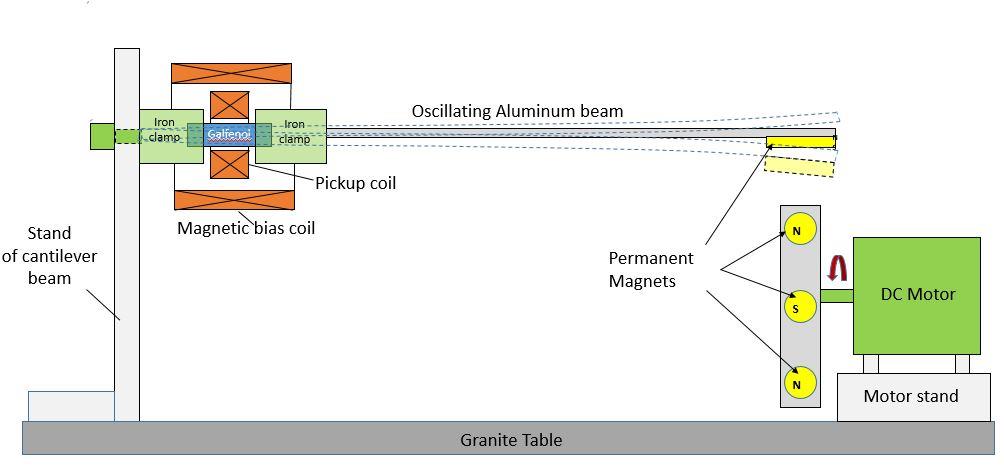
The schematic of a harvester is shown in the Figure 1. The harvester is made of an oscillating magnetostrictive rod inside a pick-up coil. The ends of the magnetostrictive rod are clamped in iron yokes by screws. To avoid the noisy disturbance generated by the oscillating system on the pickup coil, the source of vibration is allocated far from the pickup coil by an aluminum bar. There is a permanent magnet attached to the tip of the aluminum bar. A drum armed with an array of PMs on its circumference is connected to a DC motor. Rotation of the DC motor instigates an attraction/repulsive force between permanent magnets of the drum and tip of aluminum bar. Therefore, the frequency of oscillation can be controlled by the rotary drum connected to the DC motor. To investigate the performance of harvester in the presence of magnetic field, a magnetic bias coil is installed over the pickup coil to generated bias magnetic field. Significant parameters in the developed harvester are beam oscillation frequency $(f)$, intensity of bias magnetic field $(l_{bias})$ and resistive load $(R)$. The displacement of the beam can be defined by Euler-Bernoulli beam equation as:
$$EI \frac{\partial^4 w(x,t)}{\partial x^4} + \mu \frac{\partial^2 w(x,t)}{\partial t^2} + r_{ex} \frac{\partial w(x,t)}{\partial t} + r_{int} \frac{\partial^5 w(x,t)}{\partial x^4 \partial t} = 0$$
Where $w(x,t)$ is the displacement of the beam at point $x$ at time $t$ and $\mu$ is the effective mass of the harvester in unit length. $E$ is Young’s modulus and $I$ is the moment of inertia of the cross-section of the beam. $r_{ex}$ and $r_{int}$ are the external and internal damping respectively. On the other hand, the magneto-mechanical model of Galfenol can be written as:
$$\begin{cases} B = \mu \sigma H + d^* \sigma \\ \varepsilon = dH + \frac{\sigma}{E} \end{cases}$$
where $B$ and $H$ are magnetic flux density and magnetic field, respectively, $\sigma$ and $\varepsilon$ are applied stress and strain. $\mu \sigma$ is the magnetic permeability in constant mechanical stress. $d$ and $d^*$ are two magnetostrictive coefficients. The combination of the magneto-mechanical equation and the solution of equation (1) gives the generated voltage of the harvester in the form of:
$$v(t) = \frac{G_2}{1 + j\omega G_1} \left( e^{j\omega t} - e^{-\frac{t}{G_1}} \right)$$
where
$$G_1 = \frac{N^2 A \mu}{Rl}$$
$$G_2 = \frac{j\omega N A d E z}{l} \int_{l_1}^{l_2} X^* (x)$$
and $X^* (x)$ is the second derivation of the displacement, which is found from the solution of equation (1). In the experiment, the harvested voltage is measured by data acquisition system with an input impedance of 1MΩ. The specifications of the pickup coil and magnetic bias coil are presented in Table 1.
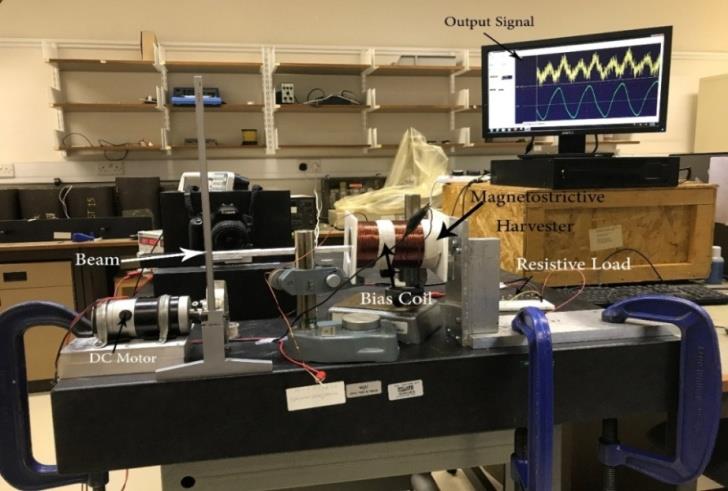
The manufactured macroscale harvester is shown in Figure 2. In this setup, the Galfenol rod, with 51 mm length and 10 mm diameter, is clamped between two iron rods and at the end, an aluminum rod is attached to them and all together have made a cantilever beam. The beam is fixed in one end, and the other end is free to vibrate. There are 6 permanent magnets around the disk attached to DC motor and another permanent magnet is attached to the end of beam. The interaction of these magnets produces a vertical displacement at the free end of the cantilever beam (the gap between rotary and fixed magnet is 25 mm). The frequency of the vibration can be easily adjusted by the input voltage of DC motor.
| Pickup coil | DC bias coil | |||||||
|---|---|---|---|---|---|---|---|---|
| Number of turns | 1500 | 567 | ||||||
| Wire thickness (mm) | 0.3 | 1 | ||||||
| Dimension (mm) | l=20 d = 22 in d 38 out = | l=42 d = 75 in d 95 out = | ||||||
| Resistance (Ω) | 33 | 3.7 |
Table 1: Pickup coil and magnetic bias coil specifications.
Results of Experiments
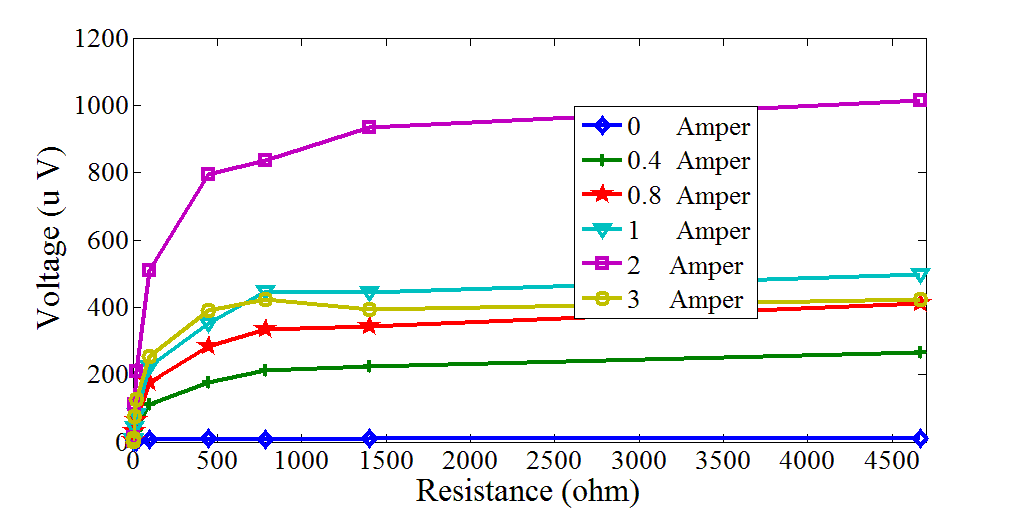
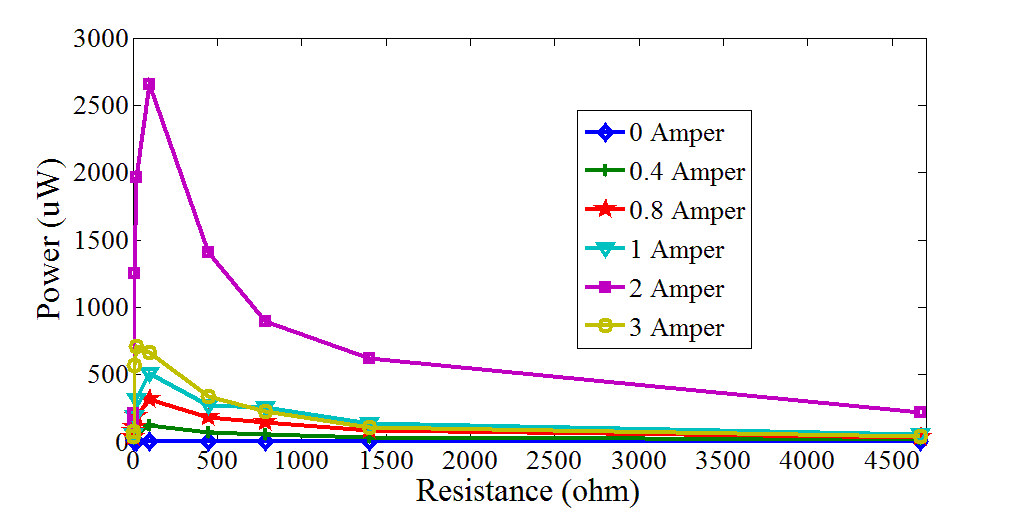
The relationship between induced voltage in the pickup coil and resistor loads in the presence of different magnetic fields are shown in Figure 3. The generated voltage is enhanced by increasing the resistor loads. In most of the bias magnetic fields, the induced voltage saturates at 1500 Ω. Furthermore, the induced voltage improves in the presence of bias magnetic fields and reaches its maximum value, 933 μV, at 2 A current bias. By increasing the magnetic bias to more than 2 A, the generated voltage is reduced. Figure 4 illustrates the general behavior of the generated power across various load resistors. The generated power increasing and reach its maximum value at 98Ωand reduces by higher value of resistive load. It is also obvious that magnetic bias enhances the generated power and the maximum power, 2654 μW, is achievable at 2 A current bias. The main reason to have higher voltage or power in a certain magnetic bias field can be referred to the fact that magnetic permeability of magnetostrictive materials depends on the bias magnetic fields. In other words, the maximum magnetic permeability occurs in certain value of magnetic field. For example, in this harvester the maximum permeability happens in 2 A current bias. Another important issue is the energy density generated by this macroscale harvester that is almost 1535μW/cm3.
Conclusions
In this paper, a macroscale magnetostrictive velocity driven energy harvester is proposed. This harvester has non-vibrating base and the external transverse force can be applied at any point of the beam. Due to ductility, high stiffness, machinability and suitability for welding, Galfenol has been chosen as the active material of this harvester. The performance of the presented macroscale harvester was measured in the presence of various magnetic bias by different resistive load. The harvester showed the highest performance when it was excited by 19.2 Hz that is the natural frequency of harvester. The energy density extracted from this harvester was 1535 μW/cm3 in the presence of 2A current bias across load resistance of 98 Ω. Such an energy density generated by this harvester shows its reliability as an energy source for photovoltaic solar Gilders in cloudy and windy weathers.
Acknowledgment
This work was done under the project number (CL/SQU-UAEU/16/05) which was funded from the joint research project in Sultan Qaboos University in Oman.
References
-
Kecik K, Mitura A, Lenci S, Warminski J (2017) Energy harvesting from a magnetic levitation system. International Journal of Non-Linear Mechanics 94: 200-206.
-
Samad FA, Karim MF, Paulose V, Ong LC (2016) A Curved Electromagnetic Energy Harvesting System for Wearable Electronics. IEEE Sensors Journal 16(7): 1969-1974.
-
Ghodsi M (2015) Optimization of Mover Acceleration in DC Tubular Linear Direct-Drive Machine Using Response Surface Method. International Review of Electrical Engineering 10(4): 492-500.
-
Shen WA, Zhu SY Zhu HP, Xu YL (2016) Electromagnetic energy harvesting from structural vibrations during earthquakes, Smart Structures and Systems 18(3): 449-470.
-
Ju S, Chae SH, Choi Y, Ji CH (2015) Macro fiber composite-based low frequency vibration energy harvester. Sensors and Actuators A: Physical 226: 126-136.
-
Haroun A, Yamada I, Warisawa S (2015) Micro electromagnetic vibration energy harvester based on free/impact motion for low frequency–large amplitude operation. Sensors and Actuators A Physical 224: 87-98.
-
Halim MA, Park JY (2015) Modeling and experiment of a handy motion driven, frequency up-converting electromagnetic energy harvester using transverse impact by spherical ball. Sensors and Actuators A: Physical 229: 50-58.
-
Karami A, Galayko D, Basset P (2017) A Novel Characterization Method for Accurate Lumped Parameter Modeling of Electret Electrostatic Vibration Energy Harvesters. IEEE Electron Device Letters 38(5): 665-668.
-
Riordan E, Galayko D, Basset P, Blokhina E (2016) Complete electromechanical analysis of electrostatic kinetic energy harvesters biased with a continuous conditioning circuit. Sensors and Actuators A: Physical 247: 379-388.
-
Tao K, Lye SW, Miao J, Hu X (2015) Design and implementation of an out-of-plane electrostatic vibration energy harvester with dual-charged electret plates. Microelectronic Engineering 135: 32-37.
-
Takhedmit H, Saddi Z, Karami A, Basset P, Cirio L (2017) Electrostatic vibration energy harvester with 2.4-GHz Cockcroft–Walton rectenna start-up. Comptes Rendus Physique 18(2): 98-106.
-
Dadkhah M, Hojjat Y, Jeon JU, Ghodsi M, Modabberifar M (2015) Voltage-Induction Synchronous Electrostatic Motor. The International Journal of Advanced Manufacturing Technology 77(1-4): 145- 164.
-
Kai Tao, Jianmin Miao, Sun Woh Lye, Xiao Hu (2015) Sandwich-structured two-dimensional MEMS electret power generator for low-level ambient vibrational energy harvesting. Sensors and Actuators A: Physical 228: 95-103.
-
Basari AA, Hashimoto S, Homma B, Okada H, Okuno H, et al. (2016) Design and optimization of a wideband impact mode piezoelectric power generator. Ceramics International 42: 6962-6968.
-
DePaula AS, Inman DJ, Savi MA (2015) Energy harvesting in a nonlinear piezomagnetoelastic beam subjected to random excitation. Mechanical Systems and Signal Processing 54-55: 405-416.
-
Gafforelli G, Ardito R, Corigliano A (2015) Improved one-dimensional model of piezoelectric laminates for energy harvesters including three dimensional effects. Composite Structures 127: 369-381.
-
Muthalif A, Diyana NH (2015) Optimal piezoelectric beam shape for single and broadband vibration energy harvesting: Modeling, simulation and experimental results. Mechanical Systems and Signal Processing 54-55: 417-426.
-
Lumentut MF, Howard IM (2016) Parametric design- based modal damped vibrational piezoelectric energy harvesters with arbitrary proof mass offset: Numerical and analytical validations. Mechanical Systems and Signal Processing 68-69: 562-586.
-
Sadeghian H, Hojjat Y, Ghodsi M, Shekholeslami (2014) An approach to design and fabrication of a piezo-actuated microdroplet generator. The International Journal of Advanced Manufacturing Technology 70(5-8): 1091-1099.
-
Firoozy P, Khadem SE, Pourkiaee SM (2017) Broadband energy harvesting using nonlinear vibrations of a magnetopiezoelastic cantilever beam. International Journal of Engineering Science 111: 113-133.
-
Mohammadzaheri M, AlQallaf A (2017) Nanopositioning systems with piezoelectric actuators, current state and future perspective. Science of Advanced Materials 9(7): 1071-1080.
-
Jafari H, Ghodsi A, Azizi S, Ghazavi MR (2017) Energy harvesting based on magnetostriction, for low frequency excitations. Energy 124: 1-8.
-
Fang ZW, Zhang YW, Li X, Ding H, Chen L (2017) Integration of a nonlinear energy sink and a giant magnetostrictive energy harvester. Journal of Sound and Vibration 39: 35-49.
-
Hoshyarmanesh H , Nehzat N , Salehi M , Ghodsi M, Lee H, et al. (2014) Piezoelectric Transducers on Curved Dispersive Bending Wave and Poke-Charged Touch Screens. Materials and Manufacturing Processes 29(7): 870-876.
-
Hoshyarmanesh H, Nehzat N, Salehi M, Ghodsi M (2015) X-ray Diffraction Measurement of Residual Stress-Strain in Sol-Gel Grown Lead Zirconate Titanate Thick Films Deposited on Nickel-Based Supper Alloy Substrate. Journal of Mechanical science and Technology 29(2): 715-721.
-
Hoshyarmanesh H, Ghodsi M, Park H (2016) Electrical Properties of UV-Irradiated Thick Film Piezo-Sensors on Superalloy IN718 Using Photochemical Metal Organic Deposition. Thin Solid Films 616: 673-679.
-
Ghodsi M, Hosseinzadeh N, Ozer A, Rajabzadeh H, Varzeghani NG, et al. (2017) Development of Gasoline Direct Injector Using Giant Magnetostrictive Materials. IEEE Transactions on Industry Applications 53(1): 521-529.
-
Sheykholeslami M, Hojjat Y, Simone C, Ghodsi M (2016) An approach to design and fabrication of resonant giant magnetostrictive transducer. Smart Structures and Systems 17(2): 313-325.
-
Karafi MR, Hojjat Y, Sasani F, Ghodsi M (2013) A Novel Magnetostrictive Torsional Resonant Transducer. Sensors and Actuators A: Physical 195: 71-78.
-
Karafi MR, Ghodsi M, Hojjat Y (2015) Development of Magnetostrictive Resonant Torsional Vibrator. IEEE Transactions on Magnetics 51(9).
-
Sheykholeslami M, Hojjat Y, Ghodsi M, Kakavand K, Cinquemani S (2015) Investigation of ΔE Effect on Vibrational Behavior of Giant Magnetostrictive Transducers. Shock and vibration pp: 9.
-
Sheykholeslami M, Hojjat Y, Ghodsi M, Zeighami M, Kakavand K (2016) Effect of magnetic field on Mechanical properties in Permandur. Materials Science & Engineering: A 651: 598-603.
-
Ghodsi M, Loghmanian M (2011) Effect of forging on ferromagnetic properties of low-carbon steel. IEEE International conference ICMSAO 2011, Kuala Lumpur, Malaysia.
-
Ghodsi M, Modabberifar M (2010) Quality Factor, Static and Dynamic Responses of Miniature Galfenol Actuator at Wide Range of Temperature. International Journal of Physical Sciences 6(36): 8143-8150.
-
Ghodsi M, Higuchi T (2008) Novel Magnetostrictive Bimetal Actuator Using Permendur. Advanced Materials Research 47-50: 262-265.
-
Naimzad A, Hojjat Y, Ghodsi M (2014) Comparative Study on Mechanical and Magnetic Properties of Porous and Nonporous Film-Shaped Magnetorheological Nanocomposites based on Silicone Rubber. International Journal of Innovative Science and Modern Engineering 2(8).
-
Ghodsi M, Teshima H, Hirano H, Higuchi T, Summers E (2007) Zero-Power Positioning Actuator for Cryogenic Environments by Combining Magnetostrictive Bimetal and HTS. Sensors and Actuators A: Physical 135(2): 787-791.
-
Ghodsi M, Mirzamohammadi S, Hojjat Y, Talebian S, Sheikhi M, et al. (2015) Analytical, Numerical and Experimental Investigation of a Giant Magnetostrictive (GM) Force Sensor. Sensor Review 35(4): 357-365.
-
Hoshyarmanesh H, Abbasi A, Moein P, Ghodsi M, Zareinia K (2017) Design and Implementation of an Accurate, Portable and Time-efficient Impedance- based Transceiver for Structural Health Monitoring, IEEE/ASME Transactions on Mechatronics 22(6): 2809-2814.
-
Davino D, Giustiniani A , Visone C, Adly AA (2012) Energy Harvesting Tests With Galfenol at Variable Magneto-Mechanical Conditions. IEEE Transactions on Magnetics 48(11): 3096-3099.
-
Wang L and Yuan F G (2008) Vibration energy harvesting by magnetostrictive material. Smart Material and Structure 17.
-
Hoshyarmanesh H, Dastgerdi HR, Ghodsi M, Khandan R, Zareinia K (2017) Numerical and experimental vibration analysis of olive tree for optimal mechanized harvesting efficiency and productivity. Computers and Electronics in Agriculture 132: 34-48.
-
Talebian S, Hojjat Y, Ghodsi, Karafi MR, Mirzamohammadi S (2015) a Combined Preisach- Hyperbolic Tangent Model for Magnetic Hysteresis of Terfenol-D. Journal of Magnetism and Magnetic Materials 396: 38-47.
-
Talebian S, Hojjat Y, Ghodsi M, Karafi MR (2015) Study on Classical and Excess Eddy Currents Losses of Terfenol-D. Journal of Magnetism and Magnetic Materials 388: 150-159.
-
Davino D, Giustiniani A, Visone C (2012) Effects of hysteresis and eddy currents in magnetostrictive harvesting devices. Physica B: Condensed Matter 407(9): 1433-1437.
-
Ghodsi M, Teshima H, Hirano H, Higuchi T (2007) Numerical Modeling of Iron Yoke Levitation Using the Pinning Effect of High Temperature Superconductor. IEEE Transactions on Magnetics 43(5): 2001-2008.
-
Ghodsi M, Higuchi T (2005) Improvement of Magnetic Circuit in Levitation System Using HTS and Soft Magnetic Material. IEEE Transactions on Magnetics 41(10): 4003-4005.
-
Ghodsi M, Ziaiefar H, Emam S, Alam K (2017) Development of Novel Magnetostrictive Energy Harvester. International Conference on Thermal Engineering, Theory and Applications, Oman.
- Nigeria’s Vulnerability in the Face of Global Energy Policy
- A Simulation Study of Investigation of Optimum Oil Production Performance by Applying Various Gas Injection Methods in Oil Reservoir
- Characterization of Permo-Triassic Reservoirs through Thermal Maturity Assessment of Westphalian Source Rocks in the Cheshire Basin
- Influence of Microwax on the Rheological and Thermal Behaviour of a Wax Crude Oil
- Real-Time Monitoring and Performance Optimization of Steam Injection in Heavy Oil Reservoirs Using Fiber Optic Sensing and Integrated Predictive Simulation Models
- Rapid On-Site Determination of the Total Petroleum Hydrocarbon Content of Soils by Handheld Fourier Transform Near-Infrared Spectroscopy: Development of a Global, Site- and Scanner- Independent Calibration Model