
Investigating the Effect of Different Nanoparticles on the Interfacial Tension Reduction
Nanoparticles gained respectful attention in the oil industry due to their ability to enhance physical properties for the injected fluid, and reservoir fluid. Many kinds of literaturehave demonstrated nanoparticles ability to decrease the interfacial tension, consequently, reduce residual oil saturation, and increase the oil recovery factor. This research aims to study the effect of nanoparticles on reducing interfacial tension between crude oil and nanofluids through applying different nanoparticles including Aluminum oxide, Nickel oxide, Zeolite, Silica, Ferric oxide, Tungsten trioxide and montmorillonite with the size of 5 nm. Different nanofluids concentrations were displaced through sand pack model, where interfacial tension between crude oil and ejected brine was estimated. Interfacial tension between crude oil/brine was measured to be 47.9 dyne/cm, finally, the interfacial tension was reduced to 30.5009 dyne/cm by using nano montmorillonite.
Introduction
The probability of exploring new huge hydrocarbon fields is not as enormous as before. On the other hand, exploring new oil fields is uneconomical due to their highly expensive costs [1, 2]. Therefore, the most economical solution is to produce the trapped oil inside the previously developed wells. Surfactant flooding and nanoparticles displacement are implemented on a high scale to produce this trapped oil and increase the oil recovery [3]. The use of nanotechnology was commonly needed in the downstream industry [4]. However, there are researches that have approved the great impact of using nanoparticles inside the reservoirs, where an enhancement of viscosity, interfacial tension, and wettability alteration occur [5]. Zhi- Yong, et al. [6] stated that TiO2 nanofluid increases the water viscosity so, providing favorable mobility ratios, which in turn improve macroscopic displacement proficiency [7], and also improve pore-scale microscopic displacement [8]. Bayat, et al. [9] settled that the use of water-based Al2O3, TiO2, and SiO2 nanofluids meaningfully reduce the interfacial tension between crude oil /water, and consequently increased the additional oil recovery from a limestone reservoir. Adsorption of lipophobic and hydrophilic polysilicon nanoparticles (~ 10 to 500 nm), were generated to explore the efficiency of wettability alteration with regard to a sandstone surface. The experiments revealed that the nanoparticles effectively change the wettability of the sandstone surface, which improves the oil recovery factor [10]. Moreover, Ehtesabi, et al. [11] have developed inexpensive and environmental friendly TiO2 nanofluids by mixing titanium tetraisopropoxide, H2O2, and water for heavy oil recovery from sandstone reservoirs. Al-Anssari, et al. [12] stated that silica nanofluids can alter the wettability of oil-wet calcite surfaces to strongly water-wet. Sedaghat, et al. [13] used a micro model to generate several flooding displacements to monitor the effect of SiO2 & TiO2 nanoparticles on wettability alteration in the presence of partially hydrolyzed polyacrylamide and sodium dodecylsulfate. The literature reported by El-hoshoudy, et al., stated that silica nanoparticles can alter rock wettability from oil-wet to water wet [14, 15, 16, 17, 18]. For the optimum nanofluid displacement, the concentration of nanoparticles should exceed the critical micelle concentration, to decrease the interfacial tension and to increase the oil recovery [19]. Therefore, this research aims to investigate the effect of nanoparticles flooding on the interfacial tension and the oil recovery. These nanoparticles including; Zeolite, tungsten trioxide (WO3), Montmorillonite, Ferric oxide (Fe2O3), Silica oxide (SiO2) and Potash Aluminum Sulfate. Each nanoparticle type was used in four different concentration (0.005, 0.01, 0.1 & 1 wt %). Finally, the interfacial tension between crude oil and brine was estimated after the conventional brine flooding.
Experimental Work
Preparation of Brine
Sodium chloride (NaCl) was used for preparing brine with a concentration of 35,000 ppm. Then sand pack was initially saturated with this brine and then crude oil displaced this brine to have the initial conditions like the reservoir conditions. Moreover, nanofluids with different El-hoshoudy AN, et al. Investigating the Effect of Different Nanoparticles on the Interfacial Tension Reduction. Pet Petro Chem Eng J 2018, 2(4): 000176.
nanoparticles concentrations subjected to sonication for 15 minutes in brine solution [20].
Equipment used for Fluids Characterization
Fluids density measured through density meter DMA 4100M, while Chandler rolling ball viscometer was used to measure the viscosity of the fluid. Finally, interfacial tension between displaced crude oil and effluent brine were determined from surface tension measurements by Du Noüy Ring Tensiometer [14, 21]. Table 1 summarizes the measure physical properties of the crude oil and brine solution.
| Fluid type | Physical property | Value | ||||||
|---|---|---|---|---|---|---|---|---|
| Crude Oil | Density, g/cc | 0.8010 | ||||||
| API | 37 | |||||||
| IFT, dyne/cm | 47.9 | |||||||
| Viscosity, cp | 6.0 | |||||||
| Brine solution | Density, g/cc | 1.3 | ||||||
| Viscosity, cp | 1.584 |
Table 1: Measured properties of the brine and crude oil.
Nanofluids Preparation
Nanofluids are kinetically stable diffusions of nanoparticles in various base fluids, such as water, polymeric solutions, glycols, or alcohols. Such nanofluids can be applied in various applications, including high- temperature operations [22], asphaltenes inhibition [23], wettability alteration [24] and in oil recovery displacement operations [12]. Other benefits involve stable rheological properties of the base fluids, IFT reduction of the crude oil/water system, and alteration the of the reservoir rock wettability [12, 25, 26]. In this study, nanofluids were prepared by the required concentrations in the previously prepared brine. Then this solution undergoes sonication for 2-3 hours to make all nanoparticles suspended inside the solution or nanofluid.
Sand Pack Handling and Flooding Experiments
Flooding experiments carried out through linear sandstone model as depicted in Figure 1, through two- main stages; Brine Flooding (Saturation) The sandstone was evacuated and then saturated with brine solution for about 12 hours to establish ionic equilibrium. Brine solution flooded at a constant flow rate of 60 cc/h through the sand packed model, where the Copyright© El-hoshoudy AN, et al.
differential pressures between the inlet and the outlet were monitored. After saturation was achieved, brine permeability (Kw) determined by measuring the pressure drop across the model and the flow rate using Darcy's law [27]. Crude Oil Flooding The stock tank oil was injected at a rate of 60 cc/h by displacement pump until the water production ceased (i.e. water cut <1%). Crude oil permeability at initial water saturation (Swi) was also measured [2]. After oil injection (API= 30.749, supplied from the western desert in Egypt), the sand pack was brine flooded until the oil production became negligible (oil cut <1%). At this stage recovered oil by primary and secondary methods is exhausted. After $$ = \frac {q \mu L}{A \Delta P} $$ q L K A P brine injection, about 3.0 pore volume of nanofluids slug was flooded, where the oil production was determined on a volume basis to calculate recovery percentage. The viscosity and interfacial tension of the displaced oil was measured. Relative permeability curve was constructed to determine the wettability alteration. This case was considered as a reference case for each following case, where the results of each nanofluid case were compared by the first case of the conventional water flooding. Porosity, permeability, initial oil, and water saturation as well as residual oil saturation determined through Equations 1-6. The bulk volume, porosity, and permeability of the used model found to be 425cc, 28.2%, and 0.632darcy respectively.
$$ P o r o s i t y (\Phi) = \left(\frac {P o r e v o l u m e}{B u l k v o l u m e}\right) \tag {1} $$ ( - ) Wet Weight Dry Weight Pore Volume Formation Brine Density = (2) (3) = (4)
1- Oi Wi Volume of Oil Injected S S Pore Volume = = (5)
= (6)
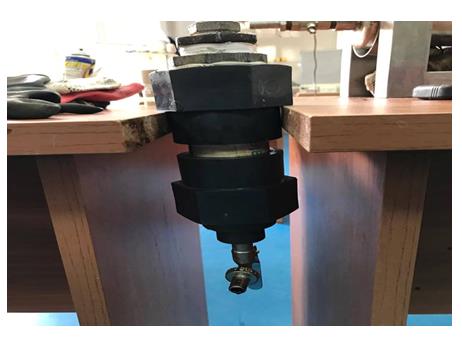
After constructing the conventional water flooding as a reference case, each nanofluid was injected at different concentrations (0.005, 0.01, 0.1 & 1 wt %) after applying sonication for 15 minutes. The oil recovery of each case was determined along with measuring the viscosity, El-hoshoudy AN, et al. Investigating the Effect of Different Nanoparticles on the Interfacial Tension Reduction. Pet Petro Chem Eng J 2018, 2(4): 000176.
interfacial tension, and wettability alteration. Accordingly, the reason behind the change (whether an enhancement or reduction) in oil recovery for each case, was identified (due to the change in oil viscosity, interfacial tension, and wettability).
Results and Discussion
Reduction of IFT
Figure 2 represents the percentage of ITF reduction for each conducted case, compared to the conventional waterflooding case. It is so clear that nanoparticles especially montmorillonite, silica nanoparticles, and ferric oxide has shown a great performance in reducing the ITF between crude oil and displaced fluid [28]. This behavior may resort to aggregation of nanoparticles in a micelle- like form at certain concentrations which adsorbed at the oil/ water boundary surface and consequently decrease the interfacial tension (IFT).
Copyright© El-hoshoudy AN, et al.
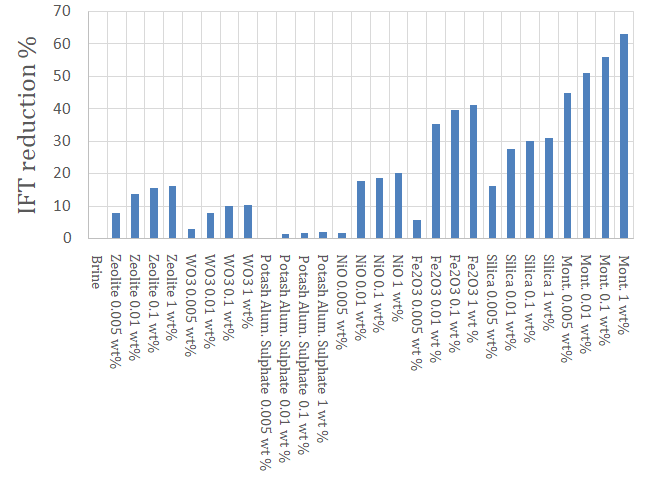
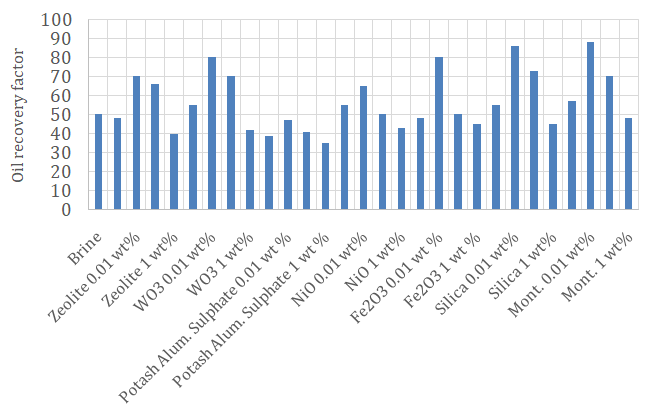
Figure 3 represents the percentage of the change in oil recovery factor for each conducted case, compared to the conventional waterflooding case. It is so clear that montmorillonite and silica both gave the highest improvement to the oil recovery factor. This may be ascertained to nanofluids ability to absorb onto rock surface, so change rock wettability from oil-wet to water- wet, which in turn enhance oil recovery. Moreover, by nanoparticles adsorption onto rock surface, they displace some of the oil by wedge-like mechanism, in which nanoparticles act as a knife dislodge the oil from the rock surface, so increase the recovery factor [29].
El-hoshoudy AN, et al. Investigating the Effect of Different Nanoparticles on the Interfacial Tension Reduction. Pet Petro Chem Eng J 2018, 2(4): 000176.
Copyright© El-hoshoudy AN, et al.
Economical Profile
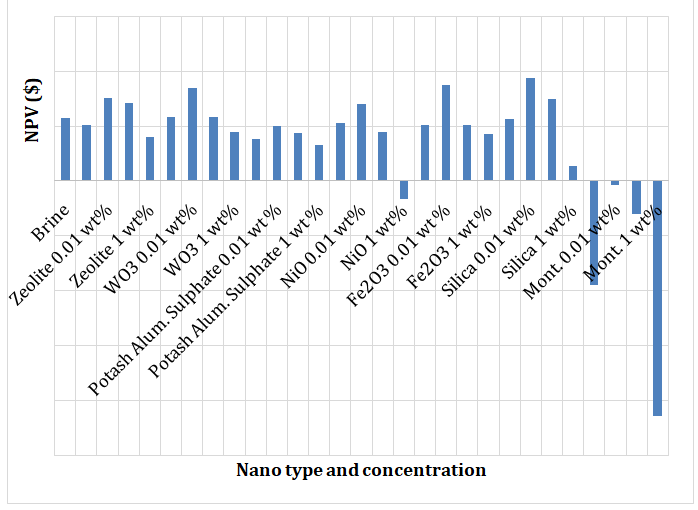
To find whether the need for this recovery mechanism is applicable or not. The net present value for the total project has to be estimated. First, the initial oil in place for a field is assumed to be 100 MM STB and the field will produce from 4 production wells with the same decline rate. Also, the number of years for production is assumed to be 10 years. Moreover, drilling and production operational cost is assumed to be 25 million dollars considering the cost of flooding operations. More and more, a discount factor of 10% is also assumed. All the previous assumptions were applied to all the cases. However, the only variable now is the nano cost that differs from each nano type and its concentration. Therefore, by considering the PV injected to reach the optimum oil recovery using this mechanism, now the cumulative net present value for the total project can be calculated as shown in Figure 4.
Conclusion
Nanoparticles have a great ability to reduce interfacial tension. Nano montmorillonite flooding has shown its great performance in decreasing the interfacial tension, where 0.005 wt% of Montmorillonite reduce interfacial tension by 40%, 0.01 wt% reduce interfacial tension by 50% and both concentrations of 0.1 wt% and 1 wt% has reduced interfacial tension to 60%. Accordingly, it is proved that increasing nano concentration from 0.005 wt % to 0.01 or 0.1 wt % lead to a noticeable enhancement in interfacial tension for all nanoparticles. Continuous El-hoshoudy AN, et al. Investigating the Effect of Different Nanoparticles on the Interfacial Tension Reduction. Pet Petro Chem Eng J 2018, 2(4): 000176.
increasing of nanoparticles concentration till 1 wt % will continue enhancing interfacial tension but slight improvement will occur for this concentration. However, this does not guarantee to increase the oil recovery as the relatively high nano concentration will plug the pore spaces leading the oil to be difficulty production that will decrease the oil recovery. The best oil recovery came from nano montmorillonite flooding. However, it was economically proven that Montmorillonite is too expensive to be used as it gives a net present value of negative value. The best nanofluid that gave highest oil recovery, with applicable reduction of interfacial tension Copyright© El-hoshoudy AN, et al.
and can be economically applied is Nano Fe2O3, that gave about 40% reduction in the interfacial tension and the highest oil recovery of 80% and it was proven that it economically applicable to be used.
References
-
Zargartalebi M, Barati N, Kharrat R (2014) Influences of hydrophilic and hydrophobic silica nanoparticles on anionic surfactant properties: Interfacial and adsorption behaviors. Journal of Petroleum Science and Engineering 119: 36-43.
-
El-hoshoudy AN, Desouky SEM, Elkady MY, Alsabagh AM, Betiha MA, et al. (2017) Hydrophobically associated polymers for wettability alteration and enhanced oil recovery–Article review. Egyptian Journal of Petroleum 26(3): 757-762.
-
Ju B, Fan T, Ma M (2006) Enhanced oil recovery by flooding with hydrophilic nanoparticles. China Particuology 4(1): 41-46.
-
Ehtesabi H, Ahadian MM, Taghikhani V, Ghazanfari MH (2013) Enhanced heavy oil recovery in sandstone cores using TiO2 nanofluids. Energy & Fuels 28(1): 423-430.
-
Al-Anssari S, Barifcani A, Wang S, Maxim L, Iglauer S (2016) Wettability alteration of oil-wet carbonate by silica nanofluid. Journal of colloid and interface science 461: 435-442.
-
Sedaghat MH, Mohammadi H, Razmi R (2016) Application of SiO2 and TiO2 nano particles to enhance the efficiency of polymer-surfactant floods. Energy Sources, Part A: Recovery, Utilization, and Environmental Effects 38: 22-28.
-
Sharma T, Kumar GS, Chon BH, Sangwai JS (2015) Thermal stability of oil-in-water Pickering em
-
Esmaeilzadeh P, Hosseinpour N, Bahramian A, Fakhroueian Z, Arya S (2014) Effect of ZrO2 nanoparticles on the interfacial behavior of surfactant solutions at air–water and n-heptane–water interfaces. Fluid Phase Equilibria 361: 289-295.
-
Arashiro EY, Demarquette NR (1999) Use of the pendant drop method to measure interfacial tension between molten polymers. Materials Research 2(1): 23-32.
-
Ling Z, Sun D, Zhang Z, Ding J, Cheng G, et al. (2013) Effect of temperature and nanoparticle concentration on the viscosity of nanofluids. J Funct Mater 44: 92.
-
Rivet S, Lake LW, Pope GA (2010) A coreflood investigation of low-salinity enhanced oil recovery, SPE Annual Technical Conference and Exhibition, Society of Petroleum Engineers, Italy.
-
Iglauer S, Sarmadivaleh M, Geng C, Lebedev M (2014) In-situ residual oil saturation and cluster size distribution in sandstones after surfactant and polymer flooding imaged with X-ray micro-computed tomography. International Petroleum Technology Conference, Qatar.
-
Esfandyari Bayat A, Junin R, Samsuri A, Piroozian A, Hokmabadi M (2014) Impact of metal oxide nanoparticles on enhanced oil recovery from limestone media at several temperatures. Energy & Fuels 28(10): 6255-6266. El-hoshoudy AN, et al. Investigating the Effect of Different Nanoparticles on the Interfacial Tension Reduction. Pet Petro Chem Eng J 2018, 2(4): 000176. Betiha M, et al. (2015) Synthesis and Characterization of Polyacrylamide Crosslinked Copolymer for Enhanced Oil Recovery and Rock Wettability Alteration. International Journal of Oil, Gas and Coal Engineering 3(4): 47-59.
-
El-hoshoudy AN, Desouky SM, Betiha MH, Alsabagh AM (2017) Hydrophobic Polymers Flooding. Application and Characterization of Surfactants, InTech.
-
Desouky SM, El-hoshoudy AN (2018) Synthesis and evaluation of acryloylated starch-g-poly (Acrylamide/ Vinylmethacrylate/1-Vinyl-2-pyrrolidone) crosslinked terpolymer functionalized by dimethylphenylvinylsilane derivative as a novel polymer-flooding agent. Int J Biol Macromol 116: 434- 442.
-
Desouky SM, El-hoshoudy AN, Attia AM (2018) Synthesis of starch functionalized sulfonic acid co- imidazolium/silica composite for improving oil recovery through chemical flooding technologies. Int J Biol Macromol 118(Pt B): 1614-1626.
-
El-hoshoudy AN, Attia AM, Dessouky SM, Gomaa S (2018) Synthesis and Evaluation of Xanthan-G-Poly (Acrylamide) CoPolymer for Enhanced Oil Recovery Applications. Petroleum & Petrochemical Engineering Journal 2(3): 1-8. Copyright© El-hoshoudy AN, et al.
-
Hezave AZ, Dorostkar S, Ayatollahi S, Nabipour M, Hemmateenejad B (2013) Investigating the effect of ionic liquid (1-dodecyl-3-methylimidazolium chloride ([C12mim][Cl])) on the water/oil interfacial tension as a novel surfactant, Colloids and Surfaces A: Physicochemical and Engineering Aspects 421: 63-71.
-
El-Hoshoudy A, Desouky S, Elkady M, Alsabagh A, Betiha M, et al. (2015) Investigation of optimum polymerization conditions for synthesis of cross- linked polyacrylamide-amphoteric surfmer nanocomposites for polymer flooding in sandstone reservoirs. International Journal of Polymer Science 2015: 14.
-
El-hoshoudy AN (2018) Quaternary ammonium based surfmer-co-acrylamide polymers for altering carbonate rock wettability during water flooding. Journal of Molecular Liquids 250: 35-43.
-
Ponmani S, William JKM, Samuel R, Nagarajan R, Sangwai JS (2014) Formation and characterization of thermal and electrical properties of CuO and ZnO nanofluids in xanthan gum. Colloids and Surfaces A: Physicochemical and Engineering Aspects 443: 37-43.
-
Romero Z, Disney R, Acuna HM, Cortes F, Patino JE, et al. (2013) Application and evaluation of a nanofluid containing nanoparticles for asphaltenes inhibition in well CPSXL4. Offshore Technology Conference, Brazil.
-
Carpenter C (2014) Application of a Nanofluid for asphaltene Inhibition in Colombia, Journal of Petroleum Technology 66(2): 117-119. El-hoshoudy AN, et al. Investigating the Effect of Different Nanoparticles on the Interfacial Tension Reduction. Pet Petro Chem Eng J 2018, 2(4): 000176.
-
Wong KV, De Leon O (2010) Applications of nanofluids: current and future. Advances in Mechanical Engineering 2.
-
Miranda CR, Lara LSd, Tonetto BC (2012) Stability and mobility of functionalized silica nanoparticles for enhanced oil recovery applications. SPE International Oilfield Nanotechnology Conference and Exhibition, Society of Petroleum Engineers, The Netherlands.
-
Takeuchi S, Nakashima S, Tomiya A (2008) Permeability measurements of natural and experimental volcanic materials with a simple permeameter: toward an understanding of magmatic degassing processes. Journal of Volcanology and Geothermal Research 177(2): 329-339.
-
Sharma T, Iglauer S, Sangwai JS (2016) Silica nanofluids in an oilfield polymer polyacrylamide: interfacial properties, wettability alteration, and applications for chemical enhanced oil recovery. Industrial & Engineering Chemistry Research 55(48): 12387-12397.
-
El-Hoshoudy AN, Desouky SEM, Betiha MA, Alsabagh AM (2016) Use of 1-vinyl imidazole based surfmers for preparation of polyacrylamide–SiO2 nanocomposite through aza-Michael addition copolymerization reaction for rock wettability alteration. Fuel 170: 161-175. Copyright© El-hoshoudy AN, et al.
- Nigeria’s Vulnerability in the Face of Global Energy Policy
- A Simulation Study of Investigation of Optimum Oil Production Performance by Applying Various Gas Injection Methods in Oil Reservoir
- Characterization of Permo-Triassic Reservoirs through Thermal Maturity Assessment of Westphalian Source Rocks in the Cheshire Basin
- Influence of Microwax on the Rheological and Thermal Behaviour of a Wax Crude Oil
- Real-Time Monitoring and Performance Optimization of Steam Injection in Heavy Oil Reservoirs Using Fiber Optic Sensing and Integrated Predictive Simulation Models
- Rapid On-Site Determination of the Total Petroleum Hydrocarbon Content of Soils by Handheld Fourier Transform Near-Infrared Spectroscopy: Development of a Global, Site- and Scanner- Independent Calibration Model