
CO2 Adsorption on Activated Carbon
Editorial
Climate change is one of the major environmental, social and economic problems affecting the world. Carbon dioxide (CO2) is considered to be the principal source of greenhouse gases that is responsible for global warming [1]. The IPCC believes that CO2 concentration increases to 570 ppm by the year 2100, provoking a global average temperature to rise by about 1.9°C [2]. Various techniques have been used to reduce the CO2 emissions among which the use of renewable energy, the energy control and the development of CO2 capture and storage (CCS) technology [3]. The CCS technique has been considered as the best option for reducing carbon dioxide emissions from large point sources. The carbon dioxide (CO2) captured from large stationary sources can be safely injected and stored in appropriate geological formations, such as deep saline formations and depleted oil and gas reservoirs [4].
Adsorption process has become a potential attractive alternative for CO2 storage in the context of carbon capture and sequestration technologies (CCS) because of its low energy requirements, cost effectiveness, and ease of use at a variety of pressures and temperatures [5]. Many different adsorbents can be used for this purpose such as clay, activated carbon (AC), zeolites, mesoporous silica, and organo-metallic structures [5].
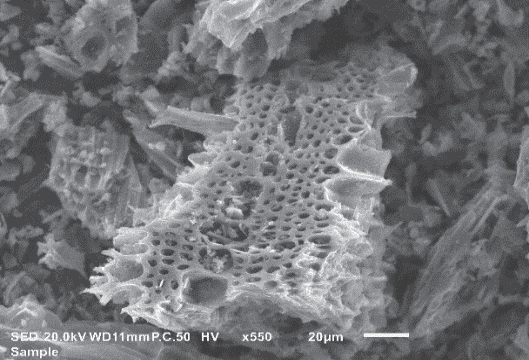
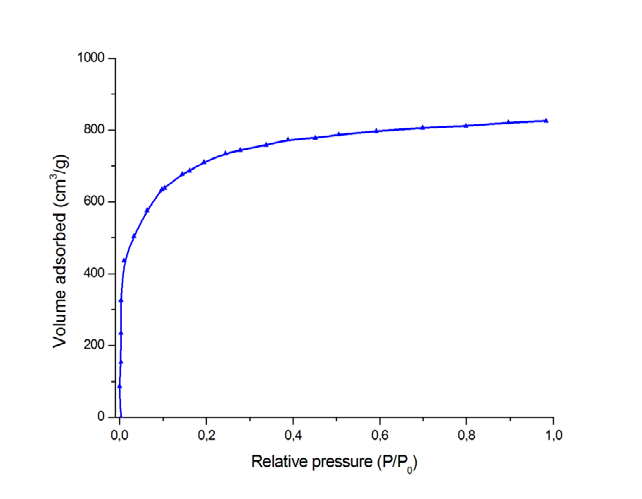
Based on the above-mentioned studies, activated carbon (AC) is used as adsorbent with CO2 [6]. The AC was characterized by SEM (Figure 1), wich present a roughness structure resembling a series of parallel lines. The AC gave rougher textures with heterogeneous surfaces and a greater variety of randomly distributed pores size. The N2 isotherm (Figure 2) shows that the studied AC can be classified as a type I isotherm [6]. According to the IUPAC classification, the adsorbent is essentially formed by micropores with a very narrow microporosity. The textural parameters show that the AC has a significant porosity, with high values of total pore volume Vtotal (0.676 cm3 g-1), surface area SBET (1565 m2 g-1) and micropore volume (0.649 cm3 g-1).
The CO2 adsorption isotherms in formulated AC were measured volumetrically at various temperatures (298, 310 and 320 K), and the experimental data were modeled with the Langmuir and Freundlich methods [6]. The Langmuir isotherm was employed to describe the monolayer adsorption into the homogeneous surface. While the Freundlich isotherm was used for multilayer adsorption and surface heterogeneity (Figure 3). These parameters proved
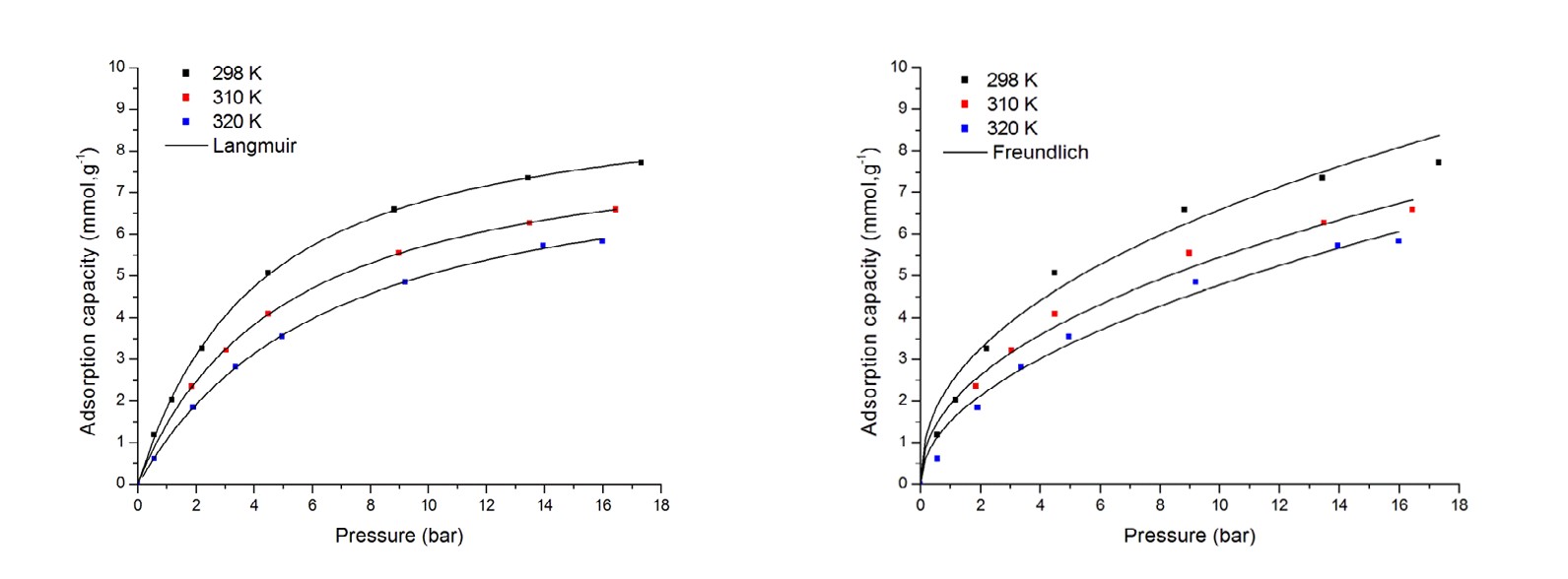
that the CO2 adsorption is spontaneous, exothermic and physisorption in nature.
References
-
Wahby A, Silvestre-Albero J, Sepulveda-Escribano A, Rodrıguez-Reinoso F (2012) CO2 adsorption on carbon molecular sieves. Microporous Mesoporous Mater 164: 280-287.
-
IEA, Energy technology perspectives.
-
Jedli H, Brahmi J, Hedfi H, Mbarek M, Bouzgarrou S, et al. (2018) Adsorption kinetics and thermodynamics properties of Supercritical CO2 on activated clay. Journal of Petroleum Science and Engineering 166: 476-481.
-
Jedli H, Jbara A, Hedfi H, Bouzgarrou S, Slimi K (2017) A laboratory study of supercritical CO2 adsorption on cap rocks in the geological storage conditions. Appl Phys A 123: 254.
-
Jedli H, Briki C, Chrouda A, Brahmi J, Abassi A, et al. (2019) Experimental and theoretical study of CO2 adsorption by activated clay using statistical physics modeling. RSC Adv 9: 38454-38463.
-
Almoneef MM, Jedli H, Mbarek M (2021) Experimental study of CO2 adsorption using activated carbon. Mater Res Express 8(6): 065602.
- Nigeria’s Vulnerability in the Face of Global Energy Policy
- A Simulation Study of Investigation of Optimum Oil Production Performance by Applying Various Gas Injection Methods in Oil Reservoir
- Characterization of Permo-Triassic Reservoirs through Thermal Maturity Assessment of Westphalian Source Rocks in the Cheshire Basin
- Influence of Microwax on the Rheological and Thermal Behaviour of a Wax Crude Oil
- Real-Time Monitoring and Performance Optimization of Steam Injection in Heavy Oil Reservoirs Using Fiber Optic Sensing and Integrated Predictive Simulation Models
- Rapid On-Site Determination of the Total Petroleum Hydrocarbon Content of Soils by Handheld Fourier Transform Near-Infrared Spectroscopy: Development of a Global, Site- and Scanner- Independent Calibration Model