
Mechanistic Kinetic Models for Catalytic Alkylation of Toluene with Methanol for Xylene Production
Mechanistic kinetic models were developed for the catalytic alkylation of toluene with methanol over H-ZSM–5 coated silicon carbide (SiC) foam catalyst at atmospheric pressure in the temperature range of 623–723 K, molar methanol to toluene ratio of 2:1 and at different catalyst weight to the toluene molar flow rate in the range 0.72–5.5 kg catalyst h/kg mol toluene in a stainless-steel flow reactor fabricated to house the ceramic foam blocks coated with catalyst. The kinetic models developed for the transformation were Langmuir-Hinshelwood-Hougen-Watson (LHHW) rate expressions based on a reaction mechanism, which involved the adsorption of reactants species on the active catalyst sites, surface reaction of the adsorbed species to produce products and desorption of products from the catalyst surface, assuming same kind of active sites on the catalyst. The optimization routine of Nelder-Mead simplex method was used to estimate the inherent kinetic parameters in the proposed models. The selection of the best kinetic model amongst the rival kinetic models was based on physicochemical and thermodynamic tests and statistical analysis was employed to further validate the best model. The rate-determining step for the alkylation of toluene with methanol over H-ZSM-5 coated silicon carbide foam catalyst was found to be the surface reaction between adsorbed toluene and adsorbed methanol. Excellent agreement was obtained between the experimental rate of reaction and conversion of toluene and the model predictions, with absolute relative residuals being at most 3.8% for conversion and 3.9% for rate of reaction. The activation energies and enthalpies of adsorption were predicted, as well as, their corresponding pre-exponential factors. The results of this study can be used for sizing the alkylation reactor for xylene production and optimization studies.
Introduction
Aromatics, benzene, toluene and xylenes (BTX), are ranked amongst the most important intermediate products in the chemical industry [1], with a wide range of applications. They are the most important precursors for chemical commodities, for example, polyesters, polyamides, polystyrene, polyurethane and plasticizers, amongst others [2]. Benzene may be referred to as the fundamental building block of aromatic compounds. Benzene, toluene and the xylenes (known as methylbenzenes) are manufactured from distillation of oil fractions and are used as intermediates in the production of a very wide range of chemicals as well as in petrol [3]. They are amongst the most important organic chemicals as seen with their plethora of uses. According to Thyssenkrupp [1], the global production of BTX aromatics is approximately 110 million tons and an increase in demand of 4%, 5% and less than 3 % per annum is expected for benzene, xylenes and toluene respectively. The primary sources of these useful aromatic compounds are reformate produced from catalytic reforming or thermal cracking of naphtha, pyrolysis gasoline from steam-crackers and coke oven light oil from coke oven plants [1].
The global market production and demand of BTX aromatics indicates that toluene is produced in excess relative to the market demand [2]. The conversion of the surplus toluene into benzene and xylenes by disproportionation and transalkylation (to produce benzene and xylene) or methylation with methanol (to produce xylenes), as considered in this work, are potential ways to balance this toluene production and demand unbalance. Toluene methylation with methanol for xylene production, however, could be a more attractive option than disproportionation of toluene because methylation can be operated at lower temperatures than disproportionation [2]. Also, methanol can be synthesized from the widely available and abundant natural gas. The global demand for xylene was estimated to be 46.5 million tons in 2019 [4]. Xylene demand was forecasted to increase to 51 million tons by 2022, while production capacity was forecasted to rise to 61 million tons. Among the xylene isomers, p-xylene has the highest demand in industry, that is, approximately 26 million tons per year or approximately 80% of the xylenes as at 2010 [2], as the precursor for the production of terephthalic acid, a very useful chemical. Polyethylene terephthalate (PET) can then be produced from terephthalic acid and it is a material used for the production of plastics (for example, for soft drink bottles), by polymerization with ethylene glycol. Typically, m-xylene is thermodynamically favoured and is the main product from the major xylene production routes [2]. The boiling points of xylenes are very close, however the differences in melting points between the isomers differ by more than 20 K [5]. As a result, more expensive and energy intensive processes like, adsorption or crystallization processes, are required for xylene separation. Alternatively, highly para-selective catalysts would be necessary to avoid these expensive separation options.
Some of the ways to increase the selectivity of p-xylene in the methylation of toluene with methanol have been reported in the literature. These include increasing the zeolite crystal size [6] and impregnation of the zeolite with phosphorous or boron compounds amongst others. As already stated, xylene serves as an intermediate for the production of a wide range of useful materials. This has made the demand for xylene increase tremendously over the past few decades. However, the unfortunate reality is that the current sources of xylene, which mainly comprise catalytic naphtha reforming and pyrolysis gasoline, are unable to meet demand proportions for this important aromatic compound [7]. The para-xylene, which amounts to only 20–25% of a typical aromatics stream from naphtha reforming [7], is a major chemical intermediate with rapidly growing demand. As a result of this growing demand for para-xylene, alternative methods for enhancing the yield and or selectivity of xylene, the para isomer in particular, are being investigated by various researchers. Some alternatives include toluene disproportionation, transalkylation of methyl benzenes with toluene and toluene alkylation (methylation) over catalysts. Although toluene disproportionation has produced significant xylene yield, with remarkable para-xylene selectivity and has been applied industrially, the formation of benzene in the product mix is considered to be a major setback.
Toluene methylation with methanol, on the other hand, produces a negligible amount of benzene and also requires methanol, a cheaper feed stock. Hence, toluene methylation is seen as an interesting alternative to naphtha reforming and toluene disproportionation. However, large volumes of work have been done and may be found on toluene methylation regarding catalyst development, but the reaction mechanism and kinetic studies of the reaction are not yet widespread, mainly because of the low levels of toluene conversion (25–30%), while maintaining high p_-_xylene selectivity ( >85 %) [7]. The xylene production may be carried out via a number of processes or ways: catalytic naphtha reforming and secondary hydrogenation of pyrolysis gasoline. The increasing demand for p-xylene over its isomers has led to the development of catalysts and operating conditions that may increase the selectivity of p-xylene in the toluene alkylation with methanol process. The challenge is most of the works that have been carried out on the kinetic study to propose a suitable model that describes the rate and mechanism for toluene alkylation for xylene production has not exhaustively considered models developed from the consideration of a plausible reaction mechanism; rather a semi-empirical approach based on two or three rate parameters in the model development is taken [8]. The prospect of establishing the catalytic methylation of toluene with methanol by developing and validating the kinetic model describing the process is a step in the direction tending towards design and development of reactor hardware and configuration to meet the p-xylene demand. This work is geared towards the development of a feasible and comprehensive mechanistic kinetic model for alkylation of toluene with methanol on a zeolite-based catalyst using Langmuir-Hinshelwood-Hougen-Watson (LHHW) approach. The inherent kinetic and thermodynamic parameters in the developed kinetic models were estimated using Nelder-Mead simplex optimization scheme. Discrimination amongst the rival kinetic models was performed using physicochemical test, thermodynamics scrutiny and statistical analysis with a view obtaining the rate-determining step for the investigated alkylation reaction. The results of this study can be used for sizing the alkylation reactor and optimization studies.
Methodology
Development of Mechanistic Kinetic Models for Catalytic Alkylation of Toluene with Methanol
The development of kinetic model requires a good formulation of elementary steps from the feed materials to products. The overall reaction employed for the development of kinetic models for the alkylation of toluene with methanol on H-ZSM-5 based catalyst is given by:
C6H5CH3 + CH3OH →C6H4(CH3)2 + H2O (1)
Different mechanistic models were developed based on Langmuir-Hinshelwood-Hougen-Watson (LHHW) mechanisms, which requires the independent adsorption of the two reactant species, toluene and methanol, on the catalyst active site, S, for any transformation to take place. This mechanism comprises five equations, Equations (2)–(6): two single-site adsorption steps, a surface reaction step and two desorption steps, thereby yielding the xylene and water products. The species are designated as T for toluene, M for methanol, X for xylene and W for water. The five elementary steps in the mechanisms for toluene alkylation reaction with methanol on H-ZSM-5 based catalyst are presented thus:
1. Adsorption of toluene (T) on the catalyst active site (S):
k T ' T + S T.S
k (2) T
2. Adsorption of methanol (M) on the catalyst active site (S):
k M ' M + S M.S
k (3) M
3. Surface reaction between adsorbed toluene (T.S) and adsorbed methanol (M.S) to yield adsorbed xylene (X.S) and adsorbed water (W.S):
k Sr ' T.S + M.S X.S + W.S
k (4) Sr
4. Desorption of adsorbed xylene:
' X.S X + S
k X k (5) X
5. Desorption of adsorbed water:
' W.S W + S
k W k (6) W The corresponding thermodynamic equilibrium constants are defined thus:
′ ′ = = = = = ′ ′ ′ (7) The overall thermodynamic equilibrium constant AT K , for the alkylation of toluene with methanol is given by:
k k k k k K K K K K k k k k k
' ; ; ; ; sr W T M X T M sr X W T M X W sr
K K K K K K = (8)
T M sr AT X W
The total site concentration, Tc , consists of vacant site and the adsorbed species concentrations, and is given by:
S W S X S M S T S T c c c c c c . . . . + + + + = (9) Applying quasi-steady state approximation, the rate expressions were derived assuming any of the elementary reactions in Equations (2) to (6) was rate-determining. A summary of the rate equations using Langmuir-Hinshelwood- Hougen-Watson approach for the toluene alkylation reaction with methanol on H-ZSM-5 based catalyst is presented in Table 1.
| Model | Rate-Controlling Step | Rate Equation |
|---|---|---|
| 1 | Adsorption of toluene on catalyst site | $(-r'_T)=\frac{k_Tc_T(p_T-\frac{1}{K_{AT}}\frac{p_Xp_W}{p_M})}{1+\frac{K_T}{K_{AT}}\left(\frac{p_Xp_W}{p_M}\right)+K_Mp_M+K_Xp_X+K_Wp_W}$ |
| 2 | Adsorption of methanol on catalyst site | $(-r'_T)=\frac{k_Mc_T(p_M-\frac{1}{K_{AT}}\frac{p_Xp_W}{p_T})}{1+K_Tp_T+\frac{K_M}{K_{AT}}\left(\frac{p_Xp_W}{p_T}\right)+K_Xp_X+K_Wp_W}$ |
| 3 | Surface reaction of adsorbed species on the catalyst surface | $(-r'_T)=\frac{k_SK_TK_Mc_T^2\left(p_Tp_M-\frac{1}{K_{AT}}\frac{p_Xp_W}{p_T}\right)}{\left(1+K_Tp_T+K_Mp_M+K_Xp_X+K_Wp_W\right)^2}$ |
| 4 | Desorption of adsorbed xylene from the catalyst surface | $(-r'_T)=\frac{k_XK_{AT}c_T\left(\frac{p_Tp_M}{p_W}-\frac{1}{K_{AT}}p_X\right)}{\left(1+K_Tp_T+K_Mp_M+K_XK_{AT}\left(\frac{p_Tp_M}{p_W}\right)+K_Wp_W\right)}$ |
| 5 | Desorption of adsorbed water from the catalyst surface | $(-r'_T)=\frac{k_WK_{AT}c_T\left(\frac{p_Tp_M}{p_X}-\frac{1}{K_{AT}}p_W\right)}{\left(1+K_Tp_T+K_Mp_M+K_Xp_X+K_WK_{AT}\left(\frac{p_Tp_M}{p_X}\right)\right)}$ |
Table 1: Rate expressions for toluene alkylation with methanol on H-ZSM-5 catalyst.
Computation of Overall Thermodynamic Equilibrium Constant
The variation of the overall thermodynamic equilibrium constant AT K , in the rate expressions (in Table 1) with temperature was calculated using the expression:
( ) ( ) ( ) 2 3 2 1 1 2 6 12 AT u In K a InT b T c T d T c T c R = ∆ + ∆ + ∆ + ∆ − + (10) The values of various constants in Equation (10), as well as the standard heats of formation at 298.15 K (J/ mol), , 0 298 , K f H ∆ and standard Gibbs free energy at 298.15 K, , 0 298 , K f G ∆ (J/mol) for the components participating in the alkylation of toluene with methanol, obtained from Sinnott and Towler [9], are presented in Table 2.
| Components | a | b | c | d | ∆H0 (J/mol) f,298K | ∆G0 (J/mol) f,298K |
|---|---|---|---|---|---|---|
| C H CH 6 5 3 | -24.355 | 51.246×10⁻² | -2.765×10⁻⁴ | 49.111×10⁻⁹ | 50.03×10³ | 122.09×10³ |
| CH OH 3 | 21.152 | 70.924×10⁻³ | 25.870×10⁻⁶ | -2.852×10⁻⁸ | -201.30×10³ | −162.62 ×10³ |
| C H (CH ) 6 4 3 2 | -25.091 | 60.416×10⁻² | -3.374×10⁻⁴ | 68.203×10⁻⁹ | 17.96×10³ | 121.21 ×10³ |
| H O 2 | 32.243 | 19.238×10⁻⁴ | 10.555×10⁻⁶ | −3.596 ×10⁻⁹ | -242×103 | −228.77 ×10³ |
But 0 0 ,298 ,298 2 f K p f K p dH c dT H c dT c = ⇒∆ = ∆ + ∫ (11)
2 3 pc a bT cT dT ∆ =∆+ ∆ + ∆ + ∆ (12)
where ( ) ( ) 6 4 3 2 6 5 3 3 2 1.0 1.0 1.0 1.0 C H CH H O C H CH CH OH ∆= × + × − × + × Hence, a ∆ =10.355, b ∆ = 2.26998×10⁻², c ∆ = -7.62 ×10⁻⁵, d ∆ = 4.402×10⁻⁸,
0 298 , K f H ∆ = -7.277×10⁴ J/mol, 0 298 , K f G ∆ = -6.7030×10⁴ J/mol and the standard entropy at 298.15 K,
0 298 , K f S ∆ = -19.2521 J/(mol K) for toluene alkylation with methanol.
− Using Equation (12) in Equation (11), the constant of integration, 2_c_ , in Equation (11) can be determined for T = 298.15 K. Multiplication of Equation (10) by ( ) RT − and substitution of known values from Table 2 into the resulting expression gives the value of another constant of integration,
1_c_ , for T = 298.15 K. Hence, using Equation (10), the general expression for the variation of the overall thermodynamic equilibrium constant, AT K , with temperature was found to be:
3 6 2 10 3 9174.8743 1.2455 1.3652 10 1.5 10 4.412 10
− − − = + + × + × + ×
AT In K InT T T T T
11.1108 (13)
Optimization Routine of Nelder-Mead
The optimization routine of Nelder-Mead simplex algorithm was used to estimate the inherent kinetic parameters in the models proposed. The routine is used to estimate the reaction rate constants and adsorption equilibrium constant parameters for the alkylation of toluene with methanol on H-ZSM-5 catalyst coated on silicon carbide foam. The Nelder-Mead simplex method is a commonly adopted numerical method for finding the minimum of an objective function in a multi- dimensional optimization problem. It is a direct search method that is usually applied to non-linear multivariate optimization problems, for which derivatives may not be known or are difficult to obtain. The Nelder-Mead simplex method is a technique that was proposed by Nelder and Mead [10], as a development of the method of Spendley, et al. [11]. The details of the method and its algorithm can be found in Nelder and Mead [10]. The gradient-based methods are effective but have not been adopted in this study owing to the difficulty of performing analytical and/ or numerical differentiation in the algorithms and the use of finite differences as a substitute for the evaluation of analytical derivatives introduces significant errors [12]. The multivariable optimization search method was employed, as there are many parameters to be estimated. The specific reaction rate and thermodynamic equilibrium constants for each of the models in Table 1 were obtained using the scheme discussed earlier to minimise the sum of squares of all errors between experimental and predicted conversions and/or rate of alkylation of toluene. Hence, for each model, we find m R K∈ that minimises the sum of square of the residuals, that is:
( ) ( ) ( ) { }
n
2 = = = − ∑ (14)
, , 1 , T expt T pred k k k k J K X X K ε τ ( ) ( ) ( ) { }
n
2 = ′ ′ = = − −− ∑ (15)
, , 1 , T expt T pred k k k k J K r r K ε τ subject to m i Ki ,......., 2 ,1 ; 0 = > ; where ε is the error, ( ) K J is the objective function, ( ) k pred T K X θ , , and ( ) k pred T K r θ, ,′ − are the respective conversion and rate models as a function of [ ] T m K K K K ,....., , 2 1 = , the vector of regression parameters and ( ) 0 T F W = τ , the so-called space time, is the independent variable. k τ is, of course, the value of τ at the kth data point, ( ) , T expt k X and ( ) , T expt k r′ − are the respective experimental values of conversion of toluene, T X , and alkylation rate, ( ) Tr′ − at the kth data point and n is the number of experimental data points. The routine requires initial guesses for all constants, which were employed until no other values that produced a smaller error were found.
Results and Discussion
Simulation Results
The variation of the equilibrium constant AT K , with temperature is presented in Table 3.
| Reaction Parameters | Temperature | ||||
|---|---|---|---|---|---|
| 298.15 K | 623 K | 673 K | 703 K | 723 K | |
| ∆H0 f (J/mol) | -72770 | -69908.9 | -69656.9 | -69529.9 | -69454.9 |
| ∆G0 f (J/mol) | -67030 | -62126.9 | -61512.5 | -61152.3 | -60915.1 |
| ∆S0 f (J/mol K) | -19.2521 | -12.4911 | -12.1015 | -11.9169 | -11.8117 |
| K AT | 5.544 ×10¹¹ | 161859.4 | 59490.02 | 34989.21 | 25182.3 |
Table 3: Thermodynamic parameters of toluene alkylation with methanol as function of temperature.
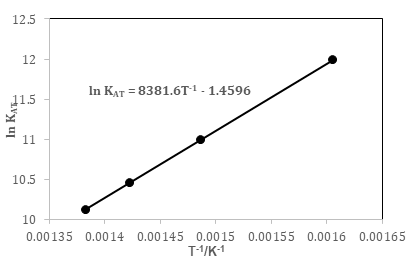
The plot of the overall thermodynamic equilibrium constant AT K , for toluene alkylation with methanol with inverse of temperature is shown in Figure 1.
The experimental data for the alkylation of toluene with methanol, catalyzed by commercial H-ZSM-5 coated over SiC foam were obtained at atmospheric pressure using a flow reactor at reaction temperatures of 623 K, 673 K, 703 K and 723 K, molar methanol to toluene ratio of 2 and spacetime,
0 T F W of 0.72 to 5.5 kg cat h/kmol of toluene [8]. The H-ZSM-5 from Merck Ltd., India was coated on the foam by dip-coating method and the coated foam used as the catalyst block for the experiment. Toluene (99 %) obtained from Merck India Ltd. and methanol (99.5%) from Spectrochem Pvt. Ltd. were used for the alkylation reaction of toluene with methanol to produce xylene and water. H-ZSM-5 was used as it shows slow rate of coking compared with other zeolites due to its low acid site density and the reticulated foam-support used enhances the reaction rate significantly over the pellet catalyst form [8]. Ghosal, et al. [8] reported the experimental procedure for the catalytic alkylation of toluene with methanol and the results are presented in Table 4.
| W F (kg cat h/ T0 kmol) | Conversion, X T | (−r′) Experimental rate, (kmol/(kg h)) T | ||||||
|---|---|---|---|---|---|---|---|---|
| T=623K | T=673 K | T=703 K | T=723K | T=623K | T=673 K | T=703 K | T=723K | |
| 0 | 0 | 0.0897 | ||||||
| 0.731 | 0.0623 | 0.0889 | ||||||
| 1.6 | 0.142 | 0.0864 | ||||||
| 2.17 | 0.19 | 0.0837 | ||||||
| 3.2 | 0.27 | 0.0769 | ||||||
| 4.29 | 0.349 | 0.0669 | ||||||
| 5.52 | 0.42 | 0.0523 | ||||||
| 0 | 0 | 0.1416 | ||||||
| 0.724 | 0.0968 | 0.131 | ||||||
| 1.61 | 0.209 | 0.1179 | ||||||
| 2.17 | 0.273 | 0.1095 | ||||||
| 3.16 | 0.373 | 0.0946 | ||||||
| 4.29 | 0.471 | 0.0773 | ||||||
| 5.55 | 0.557 | 0.0578 | ||||||
| 0 | 0 | 0.1585 | ||||||
| 0.732 | 0.109 | 0.1416 | ||||||
| 1.62 | 0.225 | 0.1223 | ||||||
| 2.18 | 0.293 | 0.1109 | ||||||
| 3.2 | 0.397 | 0.0916 | ||||||
| 4.31 | 0.486 | 0.0726 | ||||||
| 5.54 | 0.568 | 0.0543 | ||||||
| 0 | 0 | 0.1818 | ||||||
| 0.732 | 0.12 | 0.1566 | ||||||
| 1.62 | 0.25 | 0.1299 | ||||||
| 2.17 | 0.318 | 0.1155 | ||||||
| 3.19 | 0.421 | 0.0932 | ||||||
| 4.29 | 0.511 | 0.0753 | ||||||
| 5.53 | 0.593 | 0.0631 |
Table 4: Experimental Kinetic data: 0 _T_ _F_ = 0.0039 mol toluene/min and toluene to methanol molar ratio of 1:2 [8].
To obtain the experimental rates of the reaction, ( ) Tr′ − , for the fluid-solid systems, the conversion, T X , was differentiated with respect to space time, 0 T F W , since the continuity equation of the reaction components in a flow reactor is given by:
dN dX r W dt d W F ′ − = =
1 T T T T ( ) ( ) 0
(16) where T N is the number of moles of toluene, W the catalyst weight (kg) and 0 T F the initial molar flow rate of toluene into the reactor (kmol/h). The partial pressures of the chemically reactive species in the system at different conversions and
0 T F W are calculated from the stoichiometry given in Equation (1) using ideal gas law, i.e., ( ) T T T X p p − = 1 0 , ( ) ( ) 0 0 0 0 0 , T M T T T T M p p X p p = − = θ θ is the initial molar ratio of methanol to toluene in the feed and W T T X p X p p = = 0 , and the results are presented in Table 5.
| Temperature (K) | Partial pressure (atm) | |||
|---|---|---|---|---|
| p T | p M | p X | p W | |
| 623 | 0.3333 | 0.6667 | 0 | 0 |
| 0.3125 | 0.6459 | 0.0208 | 0.0208 | |
| 0.286 | 0.6194 | 0.0473 | 0.0473 | |
| 0.27 | 0.6034 | 0.0633 | 0.0633 | |
| 0.2433 | 0.5767 | 0.09 | 0.09 | |
| 0.217 | 0.5504 | 0.1163 | 0.1163 | |
| 0.1933 | 0.5267 | 0.14 | 0.14 | |
| 673 | 0.3333 | 0.6667 | 0 | 0 |
| 0.301 | 0.6344 | 0.0323 | 0.0323 | |
| 0.2636 | 0.597 | 0.0697 | 0.0697 | |
| 0.2423 | 0.5757 | 0.091 | 0.091 | |
| 0.209 | 0.5424 | 0.1243 | 0.1243 | |
| 0.1763 | 0.5097 | 0.157 | 0.157 | |
| 0.1477 | 0.4811 | 0.1856 | 0.1856 | |
| 703 | 0.3333 | 0.6667 | 0 | 0 |
| 0.297 | 0.6304 | 0.0363 | 0.0363 | |
| 0.2583 | 0.5917 | 0.075 | 0.075 | |
| 0.2356 | 0.569 | 0.0977 | 0.0977 | |
| 0.201 | 0.5344 | 0.1323 | 0.1323 | |
| 0.1713 | 0.5047 | 0.162 | 0.162 | |
| 0.144 | 0.4774 | 0.1893 | 0.1893 | |
| 723 | 0.3333 | 0.6667 | 0 | 0 |
| 0.2933 | 0.6267 | 0.04 | 0.04 | |
| 0.25 | 0.5834 | 0.0833 | 0.0833 | |
| 0.2273 | 0.5607 | 0.106 | 0.106 | |
| 0.193 | 0.5264 | 0.1403 | 0.1403 | |
| 0.163 | 0.4964 | 0.1703 | 0.1703 | |
| 0.1357 | 0.4691 | 0.1976 | 0.1976 |
Table 5: Partial pressures of chemically reactive species in the toluene alkylation with methanol over H-ZSM-5 catalyst.
The downhill simplex method due to Nelder and Mead [10] is quite robust, effective, and easily implementable on a digital computer [13], and as earlier stated, derivative methods, which are more efficient are not recommended because of the difficulty in performing both analytical and numerical differentiation needed in the gradient- based algorithms. The downhill simplex method, a multidimensional search method was employed, as there was more than one parameter to be estimated. The kinetic rate and equilibrium constants for each of the models in Table 1, were obtained using the scheme to minimize the sum of squares of all errors between experimental and predicted conversion and/or rates, as given by Equations (14) and (15) and (16) respectively. The number of experimental and simulated data points used in these equations was seven. These experimental data were obtained by Ghosal, et al. [8] in a flow reactor whose dimensions were, length, L = 200 mm, breadth, B = 42 mm and height, H = 42 mm. As it is not possible to bracket the minimum of the objective function, ( ) K J , so that the success of a subsequent optimum-isolation will be guaranteed as is usually the case in one dimensional optimization [14], the procedure required a starting guess to be given. A starting guess that is an m-vector of independent parameter variables as the first point to try was made and as highlighted by Press et al. ]14], it was prudent to restart the multidimensional minimization routine at a point where it claimed to have found a minimum. For the restarts, m of the (m+1) vertices of the simplex were reinitialized, with the claimed minimum being one of the vertices of the restart initial simplex. As highlighted by Olafadehan and Okinedo [13], difficulties associated with the non-linear systems optimization problem as in this work, arise because they can have more than one optimum. The Nelder Mead optimization method is capable of finding one or more of the optimum points depending on the initial guesses and step sizes supplied. Scilab 6.0, an open-source platform for numerical computation, was the solver used to implement the Nelder Mead optimization method. Scilab’s fminsearch function, which uses the Nelder Mead algorithm and computes the simplex from a heuristic in the neighbourhood of the initial guess was used. This function generates the simplex with the relative delta for non-zero parameters in the so-called heuristic method known as “pfeffer” method being 0.05 [15]. Using the downhill simplex method due to Nelder and Mead [10], the estimated reaction rate constants and adsorption equilibrium constant parameters for toluene alkylation with methanol to xylene over H-ZSM-5 catalyst are presented in Tables 6 to 10.
| Parameter (Model 1) | Temperature | |||
|---|---|---|---|---|
| 623 K | 673 K | 703 K | 723 K | |
| k T (atm-1 h-1) | 0.126521 | 1.8×10⁻⁶ | 5.608×10⁻⁴ | 5.2804×10⁻³ |
| k T′ (h-1) | 6.229×10⁻¹⁰ | 1.592×10⁻¹¹ | 1.712×10⁻¹¹ | 8.695×10⁻¹⁰ |
| K AT (dimensionless) | 161859.4 | 59490.02 | 34989.213 | 25182.3 |
| K T (atm-1) | 2.031 ×10⁸ | 110828.4 | 32760393 | 6072946 |
| K M (atm-1) | 151.4187 | -0.838473 | 303.0793 | 279.7421 |
| K X (atm-1) | 2.011665 | -13.78078 | 5.0975265 | -7.626737 |
| K W (atm-1) | -214.4509 | 12.32044 | 155.60952 | 380.5838 |
| K Sr (dimensionless) | -0.002271 | 108.6936 | 0.0027953 | -0.043026 |
| c T (kmol/kg cat) | 215.0139 | 105425.6 | 171249.88 | 19388.51 |
| Objective function | 7×10⁻⁶ | 1.16×10⁻⁵ | 1×10⁻⁵ | 6.6×10⁻⁶ |
Table 6: Estimated toluene adsorption reaction rate and equilibrium constants for model 1 for toluene alkylation with methanol to
| Parameter (Model 2) | Temperature | |||
|---|---|---|---|---|
| 623 K | 673 K | 703 K | 723 K | |
| k (atm-1 h-1) M | 2.751×10⁻⁴ | 4.696×10⁻⁴ | 5.31×10⁻⁵ | 9.11×10⁻⁵ |
| k′ (h-1) M | 2.84×10⁻¹¹ | 1.002×10⁻⁹ | 1.479×10⁻¹⁰ | 4.136×10⁻¹⁰ |
| (dimensionless) K AT | 161859.4 | 59490.02 | 34989.21 | 25182.3 |
| K (atm-1) T | 27.58196 | 5.128992 | 5.913323 | 7.973161 |
| K (atm-1) M | 9685186 | 468618.5 | 359168.1 | 220298.1 |
| K (atm-1) X | 6.371796 | 5.357492 | 8.172624 | 15.27797 |
| K (atm-1) W | 0.117473 | 0.015206 | 0.114144 | 2.471×10⁻⁴ |
| (dimensionless) K Sr | 4.535×10⁻⁴ | 0.002016 | 0.015368 | 5.41×10⁻⁵ |
| c (kmol/kg cat) T | 4943.945 | 1216.98 | 13230.75 | 10959.2 |
| Objective function | 7×10⁻⁶ | 1.16×10⁻⁵ | 1×10⁻⁵ | 6.6×10⁻⁶ |
Table 7: Estimated methanol adsorption reaction rate and equilibrium constants for model 2 for toluene alkylation with methanol t
| Parameter (Model 3) | Temperature | |||
|---|---|---|---|---|
| 623 K | 673 K | 703 K | 723 K | |
| K Sr (kg cat/(kmol h)) | 3.29×10⁻⁵ | 4.441×10⁻⁵ | 4.94×10⁻⁵ | 5.79×10⁻⁵ |
| K S' r (kg cat/(kmol h)) | 7.073×10⁻⁹ | 5.086×10⁻⁸ | 1×10⁻⁷ | 2×10⁻⁷ |
| K AT (dimensionless) | 161859.4 | 59490.02 | 34989.21 | 25182.3 |
| K T (atm-1) | 585453.1 | 248705.9 | 189315.4 | 135799.8 |
| K M (atm-1) | 190317.8 | 183086.8 | 165210.8 | 158390.2 |
| K X (atm-1) | 427417.6 | 260572.4 | 209556.8 | 229631.4 |
| K W (atm-1) | 7501.437 | 2547.682 | 1424.105 | 1301.377 |
| K Sr (dimensionless) | 4657.611 | 867.3105 | 429.4395 | 349.8665 |
| c T (kmol/kg cat) | 109.5421 | 116.7184 | 118.8376 | 122.5161 |
| Objective function | 1.203×10⁻⁴ | 8.06×10⁻⁵ | 7.62×10⁻⁵ | 8.1×10⁻⁶ |
| Parameter (Model 4) | Temperature | |||
| 623 K | 673 K | 703 K | 723 K | |
| k (atm-1 h-1) X | 1.32×10⁻⁵ | 2.9×10⁻⁶ | 1.2×10⁻⁶ | 4×10⁻⁶ |
| k′ (h-1) X | 0.698087 | 0.017461 | 5.6526×10⁻³ | 0.006443 |
| K (dimensionless) AT | 161859.4 | 59490.02 | 34989.21 | 25182.3 |
| K (atm-1) T | 2.812521 | 1.08071 | 2.596443 | 35.5451 |
| K (atm-1) M | -3.93481 | 1.548128 | 1.562511 | 0.02597 |
| K (atm-1) X | 1.89×10⁻⁵ | 1.636×10⁻⁴ | 2.149×10⁻⁴ | 6.277×10⁻⁴ |
| K (atm-1) W | 13.78853 | 15.96791 | 14.1231 | 21.40246 |
| K (dimensionless) Sr | -3.81781 | 92.88058 | 26.17641 | 366.464 |
| c (kmol/kg cat) T | 0.124857 | 7.832243 | 27.05542 | 28.49804 |
| Objective function | 5.1×10⁻⁶ | 6.7×10⁻⁶ | 5.2×10⁻⁶ | 6.3×10⁻⁶ |
Table 8: Estimated surface reaction rate and equilibrium constants for model 3 for toluene alkylation with methanol to xylene ove
| Parameter (Model 5) | Temperature | |||
|---|---|---|---|---|
| 623 K | 673 K | 703 K | 723 K | |
| k (atm-1 h-1) W | 9×10⁻⁷ | 3×10⁻⁷ | 1.28×10⁻⁵ | 1.3314229 |
| k′ (h-1) W | 0.010343 | 2.3×10⁻⁶ | 9.85×10⁻⁵ | 1.827×10⁻⁴ |
| K (dimensionless) AT | 161859.4 | 59490.02 | 34989.21 | 25182.297 |
| K (atm-1) T | -122.2987 | 23332.32 | 5272.596 | 31.680704 |
| K (atm-1) M | 55.00756 | -8982.299 | 1.47393 | 2.241×10⁸ |
| K (atm-1) X | -1.196×10⁻⁴ | 24332.03 | 11304.73 | 59570296 |
| K (atm-1) W | 8.54×10⁻⁵ | 0.122417 | 0.130069 | 7288.5918 |
| K (dimensionless) Sr | 2×10⁻⁷ | -0.845508 | 6620.119 | 1540031.5 |
| c (kmol/kg cat) T | 8.427428 | 58620.31 | 1553.14 | 1005.1207 |
| Objective function | 5.1×10⁻⁶ | 6.7×10⁻⁶ | 5.2×10⁻⁶ | 6.3×10⁻⁶ |
Table 9: Estimated water desorption reaction rate and equilibrium constants for model 5 for toluene alkylation with methanol to x
Discussion
The results presented in Tables 6–10 are the estimated parameters for the minimization of the objective function, Equations (14) and (15). However, it is pertinent to note that results for models 4 and 5 presented in Tables 9 and 10 respectively were obtained with a system that has an exact solution. This was because the nature of the models 4 and 5 did not accommodate the available data, as the solver displayed errors when the data set presented in Table 4 was supplied in its entirety. As seen from the results, even after fixing the system for models 4 and 5, the criterion of the positiveness of the rate and equilibrium constants was not met. Thus, despite the goodness of the fit as determined by the values of the objective function in Tables 9 and 10, the models 4 and 5 derived using the desorption of adsorbed xylene product from catalyst surface and the desorption of adsorbed water from catalyst surface as rate-controlling respectively were rejected thereby leaving models 1, 2 and 3 for further discrimination. Unlike models 4 and 5, models 1 to 3 were able to accommodate the available experimental data in its entirety; therefore, least squares optimization was possible. As it is seen by the values of the objective function in Tables 6 to 8, the solver was able to estimate parameters that provided a good fit for the data provided. To discriminate amongst the rival models 1, 2 and 3, the positiveness of the rate and equilibrium constants, the goodness of fit as determined by the values of the objective function and statistical tests amongst others are to be considered to propose the best model that describes the catalytic alkylation of toluene with methanol. Among these rival models, the best fit of the experimental conversion and/ or alkylation rate against space-time data with positive rate and equilibrium constants was obtained for models 2 and 3. That is, the adsorption of methanol on catalyst site and the surface reaction between adsorbed toluene and adsorbed methanol on catalyst sites for the alkylation of toluene with methanol for xylene production as rate-determining steps respectively. As the estimated parameters for model 1 were found to include negative values, which are not possible in industrial process, model 1 was rejected, leaving models 2 and 3 for further discrimination.
The kinetic models 2 and 3, having satisfied the positiveness of the rate and equilibrium constants and the goodness of fit as determined by the values of the objective function, were assessed against the Boudart-Mears-Vannice guidelines [16, 17, 18] to test their thermodynamic adequacy. This criterion is given by:
$$ 1 0 < - \Delta S _ {a d s} < 1 2. 2 - 0. 0 0 1 4 \Delta H _ {a d s} \tag {17} $$ where ads S ∆ and ads H ∆ are the respective entropy and enthalpy changes for adsorption.
$$ I n K = - \frac {\Delta H _ {a d s}}{R T} + \frac {\Delta S _ {a d s}}{R} \tag {18} $$ The equation relating the equilibrium constants of the adsorption of methanol on catalyst site, M K , and the surface reaction between adsorbed toluene and adsorbed methanol on catalyst sites, Sr K , with temperature, T, were obtained using least-squares technique via the application of Van’t Hoff law and plotted for models 2 and 3 in Figures 2 & 3 respectively.
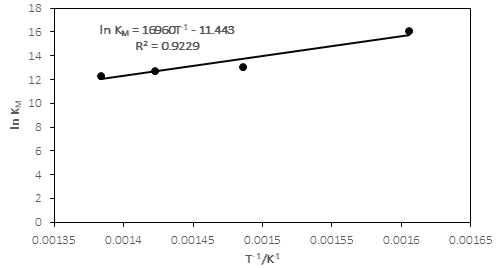
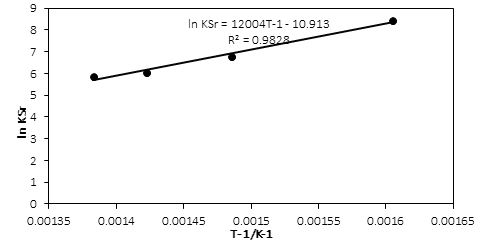
The adsorption entropy and adsorption enthalpy for both models 2 and 3 were computed using Equation (18). These values were then used to test the thermodynamic adequacy of the rival models. Despite the fact that both models satisfied the Boudart-Mears-Vannice guidelines, i.e., 10 < 22.66 < 59.21 for model 2 and 10< 21.61< 45.48 for model 3, it is obvious that the regression coefficient, 2 R , is closer to unity for model 3 (i.e., 0.9828) than for model 2 (i.e., 0.9229), as presented in Figures 2 and 3. This shows that the estimated parameters for model 3 present themselves to be more realistic as they may be better described by a straight line as opposed to model 2. To add to this realisation, the increase and decrease with temperature of the kinetic rate and equilibrium constants respectively, observed in the estimated parameters for model 3 as seen in Table 8 is not the case with model 2. Hence, the model 3, developed by assuming the surface reaction between adsorbed toluene and adsorbed methanol on catalyst surface in the alkylation of toluene with methanol for xylene production as rate-determining step is proposed to be the rate equation describing the toluene alkylation with methanol reaction over ZSM-5 catalyst coated on silicon carbide foam for xylene production. This equation is given thus:
$$ \left(- r _ {T} ^ {\prime}\right) = \frac {k _ {S r} K _ {T} K _ {M} c _ {T} ^ {2} \left(p _ {T} p _ {M} - \frac {1}{K _ {A T}} p _ {X} p _ {W}\right)}{\left(1 + K _ {T} p _ {T} + K _ {M} p _ {M} + K _ {X} p _ {X} + K _ {W} p _ {W}\right)} $$
1
2 k K K c p p p p K r K p K p K p K p Sr T M T T M X W AT T ( ) (19) ( )
2
1 T T M M X X W W
Having estimated the parameters, further discrimination among rival models was carried out by means of the t-test using Equation (20), which tests for the significance of a regression coefficient [14, 19].
X X t S − = (20)
, , T expt T pred d
n n ( ) ( ) ( ) ( )
2 2 $$ = \sqrt {\frac {\sum_ {i = 1} ^ {n} \left[ \left(X _ {T , p r e d}\right) _ {i} - \left(\bar {X} _ {T , p r e d}\right) _ {i} \right] ^ {2} + \sum_ {i = 1} ^ {n} \left[ \left(X _ {T , e x p t}\right) _ {i} - \left(\bar {X} _ {T , e x p t}\right) _ {i} \right] ^ {2}}{2 (n - 1)}} $$ X X X X S n , , , , 1 1 2 1 T pred T pred T expt T expt i i i i i i C ( ) (21) $$ S _ {d} = S _ {C} \sqrt {\frac {2}{n}} \tag {22} $$ where , T expt X is the mean of the experimental conversion of toluene (dimensionless), pred T X , the mean of the predicted conversion of toluene (dimensionless), 2 C S the combined population variance (dimensionless) and d S the standard deviation of the difference of the means (dimensionless).
The significance of the global regression was evaluated by means of an F-test, based upon the ratio of the mean regression sum of squares to the mean residual sum of squares, given by [12, 13, 20]:
1 n ( )
2 ∑ X p F X X p n
, 1 T pred i i
= $$ ' = \frac {p \sum_ {i = 1} ^ {n} \left(\left(X _ {T , p r e d}\right) _ {i}\right)}{\frac {1}{p - n} \sum_ {i = 1} ^ {n} \left[ \left(X _ {T , e x p t}\right) _ {i} - \left(X _ {T , p r e d}\right) _ {i} \right] ^ {2}} $$ (23)
1 n ( ) ( )
2 ∑ , , 1 T expt T pred i i i
= where p is the number of parameters.
The kinetic models having the highest F values and lowest t values [21, 22] are preferred to other rival models since their estimated parameters have satisfied the physicochemical constraints, are positive and statistically significantly different from zero [13]. However, amongst the five models developed, model 3 developed by taking the surface reaction between adsorbed toluene and adsorbed methanol on catalyst surface in the alkylation of toluene with methanol for xylene production as rate-determining step was the only model that fully satisfied physicochemical constraints and is the best based on its thermodynamic adequacy. Thus, it is preferred over other rival models 1, 2, 4 and 5 as it is the most practical model of the proposed five models.
The model validation was carried out after the completion of the estimation of proper kinetic parameters and the model discrimination amongst rival models. To ensure the model is relevant to an appropriate level, it was assessed against experimental data by making a parity plot of the predicted conversion against experimental conversion, as depicted in Figure 4.
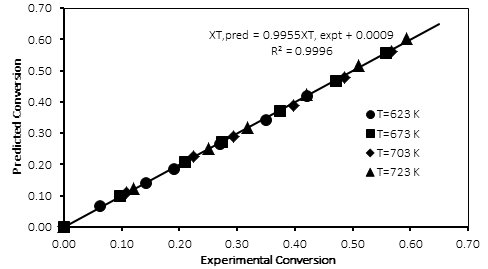
From the parity plot in Figure 4, it is observed that the corresponding experimental data point and predicted conversion fit very closely about the 45o line, with the coefficient of variation of the line that best fits the plot being 0.9996 and the intercept on the vertical axis almost zero.
Figure 5 presents a plot of the predicted and experiment plots of conversion against space-time, 0 T F W , at different temperatures, with their corresponding mean absolute percentage deviation, MAPD, value between predictions and experiments, calculated t and F values as well.
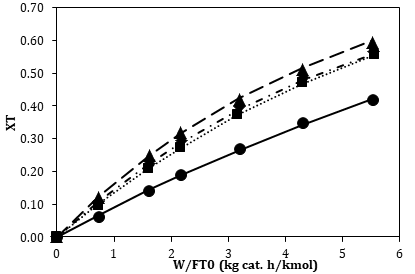
The relative error between the experimental and predicted results being at most 3.8 % and 3.9 % for conversion and reaction rates respectively. The 95% confidence interval of the estimate of the difference in means of experimental and predicted conversions obtained from the standard error of the estimator, dS , and t-distribution is presented in Table
11, as well as the p-value for the t-statistic. It may be observed from Table 11 that the 95 % confidence interval for the difference in means includes zero at all temperatures, also the corresponding p-values is at least 0.9766, which favours the hypothesis that the difference in means of experimental and predicted conversions is not significant statistically.
- Temperature (K)
- Difference in means
- Values at 95 % confidence interval t- and p-values
- -95%
- 95%
- 623
- 0.0009
- -0.174431
- 0.176278
- 0.011475; 0.991033
- 673
- 0.0001
- -0.231493
- 0.231707
- 0.001003; 0.999216
- 703
- 0.0032
- -0.231358
- 0.237819
- 0.030006; 0.976556
- 723
- -0.0029
- -0.250529
- 0.244796
- 0.025215; 0.980298
Table 10: The 95 % confidence interval for the difference in means of experimental and predicted conversions for toluene
Figure 6 depicts plots of residuals against predicted toluene conversion, which shows structureless patterns at the temperatures investigated in this study.
The structure less patterns in Figure 6 serve to further establish that the proposed model is to be preferred over other rival models as it has satisfied physicochemical and thermodynamic constraints and has proved to be a good fit for the experimental data.
Having proposed a suitable kinetic model, Equation (19), to describe the rate and mechanism by which toluene is methylated with methanol for xylene production over H-ZSM-5 catalyst coated on SiC foam, the forward and backward activation energies ( f E and b E ) and the enthalpy of adsorption, ads H ∆ , with corresponding pre- exponential factors, ( ) f k_0 , ( )_b k_0 and ( ) 0 _Sr K , were evaluated from the estimated kinetic constants and adsorption equilibrium constants using the least-squares technique via the application of the Arrhenius’ law,
0 exp E k k RT = −
and plots; and Van’t Hoff law,
0 exp H K K RT ∆ = −
and plots respectively. The plot of the
variation of the adsorption equilibrium constant for the surface reaction with temperature for alkylation of toluene has already been presented in Figure 3 and the plot of the variation of the kinetic constants for the surface reaction with temperature for alkylation of toluene is presented in Figure 7.
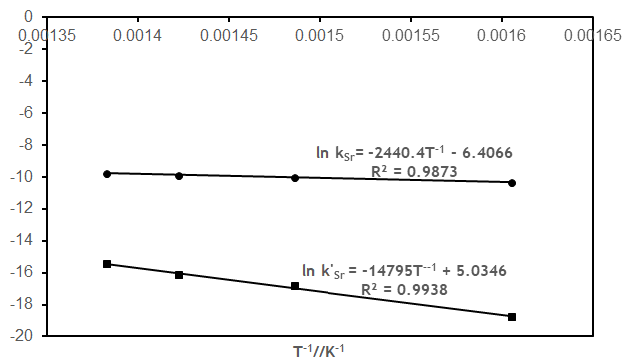
Table 12 shows the forward and backward activation energies, the adsorption entropy and the enthalpy of adsorption with corresponding pre-exponential (or frequency) factors.
| Model | E (J/mol) f | Frequency (k ) factor, 0 f | E (J/mol) b | Frequency (k ) factor, 0 b | ∆H (J/mol) ads | Frequency factor, (K ) 0 Sr | ∆S (J/mol K) ads |
|---|---|---|---|---|---|---|---|
| 3 | 20291.27 | 1.65 ×10⁻³ | 1.2302×10⁵ | 153.64 | -99810.01 | 1.82×10⁻⁵ | -90.74 |
Table 11: Calculated values of energies and frequency factors for the preferred model for toluene alkylation over H-ZSM-5 catalyst
Mechanistic kinetic models were developed for the catalytic alkylation of toluene with methanol for the production of xylene in a stainless-steel flow reactor using Langmuir-Hinshelwood-Hougen-Watson approach. The optimization routine of Nelder-Mead simplex method was used to estimate the inherent kinetic parameters in the proposed models. The selection of the best kinetic model amongst the rival kinetic models was based on physicochemical and thermodynamic tests with statistical analysis to obtain the best model. The rate-controlling step for the alkylation of toluene with methanol over H-ZSM-5 catalyst coated on silicon carbide foam was found to be the surface reaction between adsorbed toluene and adsorbed methanol on the surface of the catalyst. Excellent agreement was obtained between the experimental alkylation rate and conversion of toluene and the model predictions. The forward and backward activation energies, enthalpy of adsorption and adsorption entropy values were determined to be 2.0291×10⁴, 1.2302×10⁵, -9.9810×10⁴ and -90.74 J/ (mol K).
Statements and Declarations
Funding
Not applicable so, the authors hereby declare that no specific funds, grants, or other support from funding agencies in the public, commercial or non-profit sector, were received during the preparation and submission of this work.
Compliance with Ethical Standards
Conflict of interest
On behalf of the other authors, the corresponding author states that there is no conflict of interest that is directly or indirectly related to this work within the last 3 years of commencement of the work to the period of submitting it.
References
-
Thyssenkrupp (2014) World Market Leader in Aromatics Extraction. Japan Energy Co., Hashima, Japan.
-
The Essential Chemical Industry (2016) Benzene and methylbenzenes.
-
Hyung-Joon Ahn J (2013) Investigation into the Reaction of Toluene Methylation to p-Xylene over Acidic Zeolites. Doctoral Dissertation, Technische Universität München, pp: 153.
-
Tiseo I (2021) Global Xylene Demand and Capacity 2015–2022. Chemicals & Resources.
-
Skylakakis KZ, Fabri J, Graeser U, Simo TA (2000) Xylenes. Ullmann’s Encyclopedia of Industrial Chemistry 39: 643-661.
-
Young LB, Butter SA, Kaeding WW (1982) Shape Selective Reactions with Zeolite Catalysts. III. Selectivity in Xylene Isomerization, Toluene-Methanol Alkylation, and Toluene Disproportionation over ZSM-5 Zeolite Catalysts. Journal of Catalysis 76(2): 418-432.
-
Al-Khattaf S, Rabiu S, Tukur NM, Alnaizy R (2008) Kinetics of Toluene Methylation over ZSM-5 Catalyst in a Riser Simulator. Chemical Engineering Journal 139(3): 622-630.
-
Ghosal D, Sengupta S, Basu J (2015) Characterization of Alumina and H-ZSM-5 Zeolite and Comparison of their Performance by Toluene Methylation Reaction with Ceramic Foam as Catalyst Support. Current Catalysis 4(2): 111-124.
-
Sinnott R, Towler G (2013) Chemical Engineering Design. Principles, Practice and Economics of Plant and Process Design. 5th(Edn.), Butterworth-Heinemann, Elsevier, USA.
-
Nelder JA, Mead R (1965) A Simplex Method for Function Minimization. The Computer Journal 7(4): 308-313.
-
Spendley W, Hext GR, Himsworth FR (1962) Sequential Applications of Simplex Designs in Optimization and EVOP. Technometrics 4(4): 441-461.
-
Olafadehan OA, Ayoola AA, Akintunde OO, Adeniyi VO (2015) Mechanistic Kinetic Models for Steam Reforming of Concentrated Crude Ethanol on Ni/Al2O3 Catalyst. Journal of Engineering Science and Technology 10(5): 633-653.
-
Olafadehan OA, Okinedo EU (2009) Mechanistic Kinetic Models for Hydrogenolysis of Benzothiophene on Co-Mo/γ -Alumina Catalyst. Petroleum Science and Technology 27(3): 239-262.
-
Press WH, Teukolsky SA, Vetterling WT, Flannery BP (2007) Numerical Recipes: The Art of Scientific Computing. 2nd(Edn.), Cambridge University Press.
-
Baudin M (2010) Nelder-Mead User’s Manual. Consortium Scilab-Digiteo.
-
Olafadehan OA, Susu AA, Jaiyeola A (2008) Mechanistic Kinetic Models for n-Heptane Reforming on Platinum/ Alumina Catalysts. Petroleum Science and Technology 26(12): 1459-1480.
-
Olafadehan OA, Taiwo OP, Aribike DS (2009) Kinetics and Mechanism of Steam Reforming of Methanol on Cu/ ZnO/Al2O3 Catalyst. Journal of Engineering Research 14(2): 47-62.
-
Vannice MA, Hyun SH, Kalpakci B, Liauh WC (1979) Entropies of Adsorption in Heterogeneous Catalytic Reactions. Journal of Catalysis 56(3): 358-362.
-
Olafadehan OA, Oghenekaro SO (2008) Kinetic Models for Hydrogenolysis of Thiophene on Co-Mo/γ-Al2O3 Catalysts. Petroleum Science & Technology 26(3): 278- 297.
-
Froment GF, Bischoff KB, Wilde JD (1990) Chemical Reactor Analysis and Design. 3rd(Edn.), John Wiley and Sons, Inc.
-
Moazami N, Wyszynski ML, Rahbar K, Tsolakis A, Mahmoudi H (2017) A Comprehensive Study of Kinetics Mechanism of Fischer-Tropsch Synthesis over Cobalt- Based Catalyst. Chemical Engineering Science 171: 32- 60.
-
Mondal T, Pant KK, Dalai AK (2016) Mechanistic Kinetic Modeling of Oxidative Steam Reforming of Bioethanol for Hydrogen Production over Rh-Ni/CeO2-ZrO2 Catalyst. Industrial and Engineering Chemistry Research 55(1): 86-98.
- Nigeria’s Vulnerability in the Face of Global Energy Policy
- A Simulation Study of Investigation of Optimum Oil Production Performance by Applying Various Gas Injection Methods in Oil Reservoir
- Characterization of Permo-Triassic Reservoirs through Thermal Maturity Assessment of Westphalian Source Rocks in the Cheshire Basin
- Influence of Microwax on the Rheological and Thermal Behaviour of a Wax Crude Oil
- Real-Time Monitoring and Performance Optimization of Steam Injection in Heavy Oil Reservoirs Using Fiber Optic Sensing and Integrated Predictive Simulation Models
- Rapid On-Site Determination of the Total Petroleum Hydrocarbon Content of Soils by Handheld Fourier Transform Near-Infrared Spectroscopy: Development of a Global, Site- and Scanner- Independent Calibration Model