
Defining the Ideal Range for Reducing Oil Viscosity and the Optimal Rate of Steam Injection for a Heavy Oil Field
Heavy oil reservoirs often lend themselves well to thermal enhanced recovery techniques. Traditional methods like primary production or water injection are less effective due to the high viscosity of the oil. Steam stimulation primarily aims to elevate the reservoir's temperature, thereby reducing the oil's viscosity and improving its flow properties. Steam injection stands as one of the most prevalent thermal recovery methods, commonly applied in heavy oil reservoirs. The primary goal is to validate the process for selecting suitable reservoirs, the physical mechanisms involved, and the simulation characteristics essential for steam recovery. This study establishes the optimal multiplier for reducing oil viscosity and the ideal steam injection rate for heavy oil fields.
Introduction
Thermal Enhanced Oil Recovery (EOR) methods, also known as thermal recovery techniques, are a category of EOR processes that involve the application of heat to increase the mobility of heavy or viscous crude oil, making it easier to extract from underground reservoirs. These methods are particularly effective in heavy oil, bitumen, and certain types of oil sands reservoirs, to reduce the viscosity of oil, the thermal recovery process involves heating the reservoir. Thermal enhanced oil recovery (EOR) accounts for more than 50% of the EOR market share, with steam injection being the most widely adopted technique within this category. Another method is in-situ combustion, where a high-oxygen gas mixture is injected into the reservoir, igniting, and creating a combustion front. Steam injection is primarily employed in shallow reservoirs containing highly viscous, often heavy, crude oil. Notable examples include the oil sands in Alberta, Canada, and those in California’s San Joaquin Valley [1]. Here are some of the most common thermal EOR methods.
Steam Injection (Cyclic Steam Stimulation and Steam Flooding)
In cyclic steam stimulation, steam is injected into the reservoir for a period, heating the oil and reducing its viscosity. Once the desired viscosity is achieved, steam injection is stopped, and oil production begins. This cycle is repeated.
Steam flooding involves continuous injection of steam into the reservoir to maintain high reservoir temperatures and reduce oil viscosity, enabling the extraction of heavy oil [2].
In-Situ Combustion: In this method, air or oxygen is injected into the reservoir, where it reacts with the oil, producing heat and creating a combustion front. This heat reduces oil viscosity and enhances its mobility. Electric Heating: Electrical heaters are placed in the wellbore, which then heat the surrounding reservoir, reducing the oil’s viscosity. This method is effective in certain heavy oil reservoirs [3]. Solvent-Based Methods (VAPEX and SAGD): Vapor Extraction (VAPEX) and Steam-Assisted Gravity Drainage (SAGD) involve the injection of solvents, such as propane or butane, along with steam, to dilute and mobilize heavy oil or bitumen in oil sands reservoirs.
Steam injection has been commercially applied since the 1960s and is a well-established EOR technique. It works by heating the crude oil in the reservoir, which reduces its viscosity and partially vaporizes a portion of the oil, thus enhancing its mobility. This reduction in viscosity brings several benefits, including improved reservoir seepage conditions, lower surface tension, and increased oil permeability. The process of oil vaporization allows for smoother oil flow through the reservoir and, after condensation, leads to the production of higher-quality oil.
Steam injection is the most used thermal EOR technique, responsible for producing up to 30% of the original oil in certain cases. Moreover, it poses fewer environmental challenges compared to other EOR methods, making it a favorable option in regions with stringent regulations. Economic feasibility is a critical factor determining its implementation in specific fields [4] (Figure 1).
![Figure 1: Cyclic Steam Simulation/Injection, Steam Soaked, Huff and Puff [5].](/fulltextimages/12017/fig_1.png)
In the process of cyclic steam stimulation, a single well serves the dual purpose of oil production and steam injection. Initially, steam is injected for a period ranging from a few weeks to several months. This injected steam facilitates the convective heating of the oil immediately surrounding the injection well, leading to a reduction in oil viscosity [6].
Steam injection is paused once the desired viscosity is achieved, allowing heat to evenly disperse throughout the formation. This step enhances the amount of recoverable oil, Subsequently, the well can continue to produce oil until its temperature drops, and its viscosity increases once again. This cyclic process is repeated until the impact becomes negligible, and the economic limits are reached. It’s important to note that most of the oil is typically extracted in the initial cycles [7].
Methodology
After conducting multiple simulation runs. The optimal steam injection rate range for this field has been identified as 1500 km3. Beyond this value any further increase in the steam injection rate does not have a significant impact on oil production.
Determining the optimal oil viscosity reduction range and steam injection rate for a heavy oil field is a critical aspect of designing an effective thermal Enhanced Oil Recovery (EOR) project. The following steps are typically involved in this process: Reservoir Characterization: The first step is to thoroughly characterize the heavy oil reservoir. This includes assessing factors such as reservoir depth. Temperature, permeability, porosity and the nature of the heavy oil. Understanding the reservoir’s properties is crucial in determining the appropriate EOR method and parameters. Laboratory Testing: Laboratory experiments can be conducted to determine the oil’s response to temperature changes and the effect of steam injection. These tests can provide data on how oil viscosity changes at different temperatures and the impact of steam [8]. Reservoir Simulation: Using specialized reservoir simulation software. Engineers model the reservoir and the proposed EOR process. This simulation helps determine the optimal injection rates, steam temperatures and well spacing required to achieve the desired oil viscosity reduction and production rates. Sensitivity Analysis: Engineers perform sensitivity analyses to assess how variations in injection rates, steam quality and other parameters affect the project’s performance. This helps in identifying the range of optimal values [9]. Field Pilot Testing: Field pilot projects are often conducted to validate the findings from laboratory testing and simulations. These pilots involve actual steam injection and monitoring of oil production and reservoir behavior. Data Analysis: The data collected from laboratory testing, simulation and field pilots are analyzed to determine the optimal range for reducing oil viscosity and the steam injection rate that maximizes production [10].
Economic Evaluation: A cost-benefit analysis is crucial to assess the economic feasibility of the EOR project. Factors such as the cost of steam generation, equipment installation and the expected increase in oil production are considered. Environmental and Regulatory Considerations: Compliance with environmental regulations and the responsible use of resources, including water for steam generation are important considerations. Implementation and Monitoring: If the project is deemed economically viable and environmentally responsible. It is implemented and performance is continually monitored and adjusted as needed [11].
In this project, heavy oil field was modeled in Tempest software. Oil viscosity multiplier was defined based on previous experiences. Sensitivity analysis was done based on various viscosity multiplier for oil. Optimal oil viscosity multiplier was determined based on this research. Then, sensitivity analysis made based on different steam injection volumes, optimal steam injection volume was obtained.
The Experimental Part
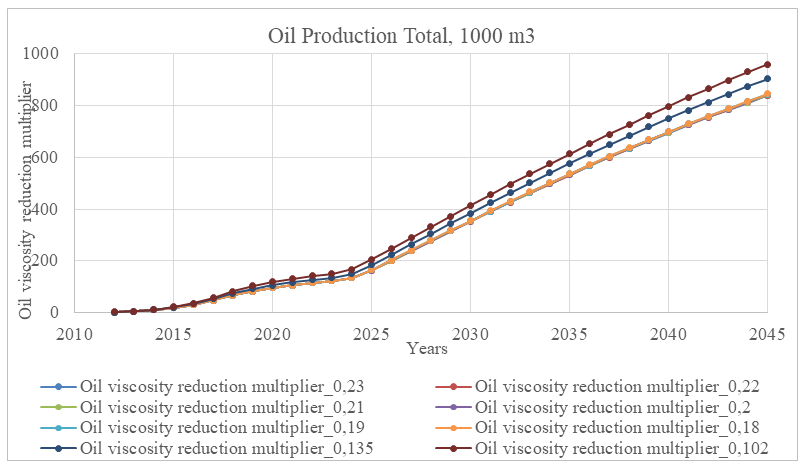
The experimental phase of this research project was carried out in the West (Qarbi) Absheron field, known for its heavy oil characteristics with oil viscosity ranging between 20-28 cP, Thermal enhanced oil recovery methods are particularly suitable for heavy oil fields. The study focused on determining the optimal range for reducing oil viscosity and the suitable steam injection rate for this specific field (Table 1 & Figure 2).
| Date | Oil Production Total, 1000 m3 | |||||||
|---|---|---|---|---|---|---|---|---|
| Oil Viscosity Reduction Multiplier | ||||||||
| 0,23 | 0,22 | 0,21 | 0,2 | 0,19 | 0,18 | 0,135 | 0,102 | |
| 0.065648148 | 2.4741 | 2.47412 | 2.475 | 2.47789 | 2.47791 | 2.47417 | 2.88814 | 3.07049 |
| 0.065659722 | 4.97879 | 4.97881 | 4.979 | 4.98178 | 4.9818 | 4.97887 | 5.49999 | 5.73227 |
| 0.065671296 | 10.9067 | 10.9067 | 10.91 | 10.9095 | 10.9095 | 10.9068 | 11.6128 | 11.9217 |
| 0.06568287 | 20.1638 | 20.1638 | 20.16 | 20.1662 | 20.1663 | 20.1641 | 22.0268 | 22.8226 |
| 0.065694444 | 30.5421 | 30.5422 | 30.54 | 30.5442 | 30.5443 | 30.5436 | 33.9998 | 36.3158 |
| 0.065706019 | 48.0891 | 48.0892 | 48.09 | 48.091 | 48.0912 | 48.0908 | 53.5416 | 58.6602 |
| 0.065717593 | 67.2449 | 67.2452 | 67.25 | 67.2469 | 67.2473 | 67.2472 | 75.2534 | 83.7646 |
| 0.065729167 | 83.6247 | 83.6251 | 83.63 | 83.6264 | 83.6269 | 83.6272 | 93.5551 | 104.684 |
| 0.065740741 | 96.1899 | 96.1904 | 96.19 | 96.1912 | 96.1918 | 96.1927 | 107.098 | 119.661 |
| 0.065752315 | 106.775 | 106.776 | 106.8 | 106.776 | 106.777 | 106.778 | 118.301 | 131.91 |
| 0.065763889 | 115.685 | 115.68 | 115.7 | 115.681 | 115.681 | 115.683 | 127.657 | 141.939 |
| 0.065775463 | 123.264 | 123.264 | 123.3 | 123.265 | 123.265 | 123.267 | 135.589 | 150.293 |
| 0.065787037 | 135.146 | 135.253 | 135.4 | 135.497 | 135.615 | 135.736 | 150.442 | 168.526 |
| 0.065798611 | 163.947 | 164.235 | 164.5 | 164.841 | 165.156 | 165.445 | 184.751 | 206.559 |
| 0.065810185 | 200.631 | 201.007 | 201.4 | 201.776 | 202.167 | 202.528 | 223.831 | 247.907 |
| 0.065821759 | 238.758 | 239.161 | 239.6 | 239.984 | 240.401 | 240.788 | 263.786 | 289.871 |
| 0.065833333 | 277.384 | 277.81 | 278.3 | 278.677 | 279.114 | 279.522 | 304.288 | 331.642 |
| 0.065844907 | 315.801 | 316.251 | 316.7 | 317.16 | 317.618 | 318.043 | 344.951 | 373.174 |
| 0.065856481 | 353.336 | 353.877 | 354.4 | 354.964 | 355.506 | 356.004 | 385.008 | 414.351 |
| 0.065868056 | 390.521 | 391.117 | 391.7 | 392.31 | 392.909 | 393.464 | 424.669 | 455.302 |
| 0.06587963 | 426.932 | 427.577 | 428.2 | 428.873 | 429.529 | 430.142 | 463.638 | 495.693 |
| 0.065891204 | 462.815 | 463.515 | 464.2 | 464.922 | 465.636 | 466.31 | 502.151 | 535.912 |
| 0.065902778 | 498.161 | 498.909 | 499.7 | 500.409 | 501.172 | 501.895 | 539.86 | 575.51 |
| 0.065914352 | 532.884 | 533.661 | 534.5 | 535.223 | 536.025 | 536.787 | 576.955 | 614.625 |
| 0.065925926 | 566.838 | 567.649 | 568.5 | 569.271 | 570.101 | 570.894 | 613.619 | 652.943 |
| 0.0659375 | 600.046 | 600.888 | 601.7 | 602.581 | 603.456 | 604.297 | 649.567 | 690.2 |
| 0.065949074 | 632.461 | 633.347 | 634.3 | 635.141 | 636.071 | 636.959 | 684.022 | 726.58 |
| 0.065960648 | 664.321 | 665.238 | 666.2 | 667.039 | 667.943 | 668.792 | 717.471 | 762.27 |
| 0.065972222 | 695.451 | 696.33 | 697.2 | 698.051 | 698.915 | 699.729 | 750.223 | 797.247 |
| 0.065983796 | 725.566 | 726.425 | 727.3 | 728.132 | 729.006 | 729.841 | 782.271 | 831.735 |
| 0.06599537 | 754.708 | 755.6 | 756.5 | 757.379 | 758.292 | 759.167 | 813.589 | 865.569 |
| 0.066006944 | 783.374 | 784.311 | 785.3 | 786.175 | 787.133 | 788.054 | 844.54 | 898.73 |
| 0.066018519 | 811.809 | 812.789 | 813.8 | 814.753 | 815.769 | 816.752 | 874.921 | 930.45 |
| 0.066030093 | 839.652 | 840.711 | 841.8 | 842.829 | 843.926 | 844.989 | 903.8 | 960.583 |
| Date | Oil Production Total. 1000 m3 | |||||||
| Steam Injection Total | ||||||||
| 2000 | 1500 | 1200 | 1100 | 1000 | 900 | 800 | ||
| 0.065648148 | 3.07049 | 3.07049 | 3.07044 | 3.07044 | 3.07049 | 3.07044 | 3.07044 | |
| 0.065659722 | 5.73227 | 5.73227 | 5.73223 | 5.73223 | 5.73227 | 5.73223 | 5.73223 | |
| 0.065671296 | 11.9217 | 11.9217 | 11.9217 | 11.9217 | 11.9217 | 11.9217 | 11.9217 | |
| 0.06568287 | 22.8226 | 22.8226 | 22.8241 | 22.8241 | 22.8226 | 22.8241 | 22.8241 | |
| 0.065694444 | 36.3158 | 36.3158 | 36.3174 | 36.3174 | 36.3158 | 36.3174 | 36.3174 | |
| 0.065706019 | 58.6602 | 58.6602 | 58.6599 | 58.6599 | 58.6602 | 58.6599 | 58.6599 | |
| 0.065717593 | 83.7646 | 83.7646 | 83.7665 | 83.7665 | 83.7646 | 83.7665 | 83.7665 | |
| 0.065729167 | 104.684 | 104.684 | 104.681 | 104.681 | 104.684 | 104.681 | 104.681 | |
| 0.065740741 | 119.661 | 119.661 | 119.642 | 119.642 | 119.661 | 119.642 | 119.642 | |
| 0.065752315 | 131.91 | 131.91 | 131.895 | 131.895 | 131.91 | 131.895 | 131.895 | |
| 0.065763889 | 141.939 | 141.939 | 141.94 | 141.94 | 141.939 | 141.94 | 141.94 | |
| 0.065775463 | 150.293 | 150.293 | 150.292 | 150.292 | 150.293 | 150.292 | 150.292 | |
| 0.065787037 | 168.526 | 168.526 | 168.521 | 168.521 | 168.526 | 168.521 | 168.521 | |
| 0.065798611 | 206.559 | 206.559 | 206.552 | 206.552 | 206.559 | 206.552 | 206.552 | |
| 0.065810185 | 247.907 | 247.907 | 247.899 | 247.899 | 247.907 | 247.899 | 247.899 | |
| 0.065821759 | 289.871 | 289.871 | 289.863 | 289.863 | 289.871 | 289.863 | 289.863 | |
| 0.065833333 | 331.642 | 331.642 | 331.635 | 331.635 | 331.642 | 331.635 | 331.635 | |
| 0.065844907 | 373.174 | 373.174 | 373.166 | 373.166 | 373.174 | 373.166 | 373.166 | |
| 0.065856481 | 414.351 | 414.351 | 414.343 | 414.343 | 414.351 | 414.343 | 414.343 | |
| 0.065868056 | 455.302 | 455.302 | 455.294 | 455.294 | 455.302 | 455.294 | 455.265 | |
| 0.06587963 | 495.693 | 495.693 | 495.685 | 495.685 | 495.693 | 495.685 | 495.359 | |
| 0.065891204 | 535.912 | 535.912 | 535.904 | 535.904 | 535.912 | 535.835 | 534.612 | |
| 0.065902778 | 575.517 | 575.517 | 575.509 | 575.509 | 575.51 | 574.903 | 572.888 | |
| 0.065914352 | 614.791 | 614.791 | 614.783 | 614.783 | 614.625 | 613.268 | 610.296 | |
| 0.065925926 | 653.616 | 653.616 | 653.607 | 653.607 | 652.943 | 650.738 | 646.883 | |
| 0.0659375 | 691.731 | 691.731 | 691.723 | 691.603 | 690.2 | 687.27 | 682.653 | |
| 0.065949074 | 729.29 | 729.29 | 729.282 | 728.736 | 726.58 | 722.756 | 717.163 | |
| 0.065960648 | 766.797 | 766.797 | 766.775 | 765.454 | 762.27 | 757.33 | 750.491 | |
| 0.065972222 | 803.803 | 803.803 | 803.612 | 801.452 | 797.247 | 791.22 | 782.887 | |
| 0.065983796 | 840.523 | 840.523 | 839.893 | 836.97 | 831.735 | 824.545 | 814.543 | |
| 0.06599537 | 876.871 | 876.871 | 875.567 | 871.838 | 865.569 | 857.001 | 845.363 | |
| 0.066006944 | 912.64 | 912.64 | 910.494 | 906.042 | 898.73 | 888.655 | 875.421 | |
| 0.066018519 | 947.39 | 947.39 | 944.203 | 939.019 | 930.45 | 919.024 | 904.515 | |
| 0.066030093 | 981.294 | 981.294 | 976.717 | 970.39 | 960.583 | 947.917 | 932.289 |
Table 1: Establishing the Optimal Range for Reducing Oil Viscosity.
According to the research, optimum oil viscosity was achieved in case of 0.102 oil viscosity reduction multiplier. Total oil production was 960.583 km3 in the beginning of 2045 year.
Based on different simulation runs. It has been defined the optimum oil viscosity reduction range for this field. It is 0.102 (Table 2 & Figure 3).
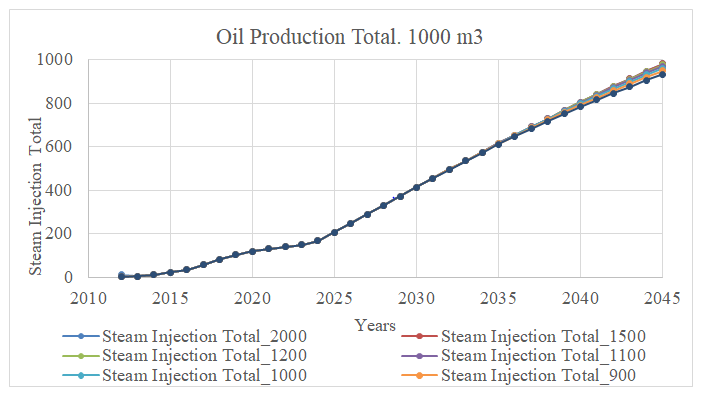
In this stage of research, sensitivity analysis was done in different volumes of steam injection. Based on this sensitivity analysis, daily 1500 m3 volume of steam injection is the optimal volume. After this volume, increase in steam injection doesn’t increase total oil production than 1500 m3 volume of steam injection.
Conclusion
In conclusion the selection of an enhanced oil recovery method for a specific field is of utmost importance and is primarily determined by screening criteria. Thermal enhanced oil recovery methods are particularly well- suited for heavy oil fields. This study primarily focused on determining the optimal oil viscosity reduction multiplier, which was found to be 0.102 after several cases. Additionally, it was established that 1500 km3 of steam injection serves as a critical threshold for this field. Beyond this point, increasing the volume of steam injection does not lead to a significant improvement in oil production.
References
-
US Energy Information Administration.
-
Marcel L (1980) Enhanced Oil Recovery. Technip, pp: 252.
-
Kokal S, Al-Kaabi A (2010) Enhanced Oil Recovery: Field Planning and Development Strategies. Gulf Professional Publishing, USA.
-
Goss RM (2019) BP Statistical Review of World Energy.
-
Oilfield, learning stages.
-
Tunio SQ, Tunio AH, Ghirano NA, Adawy ZM (2011) Comparison of Different Enhanced Oil Recovery Techniques for Better Oil Productivity. International Journal of Applied Science and Technology 1(5): 143- 153.
-
Al-Nakhli AR, Sukkar LA, Arukhe J, Mulhem A, Mohannad A, et al. (2016) In-Situ Steam Generation a New Technology Application for Heavy Oil Production. SPE Heavy Oil Conference and Exhibition, pp: SPE-184118- MS.
-
Eyvazov J, Guliyeva M, Guliyev U, Samedov Y Determination of the Optimum Oil Viscosity Reduction Range and Steam Injection Rate For Heavy Oil Field, pp: 170-174.
-
Mehdi A, Huseynov, Natig N, Hamidov, Dinara F, et al. (2022) Prospects of Using Thermal Enhanced Oil Recovery Methods in the Western (Qarbi) Absheron Field. V International Workshop, Thermal Methods for Enhanced Oil Recovery: Laboratory Testing, Simulation and Oilfields Applications, Turkiye, pp: 76.
-
Liu ZX, Liang Y, Wang Q, Guo YJ, Gao M, et al. (2020) Status and Progress of Worldwide EOR Field Applications. Journal of Petroleum science and Engineering 193.
-
Prats M (1986) Thermal Recovery. Henry L. Doherty Memorial Fund of AIME, Society Of Petroleum Engineers Of AIME, New York, pp: 283.
- Nigeria’s Vulnerability in the Face of Global Energy Policy
- A Simulation Study of Investigation of Optimum Oil Production Performance by Applying Various Gas Injection Methods in Oil Reservoir
- Characterization of Permo-Triassic Reservoirs through Thermal Maturity Assessment of Westphalian Source Rocks in the Cheshire Basin
- Influence of Microwax on the Rheological and Thermal Behaviour of a Wax Crude Oil
- Real-Time Monitoring and Performance Optimization of Steam Injection in Heavy Oil Reservoirs Using Fiber Optic Sensing and Integrated Predictive Simulation Models
- Rapid On-Site Determination of the Total Petroleum Hydrocarbon Content of Soils by Handheld Fourier Transform Near-Infrared Spectroscopy: Development of a Global, Site- and Scanner- Independent Calibration Model