
Adaptation of the Perinatal Anxiety Screening Scale in Bangladeshi Context
This study tested the factor structure, reliability and validity of the Bangla translated Perinatal Anxiety Screening Scale (PASS). Three scales the Bangla Perinatal Anxiety Screening Scale (PASS), the Anxiety Measuring Scale and the Depression Measuring Scale were applied to 151 participants (women who were in their perinatal phase). Among them 24.5% were pregnant and 75.5% were in postpartum phase. 27 participants were retested over a period of 15 days to examine test-retest reliability. Consider with the original studies, exploratory factor analysis showed 4 factor solution of the Bangla PASS with X2 = 2.201, df = 465 and p < 0.01. The temporal stability and internal consistency was also satisfactory (Cronbach’s Alpha .970). The Bangla PASS significantly and positively associated with Anxiety Measuring Scale and the Depression Measuring Scale at p < 0.01. There was no significant difference of PASS score between different groups according to perinatal phase, education level, occupation, socioeconomic status and having physical illness.
Introduction
In both high and low income country, mental health problems are a major public health issue for women of reproductive age (15–44 years).According to WHO (2008), about 7% of the global burden of diseases is contributed to mental health problems among women. Under the duration of reproductive age, perinatal period generally refers to the time a woman is pregnant and includes up to one year following birth of the child. It’s one of the most sensitive periods as well as a major transition in women’s life. A lot of changes from their bodies to their hormones and to the reality of their daily lives during this time are experienced by women. The changes to women’s thoughts, actions, feelings, and bodily sensations during pregnancy and 1 year after the baby is born are known as perinatal anxiety. The clinical features of anxiety disorders in pregnancy and postnatal are similar to those in non-pregnant women. However, concerns about the pregnancy and the infant may be presented as the main feature. There can be various stressor for perinatal anxiety such as history of previous miscarriage or unexpected termination of pregnancy or neonatal death, complication during past pregnancies with maternal or infant medical problem, mode of past deliveries, difficulties in pregnancy, significant events, health problem (personal or significant others), financial difficulties, relationship difficulties, loss of support, unwanted or unplanned pregnancy, partner who works away regularly, personal abuse or trauma, legal issues, separation or divorce, substance misuse, changes to stopped education, death or disappearance of loved one etc [1]. The nature, prevalence and determinants of mental health problems in women during pregnancy and in the year after giving birth (perinatal period) have been thoroughly investigated in high-income countries. About 10% of pregnant women and 13% of those who have given birth experience some sort of mental disorder. This result has been found by a systematic review (World development indicators, 2011). Recent body of literatures indicates that anxiety symptoms are common during pregnancy and the postpartum period; their prevalence and impacts are high. There is a growing realization that many women suffer from either new onset or worsening of existing anxiety disorders during pregnancy and postnatal and have also shown higher prevalence rates of anxiety disorders in the postnatal (the perinatal) period compared with the general population [2]. The prevalence of anxiety disorders in the antenatal period ranges from 6.6 to 21.7 % [3, 4]. Research suggests that in the perinatal period anxiety disorders are more common than depressive disorders [5]. In a study in India, 22.6% of women screened positive for anxiety out of 146 antenatal women [6]. In a research with large community sample of pregnant women, it was found that 21% had clinically significant anxiety symptoms and, of these, 64% continued to have anxiety postnatal [7]. There is evidence of the detrimental effects and squeal of maternal anxiety on mothers and infants. The occurrence of an anxiety disorder during perinatal period has important consequences. It not only impacts on the woman’s mental health, but also increases the risk of other postnatal disorders, as well as having possible effects on the unborn child. Maternal anxiety during pregnancy is associated with significant increased risk of preterm birth [8]. In another longitudinal study with 2724 children, it was found that antenatal maternal anxiety is associated with disturbances in HPA-axis deregulation and self-reported depressive symptoms in adolescence period of the child [9]. In a sample of 120 healthy, 2-year- old children, the consequences of exposure to perinatal maternal anxiety for the development of child temperament were examined. That study found that pregnancy-specific anxiety between 13 and 17 weeks of gestation was associated with increased negative temperament in the children [10]. Elevated untreated anxiety in pregnancy may impact negatively on the developing baby [10]. Antenatal anxiety may have long- term negative effects on the child’s cognitive [11], emotional and behavioral development [12]. Antenatal anxiety can also be detrimental to maternal health during pregnancy [13]. In the postnatal period, mothers presenting with a generalized anxiety disorder have been described as less responsive and less engaged during interaction with their infants, who are more likely to be withdrawn and show less positive emotional tone than infants from non- anxious mothers [14]. This supports previous findings on the association between maternal anxiety and insecure attachment in young children [15]. Intense postnatal anxiety affects maternal functioning that causes significant distress and may seriously disturb mother- infant interaction. It may affect in the area of maternal neglect and failure to thrive to infanticide [16]. During pregnancy, the risk of postnatal depression has been found to be three times higher for women with anxiety disorders [17]. Antenatal anxiety is one of the strongest predictors of postnatal depression [18]. Furthermore, postnatal anxiety appears to be preceded by antenatal anxiety in two thirds of women [12].
Problem of the Study
Perinatal anxiety can be harmful to pregnancy or postpartum phase. It can affect negatively to mother or unborn fetus or mother-child relationship. By early detection of this anxiety and taking treatment can minimize or remove this negative effect. For detecting this perinatal anxiety, adapting a scale (Bangla PASS) for measuring this anxiety as well as clinically labeling this phenomena are the main problems of this present study.
Aim of the Study
The aim of the present study was to adapt and establish psychometric properties of the Perinatal Anxiety Screening Scale (PASS) in Bangla language for Bangladeshi population (women with perinatal period).
Methods
Design
Cross-sectional survey design was chosen for the present study.
Participants
Participants of this study were women in perinatal phase (pregnancy or 1 year postpartum). A complete description of the participants is presented in Table 1. Research data were collected from total 168 participants.
Some of them didn’t complete the entire questionnaire. Finally, data of 151 participants were retained and subjected to statistical analysis.
Sampling Techniques
Research participants were selected at first by purposive sampling (women in perinatal period) and then convenience sampling (research participants) from neighbor and different medical center of Dhaka city.
Measures
Demographic Variables
Demographic information consisting of pregnancy or postnatal period, age, order of pregnancy or child, educational qualification, occupation, socioeconomic status, suffering from any kind of physical illness and taking counseling service were collected in a separate sheet of demographic information recording.
Bangla Perinatal Anxiety Screening Scale (PASS)
Perinatal Anxiety Screening Scale (PASS) is one of the validated and used scales for measuring perinatal anxiety of women. This is a recently developed scale [1]. This scale has good psychometric properties. The value of Cronbach’salpha is 0.96; correlation coefficient between the score of PASS antenatal and postnatal is 0.74. There is 31 items in PASS. There is not any reverse item. Using a 4 points rating Likert scale, participants were asked to rate their degrees of agreement of 31 different conditions. The 4 point Likert scale range from not at all (0) to almost always (3). Here a higher score indicates a high level of perinatal anxiety. The possible range of PASS score is 0- 93. Here are 3 levels of anxiety- asymptomatic (0-20), mild-moderate symptoms (21-41 and severe symptoms (42-93) with a cut of score 26.
Bangla Anxiety Scale
Bangla Anxiety Measuring Scale developed by Farah Deeba and Roquia Begum (2004) was administered to measure anxiety of participants [19]. It is 5 points (0 to 4) rating scale and contains 36 items which measure the presence and severity of anxiety on the basis of last 1 months condition. Higher score indicates a higher anxiety level. The possible score range for this scale is 0-144. This scale has also god psychometric properties. The value of Cronbach’salpha is 0.9468, test retest correlation or coefficient of stability is 0.688 (significant at .01 levels).
Bangla Depression Scale
Bangla Depression Measuring Scale developed by Md Zahir Uddin and Mohammad Mahmudur Rahman (2005) was also administered to measure the presence and severity of depression among participants [20]. It is also a 5 point stating Likert scale of 30 statements (items) basis on last 1 week’s condition. Here 1 indicates not applicable and 5 indicate totally applicable. Higher score indicates a higher depression level and possible scale range is 30- 150. The value of Cronbach’salpha is 0.708, test retest correlation or coefficient of stability is 0.599 (significant at .01 level), and split-half reliability is 0.7608.
Procedure
Translating PASS into Bangla
At first, permission was taken from the author of PASS, Susanne Somerville for translating and validating the PASS into Bangla. After taking the permission, the procedure was started. For translating and cross cultural validation of PASS into Bangla, we have followed the guidelines prescribed by Sousa and Rojjanasrirat (2011). Description of the entire process is given bellow in step by step [21].
Translation of the Original PASS into Bangla (Forward Translation)
Two independent translator (one is a subject matter expert in psychology and another one is knowledgeable in cultural and linguistic nuances in both Bangla and English) translated the original English PASS into Bangla.
Comparison of the Two Translated Bangla Versions of the PASS
Both of the translated Bangla versions of the PASS were given to an “expert review committee” of consisting 3 members (one counseling psychologist, one counseling psychologist and researcher and another one is a psychiatrist). By including their feedbacks, the first draft of the PASS in Bangla language was finalized.
Blind back-translation (Blind Backward Translation or Blind Double Translation) of the First Draft of Bangla PASS
The first draft of Bangla PASS was translated back into English by two other independent translators (subject matter expert in Bangla and English). Then the two translated versions were reviewed. This step was completely blind to the English version of PASS (they had never seen the English version of PASS).
Comparison of the two back-translated versions of the Bangla PASS
The two back translated version of the Bangla PASS were compared by two expert (one psychologist and one psychiatrist) from the “expert review committee”.
Pilot Testing of the First Draft Version of the Bangla PASS (Cognitive Debriefing)
The first draft version of the Bangla PASS was given to 30 participants whose language is Bangla for pilot testing of the items of the instrument for clarity. Participants were women and they were in perinatal phase, they fulfill the criteria of target population of this study. Each participant was asked to rate the instructions and items of the scale using a dichotomous scale (clear or unclear). Participants who rated the instructions or any item of the instrument as unclear was asked to provide suggestions as to how to rewrite the statements to make the language clearer.
Finalize the Bangla PASS
Considering the feedbacks from the pilot testing, the final Bangla version of PASS was completed for testing psychometric properties.
Full Psychometric Testing of Final Bangla Version of PASS in a Sample of the Target Population
The final Bangla version of PASS was given to total 168 participants for testing psychometric properties (reliability, validity, item analysis, factor analysis).
Data Collection
The data collection tool consisted with the final Bangla version of PASS along with Bangla Anxiety Measuring Scale, Bangla Depression Measuring Scale, Demographic information sheet and agreement paper (informed consent) for participating in this study voluntarily. Prior to collect data, ethical approval was taken from Ethics Committee of Department of Educational and Counselling Psychology, University of Dhaka. Though it was safe for the research participants, there was a probability of becoming emotionally vulnerable as it measure perinatal anxiety. In that case, there was an option of getting counselling service freely. From the 168 participants, 30 were selected conveniently for retesting at an interval of 15 days to examine test retest reliability. Data collection was accomplished in a period of 1 month (May, 2017).
Data Analysis
All data were processed using the SPSS program version 16. Incomplete data (10.11%) were uncounted. Following data analysis was completed.
Descriptive Statistics
For categorical data, frequency and percentile analysis were completed. Those categorical data are relating to pregnancy or postpartum phase, educational qualification, occupation, socioeconomic status, suffering from any kind of physical illness and taking counseling services. For continuous data, mean and standard deviation (SD) analysis were accomplished. Those continuous data are relating to order of pregnancy or children, age of participants, individual item score of Bangla PASS and total score of Bangla PASS.
Factor Structure
Item analysis: For item analysis, inter item correlation and corrected item-total correlation and Cronbach’s alpha if item deleted were completed. Exploratory Factor Analysis (EFA): For testing internal item structure of Bangla PASS, exploratory factor analysis was completed by using Principal Component Analysis (PCA) with varimax rotation.
Reliability
Internal consistency: The internal consistency reliability was analyzed by completing Cronbach’s alpha and item- total correlation. Test-retest reliability: Test-retest reliability was analyzed by Pearson Product Moment Correlation and paired sample t-test between test and retest score over a period of 15 days of Bangla PASS.
Validity
Discriminant validity: Discriminant validity was analyzed by the correlation of Bangla PASS with Bangla Anxiety Scale and Depression Scale.
Known Group Comparison: Known group comparison was analyzed by comparing the score of Bangla PASS with participant’s socioeconomic status, occupation, physical and mental health.
Results
Descriptive Statistics
Composition of the samples is presented in Table 1.
| Variable | Characteristics | Frequency (%) | PASS Mean (SD) | Test statistics (t /F) | ||||||||||
| Perinatal | Pregnant | 37(24.5) | 40.59(23.073) | -0.792 | ||||||||||
| Phase | Postpartum | 114 (75.5) | 44.05(23.061) | |||||||||||
| Educational qualification | Illiterate | 11(7.3) | 51.00(23.486) | |||||||||||
| Up to class 5 | 33(21.9) | 44.27(20.997) | ||||||||||||
| Class 6 to class 10 | 49(32.5) | 39.10(23.368) | ||||||||||||
| SSC | 26(17.2) | 44.19(23.5) | 0.65 | |||||||||||
| HSC | 14(9.3) | 47.86(23.386) | ||||||||||||
| Honours | 8(5.3) | 46.62(22.538) | ||||||||||||
| Occupation | Govt job | 12(7.9%) | 40.58(27.708) | |||||||||||
| Non-govt job | 14(9.3%) | 51(21.188) | ||||||||||||
| Housewife | 119(78.8%) | 42.14(22.877) | 1.023 | |||||||||||
| Student | 4(2.6%) | 59(14.9) | ||||||||||||
| Others | 2(1.3) | 36(26.870) | ||||||||||||
| Socio-economic status | Upper class | 9 (6%) | 43.33(27.933) | |||||||||||
| Upper-middle class | 21(13.9%) | 42.05(21.641) | ||||||||||||
| Middle class | 35(23.2) | 46.23(22.858) | 0.197 | |||||||||||
| Middle-lower class | 45(29.8) | 42.22(23.361) | ||||||||||||
| Lower class | 41(27.2) | 42.27(23.335) |
Table 1: Minimum, maximum and overall mean and SD of item
| Mean | Minimum | Maximum | |||||||||
|---|---|---|---|---|---|---|---|---|---|---|---|
| Item mean | 1.394 | 1.152 | 1.656 | ||||||||
| Item SD | 1.02 | .764 | 1.656 |
Table 3: Minimum, maximum and overall mean and SD of item
Factor Structure
Item analysis: The inter-item and item-total correlations were examined and summary is presented in Table 3.
| Correlation | Minimum | Maximum | Mean | ||||||||
|---|---|---|---|---|---|---|---|---|---|---|---|
| Inter-item | 0.09 | 0.986** | 0.507** | ||||||||
| Item-total | 0.548** | 0.869** | 0.701** |
Table 2: Summary statistics of inter-item and item-total correlation. The inter-item and item-total correlations presented in Tab
** Significant at 0.01 level. Table 3: Summary statistics of inter-item and item-total correlation. The inter-item and item-total correlations presented in Table 3 and Table 4. Inter-item correlation range is from 0.009 to 0.986 with an overall mean of 0.507. Out of 496 inter-item correlations, 489 are significant with a substantial number of them 0.30 (84.67%). There was no negative correlation between items. On the basis of item analysis, no item was excluded.
| P S te | AS m | ||||||||||||||||||||||||||||||||||||||||||||||||||||||||||||||||||||||||||||||||||||||||||||
| 1 | 2 | 3 | 4 | 5 | 6 | 7 | 8 | 9 | 10 | 11 | 12 | 13 | 14 | 15 | 16 | 17 | 18 | 19 | 20 | 21 | 22 | 23 | 24 | 25 | 26 | 27 | 28 | 29 | 30 | 3 | 1 | ||||||||||||||||||||||||||||||||||||||||||||||||||||||||||||||
| 1 | 1 | ||||||||||||||||||||||||||||||||||||||||||||||||||||||||||||||||||||||||||||||||||||||||||||
| 9 | 8 | 6* | |||||||||||||||||||||||||||||||||||||||||||||||||||||||||||||||||||||||||||||||||||||||||||
| 2 | 1 | ||||||||||||||||||||||||||||||||||||||||||||||||||||||||||||||||||||||||||||||||||||||||||||
| * | |||||||||||||||||||||||||||||||||||||||||||||||||||||||||||||||||||||||||||||||||||||||||||||
| 9 | 8 | 6* | 9 | 7 | 8* | ||||||||||||||||||||||||||||||||||||||||||||||||||||||||||||||||||||||||||||||||||||||||
| 3 | 1 | ||||||||||||||||||||||||||||||||||||||||||||||||||||||||||||||||||||||||||||||||||||||||||||
| * | * | ||||||||||||||||||||||||||||||||||||||||||||||||||||||||||||||||||||||||||||||||||||||||||||
| 9 | 8 | 6* | 9 | 7 | 3* | 9 | 8 | 4* | |||||||||||||||||||||||||||||||||||||||||||||||||||||||||||||||||||||||||||||||||||||
| 4 | 1 | ||||||||||||||||||||||||||||||||||||||||||||||||||||||||||||||||||||||||||||||||||||||||||||
| * | * | * | |||||||||||||||||||||||||||||||||||||||||||||||||||||||||||||||||||||||||||||||||||||||||||
| 9 | 4 | 2* | 9 | 4 | 5* | 9 | 3 | 9* | 9 | 3 | 4* | ||||||||||||||||||||||||||||||||||||||||||||||||||||||||||||||||||||||||||||||||||
| 5 | 1 | ||||||||||||||||||||||||||||||||||||||||||||||||||||||||||||||||||||||||||||||||||||||||||||
| * | * | * | * | ||||||||||||||||||||||||||||||||||||||||||||||||||||||||||||||||||||||||||||||||||||||||||
| 9 | 1 | 6* | 9 | 0 | 6* | 9 | 0 | 4* | 9 | 0 | 4* | 8 | 6 | 0* | |||||||||||||||||||||||||||||||||||||||||||||||||||||||||||||||||||||||||||||||
| 6 | 1 | ||||||||||||||||||||||||||||||||||||||||||||||||||||||||||||||||||||||||||||||||||||||||||||
| * | * | * | * | * | |||||||||||||||||||||||||||||||||||||||||||||||||||||||||||||||||||||||||||||||||||||||||
| 8 | 1 | 1* | 8 | 0 | 6* | 8 | 1 | 7* | 7 | 9 | 8* | 7 | 8 | 9* | 7 | 5 | 4* | ||||||||||||||||||||||||||||||||||||||||||||||||||||||||||||||||||||||||||||
| 7 | 1 | ||||||||||||||||||||||||||||||||||||||||||||||||||||||||||||||||||||||||||||||||||||||||||||
| * | * | * | * | * | * | ||||||||||||||||||||||||||||||||||||||||||||||||||||||||||||||||||||||||||||||||||||||||
| 8 | 6 | 0* | 8 | 4 | 4* | 8 | 6 | 8* | 8 | 6 | 1* | 8 | 2 | 2* | 7 | 1 | 2* | 6 | 8 | 3* | |||||||||||||||||||||||||||||||||||||||||||||||||||||||||||||||||||||||||
| 8 | 1 | ||||||||||||||||||||||||||||||||||||||||||||||||||||||||||||||||||||||||||||||||||||||||||||
| * | * | * | * | * | * | * | |||||||||||||||||||||||||||||||||||||||||||||||||||||||||||||||||||||||||||||||||||||||
| 9 | 1 | 7* | 9 | 0 | 8* | 9 | 2 | 6* | 9 | 1 | 3* | 8 | 6 | 7* | 7 | 7 | 8* | 7 | 2 | 5* | 8 | 7 | 0* | ||||||||||||||||||||||||||||||||||||||||||||||||||||||||||||||||||||||
| 9 | 1 | ||||||||||||||||||||||||||||||||||||||||||||||||||||||||||||||||||||||||||||||||||||||||||||
| * | * | * | * | * | * | * | * | ||||||||||||||||||||||||||||||||||||||||||||||||||||||||||||||||||||||||||||||||||||||
| 9 | 5 | 2* | 9 | 4 | 4* | 9 | 5 | 5* | 9 | 4 | 3* | 9 | 0 | 9* | 8 | 2 | 2* | 7 | 6 | 2* | 7 | 9 | 8* | 9 | 2 | 9* | |||||||||||||||||||||||||||||||||||||||||||||||||||||||||||||||||||
| 1 | 0 | 1 | |||||||||||||||||||||||||||||||||||||||||||||||||||||||||||||||||||||||||||||||||||||||||||
| * | * | * | * | * | * | * | * | * | |||||||||||||||||||||||||||||||||||||||||||||||||||||||||||||||||||||||||||||||||||||
| 7 | 0 | 1* | 7 | 0 | 5* | 7 | 0 | 3* | 6 | 9 | 7* | 7 | 4 | 8* | 7 | 5 | 5* | 5 | 0 | 1* | 4 | 5 | 3* | 5 | 8 | 7* | 7 | 0 | 6* | ||||||||||||||||||||||||||||||||||||||||||||||||||||||||||||||||
| 1 | 1 | 1 | |||||||||||||||||||||||||||||||||||||||||||||||||||||||||||||||||||||||||||||||||||||||||||
| * | * | * | * | * | * | * | * | * | * | ||||||||||||||||||||||||||||||||||||||||||||||||||||||||||||||||||||||||||||||||||||
| 4 | 5 | 5* | 4 | 5 | 2* | 4 | 4 | 3* | 4 | 4 | 9* | 5 | 4 | 1* | 4 | 7 | 3* | 3 | 0 | 5* | 3 | 1 | 6* | 3 | 5 | 7* | 4 | 4 | 9* | 7 | 3 | 5* | |||||||||||||||||||||||||||||||||||||||||||||||||||||||||||||
| 1 | 2 | 1 | |||||||||||||||||||||||||||||||||||||||||||||||||||||||||||||||||||||||||||||||||||||||||||
| * | * | * | * | * | * | * | * | * | * | * | |||||||||||||||||||||||||||||||||||||||||||||||||||||||||||||||||||||||||||||||||||
| 5 | 0 | 4* | 5 | 1 | 1* | 5 | 0 | 4* | 4 | 9 | 3* | 5 | 7 | 8* | 5 | 3 | 1* | 4 | 1 | 7* | 3 | 3 | 1* | 4 | 2 | 3* | 5 | 2 | 0* | 7 | 8 | 3* | 9 | 3 | 5* | ||||||||||||||||||||||||||||||||||||||||||||||||||||||||||
| 1 | 3 | 1 | |||||||||||||||||||||||||||||||||||||||||||||||||||||||||||||||||||||||||||||||||||||||||||
| * | * | * | * | * | * | * | * | * | * | * | * | ||||||||||||||||||||||||||||||||||||||||||||||||||||||||||||||||||||||||||||||||||
| 5 | 4 | 4* | 5 | 4 | 6* | 5 | 4 | 4* | 5 | 2 | 9* | 6 | 0 | 7* | 5 | 6 | 9* | 4 | 5 | 7* | 3 | 7 | 4* | 4 | 7 | 3* | 5 | 6 | 0* | 7 | 6 | 5* | 9 | 2 | 4* | 9 | 8 | 0* | |||||||||||||||||||||||||||||||||||||||||||||||||||||||
| 1 | 4 | 1 | |||||||||||||||||||||||||||||||||||||||||||||||||||||||||||||||||||||||||||||||||||||||||||
| * | * | * | * | * | * | * | * | * | * | * | * | * | |||||||||||||||||||||||||||||||||||||||||||||||||||||||||||||||||||||||||||||||||
| 6 | 1 | 8* | 6 | 1 | 6* | 6 | 1 | 3* | 6 | 0 | 1* | 6 | 7 | 3* | 6 | 3 | 7* | 5 | 5 | 9* | 4 | 1 | 3* | 4 | 5 | 9* | 6 | 1 | 7* | 8 | 0 | 5* | 8 | 7 | 1* | 9 | 2 | 1* | 9 | 1 | 9* | ||||||||||||||||||||||||||||||||||||||||||||||||||||
| 1 | 5 | 1 | |||||||||||||||||||||||||||||||||||||||||||||||||||||||||||||||||||||||||||||||||||||||||||
| * | * | * | * | * | * | * | * | * | * | * | * | * | * | ||||||||||||||||||||||||||||||||||||||||||||||||||||||||||||||||||||||||||||||||
| 6 | 4 | 9* | 6 | 3 | 5* | 6 | 3 | 8* | 6 | 3 | 3* | 7 | 1 | 2* | 6 | 1 | 7* | 6 | 1 | 1* | 4 | 6 | 5* | 6 | 0 | 2* | 6 | 8 | 4* | 8 | 0 | 4* | 8 | 6 | 8* | 9 | 1 | 4* | 9 | 2 | 8* | 8 | 8 | 6* | |||||||||||||||||||||||||||||||||||||||||||||||||
| 1 | 6 | 1 | |||||||||||||||||||||||||||||||||||||||||||||||||||||||||||||||||||||||||||||||||||||||||||
| * | * | * | * | * | * | * | * | * | * | * | * | * | * | * | |||||||||||||||||||||||||||||||||||||||||||||||||||||||||||||||||||||||||||||||
| 4 | 3 | 9* | 4 | 3 | 5* | 4 | 3 | 2* | 4 | 1 | 6* | 5 | 0 | 8* | 4 | 2 | 5* | 3 | 9 | 8* | 2 | 0 | 5* | 4 | 0 | 6* | 5 | 2 | 2* | 7 | 6 | 1* | 8 | 5 | 3* | 9 | 0 | 5* | 9 | 0 | 5* | 8 | 2 | 3* | 9 | 1 | 9* | ||||||||||||||||||||||||||||||||||||||||||||||
| 1 | 7 | 1 | |||||||||||||||||||||||||||||||||||||||||||||||||||||||||||||||||||||||||||||||||||||||||||
| * | * | * | * | * | * | * | * | * | * | * | * | * | * | * | * | ||||||||||||||||||||||||||||||||||||||||||||||||||||||||||||||||||||||||||||||
| 5 | 4 | 6* | 5 | 4 | 8* | 5 | 4 | 6* | 5 | 3 | 6* | 6 | 2 | 0* | 5 | 7 | 0* | 4 | 5 | 3* | 3 | 6 | 2* | 4 | 6 | 1* | 5 | 7 | 3* | 7 | 7 | 9* | 9 | 4 | 2* | 9 | 7 | 3* | 9 | 6 | 8* | 9 | 2 | 4* | 9 | 2 | 5* | 9 | 0 | 1* | |||||||||||||||||||||||||||||||||||||||||||
| 1 | 8 | 1 | |||||||||||||||||||||||||||||||||||||||||||||||||||||||||||||||||||||||||||||||||||||||||||
| * | * | * | * | * | * | * | * | * | * | * | * | * | * | * | * | * | |||||||||||||||||||||||||||||||||||||||||||||||||||||||||||||||||||||||||||||
| 5 | 0 | 8* | 4 | 8 | 9* | 5 | 0 | 3* | 5 | 0 | 9* | 4 | 7 | 4* | 5 | 3 | 1* | 0 | .1 | 5 | 5 | 4 | 9* | 4 | 3 | 6* | 4 | 1 | 4* | 3 | 8 | 2* | 5 | 4 | 0* | 4 | 4 | 1* | 4 | 5 | 1* | 3 | 4 | 7* | 3 | 6 | 4* | 2 | 6 | 0* | 4 | 6 | 3* | ||||||||||||||||||||||||||||||||||||||||
| 1 | 9 | 1 | |||||||||||||||||||||||||||||||||||||||||||||||||||||||||||||||||||||||||||||||||||||||||||
| * | * | * | * | * | * | 2 | * | * | * | * | * | * | * | * | * | * | * | ||||||||||||||||||||||||||||||||||||||||||||||||||||||||||||||||||||||||||||
| 5 | 3 | 2* | 5 | 2 | 2* | 5 | 3 | 8* | 5 | 3 | 8* | 5 | 1 | 6* | 4 | 2 | 5* | 0 | .2 | 5 | 5 | 7 | 9* | 6 | 1 | 0* | 5 | 4 | 3* | 4 | 1 | 0* | 3 | 4 | 4* | 3 | 0 | 5* | 3 | 2 | 2* | 1 | 6 | 9* | 3 | 8 | 1* | 3 | 2 | 7* | 2 | 9 | 1* | 7 | 2 | 3* | |||||||||||||||||||||||||||||||||||||
| 2 | 0 | 1 | |||||||||||||||||||||||||||||||||||||||||||||||||||||||||||||||||||||||||||||||||||||||||||
| * | * | * | * | * | * | 1 | * | * | * | * | * | * | * | * | * | * | * | * | |||||||||||||||||||||||||||||||||||||||||||||||||||||||||||||||||||||||||||
| 4 | 0 | 8* | 3 | 9 | 7* | 3 | 9 | 9* | 3 | 9 | 9* | 4 | 0 | 7* | 3 | 9 | 2* | 0 | .1 | 8 | 5 | 1 | 1* | 3 | 6 | 8* | 3 | 1 | 0* | 2 | 7 | 4* | 3 | 1 | 7* | 2 | 4 | 7* | 2 | 6 | 9* | 1 | 3 | 0* | 2 | 5 | 6* | 1 | 8 | 9* | 2 | 5 | 1* | 7 | 9 | 7* | 8 | 1 | 9* | ||||||||||||||||||||||||||||||||||
| 2 | 1 | 1 | |||||||||||||||||||||||||||||||||||||||||||||||||||||||||||||||||||||||||||||||||||||||||||
| * | * | * | * | * | * | 5 | * | * | * | * | * | * | * | * | * | * | * | * | * | ||||||||||||||||||||||||||||||||||||||||||||||||||||||||||||||||||||||||||
| 6 | 3 | 3* | 6 | 1 | 0* | 6 | 2 | 0* | 6 | 3 | 4* | 5 | 8 | 5* | 6 | 6 | 1* | 5 | 8 | 2* | 5 | 4 | 1* | 4 | 9 | 6* | 4 | 1 | 0* | 1 | 7 | 7* | 1 | 4 | 7* | 1 | 5 | 0* | 1 | 4 | 5* | 2 | 2 | 6* | 0 | 9 | 2* | 1 | 6 | 6* | .6 | 7 | 7 | 7 | 2 | 1* | 8 | 2 | 3* | ||||||||||||||||||||||||||||||||||
| 2 | 2 | 0 | .4 | 3 | 1 | ||||||||||||||||||||||||||||||||||||||||||||||||||||||||||||||||||||||||||||||||||||||||
| * | * | * | * | * | * | * | * | * | * | * | * | * | * | * | * | * | v | * | * | ||||||||||||||||||||||||||||||||||||||||||||||||||||||||||||||||||||||||||
| 4 | 2 | 8* | 4 | 1 | 9* | 4 | 2 | 2* | 4 | 2 | 2* | 4 | 1 | 5* | 4 | 3 | 7* | 0 | .2 | 6 | 4 | 3 | 9* | 4 | 0 | 0* | 3 | 3 | 9* | 3 | 3 | 9* | 2 | 0 | 0* | 1 | 4 | 2* | 1 | 5 | 6* | 0 | 3 | 1* | 2 | 1 | 7* | 1 | 7 | 4* | 1 | 4 | 5* | 6 | 5 | 9* | 8 | 3 | 2* | 8 | 8 | 4* | 8 | 6 | 2* | ||||||||||||||||||||||||||||
| 2 | 3 | 1 | |||||||||||||||||||||||||||||||||||||||||||||||||||||||||||||||||||||||||||||||||||||||||||
| * | * | * | * | * | * | 4 | * | * | * | * | * | * | * | * | * | * | * | * | * | * | * | ||||||||||||||||||||||||||||||||||||||||||||||||||||||||||||||||||||||||
| 3 | 8 | 4* | 3 | 5 | 1* | 3 | 7 | 6* | 3 | 7 | 6* | 4 | 1 | 6* | 4 | 6 | 0* | 6 | 0 | 7* | 3 | 2 | 3* | 3 | 5 | 6* | 3 | 0 | 3* | 2 | 9 | 7* | 2 | 6 | 0* | 3 | 2 | 4* | 3 | 6 | 5* | 3 | 1 | 0* | 4 | 5 | 7* | 4 | 0 | 3* | 3 | 5 | 5* | .1 | 3 | 9 | 2 | 7 | 0* | 3 | 5 | 8* | 4 | 4 | 4* | 4 | 3 | 0* | |||||||||||||||||||||||||
| 2 | 4 | 1 | |||||||||||||||||||||||||||||||||||||||||||||||||||||||||||||||||||||||||||||||||||||||||||
| * | * | * | * | * | * | * | * | * | * | * | * | * | * | * | * | * | * | v | * | * | * | * | |||||||||||||||||||||||||||||||||||||||||||||||||||||||||||||||||||||||
| 4 | 0 | 3* | 3 | 8 | 1* | 3 | 8 | 3* | 3 | 9 | 6* | 4 | 4 | 9* | 4 | 0 | 9* | 6 | 8 | 5* | 3 | 5 | 2* | 4 | 0 | 5* | 3 | 5 | 8* | 2 | 7 | 4* | 3 | 9 | 7* | 4 | 4 | 7* | 4 | 6 | 6* | 4 | 1 | 1* | 6 | 1 | 4* | 5 | 0 | 7* | 4 | 6 | 0* | .1 | 5 | 6 | 2 | 9 | 1* | 2 | 8 | 5* | 3 | 1 | 2* | 3 | 5 | 1* | 8 | 4 | 6* | ||||||||||||||||||||||
| 2 | 5 | 1 | |||||||||||||||||||||||||||||||||||||||||||||||||||||||||||||||||||||||||||||||||||||||||||
| * | * | * | * | * | * | * | * | * | * | * | * | * | * | * | * | * | * | v | * | * | * | * | * | ||||||||||||||||||||||||||||||||||||||||||||||||||||||||||||||||||||||
| 5 | 1 | 7* | 4 | 9 | 2* | 5 | 1 | 2* | 5 | 1 | 8* | 4 | 8 | 3* | 5 | 3 | 5* | 1 | 7 | 0* | 5 | 5 | 2* | 4 | 5 | 3* | 4 | 3 | 5* | 3 | 7 | 3* | 5 | 1 | 8* | 4 | 2 | 1* | 4 | 3 | 7* | 3 | 3 | 0* | 3 | 6 | 4* | .2 | 6 | 6 | 4 | 5 | 4* | 9 | 8 | 0* | 7 | 3 | 4* | 8 | 0 | 2* | 6 | 8 | 9* | 6 | 7 | 4* | 1 | 8 | 8* | 1 | 9 | 0* | |||||||||||||||||||
| 2 | 6 | 1 | |||||||||||||||||||||||||||||||||||||||||||||||||||||||||||||||||||||||||||||||||||||||||||
| * | * | * | * | * | * | * | * | * | * | * | * | * | * | * | * | v | * | * | * | * | * | * | * | * | |||||||||||||||||||||||||||||||||||||||||||||||||||||||||||||||||||||
Table 4: Value of KMO and Bartlett's Test. The result of the initial analysis revealed 4 factors with Eigen values over 1 explain
| 2 | 8 | 5* | 2 | 7 | 0* | 2 | 7 | 8* | 2 | 9 | 8* | 3 | 3 | 1* | 3 | 5 | 0* | 5 | 5 | 1* | 0 | .2 | 0 | 2 | 57* * | 21 * | 6* | 2 | 2 | 9* | 3 | 4 | 7* | 4 | 0 | 3* | 4 | 35* * | 32 * | 6* | 5 | 0 | 2* | .4 | 6 | 8 | 4 | 1 | 6* | 1 | 7 | 9* | 2 | 5 | 4* | 31 * | 5 | *3 | 2 | 0* | 4 | 0 | 3* | 8 | 9 | 5* | 9 | 0 | 0* | 2 | 1 | 4 | ||||||||||||||||
|---|---|---|---|---|---|---|---|---|---|---|---|---|---|---|---|---|---|---|---|---|---|---|---|---|---|---|---|---|---|---|---|---|---|---|---|---|---|---|---|---|---|---|---|---|---|---|---|---|---|---|---|---|---|---|---|---|---|---|---|---|---|---|---|---|---|---|---|---|---|---|---|---|---|---|---|---|---|---|---|---|---|---|---|---|---|---|---|---|
| 2 | 7 | * | 1 | |||||||||||||||||||||||||||||||||||||||||||||||||||||||||||||||||||||||||||||||||||||
| * | * | * | * | * | * | * | 6 | * | * | * | * | v | * | * | * | * | * | * | * | * | ||||||||||||||||||||||||||||||||||||||||||||||||||||||||||||||||||||
| 4 | 1 | 4* | 3 | 9 | 2* | 4 | 0 | 1* | 4 | 1 | 4* | 4 | 6 | 2* | 4 | 0 | 1* | 6 | 6 | 5* | 3 | 5 | 6* | 4 | 10* * | 36 * | 7* | 2 | 9 | 5* | 3 | 7 | 5* | 4 | 4 | 8* | 4 | 60* * | 39 * | 6* | 5 | 9 | 5* | .4 | 9 | 9 | 4 | 5 | 4* | 1 | 4 | 5* | 2 | 9 | 8* | 25 * | 1 | *2 | 8 | 3* | 3 | 4 | 8* | 8 | 5 | 1* | 9 | 4 | 3* | 1 | 8 | 5 | *9 | 1 | 5* | |||||||||||||
| 2 | 8 | 1 | ||||||||||||||||||||||||||||||||||||||||||||||||||||||||||||||||||||||||||||||||||||||
| * | * | * | * | * | * | * | * | * | * | * | * | v | * | * | * | * | * | * | * | * | * | |||||||||||||||||||||||||||||||||||||||||||||||||||||||||||||||||||
| 3 | 3 | 4* | 3 | 1 | 4* | 3 | 1 | 6* | 3 | 3 | 4* | 3 | 9 | 9* | 3 | 2 | 3* | 6 | 3 | 6* | 2 | 6 | 6* | 3 | 62* * | 29 * | 1* | 2 | 2 | 9* | 2 | 2 | 4* | 2 | 8 | 5* | 3 | 07* * | 23 * | 3* | 4 | 9 | 4* | 4 | 1 | 7* | 2 | 9 | 0* | 0 | 0 | 9* | 2 | 8 | 1* | 24 * | 7 | *3 | 3 | 5* | 4 | 1 | 4* | 8 | 6 | 4* | 9 | 3 | 3* | 0 | 4 | 9 | *9 | 0 | 7* | 9 | 1 | 9* | ||||||||||
| 2 | 9 | 1 | ||||||||||||||||||||||||||||||||||||||||||||||||||||||||||||||||||||||||||||||||||||||
| * | * | * | * | * | * | * | * | * | * | * | * | * | * | * | * | * | * | * | * | * | * | * | ||||||||||||||||||||||||||||||||||||||||||||||||||||||||||||||||||
| 2 | 5 | 7* | 2 | 5 | 4* | 2 | 4 | 4* | 2 | 5 | 6* | 3 | 3 | 2* | 2 | 1 | 8* | 4 | 1 | 0* | 3 | 4 | 1* | 3 | 72* * | 21 * | 7* | 0 | .1 | 4 | 1 | 9 | 6* | 2 | 0 | 6* | 2 | 22* * | 06 * | 2* | 3 | 6 | 8* | 3 | 1 | 1* | 2 | 1 | 6* | 2 | 3 | 1* | 5 | 3 | 8* | 48 * | 7 | *4 | 1 | 4* | 6 | 0 | 4* | 7 | 3 | 4* | 7 | 9 | 5* | 2 | 6 | 1 | *7 | 8 | 2* | 7 | 9 | 2* | 8 | 3 | 7* | |||||||
| 3 | 0 | 1 | ||||||||||||||||||||||||||||||||||||||||||||||||||||||||||||||||||||||||||||||||||||||
| * | * | * | * | * | * | * | * | 9 | * | * | * | * | * | * | * | * | * | * | * | * | * | * | * | |||||||||||||||||||||||||||||||||||||||||||||||||||||||||||||||||
| 3 | 8 | 0* | 3 | 5 | 4* | 3 | 6 | 8* | 3 | 7 | 4* | 4 | 0 | 2* | 3 | 5 | 2* | 6 | 7 | 9* | 3 | 1 | 7* | 3 | 88* * | 34 * | 2* | 2 | 6 | 7* | 2 | 2 | 6* | 3 | 0 | 7* | 3 | 23* * | 27 * | 4* | 4 | 9 | 6* | 4 | 3 | 8* | 3 | 1 | 2* | 0 | 3 | 8* | 3 | 3 | 1* | 27 * | 7 | *3 | 5 | 1* | 4 | 4 | 1* | 8 | 7 | 3* | 9 | 1 | 6* | 0 | .0 | 7 | 8 | 7 | 6* | 9 | 2 | 2* | 9 | 4 | 4* | 8 | 4 | 6* | ||||
| 3 | 1 | 1 | ||||||||||||||||||||||||||||||||||||||||||||||||||||||||||||||||||||||||||||||||||||||
| * | * | * | * | * | * | * | * | * | * | * | * | * | * | * | * | * | * | * | * | 8 | * | * | * | * | ||||||||||||||||||||||||||||||||||||||||||||||||||||||||||||||||
Table 5: Value of KMO and Bartlett's Test. The result of the initial analysis revealed 4 factors with Eigen values over 1 explain
| Test name | Value | ||
| Kaiser-Meyer-Olkin Measure of Sampling Adequacy | .838 | ||
| Bartlett's Test of Sphericity | Chi-Square | df | |
| 2201.368** | 465 |
Table 7: Value of KMO and Bartlett's Test. The result of the initial analysis revealed 4 factors with Eigen values over 1 explain
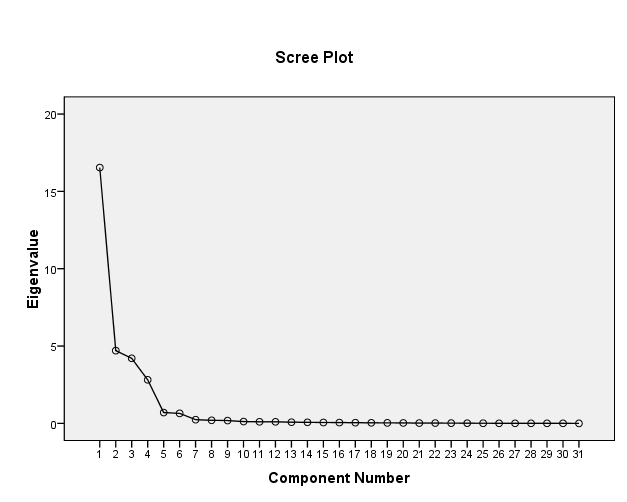
** Significant at 0.01 level Table 5: Value of KMO and Bartlett's Test. The result of the initial analysis revealed 4 factors with Eigen values over 1 explaining 100% with a factor loading value above 0.40 of the variance. There were 2 cross factor loading of factor 1 & 3. This result is presented in Table 6. Moreover, the inspection of the Scree Plot indicated 4 factors which are also supported by Rotated Component Matrix Analysis. Figure 1 indicates the Scree Plot of factors.
| Component (Factor) | |||||||||||||
|---|---|---|---|---|---|---|---|---|---|---|---|---|---|
| PASS item | |||||||||||||
| 1 | 2 | 3 | 4 | ||||||||||
| 3 | 0.918 | ||||||||||||
| 1 | 0.912 | ||||||||||||
| 2 | 0.910 | ||||||||||||
| 4 | 0.909 | ||||||||||||
| 10 | 0.889 | ||||||||||||
| 9 | 0.868 | ||||||||||||
| 5 | 0.839 | ||||||||||||
| 8 | 0.815 | ||||||||||||
| 6 | 0.804 | ||||||||||||
| 7 | 0.775 | 0.518 | |||||||||||
| 13 | 0.941 | ||||||||||||
| 12 | 0.929 | ||||||||||||
| 18 | 0.929 | ||||||||||||
| 14 | 0.923 | ||||||||||||
| 17 | 0.883 | ||||||||||||
| 15 | 0.872 | ||||||||||||
| 16 | 0.825 | ||||||||||||
| 11 | 0.523 | 0.690 | |||||||||||
| 29 | 0.960 | ||||||||||||
| 31 | 0.945 | ||||||||||||
| 27 | 0.911 | ||||||||||||
| 25 | 0.904 | ||||||||||||
| 28 | 0.902 | ||||||||||||
| 24 | 0.872 | ||||||||||||
| 30 | 0.849 | ||||||||||||
| 12 | 0.923 | ||||||||||||
| 19 | 0.854 | ||||||||||||
| 19 | 0.853 | ||||||||||||
| 23 | 0.851 | ||||||||||||
| 20 | 0.812 | ||||||||||||
| 22 | 0.752 |
Table 6: Rotated Component (Factor loading) Matrix.
Reliability
Internal consistency The Internal consistency of Bangla PASS is very good (Cronbach’s Alpha 0.970). The corrected item-total correlation coefficients were above 0.50 and values of Cronbach’s Alpha if item deleted were above 0.90. This result is presented in Table 7.
| Corrected Item-Total Correlation | Cronbach's Alpha if Item Deleted | |||||||
| PASS item | ||||||||
| item no 1 | .850** | .968 | ||||||
| item no 2 | .836** | .968 | ||||||
| item no 3 | .842** | .968 | ||||||
| item no 4 | .841** | .968 | ||||||
| item no 5 | .869** | .968 | ||||||
| item no 6 | .819** | .968 | ||||||
| item no 7 | .750** | .968 | ||||||
| item no 8 | .719** | .969 | ||||||
| item no 9 | .786** | .968 | ||||||
| item no 10 | .805** | .968 | ||||||
| item no 11 | .748** | .968 | ||||||
| item no 12 | .683** | .969 | ||||||
| item no 13 | .722** | .969 | ||||||
| item no 14 | .750** | .968 | ||||||
| item no 15 | .714** | .969 | ||||||
| item no 16 | .837** | .968 | ||||||
| item no 17 | .685** | .969 | ||||||
| item no 18 | .748** | .968 | ||||||
| item no 19 | .576** | .969 | ||||||
| item no 20 | .627** | .969 | ||||||
| item no 12 | .546** | .969 | ||||||
| item no 22 | .613** | .969 |
Table 8: Value of Corrected item-total correlation and Cronbach’s Alpha if item deleted **Test-retest Reliability** The Pearson c
item no 23 .548 .970 item no 24 .614 .969 item no 25 .667 .969 item no 19 .590 .969 item no 27 .591 .969 item no 28 .664 .969 item no 29 .569 .969 item no 31 .529 .970 item no 31 .602 .969 Significant at 0.01 level Table 7: Value of Corrected item-total correlation and Cronbach’s Alpha if item deleted Test-retest Reliability The Pearson correlation coefficient between test and retest scores over a period of 15 days of the Bangla PASS was .830 (p < 0.01). Additionally, the paired sample t-test between the two testing periods revealed no significant differences, t (27) = .773, p = 0.446. This result indicates that Bangla PASS has a temporal stability.
Validity
Discriminant validity: Discriminant validity of Bangla PASS was assessed by correlating this scale with Bangla Anxiety measuring scale and Depression measuring scale. The Pearson product moment correlation coefficient between PASS and Anxiety measuring scale is 0.872 and PASS and Depression measuring scale is 0.750. Both of this correlations are significant at 0.01 level (2 tailed). This result is presented in Table 8.
| Measure | 1 | 2 | 3 | ||||||||
|---|---|---|---|---|---|---|---|---|---|---|---|
| Bangla PASS | 1 | ||||||||||
| AMS | 0.872** | 1 | |||||||||
| DMS | 0.75** | 0.643** | 1 |
Table 9: Correlation of Bangla PASS with AMS and DMS. **Known Group Comparison** In known group comparison, there were not any si
Note: PASS – Perinatal anxiety screening scale, AMS – Anxiety measuring scale, DMS – Depression measuring scale, Significant at p < 0.01 level (2 tailed). Table 8: Correlation of Bangla PASS with AMS and DMS. Known Group Comparison** In known group comparison, there were not any significant differences of the score of Bangla PASS among different groups according to participant’s socioeconomic status, educational qualification and occupation. This result is presented in Table 1.
Discussion
Perinatal anxiety is as much as like normal anxiety. In addition, it includes excessive worries or anxiety relating to pregnancy or infant. The aim of the present study was to adapt Perinatal Anxiety Screening Scale (PASS) into Bangla for the use of Bangladeshi women who are in their perinatal phase. The rationale of this study was to detect perinatal anxiety early for the betterment of the mother and child by taking treatment. The instrument was translated following standard guidelines provided by Sousa & Rojjanasrirat, 2011 [21]. After that, complete data were collected from 151 women who were in their perinatal phase from 4 different divisions. The findings indicate that perinatal anxiety doesn’t vary significantly among different occupation, educational level, socioeconomic status and antenatal or postnatal phase. The findings are consistent with the original developers [1]. In present study, sampling study was excellent (KMO = 0.838) and very near to original study (KMO = 0.96). Inter-item correlation was sufficiently large for PCA (Bartlett’s test of sphericity, X2 = p<.00) and close to original study. In this study the identifiable number of factors are 4 (with Eigen values over 1 and suppressing absolute value less than .05), which is consistent with the main study. These 4 factor’s factor loading can explain the properties of 31 variables (items of the Bangla PASS). 4 factors were retained also based on the result of the Scree plot [24]. Those 4 factor structures are
- Acute anxiety
- General worry and specific fears
- Perfectionism control and trauma
- Social anxiety.
The internal consistency of this adapted Bangla PASS is also high. Test retest reliability was significant (r = .830, p < .001). The internal reliability coefficients of the total scale and all items were good to excellent and there was not any negative correlation between items (George and Mallery 2003). As expected, the PASS total score correlated (r=.872) positively and significantly with measures of anxiety, supporting the discriminant validity of the PASS. The PASS was also significantly and positively correlated (r = .750) with measures of depression. This finding is not surprising given the extensive co-morbidity between anxiety and depression which are evident in the literature and the study sample. A recent study indicated that up to 63 % of adults diagnosed with an anxiety disorder met the diagnostic criteria for a depressive disorder [25]. Co-morbid depression and anxiety may be more common in pregnant women than independent diagnoses of depression and anxiety [26].
Limitations
The current study bears some limitations. At first, the convenience sampling selection procedure of participants and sample size do not necessarily represent the entire target population.
Recommendation
This PASS can be tested using a comparison group of mother who are out of perinatal phase for the purpose of testing validity. Test retest stability could be measured by administering Bangla PASS in antenatal and postnatal phase to each woman who participates in test-retest measure. Future work can be done to describe the cross loading value of factors.
Conclusion
Perinatal health is a very important health concern phenomenon. In this period, perinatal anxiety has a great effect on both mother and child’s physical and psychological health. Testing psychometric properties to measure this anxiety is the main problem of this present study. Ethical approval and informed consent were taken before collecting data. Cross sectional survey design and purposive then convenience sampling techniques were chosen to test data from 168 (finally 151) participants. Demographic data sheet, Bangla Perinatal Anxiety Screening Scale, Bangla Anxiety Scale, Bangla Depression Scale were administered to collect data from participants. Descriptive statistics, factor structure, reliability, validity were tested to establish psychometric properties of Bangla Perinatal Anxiety Screening Scale. The findings are significant with the original scale. It has a good reliability and validity properties. The small sample size is a limitation as a represent of target population. Future work can be done with larger sample size and cross loading value of factor. There was not any finding and conflict of interest in conducting this study.
Conflict of interest
There was not any conflict of interest in conducting this study.
Funding
There was no fund for this study.
Ethical Approval
Ethical approval was taken from Ethics Committee of Department of Educational and Counselling Psychology, University of Dhaka.
Informed consent
Informed consent was obtained from all participants included in this study.
References
-
Somerville S, Dedman K, Hagan R, Oxnam E, Wettinger M, et al. (2014) The Perinatal Anxiety Screening Scale: development and preliminary validation. Archives of Women’s Mental Health 17(5): 443-454.
-
Ross LE, McLean LM (2006) Anxiety disorders during pregnancy and the postpartum period. J Clin Psychiatry 67(8): 1285-1298.
-
Andersson L, Sundström-Poromaa I, Wulff M, Åström M, Bixo M (2004) Implications of antenatal depression and anxiety for obstetric out-come. Obstet Gynecol 104(3): 467-476.
-
Borri C, Mauri M, Oppo A, Banti S, Rambelli C, et al. (2008) Axis I psychopathology and functional impairment at the third month of pregnancy: results from the Perinatal Depression-Research and Screening Unit (PND-ReScU) study. Journal of Clinical Psychiatry 69(10): 1617-1624.
-
Matthey S, Barnett B, Howie P, Kavanagh DJ (2003) Diagnosing post-partum depression in mothers and fathers: whatever happened to anxiety? J Affect Disord 74(2): 139-147.
-
O’Connor TG, Heron J, Glover V, Alspac Study Team (2002) Antenatal Anxiety Predicts Child Behavioral/Emotional Problems Independently of Postnatal Depression. J Am Acad Child Adolesc Psychiatry 41(12): 1470-1477.
-
Heron J, O’Connor TG, Evans J, Golding J, Glover V, et al. (2004) The course of anxiety and depression through pregnancy and the postpartum in a community sample. J Affect Disord 80(1): 65-73.
-
Ding XX, Wu YL, Xu SJ, Zhu RP, Jia XM, et al. (2014) Maternal anxiety during pregnancy and adverse birth outcomes: a systematic review and meta-analysis of prospective cohort studies. J Affect Disord 159: 103- 110.
-
Van den BBR, Marcoen A (2004) High Antenatal Maternal Anxiety Is Related to ADHD Symptoms, Externalizing Problems, and Anxiety in 8- and 9-Year- Olds. Child Development 75(4): 1085-1097.
-
Blair MM, Glynn LM, Sandman CA, Davis EP (2011) Prenatal maternal anxiety and early childhood temperament. Stress 14(6): 644-651.
-
Glover V, Richardson GA , Fabio A (2010) Systematic review of the effects of postnatal maternal anxiety on children. Arch Womens Mental Health 67(11): 1026- 1032.
-
O’Connor TG, Heron J, Golding J, Beveridge M (2002) A prospective longitudinal study of the impact of early postnatal vs chronic maternal depressive symptoms on child develo. British Journal of Psychiatry 180: 502-508.
-
Johnson RC, Slade P (2003) Obstetric complications and anxiety during pregnancy: is there a relationship? J Psychosom Obstet Gynaecol 24(1): 1-14.
-
Stein A, Craske MG, Lehtonen A, Harvey A, Savage- McGlynn E (2012) Maternal cognitions and mother- infant interaction in postnatal depression and generalized anxiety disorder. J Abnorm Psychol 121(4): 795-809.
-
Stevenson-Hinde J, Shouldice A, Chicot R (2011) Maternal anxiety, behavioral inhibition, and attachment. Attach Hum Dev 13(3): 199-215.
-
Spinelli MG (1998) Psychiatric disorders during pregnancy and postpartum. Journal of the American Medical Women’s Association 53(4): 165-169.
-
Sutter-Dallay AL, Murray L, Dequae-Merchadou L, Glatigny-Dallay E, Bourgeois ML, et al. (2011) A prospective longitudinal study of the impact of early postnatal vs chronic maternal depressive symptoms on child development. Eur Psychiatry 26: 484-489.
-
Milgrom J, Gemmill AW, Bilszta JL, Hayes B, Barnett BBJ, et al. (2008) Antenatal risk factors for postnatal depression: a large pro-spective study. J Affect Disord 108(1-2): 147-157.
-
Deeba F and Begum R (2004) Development of an Anxiety Scale for Bangladeshi Population. Bangladesh Psychological Studies 14: 39-54.
-
Uddin, Md Zahir and Rahman, Mohammad Mahmudur (2005) Development of A Scale of Depression for Use in Bangladesh, Bangladesh Psychological Studies 15: 25-44.
-
Sousa VD, Rojjanasrirat W (2011) Translation, adaptation and validation of instruments or scales for use in cross-cultural health care research: A clear and user-friendly guideline. Journal of Evaluation in Clinical Practice 17(2): 268-274.
-
Kaiser H (1970) A second generation little jiffy. Psychometrica 35(4): 401-415.
-
Bartlett MS (1954) Anote on the multiplying factors for various chi square approximations. J R Stat Soc 16: 296-298.
-
Cattell RB (1966) The scree test for the number of factors. Multivar Behav Res. Multivar Behav Res 1(2): 245-276.
-
Lamers F, van Oppen P, Comijs HC, Smit JH, Spinhoven P, et al. (2011) The factor structure of the pregnancy anxiety scale. J Health Soc Behav. Journal of Clinical Psychol Ogy 72: 341-348.
-
Field T, Diego M, Hernandez-Reif M, Figueiredo B, Deeds OAA, et al. (2010) Comorbid depression and anxiety effects on pregnancy and neonatal outcome. Infant Behavior Development 33(1): 23-29.
-
Hendrick V (1998) Evaluation of mental health and depression during pregnancy. Psychopharmacol Bull 34(3): 297-299.
- Occupational Stress and Mental Health Outcomes Among Police Officers: A Mini Review
- The Experience of Counterproductive Leadership on Mental Health and Impact on Retention in U.S. Marines: A Phenomenological Study
- Nomophobia in the Digital Age: A Study on College and University Students
- Emotional Regulation in Children with Autism and Learning Disabilities
- Antisemitism on American College Campuses and Its Impact on Jewish Students
- Exploring the Role of Empathy in the Associations of Family Functioning and Purpose in Life with Attitude towards Abortion among Undergraduates: A Moderation Analysis