
Academic Efficacy Mediates between Stress Level Appraisal and Coping Strategies among Law Students at BulSU
High caliber courses such as Law require students’ appraisal of the level of academic stress to partake in the program. This appraisal would predict the utility of coping strategies. However, the effect of appraisal on coping strategies would depend on the presence of academic efficacy among these students. There is an internal process that is culled within students, and when this efficacy is accounted for, the relationship between stress level and coping strategies diminishes a significant value. Specifically, problem-focused, emotion-focused and avoidance-focused coping would be yielded as personal beliefs are accounted for. A study of Sophomore Law students at BulSU, employing multiple regression and process analyses infers the mediation of academic efficacy on the relationship of academic stress level appraisal and coping strategies. Implications for educational practice are herein forwarded.
Introduction
Tertiary education causes stress and anxiety among students most especially those taking high caliber course program such as Law. Studies have shown that tertiary level education is really stressful and it registers stress within students who need to cull in within rigorous endeavor to battle to attain their goal. Among the degree programs in the Philippines, Law seems to be the hardest thus far, that if students are not capable of appraising as well as possess such strong believing in their capability, they hardly determine the kind of coping they will employ in [1, 2].
This appraisal would push one’s academic efficacy which in turn leads to coping strategies. Specifically, for those who have full self-understanding, they would confront scenarios thus, problem-focused coping. For others, aiming to get other’s sympathy would cling on to emotion-focused coping [3]. Still for those who hardly take control of the situation, they would resort to avoidance coping strategy [4]. Fortunately, there are Law students who survive, even maintain academic scholarships, and finish the program in the expected time as well as pass or top bar exams. On the other hand, there is the misfortune of dropping the course, as there is decrease in the enrolment from first to second term and onwards. This has been evident in Bulacan State University. Law students make appraisal of the course/program, they calculate the degree of risks and stress they would have to bear. This appraisal especially with the level of difficulties to approach with are gathered in the form of feedbacks, setting ready finances, books, cognition and the like with the amount of endeavor to bear in the program. Appraising academic stress is paramount to calculating whether one can make it or not into the program. When stress level is appraised, coping strategies would be determined [2]. Literature (Englet, 2004) attests to the fact that stress - academic or otherwise, is often appraised as severe, moderate or mild. Level 1 is mild stress and is characterized with increased heart rate and blood pressure, rapid breathing, perspiring and sweaty palms and finally, indigestion and nervous stomach (Englet, 2004). These symptoms occur in response to a stressor that causes fright or nervousness. The body releases the needed adrenaline to set the person for action. In the Law program, adrenaline is needed when facing a terror professor, doing bulky requirements and meeting deadlines. Level 2 is moderate level of stress characterized by feelings of being pressured or driven, exhausted, fatigued and symptoms such as anxiety, memory loss, colds and flu and increase in smoking or alcohol and caffeine consumption. These symptoms occur when there is no relief from a Level 1 stress. The body begins to release stored sugars and fats and use up its reserved resources. Again, in meeting deadlines both in studies and other obligations, hurdling examinations and the like are instances that may cull in moderate level of stress. Level 3 or severe stress is characterized by: insomnia, errors in judgment, personality changes, auto-immune disorders, heart disease and mental illness. When a stressful situation is not resolved and is carried on for a prolonged period, Level 3 or severe stress may be felt. In this case, the body cannot produce the energy resources it needs with the on-going strain felt, thus causing dysfunction and breakdown. For example, when failed grades come in despite diligent endeavour, a student may experience such severe level of stress.
Stress appraisals appear to be important in determining which behavioral responses and coping strategies an individual draws upon following stressful events [5]. For example, an individual may turn to drugs and alcohol to cope with a perceived threatening situation if he or she appraises the event as overloading his or her current available coping resources, or other malfunctioning behavior may transpire. Subsequently, as a student hurdling the strenuous task of studying, meeting deadlines, submitting requirements and the like, coping strategies would have to be determined as best resort to situations bearing in Lazarus and Folkman, 1984 [6]. Coping strategies are ways enabling people deal or manage situations that arise. Among Law students, their coping ways may be: perceiving and coping based on the presenting problem, involving their feelings or emotion- focused coping, and avoiding or escaping the situation or avoidance-focused. Coping strategies are conscious adaptive responses consistently applied to a broad range of stressful events. Eight ways of coping were proposed by Lazarus & Folkman (1984) [6, 7]. These are: confrontive, distancing, self-controlling, seeking social support, accepting responsibility, escape-avoidance, planful problem-solving and positive re-appraisal coping strategies. These eight subscales were treated and classified later based on three encompassing dimensions as: problem-focused, emotion- focused and avoidant-focused coping. Problem-focused coping is directed at remedying a threatening or harmful situation, its meaning, significance and outcome [3]. This is where the Law student behaves in accordance with the problem he sees in the situation thus, excelling or reaching the desired ambition. Problem- focused coping employs confrontive ways such as using aggressive or risky efforts to change the situation and planful problem-solving such as analyzing the situation, identifying possible solutions and implementing them. Emotion-focused coping include ventilating, managing or relieving one’s emotional responses towards such situation [3]. Emotionally-focused students are found to be stressed and struggling and would express their feelings towards the situation such as feeling nervous and tensed and angry. This coping is employed when a situation is impossible to change and that emotionality is managed and expressed through praying, venting or seeking support from friends or family members [8, 9]. Emotion-focused coping includes attempt to seek social support, thus turning to friends, relatives, or other people for emotional, tangible or informational support. Finally, avoidance focused coping are attempts to remove oneself mentally or even physically from such threatening or damaging situations [4]. This fact may explain the act of dropping out the course or taking time out as leave of absence. This kind of coping includes denying that the stressor exists, thus mentally disengaging in the situation using daydreaming or sleeping, and increased alcohol and drug use in order to numb the stressful feelings [9]. This may involve strategies such as escape-avoidance, shifting attention away from the stressor and then toward other activities, distancing and denial manifested in going outdoors or go shopping, use negative self-talk and etc. Research found that both problem-focused and emotion-focused coping were significantly related to positive adaptation to stress, while avoidance-focused coping was related to both positive and negative adaptation to stress [10]. Stressful the situation may be, there can be perception of its level as high, moderate and low, or manageable, bearable and escapable. These appraisals may also mean looking into one’s capability to bear those challenges and burdens to partake on, believing in the self-capability to hurdle the tasks - this is academic efficacy. Academic efficacy would equally predict coping strategies by way of determining which approach to partake, whether problem-focused, emotion focused or avoidance-focused. Thus, with the presence of academic efficacy that is heightened with stress appraisal, coping strategies would be more of utility to the college student. Self-efficacy is defined by Bandura (2004) as “one’s belief in his capability to produce designated levels of performance for events”. It determines how people feel, think, motivate themselves and behave in certain situations. Beliefs arise with one’s appraisal and thus determine the outcome of a task as Pajares (2002) puts it, belief greatly influences effort. There are types of self- efficacy such as: driving efficacy, math, language, picture, computer, dancing, etc. Briefly, one’s capability to cope academically is termed academic efficacy [11, 12]. Academic efficacy is specific to the context of academia and it focuses on a person’s belief about himself regarding academic tasks. Depending on whether students possess it and its effect is accounted for, would it determine the kind of coping Law students would partake in. Thus, when academic efficacy is accounted for, stress level appraisal would determine the utility of coping strategies [13]. The transactional model of stress and coping theory frames the study emphasizing the utility of academic efficacy in surviving high caliber degree programs [9]. One may infer a strong connection between efficacy and appraisal as it surmise that appraisal or initial evaluation may go side-by-side with believing one can do all tasks successfully. Having forwarded the preceding claims, this study explored the mediation of academic efficacy on the relationship between academic stress level appraisal and coping strategies among Sophomore Law students at Bulacan State University. Initially, it sought to establish the predictive value of the independent variable academic stress level appraisal to coping strategies. Secondly, path connecting the academic stress level appraisal with the mediating variable academic efficacy was established. Thirdly, path between the mediating variable academic efficacies predictive of coping strategies was established too. Finally, accounting for the mediation of academic efficacy, path between the independent variable and the dependent variable was analyzed thoroughly.
Conceptual Framework
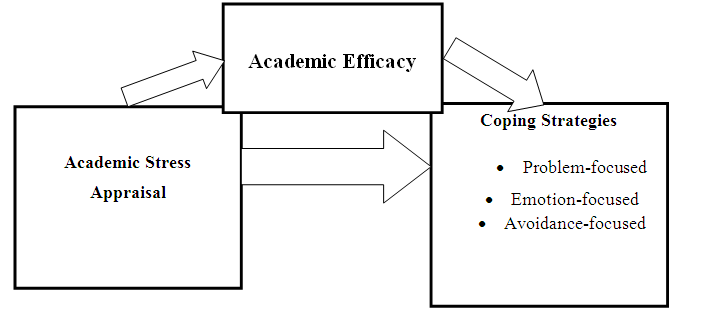
Figure 1: Academic Efficacy Mediates between Stress Level Appraisal and Coping Strategies. The variables are explicit in the paradigm above. Coping Strategies with its facets: problem-focused, emotion-focused and avoidance-focused coping are predicted by academic stress level appraisal. Academic efficacy would be predicted by academic stress level appraisal and when it is accounted for, appraisal will determine the utility of coping strategies.
Methodology
The endeavor was quantitative, regression and process model in approach as it established causal predictive values between and among the variables of interest (MacKinnon, Fairchild & Fritz, 2007). Predictive values of the dimensions of the IV - academic stress level (mild, moderate and severe) were regressed with the subscales of the DV- coping strategies (problem focused, emotion focused and avoidance focused). Paths were established: academic stress level appraisal with coping strategies, then the IV with the mediator academic efficacy (low, moderate, high) then the mediator with the DV coping strategies and finally, academic stress level appraisal with coping strategies accounting for the mediating variable academic efficacy [14]. The participants were purposively recruited from the College of Law of Bulacan State University particularly Sophomore students during the second semester of school year 2016-2017. They were specifically employed for they are in their mid-year and are the appropriate samples struggling to pursue the program they are in. There were one hundred (100), fifty-four (54) are females and forty-six (46) are males and were the more willing and available students during the time of data gathering. Their age range from 22 to 33 and with a mean of 24.04 (SD=2.67). Table 1 presents the demographic profile of the participants.
| Gender | Total | Percentage | ||||||
|---|---|---|---|---|---|---|---|---|
| Female | 54 | 54% | ||||||
| Male | 46 | 46% | ||||||
| TOTAL | 100 | 100% | ||||||
| Age | Frequency | Percentage | ||||||
| 22 and below | 32 | 32% | ||||||
| 23-25 | 48 | 48% | ||||||
| 26-28 | 10 | 10% | ||||||
| 29-31 | 8 | 8% | ||||||
| 32 and Above | 2 | 2% | ||||||
| TOTAL | 100 | 100% | ||||||
| Monthly Income | Frequency | Percentage | ||||||
| P14,000 and below | 6 | 6% | ||||||
| P15,000 - 109,000 | 68 | 68% | ||||||
| P110,000 – 204,000 | 12 | 12% | ||||||
| P205,000 – 299,000 | 10 | 10% | ||||||
| P300,000 and Above | 4 | 4% | ||||||
| TOTAL | 100 | 100% |
Table 1: Demographic profile of the respondents.
Participants were administered the questionnaires containing four (4) parts: demographic profile, academic efficacy, coping strategies and academic stress level appraisal. College-Going Self Efficacy Scale by Gibbons (2005) measures the level of academic efficacy of the participants. It has a total of ten (10) items pertaining participants’ strong belief in attaining a particular goal or execute behavior rated on a 4-point Likert type scale with the scale: 4=very sure, 3=sure, 2=somewhat sure and 1=not at all sure, the higher value means high academic efficacy. Items start with a stem, “How sure are you about being able to follow by the action. A sample item reads, “find a way to pay for Law school”. The ten items administered to the fifty participants yielded a high reliability coefficient of α=0.95, thus high psychometric property [15].
Coping Strategies
Coping strategies scale was adapted from Ways of Coping designed by Lazarus and Folkman (1994), and is a 43-item scale. Items measure the coping strategy utilized in academically stressful situation. Principal component analysis suggested deleting doubly loading items thus yielding to three ways of coping: problem-focused (item numbers 1,2,3,4,5,22,27,28, 32,35,37,38, 39, 45, 46), emotion-focused (item numbers 10, 11, 13, 14, 18, 21, 25, 31, 34, 41, 44), and avoidance-focused (item numbers 6, 7, 8, 9, 12, 15, 16, 17, 19, 20, 23, 24, 26, 29, 30, 33, 40) answered in a Likert type scale 1-4 where 1 means not used and 4 as used a great deal. A sample item reads, “just concentrated on what you had to do next in the next step”. This test has been found to have a high reliability coefficient of α=0.95 [9].
Academic Stress Level
Academic stress level scale was adapted from Stress Level Scale that was designed by the Counseling Team in California in the year 2000. It is a 45-item questionnaire that show how stress is appraised as mild, moderate or severe and is rated in a scale of 1-5 where 1 means never and 5 means almost always. Items underwent content analysis, negatively worded items were reverse scored and interpreted as the higher the score, the higher the academic stress level appraisal among the sampled Law students. Similarly, it yielded a high reliability coefficient of α=0.95.
As psychometric properties were established, mean and standard deviation were described; afterwards, regression analyses were employed. Table 2 presents the mean, standard deviation and reliability coefficient of the scales.
| Standard | Reliability | |||||||||
|---|---|---|---|---|---|---|---|---|---|---|
| Mean | ||||||||||
| Deviation | Coefficient | |||||||||
| Academic Efficacy | 2.98 | 0.12 | 0.95 | |||||||
| Coping Strategies | 2.81 | 0.74 | 0.95 | |||||||
| Academic Stress Scale | 2.60 | 0.13 | 0.95 |
Table 2: The Psychometric Properties of the Scales.
Results and Discussions
The regression for each coping strategy was done through path analyses using simple mediation model (Model 4, Hayes, 2013) and Process Procedure for SPSS Release 2.16.3 software [16]. Three runs of the Process Model 4 were conducted with each of the coping strategies as dependent variable (DV), academic stress appraisal as independent variable (IV), and academic efficacy as the mediating variable. The regression coefficients, standard errors, and confidence intervals for the models are found in the following table.
| Variable | M | SD | 1-ASL | 2-AE | 3-CSPF | 4-CSEF | 5-CSAF |
| 1- Academic Stress Appraisal (ASA) | 2.58 | .59 | — | .23 | .28** | .30** | .23* |
| 2- Academic Efficacy (AE) | 2.98 | .51 | — | .43*** | .46*** | .19 | |
| 3- Coping Strategy Problem Focused (CSPF) | 2.92 | .40 | — | -.70*** | .43*** | ||
| 4- Coping Strategy – Emotion Focused (CSPF) | 2.81 | .45 | — | .58*** | |||
| 5- Coping Strategy – Avoidance Focused (CSAF) | 2.68 | .42 | — |
Table 3: Descriptive Statistics of the Variables and Their Zero-Order Correlations. Based on the results, academic stress apprais
*p < .05. p < .01. *p <.001. Table 3: Descriptive Statistics of the Variables and Their Zero-Order Correlations. Based on the results, academic stress appraisal is significantly and positively associated with problem- focused and emotion-focused coping. Similarly, appraisal is significantly and positively correlated with academic efficacy, B = .20, t(98) = 2.28, SE = .09, p = .0249. This confirms that appraisals lead one to cull within him such capability and sustained effort to successfully accomplish task and reach one’s goal. There needs to be evaluating situations to enter in so that the person will be more than ready for the struggles at stake [6]. Academic efficacy was significantly and positively associated with problem-focused coping strategy, B = .30, t (97) = 3.80, SE = .08, p = .0003, and emotion-focused coping strategy, B = .37, t (97) = 4.98, SE = .08, p = .0000, but not with avoidance-focused coping strategy (B = .12, ns). Findings confirm who posited higher efficacy leads one to the utility of coping strategies specifically problem- focused or confrontational approach to situation [3, 12]. Interestingly, even emotion-focused coping is yielded in one’s sympathizing on what is felt by the subject.
Academic efficacy is also significantly and positively associated with problem-focused coping strategy, B = .13, t(97) = 2.64, SE = .05, p = .0096, and emotion-focused coping strategy, B = .15, t(97) = 2.22, SE = .07, p = .0286, but not with avoidance-focused coping strategy (B = .14, ns). Results confirm who aptly found efficacy to enable one to discern an action to partake and determine how best to cope in the situation at stake. Surely, an academically efficacious student will not avoid or escape any situation, thus insignificant on avoidance-focused coping [17, 18]. With the mediation model employed [19], the regression model on problem-focused coping strategy was significant, F(2,97) = 16.12, p < .001, as it explained 21.93% of its variance; the regression model on emotion- focused coping strategy was also significant, F(2,97) = 19.06, p < .001, and it explained 25.27% of its variance. However, the regression model on avoidance-focused coping strategy was not significant, F(2,97) = 2.56, ns. The summary of direct, indirect and total effects of academic stress appraisal on each coping strategy as mediated by academic efficacy is found in Table 4.
| Direct, Indirect and Total Effects | Effect | SE | LLCIa | ULCIa | Significance |
| 1 DIRECT EFFECT: ASL CSPF | .1316 | .0498 | .0328 | .2305 | Significant |
| 2 INDIRECT EFFECT: ASL AE CSPF | .0601 | .0284 | .0124 | .1257 | Significant |
| 3 TOTAL EFFECT: ASL CSPF | .1918 | .0568 | .0790 | .3045 | Significant |
| 4 DIRECT EFFECT: ASL CSEF | .1510 | .0680 | .0161 | .2859 | Significant |
| 5 INDIRECT EFFECT: ASL AE CSEF | .0727 | .0334 | .0127 | .1436 | Significant |
| 6 TOTAL EFFECT: ASL CSEF | .2237 | .0818 | .0614 | .3860 | Significant |
| 7 DIRECT EFFECT: ASL CSAF | .1395 | .0795 | -.0183 | .2973 | Not significant |
| 8 INDIRECT EFFECT: ASL AE CSAF | .0232 | .0183 | -.0032 | .0716 | Not significant |
| 9 TOTAL EFFECT: ASL CSAF | .1627 | .0857 | -.0073 | .3328 | Not significant |
Table 4: Summary of the Direct, Indirect and Total Effects of Academic Stress on Coping Strategies as Mediated by Academic Effica
Table 4: Summary of the Direct, Indirect and Total Effects of Academic Stress on Coping Strategies as Mediated by Academic Efficacy. Note: N = 100. ASL = Academic Stress Appraisal; AE = Academic Efficacy; CSPF = Coping Strategy: Problem-Focused; CSEF = Coping Strategy: Emotion-Focused; CSAF = Coping Strategy: Avoidance-Focused. a95% bias-corrected bootstrap confidence intervals The direct effect of academic stress appraisal on problem-focused coping strategy was statistically different from zero, effect = .1316, SE = .0498, 95% CI [.0328, .2305]; moreover, its indirect effect through the mediation of academic efficacy was also statistically different from zero, Effect = .0601, SE = .0284, 95% CI [.0124, .1257]; thus, the total effect was significant, effect = .1918, SE = .0568, 95% CI [.0790, .3045]. Findings confirm who found appraisals to be directly affecting academic efficacy, thus enabling confrontational or problem-focused coping [3, 13]. As a student reflects upon his strength and ability, all the more he feels capable of facing situations confidently thus, surviving the degree program he is enrolled in. The direct effect of academic stress level on emotion- focused coping strategy was statistically different from zero, effect = .1510, SE = .0680, 95% CI [.0161, .2859]; moreover, its indirect effect through the mediation of academic efficacy was also statistically different from zero, effect = .0727, SE = .0334, 95% CI [.0127, .1436]; thus, the total effect was significant, effect = .2237, SE = .0818, 95% CI [.0614, .3860]. Findings affirm Filipino’s emotionality in situations, that as appraisals are made and stress is felt, there is venting out and gaining other’s sympathy thus enabling them to cope and survive [18].
The direct effect of academic stress appraisal on avoidance-focused coping strategy is insignificant (effect = .1395, ns), its indirect effect through the mediation of academic efficacy (effect = .1395, ns) and the total effect (Effect = .1395, ns) were not significant. Highly efficacious students would not escape nor avoid situations; their responses are more of facing than turning their back [20]. The strong belief in their ability leads them to go on and not to retreat situations. The significance of academic efficacy is herein highlighted, that processing of internal abilities would lead one to strongly face stressful scenarios either through problem-focused or emotion- focused coping. This coping strategies would somehow minimize incompetence perceived and may even push student’s efforts to apply prior and current knowledge about life situations [21, 22].
Conclusions
Findings confirm the hypotheses that academic stress appraisal significantly and positively relates with both problem-focused and emotion-focused coping. Similarly, academic stress appraisal positively and significantly correlates with academic efficacy. Finally, finding the process or dynamics involved, academic efficacy mediates the relationship of stress appraisal and both problem- focused and emotion-focused coping.
Implications
Results may yield to an understanding of the mechanism behind the utility of coping strategies that are important in surviving high caliber degree programs such as Law. There is a need for every higher institution of learning to facilitate appraising the scenario to partake. Orientation to students may be rendered so that incoming students may evaluate the degree of effort to partake in the program. Furthermore, this will lead them to contemplating on inner resources and pushing for their confidence to hurdle the strenuous tasks to partake. These processes are important endeavor to ensure survival and excellence in any high degree programs.
References
-
Robbins PR, Tanck RH (1988) Interest in dreams and dream recall. Perceptual and Motor Skills 66(1): 291- 294.
-
Kundu S (2015) U.S. Higher Education Faculty Awards: Business, Education, Health Sciences and Nursing, Law, Medicine, Political and Policy Sciences, and Public Affairs 2: 588.
-
Herman JL, Tetrick LE (2009) Problem-Focused versus Emotion-Focused Coping Strategies and Repatriation Adjustment. Wiley Periodicals Inc 48(1): 69-88.
-
Ghaderi A (2015) Coping, Escape Avoidance. In: Wade T. (eds). Encyclopedia of Feeding and Eating Disorders. Springer Singapore.
-
Lazarus RS, Cohen JB (1977) Environmental stress. Human behavior and environment pp: 89-127.
-
Lazarus RS, Folkman S (1984) Stress, appraisal, and coping. New York: Springer. Singapore.
-
Beck R, Taylor C, Robbins M (2003) Missing Home: Sociotropy and Autonomy and their Relationship to Psychological Distress and Homesickness in College Freshmen. Anxiety, Stress and Coping: An International Journal 16(2): 155-166.
-
Cartwright S, Cooper DL (2008) Oxford Handbook on Organizational Well-being. Oxford University Press, Oxford pp: 616.
-
Folkman S, Moskowitz JT (2004) Coping: Pitfalls and Promise. Annu Rev Psychol 55: 745-774.
-
Hackett G, Betz NE, Casas JM, Rocha-Singh IA (1992) Gender, ethnicity, and social cognitive factors predicting the academic achievement of students in engineering. Journal of Counseling Psychology, 39(4): 527-538.
-
Bandura A (2004) Self-efficacy. In V.S. Ramachaudran (ed) Encyclopedia of Human Behavior 4: 71- 81. New York: Academic Press.
-
Pajares F (1996) Self-efficacy beliefs in academic settings. Review of Educational Research, New York 66543578.
-
Chemers M, Hu M, Li-tze, Garcia BF (2001) Academic Efficacy and First Year College Student Performance and Adjustment. Journal of Educational Psychology 93 (1): 55-64.
-
Baron RM, Kenny DA (1986) The Moderator-Mediator Variable Distinction in Social Psychological Research: Conceptual, Strategic and Statistical Considerations. Journal of Personality and Social Psychology 51(6): 1173-1182.
-
Gibbons J, Gray M (2005) Teaching social work students about social policy 58(1): 58-75.
-
Hayes AF (2013) Process Procedure for SPSS Release
-
Segerstrom SC, Taylor SE, Kemeny ME, Fahey JL (1998) Optimism is associated with mood, coping, and immune change in response to stress. Journal of Personality and Social Psychology 74(6): 1646-1655.
-
Bedewy D, Gabriel A (2015) Examining perceptions of academic stress and its sources among university students: the perception of academic stress scale. Health Psychol Open 2(2).
-
MacKinnon DP, Fairchild AJ, Fritz MS (2007) Mediation Analysis. Annual Review of Psychology 58: 593-614.
-
Schunk DH (1995) Self-efficacy, motivation, and performance. Journal of Applied Sport Psychology 7(2): 112-137.
-
Park, CL Armeli S, Tennen H (2004) The daily stress and coping process and alcohol use among college students. J Stud Alcohol 65(1): 126-35.
-
Rochlen AB, Ligiero D, Robbins PR, Tanck RH (1988) Interest in dreams and dream recall. Perceptual and Motor Skills 66: 291-294.
- Occupational Stress and Mental Health Outcomes Among Police Officers: A Mini Review
- The Experience of Counterproductive Leadership on Mental Health and Impact on Retention in U.S. Marines: A Phenomenological Study
- Nomophobia in the Digital Age: A Study on College and University Students
- Emotional Regulation in Children with Autism and Learning Disabilities
- Antisemitism on American College Campuses and Its Impact on Jewish Students
- Exploring the Role of Empathy in the Associations of Family Functioning and Purpose in Life with Attitude towards Abortion among Undergraduates: A Moderation Analysis