
Relationship between Behavior Aggressive and the of Accented Character of Adolescent
Aggressive behaviour is a part of the general family education, on the other hand it reveals, according to some prominent character traits, that it is formed throughout life. In this study we examined the interaction between accented character traits and aggressive behaviour among pre-adolescents. The research results have showed a significant correlation of five scales of hostility and test two types of accented personalities: exalted and irrepressible.
Introduction
The actuality of the problem is conditioned by the increase in the number of adolescents with aggressive behaviour. The aggressive behaviour of minors is manifested within the family towards parents and brothers, in college, towards the colleagues. Aggressiveness is a specific form of deviant behaviour because it is a human behaviour or a social action different from the normal, of non-normative type (opposed to the normative model) in the case of psycho- diseased asocial individuals, for whom there are no rules. Aggressive behaviour is not always directed outside the subject. There are situations when aggressive behaviour is directed to the subject itself. And here there is a distinction between auto-aggressive behaviours, such as suicide, self-mutilation, and other self-aggression behaviours that can endanger the health and the balance of the body (smoking, alcohol, drugs).
Aggressiveness represents all those voluntary actions directed at a person or object that have the purpose of producing, in an open or symbolic form, damage, offence or pain. The theoretical basis of research is: • The Characteristics of pre-adolescent age made by: L.S.
Vagotsky, L.I Bojovici, A.E. Licico, U. Şchiopu and others
- The Researches on the essence of aggressive behaviour by D. Dollard, Z. Freid, Karl Leonhard, E. Fromm, L. Şoitu and others.
- The aim of the work is to study the relationship between the accented nature and the aggressive behaviour of adolescents.
General Hypothesis of Research
We assume the existence of a significant correlation between aggressive behaviour and the type of accented character in adolescents.
Methodology of Research
Research sample: It consists of 50 teenagers from the 10th grade in the Chisinau municipality. The research group consists of 27 girls and 23 boys. The average age is 16.6 years. Two measuring instruments were used to carry out this study: a) K. Leongard's accented personality questionnaire. b) Questionnaire for determining the level and forms of Bass-Darki aggressiveness. c) The Pearson Correlation statistic-marematic method.
The Genesis of Aggressive Behaviour
Aggressive behaviour may be different. It extends from menacing gestures to murder, using the force the aggressor has got. Aggressive antisocial deeds are the ones that most often get attention because of their spectacular character and of the dangerous potential they have. Most researches that studied aggressive behaviour (K. Lorenz, E. Eibesfeldt, Z. Freud, R. Baron, D. Richardson, A. Buss, V. Mokanson) addressed the problem differently, so that the different opinions tend to reach to a common denominator. The following points of view can be distinguished. Thus, aggressive behaviour might be: a. a natural and instinctive behaviour of each person; b. a social phenomenon generated by the constraints and the difficulties of life in common; c. a frustration reaction; d. a behaviour learned as a consequence of education. The view that aggressiveness is innate is promoted by Z. Freud and Konrad Lorenz. In Freud's view, aggressiveness is an instinct. People are born with the instinct of being aggressive towards others and being violent. John Dollard and his associates assert that "aggression is a response to frustration," being convinced that aggressiveness is determined by extreme conditions. A. Bandura argues that aggressiveness is a socially learned behaviour that formulates the theory of social learning of aggressiveness [1]. Under the influence of education and by respecting socio-moral norms a certain type of character is formed. The formation of character meansto a large extent, the internalization of the submitted commitments and the compliance to the norms that the collective formulates towards individuals. In the broad sense of the word, character means all the essential and qualitative features that are expressed in the interpersonal relationships and in the human activity in a stable and permanent way. In a slightly narrower sense, character can be defined as a set of essential and stable features derived from human orientation and will [2]. Under the influence of education and by respecting social-moral norms a certain type of character is formed. In his studies (1968), Karl Leonhard concludes that more than 50% of the population is distinguished through prominent features that reach a certain intensity, imprint upon human personality, disrupt the personality structure going to the limit of normality. He characterized these attributes of personality, "which tend to slip into abnormality" as "accented personality" [3, 4, 5]. Karl Leonhard speaks of the existence of four fundamental features of personality, "the demonstrative nature, its essence lies in the abnormal discharge capacity which becomes a hysterical nature when it reaches higher degrees; the hyper-exact nature is the opposite of the demonstrative nature and it is distinguished through the lack of discharge ability, in case of strong accentuation it leads to psychopathy; The hyper-perseverant nature, its essence is the abnormal persistence of the effect; the unmanaged nature characterized by abnormal dominance of the behaviour by impulses. The knowledge of the accented characters, in Karl Leonhard's conception, is intended to substantiate the differences in the achievement of a continuation between normal and abnormal. Each type of personality, depending on the dominant nature, manifests a certain behaviour style: some people are irritable, aggressive, others are depressive. By highlighting the tendency toward an accented nature at an earlier age, we could prevent the abnormal, antisocial and aggressive behaviour by developing types of intelligence such as emotional and spiritual, which would self-regulate both the person's behaviour and emotional sphere. The educating of some character features such as empathy, self-repression, could manage the behaviour and emotions in different life situations, it could prevent anger explosions, verbal aggressiveness, etc.
The Results of the Experimental Study
In the research we had as objective the argumentation of the hypothesis that there is a significant correlation between the aggressive behaviour and the type of accented character in adolescents. In order to highlight the degree of hostility, we applied the Bass-Dark Hostility Inventory. The results of the average score obtained from each sub-scale are shown in Table 1.
- Subscales
- Abbreviation averages minimum maximum
- General hostility
- GH
- 39,06
- 28
- 52
- Negativism
- NE
- 3,16
- 1
- 5
- Resentment
- RE
- 4,72
- 2
- 8
- Indirect hostility
- IH
- 4,92
- 2
- 8
- Attempt
- AT
- 5,60
- 2
- 9
- Suspicion
- SP
- 6,72
- 2
- 10
- Irritability
- UR
- 5,86
- 1
- 9
- Verbal hostility
- VH
- 7,98
- 4
- 11
Table 1: The results of the Questionnaire aggression of Bass's-Darki's (a. u.).

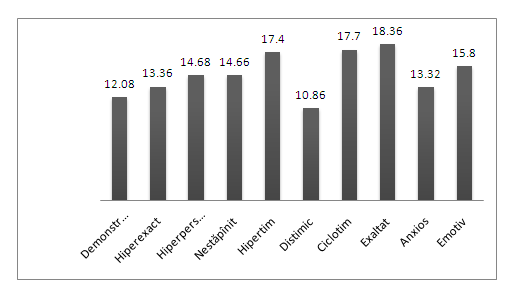
In order to highlight the accentuated personality threads we used the K. Leonhard's personality questionnaire whichis made up of 88 items, divided into 10 scales corresponding to 10 types of accented personality features: scale I -Demonstration (12 items); scale II -Hyper-exactness (12 items); scale III -hyper- persistent (12 items); scale IV -L_ack of repression_ (8 items); scale V -hypertim (8 items); scale VI - D_ysthymia_ (8 items); scale VII -C_yclothymia_ (8 items); scale VIII - E_xaltation_ (4 items); scale IX -A_nxiety_ (8 items); scale - E_motionality_ (8 items). The resulting figure may have the maximum value of 24 points: 24 indicates a 100% symptomatic percentage; the value between 13 - 75%; the value between 11 - 50%; the value between 6 - 25%. Under these circumstances, we can talk about a true accentuation only in case the percentage at one or more scales exceeds 50% [6, 7, 8].
| Subscale | Media | Min | Max | ||||||||
|---|---|---|---|---|---|---|---|---|---|---|---|
| Demonstrative | 12,08 | 4 | 22 | ||||||||
| Hiper-exact | 13,36 | 8 | 22 | ||||||||
| Hiper-persistent | 14,68 | 8 | 22 | ||||||||
| Irrepressible | 14,66 | 6 | 21 | ||||||||
| Hipertim | 17,40 | 3 | 24 | ||||||||
| Dysthymia | 10,86 | 3 | 18 | ||||||||
| Cyclothymia | 17,70 | 9 | 24 | ||||||||
| Exalted | 18,36 | 6 | 24 | ||||||||
| Anxious | 13,32 | 0 | 24 | ||||||||
| Emotional | 15,80 | 6 | 24 |
Table 2: The average score results of the personality questionnaire results, Leonhard / translated and adapted by L. Savca, 1992)
The results obtained from Table 1 are shown in Figure 1, which shows the higher and lowest average score of some accented personalities.
Sub scales to the Bass-Darky test Sub-scale to the Leonhard accented personality test DM HE HP NS HT DT CT ET AX EM HG -0,06 0,12 0,24 0,56** -0,09 0,22 0,20 0,35* -0,13 0,05 NE -0,18 -0,006 0,1 0,12 0,04 0,14 -0,02 0,04 -0,20 0,03 RE 0,08 -0,06 0,24 0,18 -0,09 0,06 0,08 0,09 0,11 0,14 IN -0,07 0,11 0,06 0,43** -0,14 0,26 0,15 0,18 -0,17 0,04 AT -0,29* -0,04 0,10 0,44** -0,22 0,26 -0,04 0,04 -0,36* -0,06 SU 0,003 0,17 0,11 -0,02 0,20 -0,16 0,22 0,36* 0,21 -0,06 IR 0,11 0,21 0,12 0,37** 0,02 0,07 0,13 0,34* -0,07 0,14 The correlation is significant for threshold p = 0.01. * The correlation is significant for the threshold p = 0.05. Table 3: Correlation between the indices of hostility and accented natures. Leonhard's sub-scales: DM - Demonstrative, HE - Hyper-exact, HP - Hyper-persistent, NS – Irrepressible, HT - Hypertim, DT - Dysthymic, CT - Cyclothim, ET - Exalted, AX – Anxious, EM - Emotive Bassa-Darki sub-scales:** OG - general hostility, NE - negativism, IN - indirect hostility, RE - resentment, AT - attempt, SU - suspicion, IR - irritability, VH - verbal hostility.
hypothesis, we analysed the degree of correlation between the Bass-Darky hostility test scales and the Leonhard (Schmiescheck) accented personality questionnaire, applying the Pearson correlation coefficient (Table 3).
VH 0,12 -0,02 0,11 0,40** -0,16 0,15 0,12 0,12 0,003 -0,03
Interpretation of the Obtained Meanings
According to the scores obtained from the correlation of the results, we determined the existence of a x significant correlation between the hostility test scales and the accented types of personality according to Leonhard in the pre-adolescents.
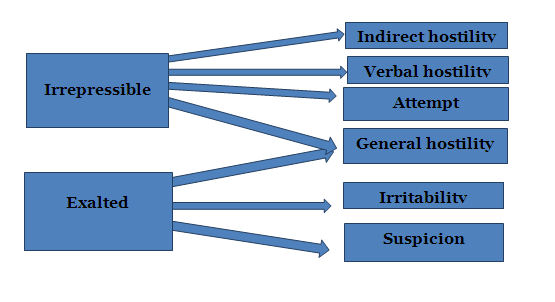
Figure 3: Correlation of the results from the hostility test and the accented personalities questionnaire. Significant correlations were determined between the following scales (Figure 3):
- General hostility, with the following sub-scales: o Irrepressible (r = 0.56); p = 0.01; directly proportional relation; o Exalted (r = 0.35); p = 0.05; directly proportional relation.
- Indirect hostility, with the Irrepressible Scale (r =
0.43); p = 0.01; directly proportional relation.
- Attempt, with the following sub-scales: o Demonstrative (r = -0,29); p = 0.05; inversely proportional relation; o Irrepressible (r = 0.44); p = 0.01; directly proportional relation; o Anxiety (r = -0.36); p = 0.05; inversely proportional relation.
- Suspicion and Exaltation (r = 0.36); p = 0.05; directly proportional relation.
- Irritability with the following scales o Irrepressible (r = 0.37); p = 0.01; directly proportional relation; o Exalted (r = 0.34); p = 0.05; directly proportional relation.
- Verbal and Irrepressible Hostility (r = 0.40); p = 0.01;
directly proportional relation. Thus, the direct proportional relations obtained between the variables indicate that the increase of the level of a variable determines the increase of the level of the one it is in relation with and respectively the decrease of one level produces a decrease of the level of another, where p = 0,05 and p = 0,01, it indicates the threshold of significance. The inversely proportional relations indicate the fact that the decrease of the level of the variable produces the increase of the level of the one it is in relation with and vice versa, the increase of one leads to the decrease of the other. For a better visualization of the correlation of the indices of character accentuation and aggressiveness at the tested pre-adolescents, we follow Figure 3. From Figure 3, we notice a significant correlation at five hostility test scales and two accented types of personality: exalted and irrepressible. From the analysis of the data, it was found that the initially elaborated hypothesis was confirmed and thus we notice a significant correlation in eight scales of the hostility test and the accented personalities at pre- adolescents. In the light of the facts mentioned above, we can emphasize the fact that the predominance of a certain pattern of hostile behaviour at the 50 pre-adolescents is directly proportional to two accented types of personality - irrepressible, exalted.
Conclusions and Recommendations
- Aggressive behaviour in adolescents is a deviation, and it is related to age peculiarities. If the intensity of this aggressiveness is not diminished, habits are formed in the manifestation of aggressive behaviour in various conditions.
- The accented nature of the person is not directly observable, but it can be "deciphered" in the life and activity of man through interference, starting from the interpretation of the observable conduct. The early detection of the accented features is possible by applying the following techniques, translated and adapted by us: the method of the "Recognition of self- portrait" elaborated by V.V. Kovaliov, A.K. Liciko Questionnaire, T.V. Matalina Features Questionnaire, Wood-word Features Questionnaire etc.
- Different methods of conflict resolution and emotional management are reflected in the speciality literature. However, little attention is paid to the measures of preventing the aggressive behaviour. Knowing the accented features from an early age would contribute to the elaboration of educational and corrective- developing programs.
- The persons identified with tendencies towards negatively accented features should be included in the corrective group of emotional self-regulation, development of emotional intelligence, development of spiritual intelligence.
Exercising in the above mentioned development programs develops character features such as empathy, self-confidence, compassion, it contributes to the formation of skills for understanding emotions and managing them, it contributes to the formation of higher spiritual values.
References
-
Bandura A, Ross D, Ross A (1961) Transmission of aggression through imitation of aggressive models. Journal of abnormal and Social Psychology 63(3): 575-582.
-
Buss AH (1961) The Psychology of aggression J. Willey, New-York, pp: 307.
-
Perciun N (2008) The Family – one of the starting factors of the aggressive behaviour at pre- adolescents, Theses: The International Scientific Conference, Psychological aspects of contemporary family and the child education problems.
-
Perciun N (2008) The Impact of the educational style within the family in the formation of the child's personality. The Child's health in school.
-
Perciun N (2003) The Factors that generate the aggressiveness at pre-adolescents and the psycho- correctional program for its abolishment, 97-102.
-
Savca L, Vîrlan M (2008) Psychic tests.
-
Savca L (2003) The Psychology of the Developing Personality, Chisinau.
-
Savca L (1996) The Vulnerability of the pre- adolescent age. Chisinau.
- Occupational Stress and Mental Health Outcomes Among Police Officers: A Mini Review
- The Experience of Counterproductive Leadership on Mental Health and Impact on Retention in U.S. Marines: A Phenomenological Study
- Nomophobia in the Digital Age: A Study on College and University Students
- Emotional Regulation in Children with Autism and Learning Disabilities
- Antisemitism on American College Campuses and Its Impact on Jewish Students
- Exploring the Role of Empathy in the Associations of Family Functioning and Purpose in Life with Attitude towards Abortion among Undergraduates: A Moderation Analysis