
Continuity and Discontinuity of Educational Experience amidst School and Family: Epistemological and Conceptual Foundations
This theoretical paper’s goal is to understand the sense ascribed to cultural continuity and discontinuity in the field of school-family-community partnership and shed light on the tendency to make the discontinuous continuous. To do this we propose a framework composed of different categories. Through this framework we situate cultural continuity and discontinuity amidst the conceptual, epistemological and metatheoretical levels and localise different forms of school/family interactions –in poverty-related context.
Introduction
In scientific, political and institutional discourse on education, we find that a child’s educational success depends on the establishment continuity of the systems composing its ecosystem. We can here refer to the discourse on interprofesionnal collaboration [1], the inclusion of at-risk students, differentiated pedagogy and the school-family-community partnership [2, 3]. The idea of establishing, in a poverty-related environment, continuity in the context of what is labeled cultural discontinuity is at the foundation of the school-family partnership and the actions deployed by educators with regard to this phenomenon [4, 5, 6]. At the base of these actions reside the implicit representations of cultural continuity and cultural discontinuity that we propose identifying within the framework of this theoretical article. These representations remain implicit in different Conceptual Paper fields, particularly child psychology, and underlie the tendency to make the cultural discontinuity continuous in a static (additive) fashion. This problem translates in specific domains such as school-family-community partnership. The ‘‘cultures’’ of the families from poverty- related contexts are negated and parents are artificially made into school’s agents without having the possibility to be fully integrated into school. Yet the political and institutional discourses promote school-family continuity, meaning putting (integrating) the systems together. How is such continuity represented alongside school-family discontinuity? This paper responds to this question from an epistemological and conceptual point of view.
First, we present the problem of cultural discontinuity in poverty-related environment. Second, we present different forms of school-family interaction with regard different epistemological conceptions of cultural continuity and cultural discontinuity. Third, we schematically systematize and extend these categories by integrating the conceptual, epistemological and met theoretical levels. This could for instance enable understanding how educators make the discontinuous continuous. We conclude by integrating the temporal dimension to our analysis.
Cultural Continuity
The constitution of the school-family-community partnership field in reaction to cultural discontinuity predominantly directs emphasis on the cultural continuity to be established or (re)established [4]. In order to reach for cultural continuity, academic parental engagement is favoured to the extent that it “helps to synchronize the demands made to students at school and at home” [23]. Let us first situate the cultural continuity – as a conceptual phenomenon-with regard to an additive (continuous) logic.
Cultural Continuity in an Additive Frame
In order to prove the ‘‘existence’’ of an already existing cultural continuity some researchers believe that school and family are not as different as the authors generally suggest. They consider these instances of socialization from a functionality perspective, by highlighting the fact that there are marked correspondences between these institutions about areas of sociability, despite minor corresponding–compared to schools, families are composed of less members than the school and the emphasis is on the affective sphere [4, 24]. The fact that parents and teachers pursue the same goal of support for academic success translates their common vision and, on a more global scale, expresses the idea of an entanglement between these instances of socialization [25, 26, 27]. As criticised by Crozier and Vincent (1996a), this perspective implies a presumed academic consensus between parents and teachers about academic goals based on the school’s form of socialization –the equilibrium’s center of the parent/teacher relationship is established around the school rather than the family [28, 29, 30].
This is reflected in typology, with a teleological orientation, based on a continuum (cf., Baum, 2002; Larivée, 2008, 2011) where the point of arrival –the ideal form of engagement to be reached by the child and the parent— implicitly constitutes school culture [31, 32, 33, 34, 35, 36, 37, 38, 39].
The idea of consensus, considered a priori, as a stable datum, between school and family expresses a static understanding of each of these cultures and their relations; they are considered homogenous ensembles where there is little cultural variation [9, 40, 41]. This is what Auerbach (2007) also states: “In these works, consensus and cooperation are assumed; parent involvement is treated as a social fact on neutral terrain rather than as socially constructed phenomena on the contested terrain of schooling” (p. 251).
The fact, for many authors, speaking about the school- family and parent-teacher relationships in a generic sense, without referring to parents’ sociocultural origins [42, 43], and presuming a consensus without looking at these cultural basis, constitute a masking operation of cultural dynamics [44, 45, 46]. The emphasis on consensus as a social fact has its counterpart in political discourse where parents of poverty-related environment are believed to share the same interests as teachers [5].
Cultural continuity in a non-additive frame
So far, we have tried to demonstrate the anchoring of cultural continuity in an additive epistemological frame. In the scientific literature on the field of the school-family partnership, we can also find some evidence of a non- additive interpretation of cultural continuity. From this perspective, it is not considered a social fact, but a destination whose reach passes through a dynamic process. Here, seeking continuity does not necessarily implies a negation of cultural discontinuity or attempted resolution ultimately involving such a negation. Also, this enterprise is, at times, a part of a dynamic relational framework where tension is seen as the engine of evolution. In this line of thinking, parental engagement is presented as a mediator in the school-family relationship [47] that takes shape amidst intersubjective relational processes from which a consensus can emerge [48, 49]. Flood and Anders (2005) present, in these terms, such a “partner-based” process [50]:
McCarthey suggested that teachers establish and maintain frequent and reciprocal communications with families. She argued that by developing a better understanding of children’s families and by helping them understand and use reading resources with their children, teachers could increase home-school congruence and continuity for all students (pp. 114).
It remains, however, that, within the limits of this teleological perspective [51], the destination to be reached is often given at the outset and circumscribed around school culture [34, 39], which is reflected, as we have already mentioned, in several typologies of parental commitment. As an expression of a static conception of culture, this perspective often leaves little room for the subjectivity of the parents (Boulanger, 2018) from poverty-related environment in regards to this culture [9, 52]. However, a non-additive conception of cultural continuity (conceptual phenomenon) sometimes implies that the parents and children of poverty-related environment contextually negociate their relationship to the world, in particular from artifacts [48, 49]. This expresses a relationship between cultural continuity and discontinuity as far as the non-additive conception of cultural discontinuity promoted by the authors just cited supports the non-additive conception of cultural continuity we were referring to. We will develop more on this later. For the moment, we present the concept of cultural discontinuity.
Cultural Discontinuity
Cultural Discontinuity in an Additive Frame
When cultural discontinuity is situated in an additive perspective, the school and the families –as two cultures representing polarities-are made of mutually exclusive closed classes or categories [9]. The emphasis on dichotomies and the manifestation of a social break-up leads more to divide than to unite the actors and their socio-cultural universe, which is reflected in particular by excluding certain forms of socialization [53]. When cultural difference is recognized, it leads to exclusion because there is an implicit or explicit hierarchy with school at the top.
The family is therefore considered as a series of risk factors and its members as carriers of deficits. This is what leads to cultural gap reinforcement:
When schools do not recognize racial and cultural issues, especially when people are not treated equally, racial and cultural boundaries and divisions between families and schools are reinforced [54].
Thus, cultural discontinuity reinforces cultural discontinuity, thanks to an additive logic implying adding the same to the same. In this perspective, rigid boundaries prevent a bidirectional exchange between the school and the family. When bidirectionality is possible, such as with Epstein’s model, the implicit hierarchy and the rigid boundary make this bidirectional relationship vertical (the school as the normative agent), formal (mainly formal types of engagement) and a linear sequence (teachers sending letter and parents calling) rather than a dialogical zone [52, 55].
Cultural Discontinuity in a Non-Additive Frame
Occasionally, moreover, cultural discontinuity is apprehended on a non-additive epistemological base. Doucet (2011) reveals in these terms the commonality between the approaches situated in this logic [53]:
Representing more of a poststructuralist world view, such frameworks have challenged the binary constructions suggested by cultural mismatch theories, insisting that boundaries between apparently separate spheres are permeable and never fixed. (p. 2707).
The presence of a cultural break could be considered an indication of a manifestation of cultural diversity [56, 57, 58]. Celebrating this diversity and considering the importance and the intrinsic value of family culture for the educational success of children from poverty-related environment, certain authors make the teachers’ knowledge, recognition and solicitation, in class, of family culture a condition for the rapprochement of the familial and scholar forms of socialization [59, 60].
Apprehending the presence of a cultural gap between the school and family not only as an indication of diversity to be exploited, but also as a constructive zone enabling the development of the child and the systems that surround them, certain authors favour the actualization of intersubjective processes, negotiation processes [61], as well as the co-construction of knowledge and dynamic articulation of cultures [62]. In this regard, Mérini (1995) refers to interculturality and Samaras and Wilson (1997) refer to the process of enculturation. From a related perspective, Changkakoti and Akkari speak of interculturation [58, 62, 63].
In order to escape from the culture of reproach, it seems important to us to be able to change the premises, namely to leave the monocultural logic behind and to take an interest in the conditions that make it possible to establish an interculturation zone. Interculturation would mean that not only family and school cultures are brought into contact, but that there is, created at the border, a third negotiation space where the alliance becomes possible, it being understood that there is not only one only possible type of interculturation.
In this line of thinking, rather than considering the consensus as a given, certain authors understand it as a sociocultural process which involves negotiation or intersubjectivity between parents of poverty-related environment and teachers [64]. Cultural discontinuity is then placed in a space conducive to a dynamic articulation of the educational universes, this in contrast with the reductionist treatment (static perspective) that Epstein (1987, 1995, 2001) makes of the entanglement of socialization spheres [25, 26, 35, 39, 66].
According to certain authors to be overall constructive, the tension generated from cultural discontinuity needs to be canalized or mediated by means of mechanisms and tools amidst a dialogical zone between the parent, the child and the teachers. Social networks also form a mediator of parental engagement and the school-family relationship [27, 28, 29, 30, 31, 32, 33, 34, 35, 36, 37, 38, 39, 40, 41, 42, 43, 44, 45, 46, 47, 48, 49, 50, 51, 52, 53, 54, 55, 56, 57, 58, 59, 60, 61, 62, 63, 64, 65, 66, 67, 68, 69, 70, 71, 72, 73].
As commendable as they may be, when they are not accompanied by a non-additive reading of the concept of culture, these dynamic conceptions of cultural discontinuity may mask a reductionist perspective or they lead to it [9].
This type of come and go between cultural continuity and discontinuity amidst a tension between an additive and a non-additive epistemologies provides us with clues as to the nature of the interactions between these two types of cultural phenomena. Let us take a look at the additive and non-additive (epistemological) relations between continuity and cultural discontinuity, providing, on this subject, some general reference points.
Additive and Non-additive Relations Between Cultural Continuity and Discontinuity: Inclusive and Exclusive Perspective
Reflecting on the additive and non-additive nature of the relationship between cultural continuity and discontinuity assumes that we identify these two phenomena as two interacting polarities. The nature of this interaction varies depending on the epistemological logic. Speaking in terms of choice (either/or) between cultural continuity and discontinuity implies an additive perspective. The phenomena of cultural continuity and discontinuity are therefore understood from an exclusive separation perspective expressing the tendency to separate two units (which are here polarities) and viewing them separately, as non-interrelated, and understanding them outside of their context, that is to say the whole in which they are both inscribed [74]. In a contrastive view, the units in question –cultural continuity and discontinuity-can be distinguished for the purposes of analysis, but functionally perceived as interrelated and contextualized; we are here in logic of inclusive separation. In support of Valsiner (1998), this leads us to propose the following plan [74]. Exclusive separation logic= Additive relation between cultural continuity and cultural discontinuity Inclusive separation logic = Non-additive relation between cultural continuity and cultural discontinuity The reader should line the two polarities –cultural continuity and discontinuity— through an exclusive perspective (additive) or inclusive perspective (non- additive).

a) Exclusive separation b) Inclusive separation Figure 1: Inclusive versus exclusive separation of cultural continuity and discontinuity.
Exclusive separation between cultural continuity and discontinuity implies at the outset considering each of them as two separated FIELDS, in Lewin’s (1936) term (Figure 1a) [75]. Cultural continuity and discontinuity –as polarities— are decontextualized from the global totality that is both a part of. Generally, cultural discontinuity is considered of as a starting point to be made into cultural continuity. This entails that at the very outset there is no cultural continuity. Therefore, cultural continuity and discontinuity are not considered of as two complementary phenomena that are necessary to each other [12]. Let’s us take the example of a consensus. In such a perspective (Figure 1a), a consensus only happens when the school and family agents have similar and convergent opinions. This occurs only when cultural continuity happens. Divergences –expressing cultural discontinuity-are considered of as obstacles to be overcame. Because cultural continuity and discontinuity are conceived as two separated in a decontextualized way phenomena, the former is projected in the school and the later in the family. This means that making the discontinuous continuous –removing discontinuity as the pathological agents-implies the school agents normatively acting upon the family to make parents actions fitting with school norms.
In a contrastive way, rather considering cultural continuity and discontinuity in an inclusive way (Figure 1b) implies recognizing them as two complementary phenomena interacting in the same field over time. Here, a consensus is a process in which there is tension between agreement and disagreement. This consensus is in a constant state of dynamic equilibrium –see in particular Tateo’s and Marsico’ (2013) concept of tensegrity [76]. This means that sameness of point of view is never achieved; it is in a constant state of tension in a dialogical space. There is never a final state corresponding to a specific and well-delimited consensus but a process of adressivness and responses [77]. Here, we situate the relation between cultural continuity and discontinuity in a non-additive epistemological frame. Yet, what is missing in our frame is the relation between additivity and non-additivity. Do we always have to choose non-additivity? Couldn’t there be an inclusive relation between additive and non-additivity as two complementary epistemological orientations?
We synthetize now the different categories presented with regard levels of inquiry in order to integrate, in a second time, this concern with the relation between additivity and non-additivity.
We mentioned earlier that each of the concepts of cultural continuity and cultural discontinuity is situated in an additive and/or non-additive epistemological frame. We mentioned for instance that taking an additive stance on cultural continuity implies imposing a consensus while a non-additive conception of both cultural continuity and discontinuity makes this consensus a process. We also said that additive cultural continuity implies recognizing functional corresponding between school and family. The first level of analysis comprises all the specific forms of school/family interaction presented previously.
The second level is epistemological. It characterises each of the form of school/family interaction (first level) with regard, first, to each concept (cultural continuity and discontinuity) and, second, to the relation between the concepts. Here, we referred to the inclusive (non- additive) or exclusive (additive) relation between the concepts of cultural continuity and cultural discontinuity (Figure 1).
The third is metatheoretical. This is the metatheoretical level in which «thought is about basic concepts that impact on both the theoretical and observational level. A metatheory itself is a set of rules, principles, or a story (narrative), that both describes and prescribes what is acceptable and unacceptable as theory- the means of conceptual exploration of any scientific domain» [13]. This is in this sense that «[s]cientific metatheories transcend (i.e., ‘meta’) theories and methods in the sense that they define the context in which theoretical and methodological concepts are constructed» [78]. It is therefore situated at a highest level than the epistemological (second level).
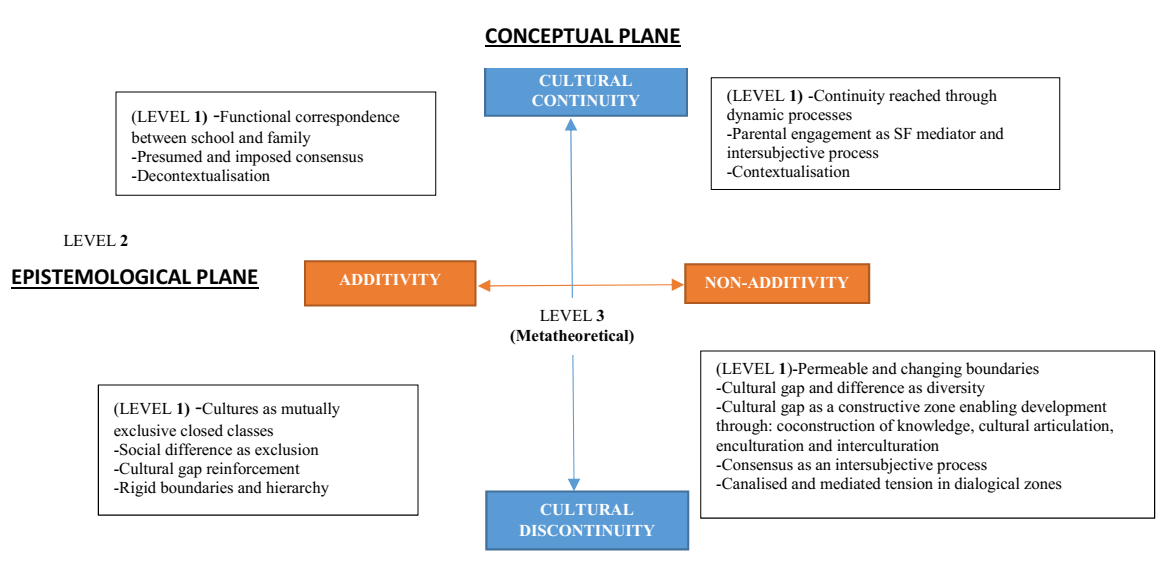
The third level refers to the inclusive or exclusive relation between the epistemological additive and non- additive orientation of each of the two conceptual phenomenon (cultural continuity and discontinuity) interacting together. So, cultural continuity can be inclusively conceived as both a dynamic (non-additive) and a static (additive) phenomenon or exclusively as either a dynamic (non-additive) or a static phenomenon (additive). It could be translated in the tension between structure and process. A consensus could be seen as both a process (non-additive continuity) leading to a product having a certain form or structure (additive continuity) when it get stabilised and anchored. It can then be renegociated when debated. Here a move from additive continuity to non-additive continuity. This is the case with social representation comprises as both a stable form and a process. Of course, there are many nuances to this illustration, for instance regarding the non-additive nature of a form or structure and the additive nature of a process.
Here, we applied the metathereotical relation between additivity and non-additivity to a concept (cultural continuity). We could also apply this to the (additive or non-additive) relation between cultural continuity and discontinuity (second level). We will not render or analysis even more complex by delving into this articulation between the second and the third level.
The Figure 2 schematizes the three aforementioned levels. The vertical axis represents the conceptual aspect (cultural continuity and discontinuity). The forms of school/family interaction (level 1) that are listed pertained to cultural continuity when they are situated on the top of the Figure 2, and to cultural discontinuity when they appear in the bottom.
The horizontal axis is epistemological (level 2). The forms of school/family interaction are situated in an additive logic when they appear in the left of the Figure 1, and to a non-additive perspective when they are situated in the right part. The met theoretical relation between additivity and non-additivity (the horizontal orange arrow) represents the third level.
Conclusion
From a spatial to a temporal conception of cultural continuity and cultural discontinuity In this text we presented four forms of cultural interactions from an ecosystemic perspective: additive cultural continuity, non-additive cultural continuity, additive cultural discontinuity and non-additive cultural discontinuity. This classification implies situating the concepts of cultural continuity and cultural discontinuity on the epistemological level, reflecting on the interplay between these concepts and opening on the relation between additivity and non-additivity. In this regard we suggested that non-additivity can necessarily imply additivity. This is the case with the very frame we proposed!
As a matter of fact, our conception of cultural continuity and discontinuity remained inscribed in a SPATIAL logic rather than temporal.
The different pieces in this schema need not be static, but they move. This schema needs change. In certain circumstances, social representations –as forms—of parental engagement and parent competences are contextually reconstructed, for instance when parents and teachers engage in flexible activities in the communities [52].
Acting reflexively, parent and teacher can distancing themselves from some stereotypes –as additive forms- and contextually (re)construct meaning [79]. Social changes such as the application of new educational policies can lead to deconstruct how schooling is conceived –in micro-discourses—in order to enable the constructive adaptation to a new context [36]. Action- research often enables a constructive and reflexive dialogue between parents and teachers [70]. Reflecting on, and distancing themselves from, a common belief (representation) of education, people engage in an intersubjective process to reconstruct it. This also happens when actors in education reconstruct their relation to ethnic beliefs through distancing and reflexive process [64].
In these different cases, cultural continuity needs discontinuity –both as a concept (cultural discontinuity) and as an epistemology (non-additivity). People distancing themselves from stereotype happens when the static is made dynamic! These recommendations could be useful for educational psychologists who act on social interfaces under the cultural guidance of ideologies and representations that our paper tried to highlight. Their discipline-psychology and particularly child psychology- still needs what Valsiner (1989) labels a developmental epistemology. With regard our paper this implies recognizing non-additivity but also extending our reflection with regard to irreversible time [80, 81].
Without this process aspect, our categories remain (relatively static) labels with no explanatory value. What needs to be done is to put this frame into irreversible time and reflect on the concept of culture [82]. What does the word cultural in cultural continuity stand for? What makes it cultural? Is it a form or process?
References
-
Bronstein L (2003) A Model for Interdisciplinary Collaboration. Social Work 48(3): 297-306.
-
Grenier N (2013) Les pratiques de différenciation d’enseignantes du primaire en classe multiethnique au Québec. Mémoire de maîtrise en Sciences de l’éducation, Université de Sherbrooke, Québec.
-
Couturier Y, Larose F, Bédard J (2009) Continuités et discontinuités de l’intervention éducative et de l’éducation socioéducative en milieu scolaire défavorisé. Les sciences de l’éducation pour l’ère nouvelle 42(4): 93-116.
-
Lawrence-Lightfoot SL (1978) Worlds Apart: Relationships between families and schools. New York, NY: Basic Books.
-
Vincent C (1996b) Parents and Teachers. Power and Participation. London: Routledge. Waller, W. (1932/1961). The sociology of teaching. New York, NY: John-Wiley.
-
Cairney TH (2001) Bridging home and school literacy: in search of transformative approaches to curriculum. Early Child Development and Care 172(2): 153-172.
-
Self EA, Milner HR (2012) Cultural discontinuities and education. In: Banks JA (Ed.), Encyclopedia of Diversity in Education Thousand Oaks, CA: SAGE, pp: 513-517.
-
Taylor LC, Clayton JD, Rowley SJ (2004) Academic Socialization.
-
Gutiérrez KD, Morales PZ, Martinez DC (2009) Remediating Literacy: Culture, Difference, and Learning for Students from Nondominant Communities. Review of Research in Education 33(1): 212-245.
-
Wapner S, Demick J (1998) Developmental analysis: A holistic, developmental, systems-oriented perspective. In: Lerner RM, deW Damon, Lerner RM (Ed.), Theoretical Models of Human Development: Handbook of Child.
-
Valsiner J (2003) Culture and its transfer: Way of creating general knowledge through the study of cultural particulars. Online Readings in Psychology and Culture 2(11): 24.
-
Overton WF (2013) Relationism and Relational Developmental Systems: A Paradigm for Developmental Science in the Post-Cartesian Era. Advances in child development and behavior 44: 21- 64.
-
Overton WF (1998) Developmental psychology: Philosophy, concepts, and methodology. In: Lerner RM, Damon de W (Ed.), Theoretical Models of Human Development, Handbook of Child Psychology, New York, 6th (Edn.), NY: John Wiley and Sons 1: 107-188.
-
Lerner RM (1998) Theories of human development: Contemporary perspectives. In: Lerner RM, Damon dW, Lerner RM (Ed.), Theoretical Models of Human Development. 5th (Edn.), Handbook of Child Psychology, New York, NY: Wiley 1: 1-24.
-
Sameroff AJ (1983) Developmental systems: Contexts and evolution. In: Mussen P (Ed.), Handbook of child psychology New York, NY: Wiley, pp: 237-294.
-
Markovà I (2007) Dialogicité et représentations sociales. Paris, France: Presses Universitaires de France
-
Valsiner J (2009) Cultural psychology today: Innovations and oversights. Culture and Psychology 15(1): 5-39.
-
Boulanger D, Larose F, Couturier Y (2010) La logique déficitaire en intervention sociale auprès des parents: les pratiques professionnelles et les représentations sociales. Nouvelles Pratiques Sociales 23(1): 152-176.
-
Boulanger D, Larose F (2013) School-Family- Community Collaboration Mediated by Artifacts: Action Plans in a Canadian Intervention Program. Congress of the American Educational Research Association (AERA). San Francisco
-
Boulanger D, Larose F, Larivée SJ, Couturier Y, Mérini C, et al. (2011) Critique des fondements et usages de l’écosystémie dans le domaine du partenariat école- famille-communauté : application d’une perspective contextuelle et socioculturelle dans le cadre du programme Famille, école, communauté, réussir ensemble. Service social 57(2): 129-157.
-
Boulanger D (2014) L’écosystémie sous l’angle des discours: mise en perspective de l’approche de Bronfenbrenner. Nouvelle Pratiques Sociales 27(1): 189-210.
-
González N (1999) What Will We Do When Culture Does Not Exist Anymore?. Anthropology & Education Quarterly 30(4): 431-435.
-
Sheldon SB, Van Voorhis FL (2004) Partnership programs in U.S. schools: Their development and relationship to family involvement outcomes. School Effectiveness and School Improvement 15(2): 125- 148.
-
Adams KS, Christenson SL (2000) Trust and the family-school relationship: An examination of parent- teacher differences in elementary and secondary grades. Journal of School Psychology 38(5): 447-497.
-
Deslandes R, Royer E, Potvin P, Leclerc D (1999) Patterns of home and school partnership for general and special education students at the secondary level. Exceptional Children 65(4): 496-506.
-
Epstein JL, Dans KF, Kaufmann FL, Hurrelmann (1987) Toward a theory of family-school connections: Teacher practices and parent involvement. Social intervention: Potential and constraints New York, NY : De Gruyter, pp: 121-136.
-
Epstein J, Fernandez G (2001) School, Family, and Community Partnerships: Preparing Educators, and Improving Schools. Boulder CO: Westview Press.
-
Crozier G (1999) Parental involvement: Who wants it? International Studies in Sociology of Education 9(3): 219-238.
-
Crozier G (2001) Excluded Parents: The Deracialisation of Parental Involvement. Race Ethnicity and Education 4(4): 329-341.
-
Vincent C (1996a) Parent empowerment? Collective action and inaction in education. Oxford Review of Education 22(4): 465-483.
-
Baum HS (2002) The Community Approach to School- Community Partnerships: Challenges and Possibilities. Communication présentée au Annual Meeting of the American Educational Research Association, New Orleans, LA.
-
Larivée SJ (2008) Collaborer avec les parents: portrait, enjeux et défis de la formation des enseignants au préscolaire et au primaire, In: Correa ME, Gervais C (Ed.), Les stages en formation à l’enseignement. Pratiques et perspectives théoriques, Québec, Presses de l’Université du Québec 219-247.
-
Larivée SJ (2011) Regards croisés sur l’implication parentale et les performances scolaires. Service Social 57(2): 5-19.
-
Bakker J, Denessen E (2007) The concept of parent involvement. Some theoretical and empirical considerations. International Journal about Parents in Education 1(0): 188-199.
-
Graue ME (1998) Representing Relationship between Parents and Schools: Making Visible the Force of Theory. Communication présentée au Reconceptualizing Early Chidhood Conference, Honolulu, Hawaii.
-
Graue ME, Kroeger J, Prager D (2001) A Bakhtinian analysis of particular home-school relations. American Educational Research Journal 38(3): 467- 498.
-
Ravn B (2005) An Ambiguous Relationship: Challenges and Controversies in the field of Family- School-Community Partnership. Questioning the discourse of partnership. Paper presented at the first ‘‘School-family partnership: past, present and future’’ meeting. Department of Psychology, University of Milano-Bicocca, Milano, Italy.
-
Schnee E, Bose E (2010) Parents Don’t do Nothing: Reconceptualising Parental
-
Theodorou E (2007) Reading between the lines: exploring the assumptions and
-
Cholewa B, West-Olatunji C (2008) Exploring the Relationship among Cultural Discontinuity, Psychological Distress, and Academic Outcomes with Low-Income, Culturally Diverse Students. Professional School Counseling 12(1): 1-16.
-
Auerbach S (2007) From Moral Supporters to Struggling Advocates: Reconceptualizing Parent Roles in Education through the Experience of Working- Class Families of Color. Urban Education 42(3): 250- 283.
-
Lareau A (1996) Assessing parent involvement in schooling: A critical analysis. In: Booth A, Dunn JF (Ed.), Family-School Links: How do they affect educational outcomes? Hillsdale, NJ: Lawrence Erlbaum Associates, pp: 57-64.
-
Lareau A, Muñoz VL (2012) "You're Not Going to Call the Shots": Structural Conflicts between the Principal and the PTO at a Suburban Public Elementary School. Sociology of Education 85(3): 201-218.
-
Atkinson R (1999) Discourses of Partnership and Empowerment in Contemporary British Urban Regeneration. Urban Studies 36(1): 59-72.
-
Blackmore J, Hutchison K (2010) Ambivalent relations: the tricky footwork of parental involvement in school communities. International Journal of Inclusive Education 14(5): 499-515.
-
Delay C (2011) Les classes populaires à l'école. La rencontre ambivalente entre deux cultures à légitimité inégale. Rennes, France: PUR.
-
Grolnick WS, Slowiaczek ML (1994) Parents ‘Involvement in Children’s Schooling: A Multidimensional Conceptualization and Motivational Model. Child Development 65(1): 237-252.
-
Fleer M, Kennedy DW (2001) Building bridges: Literacy development in young indigenous children. Canberra. Australian Early Childhood Association.
-
Fitzgerald LM, Goncü A (1993) Parent involvement in urban early childhood education: A Vygotskian approach. In: Stuart R (Ed.), Advances in early education and day care, Perspectives on developmentally appropriate practices Greenwich, CT: JAI Press 5: 197-212.
-
Flood J, Anders PL (2005) The literacy development of students in urban schools: Research and policy. International Reading Association, pp: 448.
-
Baxter LA, Montgomery BM (1996) Relating: Dialogues and dialectics. New York, NY: Guilford, pp: 285.
-
Boulanger D (2018) Parental engagement in the light of the ecosystemic foundations of the field of school- family-community partnership: Toward a psychosocial, dialogical, and developmental perspective. In: Marsico G, Tateo L (Ed.), The Emergence of Self in Educational Contexts. Theoretical and Empirical Explorations. Springer. Collection Cultural Psychology: Cham, Swittzerland, pp: 213-232.
-
Doucet F (2011) (Re) Constructing Home and School: Immigrant Parents, Agency, and the (Un) Desirability of Bridging Multiple Worlds. Teachers College Record 113(12): 2705-2738.
-
Lawson MA (2003) School-family relations in context. Urban Education 39(1): 77-134
-
Eldridge D (2001) Parent involvement: It’s worth the effort. Young Children 56(4): 65-69.
-
Nyland B (2004) Infant programmes in Australian childcare centres: are there gaps in pre-service training of childcare staff?. Early Child Development and Care 174(1): 47-57.
-
Samaras AP, Wilson JC (1999) Am I invited? Perspectives of family involvement with technology in inner-city schools. Urban Education 34: 499-530.
-
Cairney TH (1997) Acknowledging diversity in home literacy practices: moving towards partnership with parents. Early Child Development and Care, pp: 61- 73.
-
Lazar A, Slostad F (1999) How to Overcome Obstacles to Parent-Teacher Partnerships. The Clearing House: A Journal of Educational Strategies, Issues and Ideas 72(4): 206-210.
-
Valle JW, Aponte E (2002) IDEA and Collaboration: A Bakhtinian Perspective on Parent and Professional Discourse. Journal of Learning Disabilities 35(5): 469- 479.
-
Merini C (1995) Entre savoir scolaire et pratiques sociales: le partenariat à l'école. Revue Spirale 16: 169-184.
-
Changkakoti N, Akkari A (2008) Familles et écoles dans un monde de diversité: au-delà des malentendus. Revue des sciences de l’éducation 34(2): 419-441.
-
Kalyanpur M, Harry B (1997) A posture of reciprocity: A practical approach to collaboration between professionals and parents of culturally diverse backgrounds. Journal of Child and Family Studies 6(4): 487-509.
-
Epstein JL (1995) School/family/community partnerships: Caring for the children we share. Phi Delta Kapan 92(3): 81-96.
-
Bower HA (2011) Can the Epstein Model of Parental Involvement Work in a High-Minority and High- Poverty Elementary School? A Case Study. Professional School Counseling 5(2): 77-87.
-
González N, Andrade R, Civil M, Moll L (2001) Bridging Funds of Distributed Knowledge: Creating Zones of Practices in Mathematics. Journal of Education for Students Placed at Risk 6(1-2): 115- 132.
-
Gutie rrez K (2008) Developing a sociocritical literacy in the third space. Reading Research Quarterly, 43(2): 148-164.
-
Gutiérrez KD, Bien AC, Selland MK, Pierce DM (2010) Polylingual and polycultural learning ecologies: Mediating emergent academic literacies for dual language learners. Journal of Early Childhood Literacy 11(2): 232-261.
-
Moll LC (1997) The Creation of Mediating Settings. Mind, Culture, and Activity 4(3): 191-199.
-
Moll LC, Amanti C, Neff D, Gonzalez N (1992) Funds of knowledge for teaching: Using a qualitative approach to connect homes and classrooms. Theory into Practice 31(2): 132-141.
-
Moll LC, Diaz S (1987) Change as the Goal of Educational Research. Anthropology & Education Quarterly, 18(4): 300-311.
-
Dornbush SM, Glasgow KL (1996) The structural context of family-school relations. In: Booth A, Dunn JF (Ed.), Family-school links: How do they affect educational outcomes. Mahwah, NJ: Lawrence Erlbaum Associates, Publishers, pp: 35-44.
-
Valsiner J (1998) Dualisms Displaced: From Crusades to Analytic Distinctions. Human Development 41(5- 6): 350-354.
-
Lewin KL (1936) Principes of Topological Psychology. Traduit par Fritz Heider.
-
Tateo L, Marsico G (2013) The self as tension of wholeness and emptiness. Interacções 24: 1-19.
-
Bakhtin MM (1929/1970) Problème de la poétique de Dostoïevski. Paris, France: Édition du Seuil.
-
Overton WF (2007) A coherent metatheory for dynamic systems: Relational organicism contextualism. Human Development 50: 154-159.
-
Marsico G, Iannaccone A (2012) The work of schooling. Dans J. Valsiner a (Ed.), the Oxford Handbook of Culture and Psychology New York, NY: Oxford University Press, pp: 830-868.
-
Valsiner J (1989) Towards culture-inclusive developmental psychology: Overcoming epistemological obstacles. In: Valsiner J, Bern TG, Hogrefe CJ, Huber H (Ed.), Cultural context and child development: Towards a culture-inclusive developmental psychology, pp: 291-293.
-
Valsiner J (2019) The Father who is the School. Psychology and Society.
-
Understanding Parental Influences on Children’s School-related Development in the Early Years. Review of General Psychology 8(3): 163-178.
-
Abriendo Caminos para la Educaciόn: A Case Study of a Parent Outreach Initiative Building on the Knowledge, Skills, and Resources of the Latina/o Community. (Doctoral thesis). University of California, Santa Barbara, California.
- Occupational Stress and Mental Health Outcomes Among Police Officers: A Mini Review
- The Experience of Counterproductive Leadership on Mental Health and Impact on Retention in U.S. Marines: A Phenomenological Study
- Nomophobia in the Digital Age: A Study on College and University Students
- Emotional Regulation in Children with Autism and Learning Disabilities
- Antisemitism on American College Campuses and Its Impact on Jewish Students
- Exploring the Role of Empathy in the Associations of Family Functioning and Purpose in Life with Attitude towards Abortion among Undergraduates: A Moderation Analysis