
Mental Strategies of Self-Knowledge for Students with Educational Backwardness in Elementary Education
Introduction: The psychological and pedagogical needs of children nowdays cannot be met on the basis of an educational system with traditionalist practices. There is a need for a methodology that is transformative, that seeks to promote integral learning focused on the development of consciousness, forming compassionate, supportive and intelligent students who can build and live responsibly in sustainable societies. Objective: The objective of this study was to establish a model that is identified with the causality of school performance and the Mental Strategies of Self-knowledge in elementary school students, to achieve an improvement in situations of educational backwardness. Methodology: It is Action-Research, with quasi-experimental, transversal design, is descriptive and interpretative, basic and applied. The non-probabilistic and intentional sample, called “by quotas†was selected; 30 out of 360 students from the Modesto Arizpe elementary school were selected. Due to its form of integration to be analyzed from its perspective, it is parallel or concurrent. Two variables were worked: • School performance • Mental strategy of self-knowledge This research is identified as “Deliberative Practical Action Research†with quantitative focus. It obeys the Eliot Type 2 model; it made use of the different strategies of the extra-ocular vision method created by Noé Esperón, who managed to activate children from 6 to 12 years old; these can see the material world without using the material eyes. The statistical analysis included elements of descriptive statistics, used for non-parametric analysis. Results: They are presented as first findings of academic performance in Comprehension of texts (reading), Text Production and Mental Calculus, found by the Mental Strategy of Self-Consciousness of the extra-ocular vision method applied before and after to 30 students that required support. After applying mental strategies of self-knowledge, school performance is favored with 80% on average. In the multiple intelligences, an average advance of 12.25% was found. The hypothesis is accepted favorably with a 95% of confidence. Conclusion: The proposed model can be decisive for the academic performance of students in situations of educational backwardness.
Introduction
The discussions developed around the concept of school performance in elementary education are currently a major issue in educational matters. Raising the quality of education is an issue that has been discussed for several decades. Since the 1960s, the Organization for Economic Cooperation and Development (OECD) has been contemplating in education “an instrument of social mobility and prosperity for society” [1]. School performance is a problem not only in Mexico but in other countries. In the National Education System in Mexico, Language and Communication and Mathematical Thought stand out as priorities, however, there are situations of school and emotional coexistence that also significantly affect school performance.
Factors such as intellectual level, personality, motivation, skills, interests, study habits, self-esteem or teacher-student relationship are involved; sometimes it may be related to teaching methods [2]. A pedagogical and decisive alternative to identify these factors is the application of multiple intelligence instruments, based on approximate results to a psycho-pedagogical reality that the student accesses from the contents of the curriculum; organized within a general framework. Various teaching and learning strategies are presented based on a series of processes and successive actions such as method, technique, skills and strategy itself.
With regard to consciousness (from the Latin conscientia, «shared knowledge», and this of cum scientĭa, «with knowledge», the same origin that has consciousness, be aware of it) is defined, in general terms, as the knowledge that a being has of himself and his environment: existence of thought and mental states, distinction of mental processes, integration of different processes, execution of mental process and cognitive monitoring of emotional processing.
As a result of experiments in psychophysiology, carried out with the support of the UNAM and the National Institute for the Study of Consciousness, Jacobo Grinberg publishes this theory where he exposes the functioning of the human mind. The concept arises from the words “synergy” and “energy” [3]. The theory refers to the holographic matrix, which concentrates information “from which the brain must decode knowledge through different cognitive and perception skills” [3]. The term that explains communication is called neurosynergia, the ability of neurons to receive or transmit information in a convergent way, when this process is elevated, it understands and can produce more complex thoughts at once, making wider and deeper perceptions [3].
The purpose of the strategy is to develop mental and consciousness abilities, in children aged 6 to 12, to see the material world without using their material eyes, to acquire the ability to see in all directions, to see in the distance, without borders; to see in time. With the activation of the extra eye visión, the child achieves, among other skills: to increase their mental capacity; improve school performance, be more aware, improving with it, their behavior. According to Vázquez [4], self-knowledge is the result of a reflective process by which the person acquires a notion of his person, of his qualities and characteristics; this process comprises several phases such as: self-perception, self-observation, autobiographical memory, self-esteem and self-acceptance.
In education, there are students who are behind in school in all subjects or at least in areas such as language and communication; mathematical thinking and/or presenting behavioural problems (passive or active) that hinder their educational process. The objective of this study was to establish a model that is identified with the causality of school performance and the Mental Strategies of Self-knowledge in elementary school students, to achieve an improvement in situations of educational backwardness.
Methodology
A quasi-experimental, descriptive and interpretive design was carried out in students of the Modesto Arizpe Turno Matutino elementary school, Ciudad Juárez, Chihuahua, from May to June 2019. All students in the first to fifth grade who were behind in education were considered as a study group; the results of the students per unit of assessment in language and communication are 50.4% of achievement in average and in mathematics 45.0% of achievement in average.
The Mental Strategies of Self-knowledge were applied through the Extra Ocular Vision method of Noé Esperón, coordinated by himself and supported by personnel of his fully trained team; he contemplated a program of 10 sessions, organized in two sessions per week of one hour each. The strategies were applied on a level-by-level basis as an educational resource: Level I: Awareness of personal consciousness “harmonization”. Here addressed a preamble for blindfolding and walking. Level II: Understanding of Personal Consciousness. Here addressed the process of reading and images. Level III: Application of communal consciousness. This level includes “illuminating walls” through reading. Level IV: Analysis of social consciousness. Consists of “broadening consciousness” through reading. Level V: Synthesis of planetary consciousness. Here an introspection was made to the student through questions and explanations. Level VI: Evaluation of cosmic consciousness. At this level students exercised extra eye vision by using cards.
Thirty students from 1st to 5th grade were included: 19 men and 11 women, or 63.3% men and 36.6% women. Distributed as follows: 5 students in 1st grade: 3 men and 2 women; from 2nd grade 8 participants: 5 men and 3 women; from 3rd grade 5 participants: 3 men and 2 women; from 4th grade participated 6 students: 4 men and 2 women; and finally in 5th grade 6 students participated: 4 men and 2 women. Students of 6th grade were excluded, because, one of the requirements for the Extra Ocular Vision model is that the participating students are between 6 and 12 years old, and some students of 6th grade no longer met the age.
The sample size (n=30) was obtained in relation to the students who were below the average performance per evaluation unit, in language and communication and in mathematics of average performance, according to the Early Warning System (SisAT) of the Secretary of Public Education. The selected sample technique was the “non-probabilistic and intentional sample”, called “porcuotas” because it applies to those students with similar characteristics such as: educational backwardness in the subjects, in at least one area such as language and communication; mathematical thinking; and/or presenting behavioral problems (passive or active) that hinder your educational process. The variables studied included psycho-pedagogical characteristics: age, sex, grade, grades, behavior, pedagogical psycho- technical background, diseases associated with educational backwardness.
School performance was measured through attainment levels in mental calculus, language, and communication, using the SisAt instrument; and the Mental Strategy of Self- knowledge was measured through multiple intelligences and blindfolding, with Likert scale of five answer options: totally agree, agree, neither agree or disagree, disagree and totally disagree. An introductory talk was given to teachers about the problems that exist in students with regard to educational backwardness and emotional situations that impeded their development, requesting channelling those who meet these characteristics, because they’d be taken care of by a group of eye vision specialists. In addition, parents were also given a talk to learn the purpose and expected results with the application of this method; by agreeing, they made a commitment to support the process, and their express authorization in a document. After the intervention, a meeting was held to present evidence of the results obtained.
Statistical analysis included percentages, averages, ranges, mean, median, confidence intervals, and Wilcoxon T test for two related samples.
Results
They are presented as first findings of academic performance in Comprehension of texts (reading), Text Production and Mental Calculus, found by the Mental Strategy of Self- knowledge of the extra-ocular vision method applied before and after to 30 students who required support. After applying the mental strategies of self-knowledge, school performance is favored with 80.0% on average. In the multiple intelligences, an average advance of 12.25% was found. The hypothesis is accepted favourably with 95.0% confidence (Charts 1 & 2).
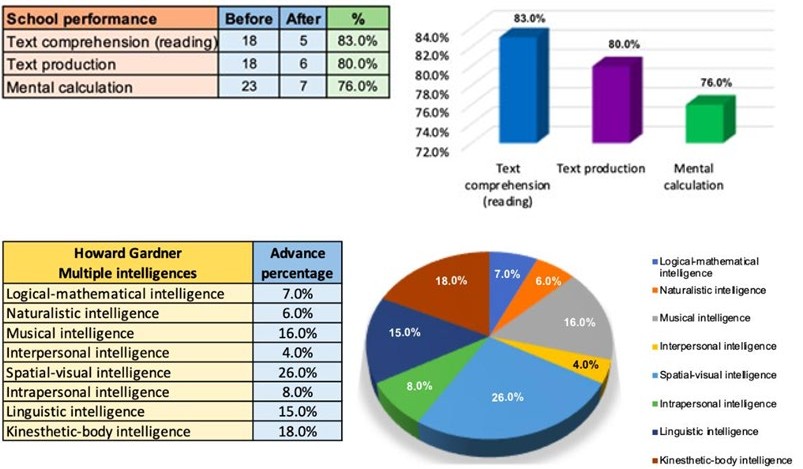
Chart 1: Findings of academic performance in students.
Chart 2: Findings of multiple intelligences.
Discussion
Discussion of the Importance of Research
The study of mental strategies of self-knowledge addressed through the method of the Extra Ocular Vision, is based on the fact that children and teenagers can read without using material eyes, having the blindfolded, as well as develop high capacities of the senses hearing, touch, taste and smell; increase mental capacity, improve their school performance, increase their ability to remember and imagine, synchronize their memories and thoughts with their words, writing and deeds, detect micro movements in people’s attitudes and they are more aware improving their behavior with them. These strategies in the Mexican education system are important; according to Gallegos [5], working with a new paradigm means leaving behind dogmatic, scientific and relativistic thinking, to give way to a vision of integrity and transdisciplinarity.
Discussion of the Methodology
For the evaluation of Mental Strategy of Self-knowledge (EMA in Spanish) with the Extra Ocular Vision method through multiple intelligences, the Likert scale was used with five response options: totally agree, agree, neither agree or disagree, disagreeing, totally disagreeing; a discrete scale was applied to measure the Early Warning System (SisAT in Spanish), which was subsequently used to cluster on an ordinal scale. In this scale, the studens process that corresponds to the program of the Ministry of Public Education was measured which considers three aspects to evaluate: Comprehension of texts (1), Production of Texts (2) and Mental Calculus (3), with their respective response options.
Discussion of Results
In this study, the good school performance of students who were behind in school shows that it is the cause of mental strategies of self-knowledge, a statement that coincides with literature. The explanation or evidence can be found in the different intellectual manifestations in the behavior and grades of the students. If you want to know attitudes outside of class or school, it is necessary to carry out another study.
In conclusion, it can be argued that the Mental Strategies of Self-knowledge based in a scientific way, improve the school performance of students with educational backwardness in relation to the levels of achievement in mental calculus, language and communication.
References
-
OCDE (1991) School and quality of teaching. Ministry of Education and Science. Barcelona: Paidós / Madrid.
-
Lamas H (2015) About school performance. Purposes and Representations 3(1): 313-386.
-
Soriano S, Soriano M (1998) Synergistic psych pedagogy, Mexico.
-
Vázquez G (2008) Philosophy of education. Madrid, Ed. Trotta.
-
Gallegos R (2018) Holistic education and the pedagogy of Ramón Gallegos. Mexico: Ramón Gallegos Foundation.
- Occupational Stress and Mental Health Outcomes Among Police Officers: A Mini Review
- The Experience of Counterproductive Leadership on Mental Health and Impact on Retention in U.S. Marines: A Phenomenological Study
- Nomophobia in the Digital Age: A Study on College and University Students
- Emotional Regulation in Children with Autism and Learning Disabilities
- Antisemitism on American College Campuses and Its Impact on Jewish Students
- Exploring the Role of Empathy in the Associations of Family Functioning and Purpose in Life with Attitude towards Abortion among Undergraduates: A Moderation Analysis