
The Relationship between Types of Passion, Mindfulness and Hedonic well-being for Tennis Athletes
Passion has recently gained considerable attention in various fields of study. Passion is defined as “a strong inclination toward an activity that people love and in which they invest time and energyâ€. The present study investigates the relationship between passion and hedonic well-being as well as the mediating effect of mindfulness. One hundred and one professional tennis players (19.82 years, SD =1.94) completed a scale of passion for sport, positive and negative affects, life satisfaction and mindfulness. Results indicated that harmonious and obsessive passions were associated, respectively, positively and negatively with composite hedonic well-being. Moreover, Bootstrapping results indicated that mindfulness was proved to mediate the relationship between both types of passion and indices of well-being (positive affect, negative affect, and life satisfaction). The findings inform future research to promote the mindfulness-based intervention to improve many outcomes.
Introduction
The existing research literature on sports psychology and sports performance, passion has received a great deal of scholarly attention as an issue of major concern. A special focus has been given to its role, its origin, its effects as well as its links with certain psychological aspects. Obviously, scientific conceptualizations and theories of passion are always divergent, sometimes even contradictory.
In general, passion always evokes an impulse towards a favorite activity to which an individual would be attached in a particular way. Vallerand et al. [1] defined passion as<<a strong inclination toward an activity that people love and in which they invest time and energy>>. Passion has gained a growing interest in various areas, such as work [2, 3], exercise [4], and burnout [5]. According to the Dualist Model of Passion [6], passion encompasses two dimensions which are defined differently, leading to various emotional outcomes for engaging in the individuals chosen activity.
Harmonious and Obsessive Passion
The Dualist Model of Passion [7] describes two dimensions of passion. The autonomous and free internalization of activity leads to harmonious passion. Athletes can be deemed harmoniously passionate when they engage in an activity of their own volition [7]. Besides, harmonious passion refers to a motivational force and flexible engagement in a given activity [8]. Conversely, obsessive passion is characterized by a controlled internalization of the activity and is experienced as an invincible desire to engage in one’s favorite activity [7].
An athlete would identify with obsessive passion when s/he engages in sport due to interpersonal pressures and inner contingencies [9, 10]. The emotional experience specific to each type of passion is different. For example, harmonious passion is related to subjective well-being and flow during the engagement in the activity of poker. On the contrary, Obsessive passion leads to guilt [11, 12] and emotional exhaustion. However, more recent studies found a positive association between harmonious passion, life satisfaction, sense of psychological growth, and mastery. In contrast, holding an obsessive passion contributes to anxiety [13]. Currently, there is a series of studies connecting behavioral outcomes and passion. Harmonious passion was found to enhance psychological well-being [14], subjective vitality [15], sexual gratification [16], subjective happiness [17], and exercise addiction [18]. By contrast, obsessive passion is related to a motivation [19], dance addiction [20], and burnout [21].
Research on well-being in sport has found that many traits and characteristics of well-being have been linked with passion. A recent study conducted by Bum (2019) has found that harmonious passion for sports increased positive emotions [22, 23], whereas a high level of obsessive passion can lead to negative emotions. Similarly, Salama-Younes [15] found that obsessive passion is associated with growing life satisfaction and vitality (2018). The intrinsic motivation model is a field of research auspicious to the study of passion as a motivational impetus. Consequently, researchers have found a positive correlation between harmonious passion and intrinsic motivation [24].
Research on the passion for exercise has been relatively large. A study by Soós, Vega, Ruíz-Barquín, and Szabo indicated that obsessively passionate athletes in the individual sport are addicted to exercise compared to their counterparts in a team sport. Similarly, Bureau et al. [16] examined college students spent on exercise. They found that athletes with harmonious passion had spent more time on the activity than athletes with obsessive passion In terms of performance; others have revealed that passionate high school basketball players (harmonious and obsessive) have a higher level of objective performance [25].
The Mediating Role of Mindfulness
Mindfulness is defined as the ability to be alert and aware of the sensory, cognitive, and emotional experiences of everyday life in the present moment without judgment [26]. Research on mindfulness has demonstrated that it has many beneficial effects on positive affect, work engagement [27], mood [28], life satisfaction [29], and psychological well- being. Mindfulness promotes prevention against negative psychological reactions such as anxiety [30, 31] and life stress [32]. A more in-depth analysis has been carried out on the relationship between the two conceptions: passion and mindfulness. Recent studies have shown that obsessive passion for video gaming is significantly and negatively related to mindfulness. Harmonious passion, on the other hand, has no relationship with video gaming [33].
Unlike traditional approaches, which suggest that negative thoughts and emotions need to be controlled, eliminated, or replaced, mindfulness and acceptance interventions aim to develop the ability to consciously pay attention to internal or external experiences of the present moment without making value judgments. For example, the MBSR approach has been deployed for specific issues such as stress, pain [34], and adjustment to illness [35]. Also, the positive effect of the intervention of mindfulness protects from eating disorder [36], emotion dysregulation, and stress.
Several previous studies have focused a great deal of attention on the importance of mindfulness in the field of sport [37]. In the pursuit of sporting success, practicing mindfulness exercises (the MAC protocol: Mindfulness- Acceptance-Commitment) was developed to reduce anxiety [38], increase anaerobic performance and deal with behavioral disorders [39, 40].
To summarize, harmonious passion and obsessive passion refer respectively to two different modes of internalization. With harmonious passion, activity is valued and based on autonomous behavioral regulation and therefore takes place in identity. In contrast, with obsessive passion, the individual engages in their activity under constraints. Researchers proved that passions have an influence on well-being. More specifically, holding a harmonious passion for exercise enhances soccer players’ positive emotions and reduces their negative emotions [24]. By contrast, obsessive passion is positively related to negative emotions [22]. Given that little research has examined the relationship that maintains passion with well-being for tennis players, the present research sought to investigate the role of harmonious passion and obsessive passion as a determinant of hedonic well-being in the context of this specific sport.
Passion also has important emotional consequences well documented in the existing literature. Previous studies show variability depending on the type of passion. Indeed, individuals with harmonious passion experience a greater number of positive affects, unlike obsessively passionate individuals [3, 13]. The emotions stimulated by passion appeared to have an influence on other processes such as mindfulness. More specifically, contrary to obsessive passion, harmonious passion is linked positively with mindfulness, which in turn enhances positive affect [40, 41]. Despite the abundant research, that has examined the link between passion and internal responses, such as intrinsic motivation [42], only scant research has examined the interaction of the two types of passion with subjective well-being and mindfulness as a mediating variable. In order, to verify these postulates, this study looked at the role of mindfulness between passion and tennis player’s well-being.
The present study
The present study aims to (1) investigate the link between passion and hedonic well-being; and (2) analyze the role of mindfulness as a mediator in the relationship between passion indicators of hedonic well-being. It was hypothesized that harmonious positively correlated to subjective well-being contrary to obsessive passion. In addition, it was expected that mindfulness would be a mediator between both two types of passion and indicators of hedonic well-being.
Methods
Participants
The sample of this study consisted of 101professional tennis players, 52(51.5%) were males, living in France. The participants indicated that they typically practice their activity 5.53(SD = 1.66) hours per week. The mean age of participants was 19.82 years (SD =1.94). The career length in the specified sport ranged from 9 years to 20 years (M = 12, SD = 1.86).Specifically, 68.3% performed at national and international levels and the remaining 31.7% were working towards achieving such status.
Measures
The Passion Scale: The Passion Scale [6] assesses perceptions relating to the two passion types: harmonious and obsession passion. Harmonious passion was measured using a 6-item subscale. The participants were asked to rate on a 7-point Likert scale to indicate to what extent, for example,(“My activity is in harmony with the other activities in my life”).A harmonious passion score was calculated. Six items to evaluate the obsessive passion (e.g. “have difficulties controlling my urge to do my activity”). An obsessive passion score was calculated by summing the responses.
The Positive and Negative Affect Schedule: To assess positive and negative effect, The Positive and Negative Affect Schedule was used(Nicolas et al., 2014).This multi- dimensional inventory consists of 20 items that assess positive affect (e.g. “happy”, “proud”,“ interested”) and negative affect (e.g. “angry”, “irritable”). Athletes responded according to the degree to which each statement applied to them, using a Likert scale ranging from 1(very slightly or not at all) to 5 (extremely).All items were averaged to calculate an overall life satisfaction score for each athlete.
The Satisfaction with life scale: The Satisfaction with life scale [43] was used to evaluate participants’ life satisfaction. It is a short 5-item instrument (e.g. ‘‘I am satisfied with my life’’). Athletes were asked to rate their level of agreement to each item. To this end, a 7-point Likert-type scale was used (1=strongly disagree to 7=strongly agree). All items were averaged to produce an overall life satisfaction score for each athlete.
Hedonic composite well-being: To assess hedonic well-being, the average scores of positive affects and life satisfaction were added together, followed by a subtraction of the scores of negative affects from the obtained sum [44, 45].
**Mindfulness:** In order to assess mindfulness, the _Mindfulness_ _Attention Awareness Scale_ [46] was used. This scale contains 15 items that assess the dispositional mindfulness and the capacity to be conscious in the present (e.g. ). Participant answered on a 6-point scale ranging from and . Each respondent has an overall mindfulness score based on the sum of their responses.Procedure
The researcher explained to the coach the purpose of the study in order to obtain permission to distribute the survey package to athletes. Participants completed the questionnaires independently. Once the questionnaires had been collected, the coach returned them to the primary researcher on the same day or later. Participants answered to questionnaires measuring: demographic information, harmonious passion, obsessive passion, life satisfaction, positive affect, negative affect, and mindfulness.
Data Analyses
Descriptive statistics, including the mean and standard deviation, were calculated for each variable. A simple Pearson correlation was calculated between harmonious/ obsessive passion scores and composite score of well-being to determine the link between both types of passion and hedonic well-being. Second, In order to assess mediation of mindfulness, two separate models were estimated. The bootstrapping strategy with the SPSS macros by Jermann F, et al. [47] was used to analyze indirect effect of passion on well- being through mindfulness, with 10,000 samples to derive a 95% confidence interval. Indirect effects are considered significant when the 95% confidence intervals exclude zero.
Results
Preliminary Analysis
Questionnaire data was imported into SPSS 23.The preliminary data screening for missing values and outliers revealed that no missing values were found for most variables among the items [48]. Assumptions of multivariate analysis has been verified through skewness and kurtosis values. Means and standard deviations are presented in Table 1. Reliability analysis (Cronbach’s α) revealed that the scales used to measure each of the variables were internally consistent (Table 1) [49, 50]. The one exception was the reduced sense of life satisfaction (α=0.53).
| Mean | SD | α | ||
|---|---|---|---|---|
| 1 | Harmonious passion | 20,48 | 9,56 | 0,96 |
| 2 | Obsessive passion | 17,82 | 5,17 | 0,90 |
| 3 | Positive Affect | 30,47 | 6,99 | 0,88 |
| 4 | Negative Affect | 21,89 | 6,7 | 0,79 |
| 5 | Life satisfaction | 16,49 | 5,47 | 0,53 |
| 6 | Mindfulness | 33.99 | 6.22 | 0,77 |
| 7 | Well-being | 25.08 | 1.48 |
Table 2: Descriptive statistics (_n_ = 101)
Hypothesis 1
First, a correlation matrix was generated to examine the relationships among all three constructs, which included harmonious passion, obsessive passion; as well as total scores of well-being (Table 2). Results indicated that harmonious passion was positively correlated with composite score of well-being (r = .607, p < 0.01). Whereas obsessive passion was negatively correlated with composite score of well-being (r = -.326, p < 0.01). According to the recommendations by Hayes [51], unrelated variables should not be included within the multiple regression analysis. Multiple regression analyses were conducted and results supported the above- mentioned hypotheses that harmonious passion (β = .389, P < 0.01) and obsessive passion (β =.-113, P < 0.01) are, respectively, associated positively and negatively with composite well-being.
| Harmonious Passion | Obsessive Passion | |||
|---|---|---|---|---|
| 1 | Positive affect | .366** | -.205* | |
| 2 | Negative affect | -.456** | .279** | |
| 3 | Life satisfaction | .633** | -.288** | |
| 4 | Mindfulness | .355** | -.305** | |
| 5 | Well being | .607** | -.326** |
Table 1: Summary of bootstrap analysis showing the indirect effects of mindfulness on the well-being through passion (n = 101).
p < .001 *p< .005 Table 2**: Correlation coefficients of Harmonious Passion, Obsessive Passion and Positive Affect, Negative Affect, Life Satisfaction and Mindfulness variables, (n = 101).
Hypothesis 2
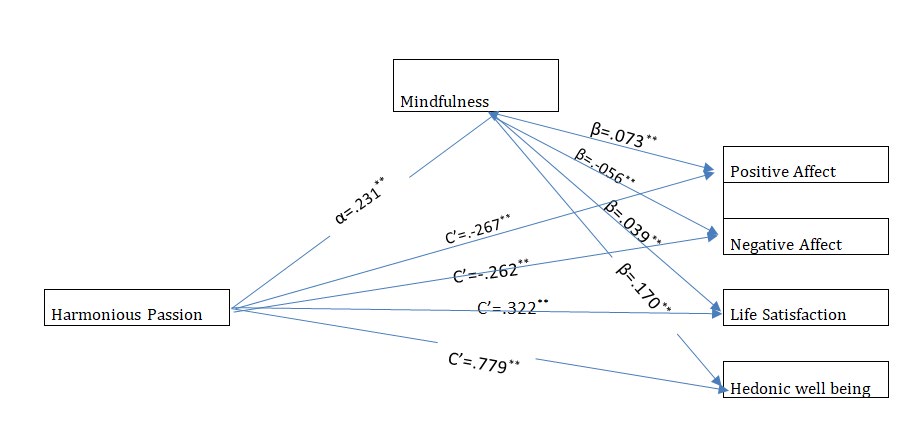
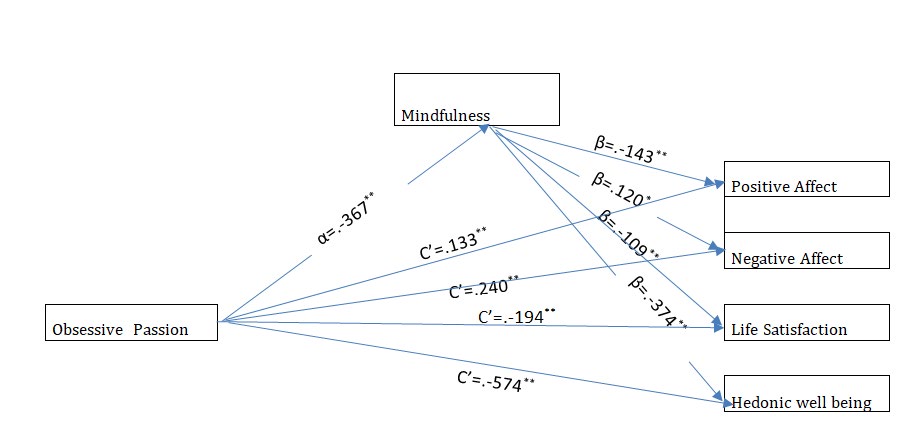
To determine whether the mediating affects of mindfulness on athletes’ well-being were statistically significant, the PROCESS macro for SPSS was used. Two models were tested to determine whether the mediating affects of mindfulness on three dimensions of well-being were statistically significant. Each model included two independent variables (harmonious and obsessive passion), a single mediator variable (Mindfulness) and 4 dependent variables (indices of well-being). All models displayed adequate fit with the data. The path coefficients are presented in Figures 1 and 2. Using a nonparametric bootstrapping method [47] with 10000 samples [51] to derive a 95% confidence interval. Indirect effects are considered significant when the 95% confidence intervals exclude zero (Table 3). Indirect effects of both type of passion on positive affect, negative affect, life satisfaction and composite well-being met this criterion.
- Indirect Effect Harmonious passion-Mindfulnesswell being
- Indirect Effect obsessive passion-
- Mindfulness-well being
- (95% CI)
- (95% CI)
- Positive affect
- .073**(0,19 to ,19)
- .-143**(,-284 to .-041)
- Negative affect
- .-056**(,13 to 006)
- ,120**(.-226 to .-028) life satisfaction
- .039**(008 to 082)
- .-109**(.008 to .082) well - being
- .170**(053 to 338)
- .-374**(.-741 to.-111)
Table 3: Summary of bootstrap analysis showing the indirect effects of mindfulness on the well-being through passion (n = 101).
Discussion
The present research aimed to explore the link between both types of passions and tennis players’ subjective well- being. Hedonic well-being has been studied according to two components: an affective component that constitutes positive and negative affects, and a cognitive component that includes life satisfaction.
Consistent with our expectations, a positive relationship was found to be shared between harmonious passion and athletes’ well-being, and this relationship was reversed for obsessive passion. This is in agreement with results reported in previous studies that found that harmonious passion was associated with emotional consequences such as increased levels of well-being. In contrast, obsessive passion was negatively correlated with well-being among a sample of 172 soccer players [24].
Research that evaluated the relationship between harmonious /obsessive passions and well-being revealed that the interactions were significant; the more important the scores for harmonious passion are, the more important scores for well-being are [5]. In addition, these findings updates previous studies devoted to the link between passion and well-being inside and outside of sport [53, 54]. Similarly, Stenseng, et al., pointed out that harmonious passion for leisure sports engenders subjective well-being [55, 56], while obsessive passion was negatively associated with subjective well-being. Regarding the consequences of passion, many differences appear between the two forms. Harmonious passion has positive affective consequences, whereas with obsessive passion they turn out to be negative [55, 57].
This study, therefore, adds to the literature by successfully generalizing the link between passion and well- being. Indeed, such findings are consistent with research conducted with competitive basketball players and focusing on the affective experiences such as positive, negative affect as well as vitality associated with passion. Findings from this investigation contribute a greater understanding of the processes by revealing that the more activity is lived with a harmonious passion, the more it arouses positive affective experiences within the realm of sport, whereas the obsessive passion presents the opposite profile [58].
The present study also particularly offers specific predictions about the association between both types of passion and emotion. For this purpose, the type of passion developed will have a significant impact on sports participants’ emotions. For example, the passion for sport, if it is harmonious, is associated with positive emotion. On the contrary, in its obsessive mode, it is linked to increasing negative emotion [22].
In addition, although the above mentioned studies reveal that obsessive passion has a negative correlation with the psychological outcomes, it can also engender a great deal of pleasure and excitement during the practice time [59]. Also, obsessively passionate individuals have been reported to spend more time in vigorous activity than harmoniously passionate individuals [16].
Hence, our findings further corroborates the contention that mindfulness, such as passion, has the potential to be an explaining factor for well-being. Despite growing empirical evidence examining the potential benefits of mindfulness in affect and one’s experience of well-being [40, 60], there are few studies that have investigated the mediating role of mindfulness in well-being through passion. The present research goes further to focus on the mediating role of mindfulness in positive affect, negative affect, life satisfaction and hedonic well-being through passion. The results revealed that both types of passion (harmonious and obsessive passion) were directly and indirectly associated with well- being through mindfulness. As a result, it is evident that mindfulness was associated with profile passion. Specifically, Mills found a positive correlation between harmonious passion and mindfulness [32].
Mindfulness plays a significant role in mediating between various outcomes and passion. Likewise, the more the individual was harmoniously passionate, the more s/ he allowed access to mindfulness and well-being, whereas obsessive passion limits one’s mindful capacity and positive emotion [61].
Concerning obsessive passion, the results of the current study revealed a negative relationship with well-being. However, follow-up bootstrap-based data revealed both directly and indirectly established relationship between obsessive passion and well-being through mindfulness. This is in agreement with previous research demonstrating the association between obsessive passion and positive and negative affects through mindfulness [61].
Research suggests that Athletes’ mindfulness capability could be associated with a wide range of outcomes. Consequently, several studies have evaluated the efficacy of the intervention of mindfulness to boost the sense of well- being [62]. In congruence with our expectations, the present results suggest the competence-promoting processes in mindfulness-based intervention, to the extent that it can foster well-being. For example, a 2018 study by Shortway, et al. used a sample of 108 student athletes who received an instructional home-directed mindfulness program comprising daily meditation sessions. Their results showed that mindfulness intervention enhanced athletes’ well-being [62]. In the research literature, there are new emergent ways to cultivate well-being in athletes. In the same vein, Baltzell and Akhtar conducted a research with collegiate athletes from multiple sports who participated in MMT Straining [63]. This intervention proved the improvements in constructs related to well-being [64, 65, 66, 67, 68].
Limitations and additional future research
Notwithstanding this research inevitably generates valuable implications for the tennis players, some limitations need to be considered. First, the sample was comparatively limited in terms of size and case study. Our sample was limited to one hundred French tennis players leaving uncertain the extent to which the findings generalize to other athlete groups, such as athletes of different ages, who practice other activities, and athletes from different cultural backgrounds. Second, the value of Cronbach’s alpha of shorter scales (life satisfaction scale)is not accurate enough to give the exact interpretation of the coefficient. Third, the particular measure of mindfulness adopted in this study allows determining the level of consciousness and attention to the present moment [69, 70].
Further future research is needed to better understand the characteristics of training aimed at changing type of engagement in the activity. Thus, our results underscore the link between the concept of passion and mindfulness in understanding well-being in sport. In terms of practice, it would be very relevant to add interventions to improve mindfulness, and therefore psychological well-being in order to obtain a complete model for predicting athletic performance. Given the relationship between passion, mindfulness and, subjective well-being, future research can be carried out mainly to expand our understanding of scales measuring different facets of mindfulness. For example, the Five Facet Mindfulness Questionnaire is one of the scales measurement on the five aspects (or facets) of mindfulness to be employed in this respect [72].
Conclusion
The results of this study expand our understanding of the likely antecedents and psychological processes that contribute to well-being. Based on the Dualist Model of Passion, a harmonious passion promotes free engagement resulting from an intrinsic choice without contingencies. With an obsessive passion, a certain inner compulsion pushes the individual to engage in the activity. The emotional experience specific to each type is also different: harmonious passion is positively linked to hedonic well-being during engagement in the activity. On the other hand, obsessive passion is negatively associated with hedonic well-being.
References
-
Vallerand RJ, Blanchard C, Mageau GA, Koestner R, Ratelle C, et al. (2003a) Les passions de l’âme: On obsessive and harmonious passion. J Pers Soc Psychol 85(4): 756-767.
-
Forest J, Mageau GA, Sarrazin C, Morin EM (2011) ‘’Work is my passion’’: The different affective, behavioural, and cognitive consequences of harmonious and obsessive passion toward work. Canadian Journal of Administrative Sciences 28(1): 27-40.
-
Yukhymenko-Lescroart MA, Sharma G (2019) The Relationship between Faculty Members’ Passion for Work and Well-Being. Journal of Happiness Studies 20(3): 863-881.
-
Lichtenstein MB, Jensen ES, Szabo A (2020) Exercise addiction, obsessive passion and the use of nutritional supplements in fitness center attendees. Translational Sports Medicine 2: 131.
-
Vallerand RJ, Mageau GA, Elliot AJ, Dumais A, Demers MA, et al. (2008) Passion and performance attainment in sport. Psychology of Sport and Exercise 9(3): 373-392.
-
Vallerand RJ, Blanchard C, Mageau GA, Koestner R, Ratelle C, et al. (2003b) Les passions de l’âme: On obsessive and harmonious passion. Journal of Personality and Social Psychology 85(4): 756-767.
-
Vallerand RJ (2015) The Psychology of Passion: A Dualistic Model. Oxford University Press.
-
Vallerand RJ, Blanchard C, Mageau GA, Koestner R, Ratelle C, et al. (2003c) Les passions de l’âme: On obsessive and harmonious passion. Journal of Personality and Social Psychology 85(4) : 756-767.
-
Mageau G, Vallerand R (2007) The moderating effect of passion on the relation between activity engagement and positive affect. Motivation and Emotion 31: 312–321.
-
Mageau GA, Vallerand RJ, Charest J, Salvy SJ, Lacaille N, et al. (2009) On the Development of Harmonious and Obsessive Passion: The Role of Autonomy Support, Activity Specialization, and Identification With the Activity. Journal of Personality 77(3): 601-646.
-
Lee CK, Chung N, Bernhard BJ (2014) Examining the structural relationships among gambling motivation, passion, and consequences of internet sports betting. Journal of Gambling Studies 30(4): 845-858.
-
Oikonomidis A, Palomäki J, Laakasuo M (2019) Experience and Passion in Poker: Are There Well-Being Implications?. Journal of Gambling Studies 35(2): 731- 742.
-
Bonneville-Roussy A, Vallerand RJ (2020) Passion at the heart of musicians’ well-being. Psychology of Music 48(2): 266-282.
-
Vallerand RJ (2012) The role of passion in sustainable psychological well-being. Psychology of Well-Being. Theory, Research and Practice 2(1): 1.
-
Salama-Younes M (2018) Passion types and subjective well-being for French older adult runners. Journal of Leisure Research 49(3-5): 177-195.
-
Bureau AT, Blom LC, Bolin J, Nagelkirk P (2019) Passion for Exercise: Passion’s Relationship to General Fitness Indicators and Exercise Addiction. Int J Exerc Sci 12(5): 122-135.
-
Moe A (2016a) Harmonious passion and its relationship with teacher well-being. Teaching and Teacher Education 59: 431-437.
-
Moe A (2016b) Harmonious passion and its relationship with teacher well-being. Teaching and Teacher Education 59: 431-437.
-
Young BW, De Jong GC, Medic N (2015) Examining relationships between passion types, conflict and negative outcomes in masters athletes. International Journal of Sport and Exercise Psychology 13(2): 132- 149.
-
Akehurst S, Oliver EJ (2014) Obsessive passion: A dependency associated with injury-related risky behaviour in dancers. Journal of Sports Sciences 32(3): 259-267.
-
Curran T, Appleton PR, Hill AP, Hall HK (2013) The mediating role of psychological need satisfaction in relationships between types of passion for sport and athlete burnout. Journal of Sports Sciences, pp: 597-606.
-
Curran T, Hill A, Jowett G, Mallinson-Howard S (2014) The relationship between multidimensional perfectionism and passion in junior athletes. International Journal of Sport Psychology 45: 369-384.
-
Bum CH (2019) Structural relationships among exercise passion, emotion, and adherence behaviors of sports participants. Social Behavior and Personality: An International Journal 47(2): 1-11.
-
Amemiya R, Sakairi Y (2019b) The effects of passion and mindfulness on the intrinsic motivation of Japanese athletes. Personality and Individual Differences 142: 132-138.
-
Verner-Filion J, Vallerand RJ, Amiot CE, Mocanu I (2017) The two roads from passion to sport performance and psychological well-being: The mediating role of need satisfaction, deliberate practice, and achievement goals. Psychology of Sport and Exercise 30: 19-29.
-
Kabat‐Zinn J (2003) Mindfulness‐Based Interventions in Context: Past, Present, and Future. Clinical Psychology: Science and Practice 10(2): 144-156.
-
Malinowski P, Lim HJ (2015) Mindfulness at Work: Positive Affect, Hope, and Optimism Mediate the Relationship Between Dispositional Mindfulness, Work Engagement, and Well-Being. Mindfulness 6(6): 1250- 1262.
-
Swickert R, Bailey E, Hittner J, Spector A, Benson- Townsend B, et al. (2019). The Mediational Roles of Gratitude and Perceived Support in Explaining the Relationship between Mindfulness and Mood. Journal of Happiness Studies 20(3): 815-828.
-
Kong F, Wang X, Zhao J (2014) Dispositional mindfulness and life satisfaction: The role of core self-evaluations. Personality and Individual Differences 56: 165-169.
-
Le Pera N (2011) Relationships between boredom proneness, mindfulness, anxiety, depression, and substance use. American Psychological Association 8(2).
-
Ruffault A, Bernier M, Thiénot E, Fournier JF, Flahault C (2017) Exploring the links between mindfulness skills, physical activity, signs of anxiety, and signs of depression among non-clinical participants. Journal de Thérapie Comportementale et Cognitive 27(1) : 16-24.
-
Kaiseler M, Poolton JM, Backhouse SH, Stanger N (2017) The Relationship between Mindfulness and Life Stress in Student-Athletes: The Mediating Role of Coping Effectiveness and Decision Rumination. The Sport Psychologist 31(3): 288-298.
-
Mills DJ (2019) Does dispositional mindfulness moderate how individuals engage in their passions? An investigation into video games. Leisure Studies 38(5): 651-665.
-
Mohammed WA, Pappous A, Sharma D (2018) Effect of Mindfulness Based Stress Reduction (MBSR) in Increasing Pain Tolerance and Improving the Mental Health of Injured Athletes. Frontiers in Psychology 9.
-
Keyvan, S, Khezri Moghadam N, Rajab A (2018) The Effectiveness Of Mindfulness Based Stress Reduction (Mbsr) On Psychosocial Adjustment To Illness In Patient With Type 2 Diabetes. Iranian Journal of Diabetes and Metabolism 17(2): 105-116.
-
Keng SL, Ang Q (2019) Effects of Mindfulness on Negative Affect, Body Dissatisfaction, and Disordered Eating Urges. Mindfulness 10(9): 1779-1791.
-
Querstret D (2020) Mindfulness-Based Stress Reduction and Mindfulness-Based Cognitive Therapy for psychological health and wellbeing in non-clinical samples: A systematic review and meta-analysis. International Journal of Stress Management.
-
Terzioğlu ZA, Yıldız M, Çakır SG (2020) Examining the effectiveness of mindfulness based training program on female handball players’ psychological skills and coping with stress strategies. Turkish Journal of Sport and Exercise 22(1): 30-37.
-
Josefsson T, Ivarsson A, Gustafsson H, Stenling A, Lindwall M, et al. (2019) Effects of Mindfulness-Acceptance- Commitment (MAC) on Sport-Specific Dispositional Mindfulness, Emotion Regulation, and Self-Rated Athletic Performance in a Multiple-Sport Population. Mindfulness 10(8): 1518-1529.
-
Gross M, Moore ZE, Gardner FL, Wolanin AT, Pess R, et al. (2018) An empirical examination comparing the Mindfulness-Acceptance-Commitment approach and Psychological Skills Training for the mental health and sport performance of female student athletes. International Journal of Sport and Exercise Psychology 16(4): 431-451.
-
St-Louis AC, Verner-Filion J, Bergeron CM, Vallerand RJ (2018a) Passion and mindfulness: Accessing adaptive self-processes. The Journal of Positive Psychology 13(2): 155-164.
-
St-Louis AC, Verner-Filion J, Bergeron CM, Vallerand RJ (2018b) Passion and mindfulness: Accessing adaptive self-processes. The Journal of Positive Psychology 13(2): 155-164.
-
Amemiya R, Sakairi Y (2019a) The effects of passion and mindfulness on the intrinsic motivation of Japanese athletes. Personality and Individual Differences 142: 132-138.
-
Diener E, Emmons RA, Larsen RJ, Griffin S (1985) The Satisfaction With Life Scale. Journal of Personality Assessment, 49(1): 71-75.
-
Chang JH, Huang CL, Lin YC (2015) Mindfulness, Basic Psychological Needs Fulfillment, and Well-Being. Journal of Happiness Studies 16(5): 1149-1162.
-
Diener E, Suh EM, Lucas RE, Smith HL (1999) Subjective well-being: Three decades of progress. Psychological Bulletin, 125(2) : 276-302.
-
Jermann F, Billieux J, Larøi F, d’Argembeau A, Bondolfi G, et al. (2009) Mindful Attention Awareness Scale (MAAS): Psychometric properties of the French translation and exploration of its relations with emotion regulation strategies. Psychological Assessment 21(4): 506-514.
-
Preacher KJ, Hayes AF (2004) SPSS and SAS procedures for estimating indirect affects in simple mediation models. Behavior Research Methods, Instruments, & Computers 36(4): 717-731.
-
Meyers LS, Gamst G, Guarino AJ (2013) Applied Multivariate Research: Design and Interpretation. SAGE.
-
Tabachnick BG, Fidell LS, Ullman JB (2007) Using multivariate statistics (Vol. 5). Pearson Boston, MA.
-
Tabachnick BG, Fidell LS, Ullman JB (2019) Using multivariate statistics (Seventh edition). Pearson.
-
Hayes AF (2009) Beyond Baron and Kenny: Statistical Mediation Analysis in the New Millennium. Communication Monographs 76(4): 408-420.
-
Shrout PE, Bolger N (2002) Mediation in experimental and non-experimental studies: New procedures and recommendations. Psychological Methods 7(4): 422- 445.
-
Curran T, Hill AP, Appleton PR, Vallerand RJ, Standage M (2015) The psychology of passion: A meta-analytical review of a decade of research on intrapersonal outcomes. Motivation and Emotion 39(5): 631-655.
-
Schellenberg BJI, Verner‐Filion J, Gaudreau P, Bailis DS, Lafrenière MK, et al. (2019) Testing the dualistic model of passion using a novel quadripartite approach: A look at physical and psychological well‐being. Journal of Personality, 87(2): 163-180.
-
Schellenberg BJI, Verner‐Filion J, Gaudreau P, Bailis DS., Lafrenière MK, et al. (2019) Testing the dualistic model of passion using a novel quadripartite approach: A look at physical and psychological well‐being. Journal of Personality 87(2): 163-180.
-
Stenseng F, Forest J, Curran T (2015) Positive Emotions in Recreational Sport Activities: The Role of Passion and Belongingness. Journal of Happiness Studies 16(5): 1117-1129.
-
Carpentier J, Mageau GA, Vallerand RJ (2012) Ruminations and Flow: Why Do People with a More Harmonious Passion Experience Higher Well-Being? Journal of Happiness Studies 13(3): 501-518.
-
Vallerand RJ, Rousseau FL, Grouzet FME, Dumais A, Grenier S, et al. (2006) Passion in Sport: A Look at Determinants and Affective Experiences. Journal of Sport and Exercise Psychology 28(4): 454-478.
-
Lafrenière MAK, Vallerand RJ, Donahue EG, Lavigne GL (2009) On The Costs and Benefits of Gaming: The Role of Passion. Cyber Psychology & Behavior 12(3): 285-290.
-
Baer RA, Lykins ELB, Peters JR (2012) Mindfulness and self-compassion as predictors of psychological wellbeing in long-term meditators and matched nonmeditators. The Journal of Positive Psychology 7(3): 230-238.
-
St-Louis AC, Verner-Filion J, Bergeron CM, Vallerand RJ (2018c) Passion and mindfulness: Accessing adaptive self-processes. The Journal of Positive Psychology 13(2): 155-164.
-
Shortway KM, Wolanin A, Block-Lerner J, Marks D (2018) Acceptance and Commitment Therapy for Injured Athletes: Development and Preliminary Feasibility of the Return to ACTion Protocol. Journal of Clinical Sport Psychology 12(1): 4-26.
-
Baltzell A, Akhtar VL (2014) Mindfulness meditation training for sport (MMTS) intervention: Impact of MMTS with division I female athletes. The Journal of Happiness & Well-Being 2(2): 160-173.
-
Ando M, Natsume T, Kukihara H, Shibata H, Ito S (2011) Efficacy of mindfulness-based meditation therapy on the sense of coherence and mental health of nurses. Health 3(2): 118-122.
-
Antonio Crego, José Ramón Yela, María Ángeles Gómez- Martínez, Ahmed A. Karim (2019) The Contribution of Meaningfulness and Mindfulness to Psychological Well- Being and Mental Health: A Structural Equation Model | Springer Link. Journal of Happiness Studies.
-
Gustafsson H, Skoog T, Davis P, Kenttä G, Haberl P (2015) Mindfulness and Its Relationship with Perceived Stress, Affect, and Burnout in Elite Junior Athletes. Journal of Clinical Sport Psychology 9(3): 263-281.
-
Jislin-Goldberg T, Tanay G, Bernstein A (2012) Mindfulness and positive affect: Cross-sectional, prospective intervention, and real-time relations. The Journal of Positive Psychology, 7(5): 349-361.
-
Marsh H, Vallerand R, Lafrenière MA, Parker P, Morin A, et al. (2013) Passion: Does One Scale Fit All? Construct Validity of Two-Factor Passion Scale and Psychometric Invariance Over Different Activities and Languages. Psychological Assessment 25(3): 796-809.
-
Michel Nicolas, Guillaume Martinent, & Mickaël Campo. (2014) Evaluation of the Psychometric Properties of a Modified Positive and Negative Affect Schedule Including a Direction Scale (PANAS-D) among French Athletes | Michel Nicolas-Academia.edu. Psychology of Sport and Exercise.
-
Seguin‐Levesque C, Lalibertea MLN, Pelletier LG, Blanchard C, Vallerand RJ (2003) Harmonious and Obsessive Passion for the Internet: Their Associations With the Couple’s Relationship1. Journal of Applied Social Psychology 33(1): 197-221.
-
Vallerand RJ (2016) On the Synergy between Hedonia and Eudaimonia: The Role of Passion. In: Vittersø J (Ed.), Handbook of Eudaimonic Well-Being, Springer International Publishing, pp: 191-204.
- Occupational Stress and Mental Health Outcomes Among Police Officers: A Mini Review
- The Experience of Counterproductive Leadership on Mental Health and Impact on Retention in U.S. Marines: A Phenomenological Study
- Nomophobia in the Digital Age: A Study on College and University Students
- Emotional Regulation in Children with Autism and Learning Disabilities
- Antisemitism on American College Campuses and Its Impact on Jewish Students
- Exploring the Role of Empathy in the Associations of Family Functioning and Purpose in Life with Attitude towards Abortion among Undergraduates: A Moderation Analysis