
Workforce in the United States: How Do Women Lead? A Brief Overview
The workforce in the United States is made up of almost an equal percentage of males and females, but women continue to lag significantly behind men in terms of leadership positions both in corporations and politics. Studies show women tend to favor transformational leadership style as well as democratic style and contingent reward behavior leadership style. Two of the traits that seem to harm the effectiveness of women leaders are their unwillingness to self-promote and hesitation when faced with negotiations. This article explores the literature surrounding the leadership styles of men and women and seeks to determine why one gender is considered more effective than the other, resulting in leadership positions being filled by mostly males.
Women in Leadership
In the United States, women make up approximately 47 percent of the workforce and earn more bachelors and masters degrees than their male counterparts [1]. As part of the workforce, women have made significant advances in leadership positions. Warner, et al. [2] stated, “In 1980, there were no women in the top executive ranks of Fortune 100 companies; by 2011, 11 percent of those corporate leaders were women”. These advances also have been seen in the political world with women in Congress increasing from 47 in 1992 to 104 in 2014 [2].
While significant progress has been made in a relatively short period of time, women are still significantly behind men in terms of leadership positions. Warner, et al. [2] estimated women in top leadership positions, in a broad range of fields, vary between 5 and 20 percent. Only 5 percent of Fortune 500 CEOs are women and “only 7 percent of the top executives in Fortune 100 companies” are women [2]. Also important to note is women of color make up “38.3 percent of the female civilian labor force,” yet there are only “two women of color CEOs in the Fortune 500” [2]. Women of color also are absent from more than 66 percent of Fortune 500 companies boards of directors as of 2013 and make up “only 4.7 percent of executive or senior level officials and managers in S&P 500 companies” [2].
This conjures the question of why we see this low number of women in leadership positions when they are just as accomplished as men in many other ways. Do men and women have different leadership styles and is one gender more effective as a leader than the other? This paper will review literature on the topic to explore potential leadership style differences, as well as the effectiveness of female leadership
Gender and Leadership Studies
Hoyt (2013/2016) explained “writers in the mainstream press are asserting there are indeed gender differences in leadership” while academic researchers have a wider variety of views, with many arguing there are little to no differences. Northouse [1] noted it was not until the 1970s when research began related to gender and leadership. At that time, the question in gender and leadership studies was whether women could lead. It was not until women were in leadership positions research became related to how women lead and the effectiveness of their leadership.
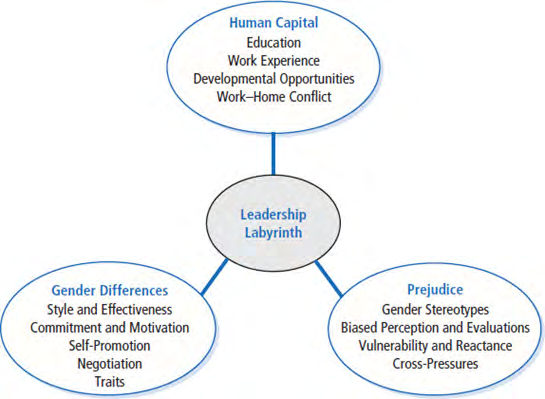
As shown in Figure 1, Northouse [1] theorized the reason for the gender gap in leadership is due to three explanations which include 1) human capital differences, 2) gender differences in leadership styles and effectiveness, and 3) prejudice. Human capital differences include women having larger responsibility loads at home, including raising children and domestic duties, causing them to have less work experience and continuity at their jobs [1]. Northouse [1] also noted women who choose to use flextime and workplace leave often are marginalized and taking time off can make reentry into their careers difficult. Prejudice against women in the workplace usually is in the way of gender; stereotypes; while men are stereotyped as confident, assertive, and independent and women as sensitive, warm, and helpful [1]. While the human capital differences and prejudices are important to note regarding women, their leadership style and effectiveness will be explored more in-depth by this review.
Women’s Leadership Styles
Examining if men and women’s leadership styles differ has been studied frequently in modern research to assist with determining why women are underrepresented in top leadership positions. One of the findings from this research has shown women tend to utilize a transformational style of leadership [1, 3]. Transformational leadership can be defined as “an inspirational method of leading others that involves elevating one’s followers’ motivation, confidence, and satisfaction by uniting them in the pursuit of shared, challenging goals, and changing their beliefs, values, and needs” [4]. Powell [5] theorized women utilize transformational leadership because it is associated with more feminine traits, such as nurturance and agreeableness, and less associated with more masculine traits, such as aggression. It is worthwhile to mention Northouse [1] noted even as transformational leaders, women are still valued less than men [3] elaborated “recent findings suggest that the devaluation of female leaders by male subordinates has been shown to extend to female transformational leaders”.
Democratic, or participative leadership style, also has been associated with women in leadership positions [1, 3]. This style of leadership is one that allows followers to make their own decisions and encourages equal rights [4]. Powell [5] further developed this theory by explaining the democratic style of leadership utilized by women reflects women’s abilities to involve others in the decision-making process. Studies of democratic leadership have found groups within this type of leadership are “friendly and more group- oriented” when compared to autocratic and laissez-faire leadership style utilized by men [4].
In transactional leadership, contingent rewards are provided to followers based on behavior the leader sees as positive, such as superior performance or other achievements [4]. Women are more likely to utilize contingent reward behavior of transactional leadership when compared to men [1, 5]. However, transactional leadership usually is seen as a more masculine style of leadership and Powell [5] explained women, being “higher than men in the contingent reward dimension of transactional leadership,” provided support for the provision; there are no differences in leadership styles among the genders.
Effectiveness of Women Leaders
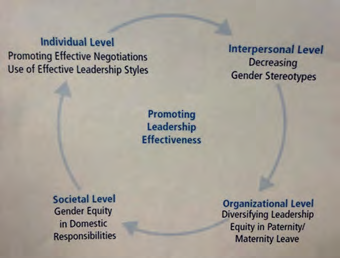
When looking at leadership styles, gender, and effectiveness, “the dimensions of transformational leadership and the contingent reward dimension of transactional leadership are positively associated with leader effectiveness based on individual, team, and organizational performance” [5]. This contrast with passive management by exception and laissez-faire leadership which are negatively associated with leader effectiveness and both are seen more in male leadership behavior [5]. The good news is many organizations are beginning to make fundamental changes allowing women to be more effective as leaders [3]. As shown in Figure 2, decreasing gender stereotypes, gender equity in domestic responsibilities and diversifying leadership are just a few of the factors successfully promoting female effectiveness in leadership [3].
Even with changes being made to increase the effectiveness of women leaders there are still disadvantages faced when considering their effectiveness as leaders. Hoyt [3] explained one of the disadvantages for women are they are less likely to negotiate when compared to men. This is further clarified by Hoyt [3] stating, “The negotiations need to ascend the leadership hierarchy, yet often are unstructured, ambiguous, and rife with gender triggers-exactly the type of situation that particularly disadvantages women”. Another disadvantage faced by women is they are less likely to self- promote for leadership positions [3]. The reasoning for this is women who self-promote may be seen as “less socially attractive and less hirable”.
These patterns in effectiveness are not always seen across all disciplines. For example, in military positions, research has found women are less effective than men as leaders, while women were more effective than men in the fields of education, government, and social service organizations [3]. Women also were found to be less effective leaders “when they supervised a higher proportion of male subordinates” but more effective than men when placed in middle management positions [3]. Hoyt [3] summarized the research on women’s effectiveness as leaders stating research does support “small differences in leadership style and effectiveness between men and women”.
Answering the Question of How Women Lead
Do female leaders differ from their male counterparts? After reviewing the literature, the answer is not simple. Research suggests only slight differences exist, and for the most part, these difference are not enough to justify the gender gap seen in top leadership positions. The effectiveness of men and women as leaders also will vary because “while men and women are equally effective in some settings, more often effectiveness depends on the fit between the setting and management gender” [7]. The American Psychological Association [7] also cautioned against specifying one type of leadership style for either gender since, “some men will have more feminine management styles while some women will have more masculine management styles”. Eagly, et al. [8] summarized the answer to differing leadership styles best by stating, “the behavior of female leaders, compared with that of male leaders may be more interpersonally oriented, democratic, and transformational.
Using Lessons Learned
According to Northouse [1] “Women face a double standard in the leadership role; they must come across as extremely competent but also as appropriately “feminine,” a set of standards to which men are not held”. The senior author of this article experienced this double standard frequently working in the field of occupational safety, which is basically dominated by men. For example, if a women were wearing no makeup, it meant she was trying too hard to be masculine, while wearing too much makeup made her look incompetent at her job. She always tries to find a happy medium where she dresses just enough and has just enough makeup on to have a “feminine” quality, yet not be intimidating when going into meetings with primarily men.
Awareness
It is important to be aware of the challenges a women faces in the role of a leader. It is important to have knowledge about the background of women in leadership positions, as they become models for other women. Knowledge is power; therefore, it is important to know the challenges and advantages faced by women and how to overcome them. One significant challenge pointed out by research is women tend not to promote themselves as well as men. This must be remediated!
Bottom Line
Essentially, there are minimum differences in leadership effectiveness between women and men. What is important is that women have the opportunity to utilize their great capability as leaders.
References
-
Northouse PG (2016) Leadership: Theory and practice 8th (edn), Thousand Oaks, CA: Sage Publishing.
-
Warner J, Ellmann N, Boesch D (2018) The women’s leadership gap. Center for American Progress.
-
Hoyt CL (2016) Women and leadership. In: G.R. Hickman (Ed.) Leading organizations: Perspectives for a new era. Thousand Oaks: CA: Sage Publishing, pp: 352-367.
-
Forsyth DR (2014) Group dynamics 6th (Edn), Belmont, CA: Wadsworth Cengage Learning.
-
Powell GN (2011) The gender and leadership wars. Organizational Dynamics 40(1): 1-9.
-
Hickman GR (Ed.) (2016) Leading organizations: Perspectives for a new era 3rd (edn), Thousand Oaks, CA: Sage Publishing.
-
American Psychological Association (2006) When the boss is a woman.
-
Eagly A, Johannesen-Schmidt M (2001) The leadership styles of women and men. Journal of Social Issues 57(4): 781-797.
- Occupational Stress and Mental Health Outcomes Among Police Officers: A Mini Review
- The Experience of Counterproductive Leadership on Mental Health and Impact on Retention in U.S. Marines: A Phenomenological Study
- Nomophobia in the Digital Age: A Study on College and University Students
- Emotional Regulation in Children with Autism and Learning Disabilities
- Antisemitism on American College Campuses and Its Impact on Jewish Students
- Exploring the Role of Empathy in the Associations of Family Functioning and Purpose in Life with Attitude towards Abortion among Undergraduates: A Moderation Analysis