
The Psycho-Economic Model of Love Dynamics
The psycho-economic model of love dynamics comes from the economic point of view of metapsychology. This model postulates that each individual is endowed with a quasi-stable libidinal energy, in motion in his or her love relationships. Its main phases are: investment, self-disinvestment; overinvestment; loss of drive object; divestment; the disinvestment of the instinctual object; self-investment and reinvestment. It has several implications in individual, marital and family affective life. This model is mainly used here in the context of romantic disappointments, in particular prevention and restoration.
Introduction
The psycho-economic model of love dynamics (PEMLD) that we propose is theoretically anchored in metapsychology. Under the term metapsychology that Freud [1] constructed with the beginnings of psychoanalysis is designated “the psychology that goes beyond (meta) the conscious”. Metapsychology is sometimes considered the second name of psychoanalysis [2]. It is its cryptic name in a way, but can be taken as its proper name. It refers to psychoanalysis in its speculative (essentially theoretical) part. The ‘esoteric’ resonance of the word, evoking opacity, indicates that there is something here to be deciphered about the secret identity of psychoanalysis as ‘science of the unconscious’.
This Freudian theory of psychic functioning is the result of the author’s experience of psychoanalytic practice over more than thirty years. According to Freud [3], metapsychology is to the observation of psychological facts what metaphysics is to the observation of physical facts. It is an expression of the passage from descriptive clinic to theoretical conception. Freud [3] considers it as the study of mental functioning based on three dimensions: topical, dynamic and economic. It is specifically on the third dimension that we have based ourselves to conceive the psycho-economic model of love dynamics. Before presenting this model in depth, it seems necessary to us to recall the three points of view of the metapsychological theory.
Brief Reminder of the Points of View of the Metapsychological Theory
It is through metapsychology that Freud proposes a mode of observation according to which each psychic process is explored through three points of view. These are the topical point of view, the dynamic point of view and the economic point of view.
The Topical Point of View
The topical point of view introduces the idea that the psychic apparatus (mode of organization and functioning of the human psyche) is composed of different psychic ‘places’, ‘territories’ that obey processual laws. Processes here are fundamental mechanisms that operate in the psyche of the individual.
The topical studies the different ‘places’ of the psychic apparatus and their relationships (topical comes from the Greek, topos, place). The word ‘topical’ refers to a geographical description of the psychic apparatus. Freud developed two topics:
- the first topic (1900) assumes three psychic systems: the Unconscious, the Preconscious and the Conscious;
- the second topic postulates three instances: the id, the ego and the superego [4]. These two models do not exclude each other but complement each other. Indeed, the reference to the Unconscious has always been central in Freud’s work, even after the elaboration of the Second Topical [5, 6, 7, 8].
The Dynamic Point of View
The dynamic point of view allows us to study the way in which the forces that run through the psychic apparatus conflict, combine and articulate themselves. The psychic conflict is manifested by the organization of symptoms as an expression of opposing internal demands, such as desires, representations or antagonistic drive forces [9].
The psychic apparatus is the seat of conflicting forces, which oppose desires and defenses [10, 11]. The conflicts are dynamic and unconscious and the conflicting forces are of drive origin. Freud bases this conflict on the opposition:
- Two drives: self-preservation drives and sexual drives, then life drives and death drives;
- Instances of the psychic apparatus: between the id and the superego in neuroses and between the ego and external reality in psychoses.
The Economic Point of View
The economic point of view qualifies a psychic process that consists in the circulation and distribution of a quantifiable energy of a pulsional nature (also called pulsional energy), susceptible to increase and decrease as well as to equivalences. Psychic representations are invested with quantities of energy, of a pulsional nature, and the psychic apparatus has the tendency to prevent a stasis of these energies and to keep the total sum of the excitations with which it is charged as low as possible. For Freud, the “quantitative factor” has always been a determining factor in the individual psychic organisation [12, 13, 14, 15].
The economic point of view postulates a circulation of energy within the psychic apparatus and describes the play of psychic investments. The economic corresponds to the flow and strength of investments and disinvestments of the self or of others (the object). Metapsychology thus endeavours here to study how this energy circulates, how it is invested, and how it is distributed between the various objects. Psychic energy is considered here under a quantitative angle. We will speak of drive energy or libidinal energy or even “quantum of affect” [16].
We remain here in the first conception of the drive where Freud distinguished the drives of self-preservation which feed the narcissistic investments and the sexual drives which feed the objectal investments [17, 18, 19].
The love state, for example, illustrates the patterns of overestimation of the loved object and devaluation of the subject himself. It also highlights the quantitative aspect of psychic energy and the interplay of investments and disinvestments of the self and of this pulsional object. It is precisely within this framework that we propose a specific model of the dynamics of love from this economic point of view.
Fundamental Concepts of the Psycho- Economic Model of Love Dynamics
The psycho-economic model of love dynamics draws its fundamental concepts from the metapsychological source. These are mainly:
- The love drive: the force that drives the individual to perform a love action in order to resolve a love tension.
- The libidinal energy: This is the energy linked to love. It is what puts love into action. It is a vital psychological energy, attached to sexuality in the broad sense, i.e. pleasure.
- Available libidinal energy (EDi): the amount of libidinal energy that the individual acquires in his or her various relationships and that is available to be invested.
- Source libidinal energy (EDs): The libidinal energy that comes mainly from parents or parental substitutes.
- Complementary Libidinal Energy (Ec): Libidinal energy from other relationships other than parents or surrogates.
- The drive object: The person, situation or thing to which the available libidinal energy is directed.
Basic Postulate of the Psycho-Economic Model of Love Dynamics
The economic point of view of the metapsychological theory postulates a circulation and a distribution of a quantifiable energy of a pulsional order within the psychic apparatus. This psychic energy is considered under a quantitative angle. We speak of drive energy or libidinal energy or even of “quantum of affect”. This is where the postulate of PEMLD comes from, which states that “each individual is endowed with a quasi-stable libidinal energy, in movement in his or her love relationship(s)”.
Main Phases of the Psycho-Economic Model of Love Dynamics
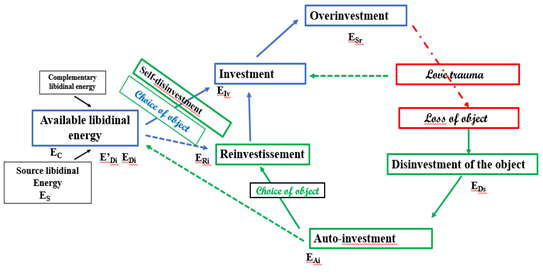
The main phases of the psycho-economic model of love dynamics are investment, disinvestment of the self, overinvestment, loss of the drive object, disinvestment, disinvestment of the drive object, self-investment and reinvestment. These phases are not necessarily chronological in the course of the love dynamic.
Investment and Disinvestment of the Self
We fall in love by making a choice of drive object. We become attached to this object by offering it a certain amount of libidinal energy (Invested Energy: IEv). This process is called investment. It takes place simultaneously with the disinvestment of the self where we transfer the libidinal energy available in us to the drive object.
Overinvestment
The attachment with the drive object can increase, the link becomes stronger because we invest more and more libidinal energy (overinvested energy: ESr), it is the overinvestment.
The Loss of the Drive Object
However, it can happen that there is a punctual crisis or a break resulting from a love trauma (crisis in the relationship). This can also lead to a definitive break, a consummated disappointment in love, i.e. the loss of the drive object.
Trauma in love without a break can be resolved between the partners or be taken care of by a psychological care professional to return to the investment process.
Disinvestment of the Drive Object
The loss of the object is followed by a process of mourning for love. The most important process in this work is the disinvestment of the drive object. It consists in withdrawing the invested Energy (IEv) or the over-invested Energy (ESr) from the lost drive object. This phase can be done alone, with the help of social support, but if the situation seems to become complicated, it will require the psychological support of a professional.
Self-Investment
The individual in withdrawing energy (Disinvested Energy: DEs) must first put it back into himself, this is self- investment. It is a stage during which one resources oneself, recharges oneself, renews oneself to acquire the self-invested Energy (EAi).
Reinvestment
After the lull (self-investment phase), the individual can make his new choice of object, where he will invest again, it is the reinvestment. One can also reinvest on the old impulsive object in which one had disinvested. It is done from the new available energy (EDi = E’Di + EAi) (Figure 1).
Implications of the Psycho-Economic Model of Love Dynamics
The psycho-economic model of love dynamics has several implications for individual, marital and family emotional life.
The Importance of Parental Affection and Relatives
It is important that parents give a lot of love (libidinal source energy) to their child so that the child can have something to offer emotionally to its future partner. Entering a relationship with emotional deficiencies is a predisposition to love crises. If possible, it is also necessary to meet people outside the family (friends, colleagues, etc.) who can also offer you a certain amount of love (complementary libidinal energy). The latter is essential to supply the libidinal energy available for the love relationship.
Object Choice: A Delicate Process
The choice of the drive object is the concrete beginning of the process of the love dynamic. It is a crucial phase. It induces questions such as: does this object deserve to be invested or over-invested with drive energy? Is this new object worth reinvesting drive energy into? The choice of the beloved object would therefore be a fairly decisive process, to the point where certain professionals in the conjugal field are sometimes called upon.
The Advantages and Risks of Over-Investment
The transition from investment to overinvestment is important for the strengthening, reinforcement and consolidation of bonds in the love relationship. Some of the dedication necessary for the survival of the relationship cannot take place without this second phase. However, it is important to note that over-investment is necessary depending on the purpose of the relationship. Overinvestment is recommended for a romantic relationship that has marriage as its goal, as it fosters a stronger love attachment for a solid marital foundation. Overinvestment is less appropriate for relationships that are intended to be short-lived from the start. When the moment of separation arrives as agreed, the partner who has overinvested may be in trouble, as he or she is unable to disinvest quickly.
It is also important to note that it is not the overinvestment that leads to the break-up. The latter is only an unexpected variable in the love project. However, overinvestment can be presented as the overestimation of the loved object and the devaluation of the self. If it is literally interpreted as such by the drive object and the drive object underestimates the overinvesting partner, this can lead to esteem crises in the relationship.
The Crucial Role of the Disinvestment of the Drive Object
After a break-up, if the disinvestment is not done, or is not done effectively, the individual may face complicated love mourning or pathological love mourning. Complicated love bereavement is characterized by a disruption of the mourning process which does not get underway or does not reach its conclusion. The bereaved person may relive the old relationship in a phantasmatic way, in the real or imaginary world, consciously or unconsciously, with or without being in a new relationship. It will be difficult for them to appreciate the love offered by the new partner. Pathological love bereavement is characterized by the occurrence of psychiatric disorders during the bereavement period. Depression is very common. However, some love breakdowns can lead to psychotic decompensation.
It is not recommended to directly engage in a new relationship (reinvest) after a romantic break-up. There is a risk that we have little to offer the new partner emotionally. It is likely that a certain amount of libidinal energy (invested or over-invested) is still in the other relationship. We will have a lot to ask of the other person, as we are quite empty and need to be filled. This situation can lead to great frustration on both sides.
It is almost impossible to completely withdraw the libidinal energy invested or over-invested in a relationship. To this end, experiencing several disappointments in love implies that we empty ourselves by leaving quantums in each broken relationship. The amount of energy available for the future relationship would then be very low. We will be almost empty, almost nothing to offer. In turn, the more we experience disappointments in love, the more likely it is that other disappointments will occur. We become “polytraumatized in love”. At this point, we necessarily need psychological care. Moreover, it is appropriate to have psychological support before, during and after any love project.
In our clinical practice, we have noticed that when the work of mourning in love does not go well, there is:
- The degradation of the meaning of love
- The generalization of the author of the “disappointment” (all men/all women are the same)
- The fear of relaunching
- Denial of love
- Denial or rejection of love
- Partial commitment
- Vengeful behaviour
- Continued celibacy
The Necessary Regeneration through Self- Investment
Self-investment allows the person after a disappointment in love to recharge his libidinal energy. This leads them to regain self-esteem, self-confidence and self-assertion. If self- investment does not take place or is not effectively done, there will be a negative impact on our perceived or projected value. We will be without self-esteem, consequently low self- esteem. We will reflect this in our attitudes and behaviour. Potential partners will notice it. There is a risk that we will not be attractive or that we will become “easy prey”. There is a great risk that the new partner will abuse us.
Questioning the Commitment to Multiple Relationships
Another implication of the psycho-economic model of love dynamics is that it questions an individual’s effective commitment to multiple love relationships. Indeed, according to the PEMLD postulate, each individual is endowed with a quasi-stable libidinal energy, which is in motion in his or her love relationship(s). Can a person invest the same amount of impulse energy in each of his or her love relationships? In practice this seems difficult. However, if it happens that there is a demand for an equitable sharing of love quantum by each of the loved objects, what is the play of investments and disinvestments of the self and of the instinctual objects? What are the patterns of overestimation of loved objects and devaluation of the subject involved in several love relationships?
Conclusion
Freud understood that the functioning of the psychic apparatus is linked to a circulating energy. There are several types of psychic energy, with different qualities. The energy that governs the psychic phenomena of sexual life (in the broad sense) is called libido. It is called libidinal energy. It is what interests us in the psycho-economic model of love dynamics. It is this energy that is linked to an object, which in this case is the person (real or imaginary) towards whom love is directed: the beloved (my lover). This energy, by linking itself to the object of love (drive), generates the object relation that we transpose here under the term love relation. The object relationship is largely phantasmatic (imaginary), i.e. made up of representations that modify the apprehension of reality and the love bond. The love bond is strongly influenced by the libidinal energy that is fixed, withdrawn or passed from one object to another. The nature, quality, evolution and prognosis of a love relationship are dependent on the movements of libidinal energy. This is what the economic model of love dynamics postulates. With regard to disappointments in love, it therefore proposes an effective regulation of love energy for a better prevention and an efficient restoration.
References
-
Freud S, Breuer J (1895) Études sur l’hystérie. Paris, PUF.
-
Freud S (1915) Métapsychologie. Paris, Gallimard.
-
Freud S (1925) Ma vie et la psychanalyse. Ma vie et la psychanalyse, paris, Gallimard, 169: 9-91.
-
Freud S (1920) Au-delà du principe de plaisir. Paris, Payot.
-
Audet S (2006) La rupture amoureuse: vision contemporaine d’un processus de deuil et de réorganisation. Intervention 1(125): 138-148.
-
Caradec V (2003) Le «Soi intime» à la lumière de la recomposition conjugale tardive. Sociologie et sociétés 35(2): 97-120.
-
Cohen-Émérique M (1993) L’approche interculturelle dans le processus d’aide. Santé mentale au Québec 18(1): 71-91.
-
Duvigaud J (1990) La genèse des passions dans la vie sociale. Paris, PUF.
-
Freud S (1938) Abrégé de psychanalyse. Paris, PUF.
-
Freud S (1923) Petit abrégé de psychanalyse. Paris, PUF.
-
Freud (1968) Pulsions et destins des pulsions, Métapsychologie. Paris, Gallimard, pp: 11-43.
-
Genest Dufault S (2007) Rupture amoureuse chez les jeunes hommes: masculinités et deuil. Intervention 1(127): 127-135.
-
Kaufmann JC (2010) Que sais-je?. Sociologie du couple. Paris, PUF.
-
Klosko JS, Young JE (1995) Je réinvente ma vie. Paris, Éditions de l’homme, pp: 360.
-
Legault G (2000) L’intervention interculturelle. Montréal, Gaëtan Morin éditeur, pp: 364.
-
Lemieux D (2003) La formation du couple racontée en duo. Sociologie et sociétés 35(2): 59-77.
-
Morin P (2010) L’approche par les capacités. SES, Université de Sherbrooke.
-
Nantel YC, Gascon E (2002) Les difficultés masculines et l’intervention sociale. Une question de liens. Intervention 116: 103-111.
-
Vinois P, Mongasson L (2005) Rubrique-Peut-on Prévenir les ruptures du couple?. Informations sociales 2(122): 112-113.
- Occupational Stress and Mental Health Outcomes Among Police Officers: A Mini Review
- The Experience of Counterproductive Leadership on Mental Health and Impact on Retention in U.S. Marines: A Phenomenological Study
- Nomophobia in the Digital Age: A Study on College and University Students
- Emotional Regulation in Children with Autism and Learning Disabilities
- Antisemitism on American College Campuses and Its Impact on Jewish Students
- Exploring the Role of Empathy in the Associations of Family Functioning and Purpose in Life with Attitude towards Abortion among Undergraduates: A Moderation Analysis