
The Contribution of Relational Support to Parental Self-Efficacy in Fathers and Mothers
Research has shown that parental self-efficacy—the degree of confidence in one’s effectiveness as a parent—is an important predictor of behavioral competence in parenting for both fathers and mothers. One factor found to contribute to parental selfefficacy is the level of support and validation that a parent receives from important others in his or her life. In this study, we sought to better understand how mothers and fathers might differentially derive on-going relational support for parenting from various sources of social support and how that support might differently influence mothers’ and fathers’ parental selfefficacy. We hypothesized that relational support offered by partners, friends, and family would predict greater parental self-efficacy for both fathers and mothers. Given that mothers tend to receive more general social validation as parents than fathers, however, we expected that partner support would be a more influential predictor of parental self-efficacy for fathers than for mothers. Findings indicated that relational support equally predicted parental self-efficacy for mothers and fathers and that although both mothers and fathers reported receiving support from their partners, families, and friends, only partner support was related to greater parental self-efficacy for both, and at similar levels.
Introduction
Over the last two decades, interest in the degree to which fathers engage in interaction with their children has increased, as has social pressure for fathers to be more involved. Fathers are increasingly expected to engage in child-care tasks and the nurturing of children at levels more equal to that of mothers. Yet mothers have traditionally received more social validation for parenting than do fathers. As children, girls receive more socialization for parenting than do boys [1], and as mothers they are often allotted more job flexibility and institutional support [2] and spend more time interacting with and caring for their children than do fathers [3, 4]. Compared to mothers, fathers appear to receive less support and validation for their investment in the parental role, a difference that may be an important factor in understanding and promoting their greater involvement.
One important predictor of the degree to which fathers adopt a central, engaged paternal role is maternal attitudes toward fathers’ involvement [1]. Research on maternal gatekeeping shows that when mothers discourage or attempt to control fathers’ participation or their involvement with their children, fathers are more likely to withdraw [5]. Research has also shown that women who embrace a traditional gender ideology that views mothers as natural and indispensable nurturers and fathers as supporters are more likely to engage in maternal gatekeeping, conscribing fathers’ involvement [6]. However, when mothers embrace a more egalitarian view of parenting roles, encourage fathers’ participation, and are supportive of fathers’ involvement with their children, fathers are likely to engage more with their children [7].
While parenting support from a father’s partner may be particularly important for his engagement in parenting, it is unclear whether support from one’s partner influences either mothers’ or fathers’ belief in their ability to parent competently. As part of a larger study in which we sought to understand how parents negotiate parenting roles and how their attitudes and behaviors influence fathers’ involvement, we began to wonder if a partner’s support has similar levels of influence on mothers’ and fathers’ sense of parental self-efficacy. In particular, we wanted to know whether the parental self-efficacy of fathers is more likely to be influenced by partner support than is the self-efficacy of mothers. A better understanding of the process of co-parenting and factors associated with fathers’ involvement could help increase fathers’ engagement with and positive influence on their children’s development.
In addition to questions regarding the influence of partner support on parental self-efficacy, we also wondered about the ways in which mothers and fathers may draw upon their other close relationships to support and validate their sense of competence as parents. How might the types of relationships that mothers and fathers rely on differ, and how might the impact of those relationships differently influence mothers’ and fathers’ parental self-efficacy? We wanted to know specifically whether fathers require more support for parenting from their partner than mothers, and if this also extends to family and friends.
Parental self-efficacy, a parent’s perception of their ability to adequately and competently complete parenting tasks, has been found to be an important factor in effective parenting and the motivation to engage and persist in the challenges of parenting and co-parenting [8, 9, 10, 11]. Among fathers, greater parental self-efficacy has been associated with higher levels of father-child involvement [12]. Research has indicated that high parental self-efficacy scores are associated with positive outcomes for both parents and their children. For example, parental self-efficacy has been shown to affect the types and quality of parenting practices provided by mothers and fathers, which in turn affects the development of secure parent-child attachments [13, 14]. In a meta-analysis conducted by Jones, et al. [9], parental self- efficacy was found to influence parental adjustment and well-being and behavioral problems in both young children [15, 16] and adolescents [17, 18]. Research has also shown that parental self-efficacy has important implications for parenting interactions. Under conditions in which mothers were high or fathers were low in parental self-efficacy, mothers were more likely to engage in gatekeeping behaviors and undermine fathers’ participation in parenting [5].
Research has further demonstrated that parental self- efficacy is fostered not only by positive experiences as a parent but also by validation and support offered by others [16]. Studies have indicated that mothers and fathers look to each other for affirmation of their parenting skills and competence [19, 20, 21] and that spousal support has important implications for family dynamics [10, 22]. Yet those effects have appeared to differ somewhat for mothers and fathers. For example, researchers have found that although partner reports of marital satisfaction were negatively associated with parental self-efficacy, this effect was significant only for the parental self-efficacy of fathers, not of mothers. Research also suggests that outside sources of support influence mothers and fathers in different ways. In a study of the association between attitudes toward expressing emotion, perceived social support, and mother’s and father’s postnatal adjustment, Castle, et al. [19] reported that positive attitudes toward the expression of emotion were positively related to perceived social support for mothers but negatively related to perceived social support for fathers.
The importance of social support in the development of parental self-efficacy has been studied more among mothers than among fathers, and most often in first-time mothers, for whom social support has been found to predict maternal parental self-efficacy and to moderate the relationships between stress and postpartum depression [23]. L e a h y - Warren, et al. [23] for a review of the literature; also see [24, 25]. House [26] demonstrated that mothers benefit from both formal sources of support, such as nurses, midwives, or doctors, and informal sources, including partners, parents, siblings, friends, and neighbors. But even studies that assess different sources of support often conflate these into a total support score rather than analyzing the unique contributions of various sources of support to parental self-efficacy [25]. In a notable exception, an examination of support from the partners and parents of first-time mothers in Australia, greater support from a mother’s parents was related to higher levels of maternal self-efficacy, whereas support from her partner was not [27].
While social support has generally appeared to be linked to maternal self-efficacy, the mixed findings regarding various sources of support led us to seek to better understand differences in the importance of various support relationships and in the influence of these types of support on both mothers’ and fathers’ parental self-efficacy. We were also interested in learning about the impact of relational support for mothers and fathers beyond the postpartum transition to parenthood. Accordingly, we recruited parents with varying degrees of parenting experience and examined three different sources of support—from one’s partner, family, and friends—to investigate whether and to what degree these support relationships were associated with mothers’ and fathers’ self-efficacy.
Based on previous research findings, we proposed the following three hypotheses:
- Higher levels of relational support will predict greater parental self-efficacy for both mothers and fathers.
- Support from one’s partner, family, and friends will have a greater influence on the parental self-efficacy of fathers than it will on that of mothers.
- Support from one’s partner will have a greater influence on the parental self-efficacy of fathers and mothers than will the support of family and friends.
Method
As part of a larger study, we recruited a sample of 97 parents (57 mothers and 40 fathers) via social media to complete an online self-report survey and offered a small monetary incentive for their time. To be eligible to participate in the study, parents were required to be married or cohabitating and to have children under the age of seven. Respondents were mostly white (76.5%) or Hispanic (8.2%), with moderate incomes; only 15% earned less than $35,000 annually, while 44% earned $35,000 - $70,000 and 40% earned more than $70,000. Most respondents, 89%, had attended some college, and the majority, 58%, had obtained a college degree. The length of the parents’ relationship with their partner ranged from 1 to 25 years (M= 9.85 years; SD = 4.89). Most families had either one or two children, 31% and 51%, respectively, while 18% had three or more children. The age of the children in the families ranged from 0 to 21 and averaged 4.94 (SD = 3.73).
To assess the degree to which mothers and fathers utilized various sources of support and their level of parental self-efficacy, participants were asked to complete an online survey. The survey included the Multidimensional Scale of Perceived Social Support [28] and the Parenting Sense of Competence Scale [29]. The MSPSS is a 12-item self-report inventory that divides social support into three categorical subscales: support from significant other, support from family, and support from friends. Higher scores for each subscale indicate that a parent reported relying more highly on that subsystem for support. Each subscale contains statements such as “I can share my joys and sorrows with my significant other.” Responses were measured using a 7-point Likert scale ranging from 1 (very strongly disagree) to 7 (very strongly agree). In previous research [30], Cronbach’s alpha of .91 was reported for the total scale, indicating a high degree of internal reliability. For this sample, the internal reliability was assessed for each of the three types of support and found to be strong for each subscale: Cronbach’s alpha = .89 for the partner support items, .90 for the family support items, and .88 for the friend support items.
The Parenting Sense of Competence Scale [29] was utilized to measure parental self-efficacy. The PSOC contains 17 items assessing the respondents’ perception of their parental competence and includes items such as “Being a parent is manageable, and any problems are easily solved.” Responses were measured on a 6-point scale ranging from 1 (strongly disagree_)_ to 6 (strongly agree). Following previous research [31], negatively worded items were reverse-scored and added to the other items to calculate a total scale score, with higher scores indicating a higher sense of paternal competence (Cronbach’s alpha = .85).
Results
Descriptive statistics for all variables are presented in Table 1. To examine differences between mothers and fathers in the level of support they reported receiving from each of the three sources and to examine differences in their levels of parental self-efficacy, we first conducted a multivariate analysis of variance. As shown in Table 1, results indicated that parental self-efficacy did not differ significantly between mothers and fathers. Furthermore, neither the total level of support nor the support received from partner, family, and friends differed significantly between mothers and fathers.
Sources of Support
| Parental Self-Efficacy | Partner | Family | |
|---|---|---|---|
| Mothers | 4.17 (0.67) | 5.80 (1.03) | 5.15 (1.25) |
| Fathers | 4.28 (0.70) | 6.02 (1.18) | 5.33 (1.35) |
| F | 0.6 | 0.96 | 1.42 |
| p | 0.44 | 0.33 | 0.52 |
Next, to test our primary hypothesis that higher levels of relational support are related to higher levels of parental self-efficacy, we employed a regression model using the full sample (n = 96) in which the parental self-efficacy was predicted by support from partner, support from family, and support from friends. The model was statistically significant, F(3, 93) = 7.59, p < 0.001, and explained 17% of the variance in parental self-efficacy. However, support from spouse or significant other was found to be the only significant predictor of parental self-efficacy (β = 0.49).
Following this, we conducted separate regression analyses for mothers and fathers to examine possible differences in how mothers and fathers derive parental self-efficacy from sources of support. The model predicting parental self-efficacy was significant for both mothers, F(3, 53) = 3.76, p = 0.016, and fathers, F(3, 36)= 3.82, p = 0.018. While approximately 13% of the variability in mothers’ parental self-efficacy was explained by relational support, 18% of that variability in fathers was explained by relational support, although this difference was not statistically significant (Z = 0.35, p > .05). Results also indicated that for mothers, higher levels of support from their partner were significantly predictive of higher parental self-efficacy, whereas support from family and friends was not (Figure 1). The results for fathers showed that higher support from the partner was also associated with higher parental self-efficacy, whereas support from family and friends was not. Comparisons of the beta coefficients in the models for mothers and fathers indicated non-significant differences between mothers and fathers in the contributions of partner (Z = 0.62), family (Z = -0.02) and friend support (Z = -1.77).
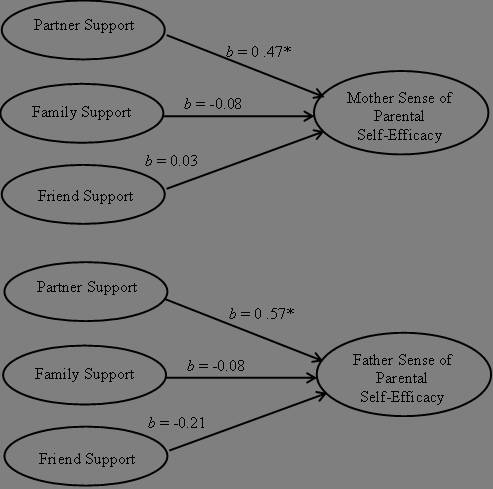
Note: * p < 0.05. Figure 1: The relations between various sources of social support and mothers’ and fathers’ parental self-efficacy.
Discussion
The results from this study suggest that relational support is important to both mothers and fathers and that support from a spouse or significant other has important implications for both mothers’ and fathers’ parental self- efficacy. Our findings thus align with research evidencing a link between relational support and parental self-efficacy and expands on this work by investigating both fathers and mothers, including parents with various levels of parenting experience, and by investigating the contribution of various sources of support.
Contrary to our hypotheses, mothers and fathers reported receiving similar levels of support from partners, family, and friends, and the support they received did not differentially affect mothers’ and fathers’ parental self- efficacy. As indicated, only partner support was predictive of parental self-efficacy, an effect that appeared to be roughly equal across mothers and fathers. This finding is inconsistent with Haslam, et al. [27] research suggesting that family support was related to maternal self-efficacy in first- time mothers but partner support was not, which may reflect that the support needs of first-time mothers in the transition to parenthood differ from those of mothers more generally and that partner support becomes a more primary source of support for mothers beyond the early months of first-time parenthood. Future research comparing the support needs of parents generally and during specific transitional periods would provide a better understanding of the role of social support in influencing parental outcomes.
Although this study did not investigate differences in the types of support—emotional, instrumental, informational, etc.—offered by the various sources, assessing the types of support, along with the sources from whence they are drawn might give us a better understanding of how mothers and fathers look to others to for parental support and validation.
Indeed, it is likely that the contribution of social support to parental self-efficacy is more complex than modeled in this study, and further research should consider not only sources and types of support offered, but also mothers’ and fathers’ motivations in deriving support and differences in mothers’ and fathers’ perceptions of and response to relational support.
The results of this initial study, however, point to factors that are likely to contribute to the development and maintenance of parental self-efficacy and that deserve additional study. For example, parental self-efficacy has been found to be an important motivator of fathers’ involvement with their children [32]. By suggesting that partner support is an important predictor of fathers’ parental self- efficacy, the findings of this study align with research on maternal gatekeeping which finds that mothers’ attitudes and behaviors toward fathers influence fathers’ degree of involvement with their children and indicates that the relation between partner support and parental self-efficacy may be one of the mechanisms through which that influence operates. Additional insight into the importance of mothers’ influence on fathers’ parental involvement and level of confidence as parents would help us better understand how coparenting interactions can lead to shifts in fathers’ investment in the parenting role and offers a promising direction for future research.
The importance of relational support in promoting parental self-efficacy affirmed by this study may also help explain the reported decrease in father involvement that often occurs when parents divorce [33]. Divorced fathers have reported feeling less able to maintain closeness with their children and having lower rates of confidence in their abilities as parents [34, 35], which may be explained in part by their being less likely to receive direct spousal support for their parenting. Future research should examine the types of relationship support available to divorced as well as resident fathers and how such support influences their parental self- efficacy.
This study provides an initial step in understanding the role of various sources of social support on parental self- efficacy, and its findings regarding the primacy of partner support upholds considerable evidence suggesting that the quality of the relationships between partners is an important mechanism in promoting parental self-efficacy, more competent parenting, and greater father involvement. Given these findings, it may be particularly important to attend to the degree of support between partners in designing interventions to improve parental adjustment and parenting outcomes.
References
-
Parke RD (2002) Fathers and families. In: Bornstein MH (Ed.), Handbook of parenting. Being and becoming a parent Mahwah NJ: Lawrence Erlbaum Associates 3: 27- 63.
-
Berdahl JL, Moon SH (2013) Workplace mistreatment of middle class workers based on sex, parenthood, and caregiving. Journal of Social Issues 69(2): 341-366.
-
Yavorsky JE, Dush CK, Schoppe‐Sullivan SJ (2015) The production of inequality: The gender division of labor across the transition to parenthood. Journal of Marriage & Family 77(3): 662-679.
-
Yeung WJ, Sandberg JF, Davis-Kean PE, Hofferth SL (2001) Children’s time with fathers in intact families. Journal of Marriage & Family 63(1): 136-154.
-
Schoppe Sullivan SJ, Altenburger LE, Lee MA, Bower DJ, Kamp Dush CM (2015) Who are the gatekeepers? Predictors of maternal gatekeeping. Parenting 15(3): 166-186.
-
Gaunt R (2008) Maternal gatekeeping: Antecedents and consequences. Journal of Family Issues 29(3): 373-395.
-
Schoppe-Sullivan SJ, Mangelsdorf SC (2013) Parent characteristics and early coparenting behavior at the transition to parenthood. Social Development 22(2): 363-383.
-
Bandura A (1993) Perceived self-efficacy in cognitive development and functioning. Educational Psychologist 28(2): 117-148.
-
Jones TL, Prinz RJ (2005) Potential roles of parental self-efficacy in parent and child adjustment: A review. Clinical Psychology Review 25(3): 341-363.
-
Merrifield KA, Gamble WC (2013) Associations among marital qualities, supportive and undermining coparenting, and parenting self-efficacy testing spillover and stress-buffering processes. Journal of Family Issues 34(4): 510-533.
-
Teti DM, Gelfand DM (1991) Behavioral competence among mothers of infants in the first year: The mediational role of maternal self‐efficacy. Child Dev 62(5): 918-929.
-
Fagan J, Barnett M (2003) The relationship between maternal gatekeeping, paternal competence, mothers’ attitudes about the father role, and father involvement. Journal of Family Issues 24(8): 1020-1043.
-
Coleman PK, Karraker KH (1998) Self-efficacy and parenting quality: Findings and future applications. Developmental Review 18(1): 47-85.
-
Hoza B, Owens JS, Pelham WE, Swanson JM, Conners CK, et al. (2000) Parent cognitions as predictors of child treatment response in attention-deficit/hyperactivity disorder. J Abnorm Child Psychol 28(6) 569-583.
-
Day DM, Factor DC, Szkiba-Day PJ (1994) Relations among discipline style, child behaviour problems, and perceived ineffectiveness as a caregiver among parents with conduct problem children. Canadian Journal of Behavioural Science 26(4): 520-533.
-
Izzo C, Weiss L, Shanahan T, Rodriguez-Brown F (2000) Parental self-efficacy and social support as predictors of parenting practices and children’s socio-emotional adjustment in Mexican immigrant families. Journal of Prevention & Intervention in the Community 20(1-2): 197-213.
-
Ardelt M, Eccles JS (2001) Effects of mothers’ parental efficacy beliefs and promotive parenting strategies on inner-city youth. Journal of Family Issues 22(8): 944- 972.
-
Bogenschneider K, Small SA, Tsay JC (1997) Child, parent, and contextual influences on perceived parenting competence among parents of adolescents. Journal of Marriage & Family 59(2): 345-362.
-
Castle H, Slade P, Barranco‐Wadlow M, Rogers M (2008) Attitudes to emotional expression, social support and postnatal adjustment in new parents. Journal of Reproductive and Infant Psychology 26(3): 180-194.
-
Warren PL (2005) First‐time mothers: Social support and confidence in infant care. J Adv Nurs 50(5): 479-488.
-
Patulny R (2012) Social contact, efficacy and support amongst Australian fathers. Journal of Family Studies 18(2-3): 222-234.
-
Fagan J, Lee Y (2014) Longitudinal associations among fathers’ perception of coparenting, partner relationship quality, and paternal stress during early childhood. Family Process 53(1): 80-96.
-
Leahy-Warren P, McCarthy G (2011) Maternal parental self-efficacy in the postpartum period. Midwifery 27(6): 802-810.
-
Razurel C, Kaiser B, Antonietti J, Epiney M, Sellenet C (2017) Relationship between perceived perinatal stress and depressive symptoms, anxiety, and parental self- efficacy in primiparous mothers and the role of social support. Women & Health 57(2): 154-172.
-
Shorey S, Chan SW, Chong YS, He H (2015) Predictors of maternal parental self-efficacy among primiparas in the early postnatal period. West J Nurs Res 37(12): 1604- 1622.
-
House JS (1981) Work stress and social support. Addison-Wesley.
-
Haslam DM, Pakenham KI, Smith A (2006) Social support and postpartum depressive symptomatology: The mediating role of maternal self-efficacy. Infant Mental Health J 27(3): 276-291.
-
Zimet GD, Dahlem NW, Zimet SG, Farley GK (1988) The multidimensional scale of perceived social support. Journal of Personality Assessment 52(1): 30- 41.
-
Johnston C, Mash EJ (1989) A measure of parenting satisfaction and efficacy. Journal of Clinical Child Psychology 18(2): 167-175.
-
Dahlem NW, Zimet GD, Walker RR (1991) The multidimensional scale of perceived social support: A confirmation study. J Clin Psychol 47(6): 756-761.
-
Ponomartchouk D, Bouchard G (2015) New mothers’ sense of competence: Predictors and outcomes. Journal of Child & Family Studies 24(7): 1977-1986.
-
Beitel AH, Parke RD (1998) Paternal involvement in infancy: The role of maternal and paternal attitudes. Journal of Family Psychology 12(2): 268-288.
-
Madden-Derdich DA, Leonard SA (2000) Parental role identity and fathers’ involvement in coparental interaction after divorce: Fathers perspectives. Family Relations 49(3): 311-319.
-
Kruk E (2010) Parental and social institutional responsibilities to children’s needs in the divorce transition: Fathers’ perspectives. Journal of Men’s Studies 18(2): 159-178.
-
Troilo J, Coleman M (2013) I don’t know how much more I can take: How divorced nonresidential fathers manage barriers to involvement? Fathering 11(2): 159-178.
- Occupational Stress and Mental Health Outcomes Among Police Officers: A Mini Review
- The Experience of Counterproductive Leadership on Mental Health and Impact on Retention in U.S. Marines: A Phenomenological Study
- Nomophobia in the Digital Age: A Study on College and University Students
- Emotional Regulation in Children with Autism and Learning Disabilities
- Antisemitism on American College Campuses and Its Impact on Jewish Students
- Exploring the Role of Empathy in the Associations of Family Functioning and Purpose in Life with Attitude towards Abortion among Undergraduates: A Moderation Analysis