
The Perspectives of Improvement of the Mental well-being of Internally Displaced Students in English Language Classes in Ukraine
The paper explores the ways of the improvement of the mental well-being of internally displaced students in English language classes in Ukraine. It is a preliminary attempt to analyze the impact of emotional support, inclusive language, safe environment, awareness and sensitivity, and trustful relationships on internally displaced students when all of them are implemented in regular English for Specific Purposes (ESP) classes. 40 English for Specific Purposes teachers took part in the research. The sample was selected on the basis of the stratified sampling technique. The study presents the results gained from interviews with Ukrainian ESP teachers from Igor Sikorsky Kyiv Polytechnic Institute. A qualitative case study research results have emphasized the positive changes in internally displaced students’ mental well-being with the implementation of activities implementing emotional support, inclusive language, a safe environment, awareness and sensitivity, and trustful relationships. The well-organized varied support leads to the effective personal development of internally displaced students; makes them more adaptable to a new environment, and raises the level of internally displaced students’ self-confidence. The findings of this study support the idea that it is effective to provide internally displaced students with emotional support, inclusive language, a safe environment, awareness and sensitivity, and trustful relationships not only within the framework of psychological courses but regular ESP classes as well.
Introduction
From February 2023 Ukraine was facing a complex humanitarian situation due to the war with Russian Research Note Federation. This conflict resulted in a significant number of internally displaced persons (IDPs), including students.
Internally displaced (ID) students in Ukraine faced numerous challenges. They had often to leave their homes and universities in conflict-affected areas and move to safer regions of the country. This displacement disrupted their education, social communication, relationships, and daily lives, in general. The Ukrainian government and various international organizations, including the United Nations and non-governmental organizations, were working to provide assistance to internally displaced students. This assistance included access to education in their new locations, counseling services to address trauma and support for their overall well-being.
Improving the mental well-being of internally displaced students is crucial, as they often face unique challenges and stressors due to their displacement. In literature [1, 2] there are several strategies and approaches to support students’ mental well-being. Such strategies as emotional support, inclusive language, a safe environment, awareness and sensitivity, and trustful relationships have been chosen based on the analysis of their efficiency [3, 4, 5]. Previous works have been limited to the investigation of psychological well- being among internally displaced adolescents implementing regular psychological courses and not as a part of regular disciplines delivered to students at the university. A neglected area in the field of psychological well-being among internally displaced adolescents was that most investigations were made outside Ukraine, so the mentality and cultural traditions of the investigated sample were different from those of Ukrainian students.
Following the topic of our study we focus on those that were chosen by English language teachers to be implemented during English language classes. So, the aim of our study is to investigate the effective perspectives, on how the mental well-being of internally displaced students in Ukraine can be improved during English language classes. Returning to the question posed at the beginning of this study, it is now possible to state that providing internally displaced students with emotional support, inclusive language, a safe environment, awareness and sensitivity, and trustful relationships during regular ESP classes has a high impact of Ukrainian Internally displaced students’ well-being.
Methods
General Background of Research
To achieve the goals the study employed a qualitative case study research design with data collected from interviews and observations. Data received during the interviews are based on the teacher’s personal feelings, personal self- evaluation, and peer observation. The interviews and peer observations were conducted from February to April 2023. After explaining the interview’s purpose, the interviewers approached the ESP teachers and conducted a face-to-face interview to complete the data. The interview was divided into two parts. The first part of the questionnaire was used to collect information about teacher’s personal feelings and personal self-evaluation, and the second part was used to get information from peer observations. 100 percent of ESP teachers have 7-10 years of experience.
The Participants
The participants in this study were 40 English language teachers. The criterion for selecting participants was the presence of internally displaced students in the academic groups where teachers deliver classes.
Instrument and Procedures
The semi-structured interview was chosen based on the idea that it provides an opportunity to explore additional information about teachers’ feelings concerning the implementation and impact of ways in which the mental well-being of internally displaced students can be improved during English language classes. The interview includes several blocks: emotional support, inclusive language, a safe environment, awareness and sensitivity, and trustful relationships (Table 1).
| BLOCK 1 | Questions |
|---|---|
| Emotional Support | How could you provide emotional support to internally displaced students during ESP class? How can you help internally displaced students to share their feelings during ESP class? |
| BLOCK 2 | Questions |
| Inclusive Language | What kind of inclusive language do you use when communicating with internally displaced students during ESP class? How do you avoid using stereotypes when talking to internally displaced students during ESP class? |
| BLOCK 3 | Questions |
| Safe Environment | How could you foster a safe environment for internally displaced students during ESP class? What security measures can be implemented during ESP class? |
| BLOCK 4 | Questions |
| Awareness and Sensitivity | How could you promote awareness and sensitivity for internally displaced students during ESP class? What task do you use to cultivate empathy rather than judgment during ESP class? |
| BLOCK 5 | Questions |
| Trustful Relationships | How can you build trustful relations between students during ESP class? How can you develop positive and supportive relationships among students during ESP class? |
Table 1: Interview blocks proposed to ESP teachers.
The interview takes about 5 minutes for each participant. The type of answers was open for all questions.
Results
The quantitative and qualitative analysis of experimental data indicates that a sample of 40 teachers was recruited with a response rate of 100 %. The results obtained revealed that when talking about emotional support teachers mentioned that they used different tasks focused on attentive listening, empathizing, and validating each student’s feelings. ESP teachers believe that they are of great importance. Sixty percent of interviewed ESP teachers suggested that a therapeutic effect can be reached when internally displaced students share their emotions with other groupmates in a safe and non-judgmental environment. One of the teachers said:
“When I need to discuss sensitive topics such as mental health, addiction recovery, future career, chronic illness, grief, or experiences like displacement, or way of rebuilding Ukraine after the war, I always ask students to do it in groups. Because internally displaced students may feel shy or uncomfortable articulating their ideas to the public, I believe that explaining ideas to classmates in small groups is less stressful for this purpose I use group discussions, small role- plays, or pair work.” Of the 40 ESP teachers who participated in the interview, just over 80% percent when giving responses about a safe environment mentioned that it is necessary to create not only physically but emotionally safe spaces at universities. It may involve implementing security measures, as well as promoting a culture of respect, empathy, and inclusion. One of the interviewed teachers said:
“Fostering an emotionally safe environment is crucial for internally displaced students. When students’ answers are not correct, I try to allow other students to help them and depict mistakes in a positive light, to remove the shame of making errors, which empowers ID students to learn. Usually, for ice-breaking activities, I propose students show or explain how they are feeling today. If someone explains his/her problems, I usually ask other students to share their experiences. In such a way, peer support in class is based on the principle of shared experiences. If other students have faced similar challenges or situations, it can create a strong sense of understanding and empathy among them.” The majority of ESP teachers when asking about awareness and sensitivity felt that responding with empathy rather than judgment is a good solution. In this respect, one of the ESP teachers mentioned:
“Sometimes during ESP class, I try to create recreation opportunities, I propose ID students activities to help them relax and de-stress. I know that art, music, sports, and other forms of creative expression can be therapeutic. So, I can ask students to draw mind maps, use scribing techniques, or check their knowledge of grammar or vocabulary by playing with Kahoot or Bamboozle”.
In response to questions in Block 5 the majority of those surveyed indicated that building trustful relationships in a classroom setting is essential for fostering a positive learning environment, still, it takes time and consistent effort. One of the ESP teachers admitted:
“When thinking about building trustful relationships between ID students and their classmates or teachers I focus on making connections as far as it helps me to know ID students beyond the classroom. Learn about their interests, hobbies, and aspirations. Such personal connection shows that I value them as individuals.” The overall response to questions in Block 2 was surprising. Nevertheless, all ESP teachers agree that inclusive language is helpful, they cannot list the words that must be used in ESP class. Very few participants (5%) demonstrated their awareness of inclusive language, one of the ESP teachers said:
“During ESP class I try to avoid stigmatizing language. For instance, if we discuss negative things, I don’t use such words as “dark”, when referring to a feeling of being sad. I think instead of using stigmatizing language, teachers can choose to use more inclusive language that honors the diversity of groups and their multiple identities”.
Having analyzed peer-observation protocols, we calculated the frequency of strategies, which were implemented during the ESP classes to improve internally displaced students’ mental well-being.
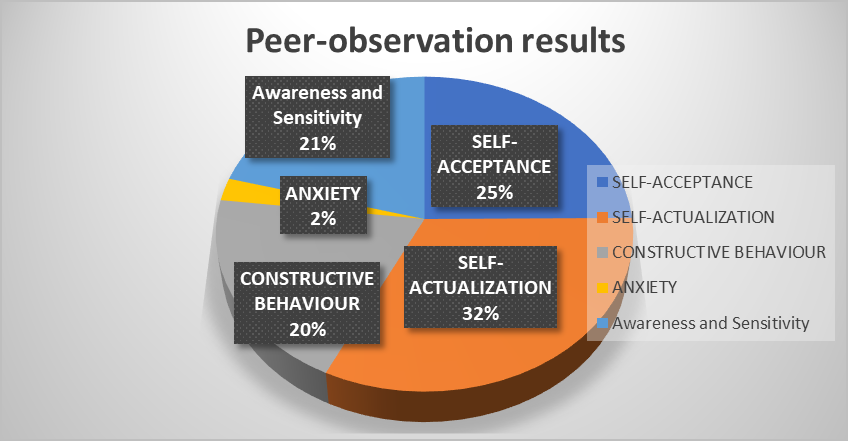
To sum up, almost all teachers noticed the changes that occurred in the personal development of ID students. This was proved by a decrease in ID students’ anxiety, an increase in their self-attitude and self-acceptance, a transformation in self-actualization, and the choice of constructive behavior strategies during communication, as well as a decrease in negatively colored experiences and general psychological tension.
Discussion
Internal displacement of students, the maladaptation and marginalization that accompany it, influence the process of students’ personal development. It creates severe stressful situations, gives rise to a feeling of hopelessness, and often causes homelessness, unemployment, poverty, and even suicide [6]. Nevertheless, individuals are usually displaced in order to reduce the effects of traumatic events, at the same time, it creates new problems connected with home and school changes, and parental employment.
In Huppert FA, et al. [7, 8] is highlighted that changes in social status and environment, entry into a new environment, personal and financial instability, and increased importance of close emotional contact compared to other age periods with the simultaneous fear of rejection – still is not a complete list of students’ problems.
We agree with O Keeffe P [9] that studying at a university for internally displaced students imposes new requirements on teachers’ work. Due to their age, and social and psychological characteristics, ID students are mostly susceptible to emotional or social instability and psychological crisis [10]. One of the manifestations of this crisis is maladaptation, the loss of value guidelines that underlie the building of life scenarios, and the choice of strategies for professional and personal self-realization.
The need for adaptation arising in connection with a radical change in activity and social environment overlapped with the normative crisis in adolescence associated with professional and personal self-determination. When talking about ID students, their situation is also complicated by unresolved social and psychological problems, sometimes low financial security, and the lack of much-needed support from parents or society.
The well-organized varied support leads to the effective personal development of ID students; makes their adaptability to a new environment, raises the level of ID students’ self-confidence, and develops their ability to self- control and self-organize.
The results of our study support the idea from Kodlin D [11] that such in-class activities as group discussions, small role-plays, or pair work provide ID students with the trustful relationships, awareness, and sensitivity that they lack outside the class. It allows ID students to look at each other and life situations differently, to see the best in themselves, their peers, and the world around them that was previously unnoticed. The atmosphere of trust and emotional acceptance allowed students to come into close contact with other students, teachers, and even psychologists (if acceptable), express their opinions, see their future differently, and change their worldview.
Conclusion
To sum up, the study showed the effectiveness of providing ID students with emotional support, inclusive language, a safe environment, awareness and sensitivity, and trustful relationships not only within the framework of psychological courses but regular ESP classes as well. The activities proposed to ID students during ESP classes help to prevent possible deviations in students’ personal development that can be manifested in maladaptation, in deformation of the system of relations with the social environment.
The evidence from this study suggests that our findings can be used to organize varied support for the personal development of ID students in Ukraine in the context of adaptation to a new environment.
Acknowledgements
The support was given by the Department of English Language for Humanities and Faculty of Linguistics, Igor Sikorsky Kyiv Polytechnic Institute, Ukraine.
References
-
Bosacker CMA (2016) The Examination of Peer Support on Psychological and Academic Functioning in a Sample of Inner-City Latino Students. PCOM Psychology Dissertations 2: 368-378.
-
Yasin MS, Dzulkifli MA (2011) The Relationship between Social Support and Academic Achievement. International Journal of Humanities and Social Science 5(1): 277-281.
-
Ahmad K, Iqbal H (2022) Group intervention for university students who are Internally Displaced Persons. International Journal of Intercultural Relations 91: 274-281.
-
Ahmed K, McCarthy P, Kaddoura N, Thomas A, Al- Harthy A (2022) Inclusive Language in Student Writing: Awareness and Innovation. Advances in Social Sciences Research Journal 9(7): 54-75.
-
Lavrysh Y, Simkova I, Tuliakova K (2022) Inclusive Communicative Strategies in an ESP Classroom: A Case Study. English Studies at NBU 8(2): 215-232.
-
Eray S, Murat, D, Uçar HN (2020) Psychological Well- Being Among Internally Displaced Adolescents and the Effect of Psychopathology on PTSD Scores Depends on Gender. Community Ment Health J 56: 1489-1495.
-
Huppert FA (2009) Psychological Well-being: Evidence Regarding its Causes and Consequences. Applied Psychology: Health and Well-Being 1: 137-164.
-
Tillquist NM (2023) A Student Perspective on the Importance of Inclusive Pedagogy. Journal of Animal Science 101(S3): 71.
-
O Keeffe P (2023) Higher Education in Refugee Camps via Collaborative Blended Learning: The Impact and Benefits for Refugees and Their Student Tutors. In: Wolsey TD, Karkouti IM (Eds.), Teaching Refugees and Displaced Students. Springer Texts in Education. Springer pp: 109-125.
-
Tante AC, Anyen ME (2023) Social Support and the Psychosocial Adjustment of Internally Displaced Students. In: Rakich S (Ed.), Cases on Current Issues, Challenges, and Opportunities in School Counseling. IGI Global pp: 30-59.
-
Kodlin D (2023) Inclusive Reconstruction in Times of War-The Case of Ukraine: Including the Displaced Population in Participatory Action. Master Thesis.
- Occupational Stress and Mental Health Outcomes Among Police Officers: A Mini Review
- The Experience of Counterproductive Leadership on Mental Health and Impact on Retention in U.S. Marines: A Phenomenological Study
- Nomophobia in the Digital Age: A Study on College and University Students
- Emotional Regulation in Children with Autism and Learning Disabilities
- Antisemitism on American College Campuses and Its Impact on Jewish Students
- Exploring the Role of Empathy in the Associations of Family Functioning and Purpose in Life with Attitude towards Abortion among Undergraduates: A Moderation Analysis