
The Moderating Role of Family Functioning in the Relationship between Dark Triad Personality and Cyberbullying among Undergraduates
The emergence of modern technology has increased negative vices such as cyberbullying. This form of aggression has increased in intensity among the youths. However, ways of ameliorating this menace to curtail its debilitating effects have not been fully explored. Thus, the present study aimed to examine the moderating role of family functioning in the relationship between dark triad personality and cyberbullying among undergraduates. The participants were five hundred and sixty-five (565) undergraduate students between the ages of 18 and 30 (Mean age 21.99; SD = 2.82) drawn through purposive sampling from a sample of Nigerian undergraduate students. Self-report measures of the 27-item Short Dark Triad Questionnaire (SD3), Cyber Victim and Bullying Scale (CVBS), and Family APGAR Scale were used for data collection. The hypotheses were tested using the Hayes PROCESS macro for SPSS version 3.00. The results showed that dark triad personality (Machiavellianism, narcissism, and psychopathy) were positively associated with cyberbullying among undergraduate students. Family functioning is negatively associated with cyberbullying. In addition, family functioning moderated the relationship between dark triad personality (Machiavellianism, narcissism, and psychopathy) and cyberbullying among undergraduate students. The study revealed that dysfunctional family functioning increased the extent to which students engage in cyberbullying in the presence of a dark triad personality (Machiavellianism, narcissism, and psychopathy).
Introduction
The era of the internet and technology has proven how humans can easily get the job done and quickly access information. There is no doubt that the internet has helped people for different purposes, both positively (e.g., problem- solving) and negatively (e.g., cyberbullying) [1]. However, the spate of cyberbullying happening in many parts of the world has posed a menace and an insidious threat to the psychological wellbeing of all involved [2], especially in the University setting. This led to increased research into the causes of this menace and its effect on the perpetrator and the victim under various circumstances and jurisdictions [3, 4, 5].
Cyberbullying is a deliberate and repeated aggressive act intentionally performed by an individual or group of individuals using electronic forms of contact (e.g., computers and smartphones) against an individual who cannot easily defend themselves [6]. It connotes willful and repeated harm inflicted through computers, cell phones, and other electronic devices. Olumide, et al. [7] see cyberbullying as the use of information and communication technologies to support deliberate, repeated and hostile behaviour by an individual or group that is intended to harm others. Chan, et al. [8] asserted that cyberbullying is a form of antisocial behaviour on the Internet, which may involve the use of various types of computing devices and telephones to inflict harm and stress or pose a threat to a weaker one [9]. Cyberbullying perpetrators hide under the umbrella of the anonymity of the internet to bully their victims. It involves an act of sending and posting hostile and cruel messages and pictures via the Internet or other devices of information communication technology (ICT) that causes psychological and social harm. Cyberbullying behaviours can be classified as either overt or relational forms of aggression and are characterized by intentionality. For instance, overt harassment is generally perpetrated through electronic texts, such as by sending abusive or threatening messages to the victim. In contrast to this, relational aggressive behaviours may consist of impersonation (e.g., manipulating the victim’s social relationships by sending messages to others through the victim’s hacked electronic account), exclusion (e.g., deliberately barring the victim from participating in an online social activity), denigration (e.g., posting embarrassing photos, rumours, or personal information on the Internet), and outing or trickery (e.g., disclosing personal, sensitive, or embarrassing information that will be shared through an electronic format to unintended recipients).
Furthermore, the prevalence of cyberbullying has kept on increasing in recent times. In 2016, the percentages for cases of victimisation were between 1.0 and 61.1% [10]. In the same period, the proportion of perpetration was between 3.0% and 39.0%. Lifetime prevalence for cyberbullying was between 4.9% and 65.0%, while those of perpetration throughout life varied between 1.2% and 44.1% [10]. The review showed that the proportion of victims/perpetrators of cyberbullying was between 1.5% and 72.0%, and lifetime cyberbullying ranged between 5.0% and 64.3% for perpetration throughout life. Extant studies [11, 12] have shown that one in five children was involved in cyberbullying either covertly or relationally, thus prompting the magnitude to increase daily. This invariably exposes the victims to physical and mental strain [13].
Nigeria is no exception; with increasing access to the internet and social media platforms, individuals, especially young people, become victims of online harassment and bullying, such as spreading false information, harassment, threats, or the unauthorized sharing of personal information [6]. For instance, Olumide, et al. [5] asserted that about a quarter of students were perpetrators of cyberbullying and that the correlates of perpetration were a history of cyber victimization and daily Internet access. As a result of the vast spread in technology witnessed by the increased patronage at cyber cafes and increased embracement of communication technologies by Nigerian youths, it has increased cyberbullying among the youths [13].
Corollary cyberbullying tenets fall under three specific characteristics: unlimited Internet capacity, the perpetrator’s anonymity, and the broad audience. This implies that it can be seen, commented on, and shared by several people, friends, acquaintances, friends and acquaintances of friends, and even strangers, yet the perpetrator might not be known. Thus, a broader audience is witness to the cyber victim’s humiliation. Sadly, due to the broader audience, neither the cyber victim nor the cyberbully can control events after perpetration. As the internet has unlimited capacity, the harmful acts happening to the victim can be shared and commented upon, and in general, they are available for a longer time. This is pertinent because others can download and repeatedly upload harmful content. Therefore, the cyberbullying perpetrator loses control over the harmful content and thus might feel less responsible for the negative events happening to the victim. Extant studies have identified some factors that precipitate cyberbullying, such as impulsivity and low self- control, offensive and avoidant communication, negative and conflictual relationships among family members, exclusion from the peer group and rejection by the peers [14], hostile parenting, aggression, and male gender.
However, Kang, et al. [15] stated that the most prevailing personality trait that predisposes to cyberbullying is the dark triad personality because of its commonly adopted model of malevolency. Dark triad personality refers to a trinity of personality traits that are typically considered to be socially undesirable. Although the traits are considered socially undesirable, it should be noted that they are still within the average, sub-clinical (normal person) range and thus manifest in society on a trait-based spectrum.
These personality traits are characterized by different manifestations, namely psychopathy, narcissism, and Machiavellianism. Psychopathy is characterized by a lack of empathy, sympathy, love, remorse, shame, guilt, and superficial emotions. Individuals high in psychopathy do not consider the welfare of others and do not refrain from harming other people or disobeying moral conventions if they are not in line with their own goals or wishes. Their acceptance of moral rules is only an illusion. Overall, psychopathy seems to predict proactive and reactive aggression, bullying, cyberbullying [16], cyber aggression, and emotional manipulation.
However, narcissism is the pursuit of gratification from vanity or egoistic admiration of one’s attributes and can exert various negative influences on relations with other individuals. Individuals high in narcissism show high levels of adaptive and maladaptive behaviour, making them pretentious, conceited, and exhibitionistic [9]. However, extant studies [17] have reported positive associations between narcissism and cyberbullying, showing that individuals high in narcissism do not consider the welfare of others and do not refrain from harming other people.
Furthermore, Machiavellianism is characterized by a duplicitous interpersonal style, cynic disregard for morality, and focus on self-interest and personal gain, but is not linked to a specific clinical diagnosis. The characteristics of Machiavellianism can be distinguished into cognitions, desires, and behaviour. Cognitions encompass self- absorption, opposing worldviews, and the tendency to plan and scheme ahead. Thus, individuals high in Machiavellianism are focused on self-promotion and self-protection, status and dominance, and impulse regulation to attain their goals. As a result, their behaviour tends to be abusive, impassive, hostile, self-centred, and manipulative.
Machiavellianism has been linked to lower empathy, higher callousness, and higher emotional intelligence. Thus, individuals high in Machiavellianism might have trouble with (or less incentives for) processing emotions in general.
Nevertheless, identifying the factors that can act as boundary conditions in the relationship between dark triad personality and cyberbullying is important in order to ameliorate its inimical effects. Extant studies Tandiono IM, et al. [18] have suggested that family functioning can act as a boundary condition that can weaken the effect of dark triad personality traits on cyberbullying. This is pertinent because the family is the first point of contact for children. Thus, its impact on a child’s life is expected to affect the individual’s social life.
Family functioning is the interactions with family members that involve physical, emotional, and psychological activities. It refers to relationships with each other in the family that foster a balance of emotional ties, relationship stability, and communication within the family [18]. Family functioning has an interconnection system, which affects relationships through cohesion, flexibility, and communication. Thus, individuals who come from dysfunctional families report impaired communication, less emotionality, less affective expression, more control, less cohesion, and less adaptability than those from a functioning family [19]. Aligning with this, previous studies Espelage DL, et al. [20] have linked dysfunctional family functioning to bullying perpetration, hostile family environment, parental conflict, domestic violence, low parental communication, lack of parent emotional support, authoritarian parenting, inappropriate discipline, and parental abuse.
However, studies on cyberbullying have been done in diverse environments and contexts, but little is known about dark triad personality implications on cyberbullying, especially in a neglected context like Nigeria. In addition, knowledge of possible associations of family functioning, dark triad personality and cyberbullying has not been fully explored to show its buffering or attenuating effect. Thus, the present study aims to bridge the gap in the literature by exploring the moderating role of family functioning in the relationship between dark triad personality and cyberbullying among undergraduates. This is to provide tailored and specific strategies to enhance students’ mental health and overall quality of life, especially among those with potential risk of susceptibility.
Hypotheses
In the present study, we posit that: 1a. Dark triad (Machiavellianism) personality will positively predict cyberbullying among undergraduates. 1b. Dark triad (narcissism) personality will positively predict cyberbullying among undergraduates. 1c. Dark triad (psychopathy) personality will positively predict cyberbullying among undergraduates. 2. Family functioning will negatively predict cyberbullying among undergraduates. 3a. Family functioning will moderate the relationship between Machiavellianism’s dark triad personality and cyberbullying such that the positive relationship between Machiavellianism and cyber bullying will be weaker when family functioning is high rather than low. 3b. Family functioning will moderate the relationship between narcissism’s dark triad personality and cyberbullying such that the positive relationship between narcissism and cyberbullying will be weaker when family functioning is high rather than low. 3c. Family functioning will moderate the relationship between psychopathy’s dark triad personality and cyberbullying, such that the positive relationship between psychopathy and cyber bullying will be weaker when family functioning is high rather than low.
Materials and Methods
Participants
The participants for the present study were 565 undergraduates from federal Universities in Southeast Nigeria (male n=143, 25.3%, female n=422, 74.7%) between the ages of 18 to 30 years (mean age = 21.99, SD = 2.82). The
participants were selected through the purposive sampling method. For marital status, 556 (98.4%) were single, while 9 (1.6%) were married. On religion, 527 (93.3%) were Christians, and 38 (6.7%) were Muslims. On ethnicity, 505 (89.4%) were Igbo, 25 (4.4%) were Hausa, and 35 (6.2%) were Yoruba. On the level of study, 113 (20%) were in the 100 level, 104 (18.4%) were in the 200 level, 84 (14.9%) were in the 300 level, 214 (37.9%) were in the 400 level, and 50 (8.8%) were in 500 level.
Measures
Short Dark Triad Questionnaire
Jones, et al. 27-item Short Dark Triad questionnaire was used to access dark triad personality. The scale has three dimensions: Machiavellianism (items 1-9), sample items include: “Make sure your plans benefit yourself, not others”; Narcissism (items 10-18), sample items include: “I know that I am special because everyone keeps telling me so, I am an average person” and Psychopathy (items 19-27), sample items include: I will say anything to get what I want”. The items are scored using 5-point Likert options from 1 (strongly disagree) to 5 (strongly agree). Jones, et al. reported Cronbach alpha reliabilities for the SD3 subscales as .71, .77, and .80 for narcissism, Machiavellianism, and psychopathy, respectively and an overall score of .81. The present study reported a satisfactory reliability coefficient of .77, .76, and .83 for Machiavellianism, narcissism, and psychopathy, respectively, and an overall score of .85, which is comparable to Jones, et al. and Onyedire, et al. reliability index.
Cyber Victim and Bullying Scale (CVBS)
The Cyber Victim and Bullying Scale (CVBS) developed by Çetin, et al. was used to measure cyberbullying. The scale measures the actions one performs on the internet to bully others using a 5-point scale ranging from 1 (Never) to 5 (Always). The scale consists of 22 items measuring cyber forgery, verbal bullying, and hiding identity. The scale can be used as a single or composite construct. In the present study, it is used as a single construct using the overall score. Sample items include: “Using the Internet for fraudulent act” and “Sending infected file/program via e-mails”. A higher score represents a higher bully. Cetina, et al. reported an overall score of .69 on the scale. The present study yielded a reliability index of .86.
Family APGAR Index
The Family APGAR Index assessed participants’ family parameters ranging from adaptability, partnership, growth, affection, and resolve. Sample items include: “I am satisfied with the support I receive from my family when something concerns me,” and “I am satisfied with how my family discusses issues of common interest and shares the problem solution with me.” The scale is scored on a four-point Likert response format ranging from 0 (hardly ever) to 3 (almost always). A higher score indicates the higher perceived functionality of the family. Smilkstein reported a Cronbach alpha coefficient of .80. A reliability coefficient of 72. was reported in the current study. In prior studies, APGAR has been used in Nigerian settings with an acceptable reliability coefficient [21].
Procedure
The study was conducted in three universities in southeast Nigeria: University of Nigeria, Nsukka, Nnamdi Azikiwe University Akwa, and Federal University of Science and Technology Owerri. The researchers recruited and trained three research assistants who helped administer and collect the copies of the questionnaire. Prior to that, the purpose of the study was elucidated to the participants. All participants were informed that their responses to the questionnaire would remain confidential. The researchers and research assistants purposely distributed copies of the questionnaire to the students who consented to partake in the study and were students of the above-named federal universities used in the study. Participants were urged to respond to each questionnaire as truthfully and sincerely as possible. However, participants were informed that they were free to withdraw at any study stage without prejudice. The copies of the questionnaire were administered to the participants in the classrooms and hostels. Filling out the copies of the questionnaire lasted for a couple of weeks. After that, the researchers and research assistants thanked the participants for spending their time completing the questionnaire. After completion and collection, correctly filled copies of the questionnaire were used for analysis. A total of five hundred and eighty (580) copies of the questionnaire were returned, fifteen (15) copies were discarded as a result of improper completion, while five hundred and sixty-five (565) valid copies were used for the analysis, yielding a valid response rate of 95.8% out of the five hundred and ninety (590) copies of the questionnaire that were initially distributed.
Data Analysis
Pearson correlation was used to examine the relationship among the study variables, while Model 1 of Hayes PROCESS macro for SPSS version 3.00 was used for data analysis. This is apt for testing direct effects and simultaneously checking for moderation.
Results
| Variables | M | SD | 1 | 2 | 3 | 4 | 5 | 6 | 7 | 8 | 9 | 10 | 11 |
|---|---|---|---|---|---|---|---|---|---|---|---|---|---|
| 1.Gender | - | - | - | ||||||||||
| 2.Age | 21.99 | 2.82 | -.32** | - | |||||||||
| 3.Marital status | .19 | .39 | -.02 | .16** | - | ||||||||
| 4.Level | 27.03 | 11.48 | -.18** | .65** | .14** | - | |||||||
| 5.Religion | .09 | .29 | -.06 | .17** | .03 | -.00 | - | ||||||
| 6.Ethnic group | .50 | .70 | -.01 | .01 | -.02 | -.01 | -.00 | - | |||||
| 7.Machiavellianism | 18.15 | 4.70 | -.02 | -.02 | -.01 | .01 | .04 | .01 | - | ||||
| 8.Narcissism | 25.51 | 5.39 | .02 | -.02 | .03 | -.05 | -.06 | .08* | -.02 | - | |||
| 9.Psychopathy | 24.42 | 6.07 | .05 | -.05 | .04 | -.08* | -.05 | .06 | -.02 | .77** | - | ||
| 10.Family functioning | 5.69 | 2.27 | 00 | -.03 | .04 | .01 | -.02 | -.02 | -.11** | -.04 | -.07 | - | |
| 11.Cyberbullying | 45.15 | 13.80 | .09* | .04 | .14** | .12** | -.08 | .09* | .09* | .08* | .08* | -.02 | - |
Table 1: Descriptive and correlation statistics of the demographic and predictor variables.
. Correlation is significant at the 0.01 level (2-tailed). *. Correlation is significant at the 0.05 level (2-tailed).Note: N = 565, * = p <.05 (two-tailed), = p < .01 (two-tailed). Gender was coded 0 = male, 1 = female. M=Mean, SD= Standard Deviation. Table 1: Descriptive and correlation statistics of the demographic and predictor variables.
bullying. Machiavellianism (r = .09, p <.05), Narcissism (r = .08, p <.05), and psychopathy (r = .08, p <.05) respectively correlated positively with cyberbullying, whereas family functioning did not.
In Table 1, gender, age, marital status, levels, religion and ethnic group were added as controls, meanwhile gender (r = .09, p <.05), marital status (r = .14, p <.01), levels (r = .12, p <.01), and ethnic group (r = .09, p <.05) correlated with cyber
| Variables | β | SE | T | 95%CL ∆R2 ∆F |
|---|---|---|---|---|
| LLCI ULCI | ||||
| Machiavellianism | .26 | .12 | 2.15* | .20 .50 |
| Narcissism | .23 | .57 | 2.16* | .22 .44 |
| Psychopathy | .20 | .09 | 2.12* | .11 .38 |
| Family functioning (FF) | -.10 | -.25 | -2.09* | -.40 -.60 |
| Machiavellianism X FF | .11 | .05 | 2.08* | .11 .21 |
| Narcissism X FF | .12 | .25 | 2.31* | .22 .31 |
| Psychopathy X FF | .10 | .04 | 2.18* | .19 .27 16.02 5.11 3* |
Table 2: ** Hayes PROCESS Macro Result for Moderating Role of Family Functioning on the Relationship between Machiavellianism, Na
Note: * = p < .05 (two-tailed), = p < .01 (two-tailed). β = Regression Coefficient; SE = Standard Error; t = population t value; p= Probability Level; LLCI and ULCI = Lower and Upper Limit Confident Interval; ∆R2Adjusted R square. Table 2:** Hayes PROCESS Macro Result for Moderating Role of Family Functioning on the Relationship between Machiavellianism, Narcissism, and Psychopathy on Cyber Bullying.
In Table 2, for the direct effects, Machiavellianism is positively associated with cyberbullying (β = .26, 95% CI [.20 to .50], p = <.05); thus, hypothesis 1a was supported. This indicates that every increase in Machiavellianism also leads to an increase in cyberbullying by .26 units. The result also showed that Narcissism was positively associated with cyberbullying (β = .23, 95% CI [.22 to 44], p = <.05);
thus, hypothesis 1b was supported. This indicates that every increase in narcissism also leads to an increase in cyberbullying by .23 units. For Psychopathy, the result showed a positive association with cyberbullying (β = .20, 95% CI [.11 to .38], p = <.05); thus, hypothesis 1c was supported. This indicates that every unit rise in psychopathy leads to an increase in cyberbullying by .20 units. Family
functioning negatively associated with cyberbullying (β = -.10, 95% CI [-.40 to -.60], p = <.05), therefore hypothesis 2 was supported. This indicates that every unit’s rise in family functioning leads to a decrease in cyberbullying by .10 units.
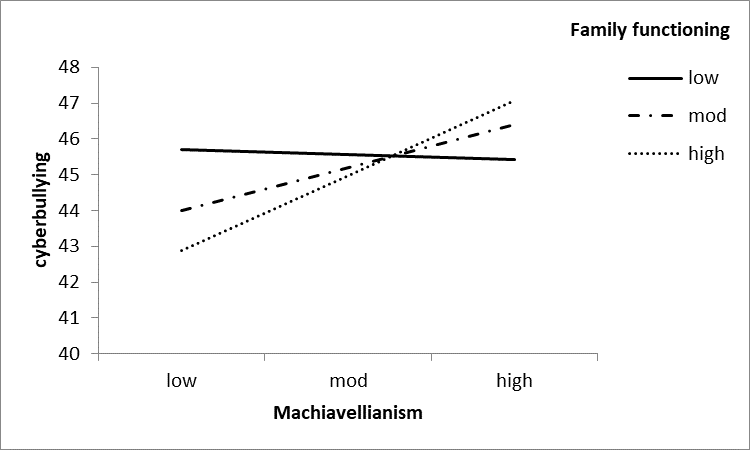
For the indirect effects, the interaction effect between Machiavellianism and family functioning produced a significant effect on cyberbullying (β = .11, 95% CI [.11 to .21], p = <.05), indicating that family functioning moderates the relationship between Machiavellianism and cyberbullying. Thus, hypothesis 3a was supported. The slope of the interaction (see Figure 1) indicates that Machiavellianism did not predict cyberbullying for people with low family functioning (β = -2.69, p = >.05), but for people with moderate (β = .30, p = <.05) and high family functioning (β = 2.30, p = <.05).
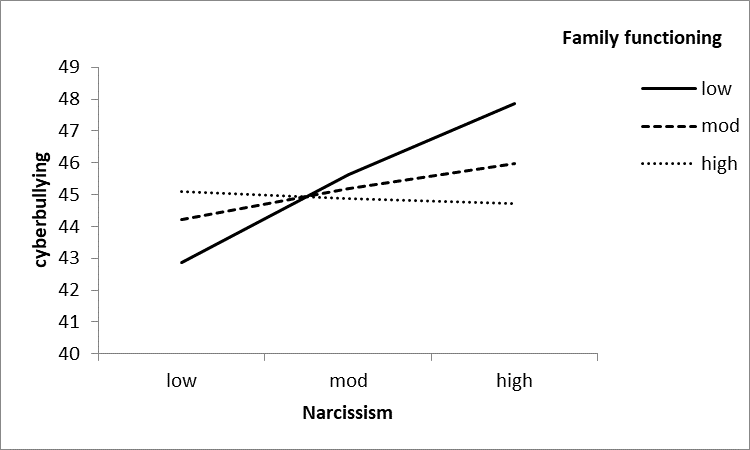
The interaction effect between narcissism and family functioning produced a significant effect on cyberbullying (β = .12, 95% CI [. 22 to .31], p = <.05), indicating that family functioning moderates the relationship between narcissism and cyberbullying. Thus, hypothesis 3b was supported for the slope of the interaction (see Figure 2), which indicated that narcissism only predicted cyberbullying for people with low family functioning (β = -2.68, p = <.05), but not for people with moderate (β = .31, p = >.05) and high family functioning (β = 2.31, p = >.05).
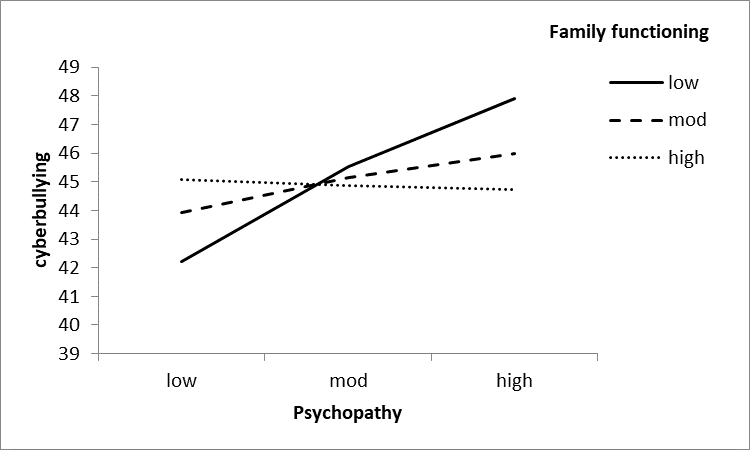
The interaction effect between psychopathy and family functioning produced a substantial impact on cyberbullying (β = .10, 95% CI [.19 to .27], p = <.05), indicating that family functioning moderates the relationship between psychopathy and cyberbullying. Thus, hypothesis 3c was supported for the slope of the interaction (see Figure 3), which indicated that psychopathy predicts cyberbullying for people with low family functioning (β = -2.69, p = <.05), but not for people with moderate (β = .31, p = >.05) and high family functioning (β = 2.31, p = >.05).
Discussion
The goal of this present study was to examine the moderating role of family functioning on the relationship between dark triad personality (Machiavellianism, narcissism, and psychopathy) and cyberbullying among undergraduates. The results showed that Machiavellianism is positively associated with cyberbullying. This finding agrees with previous studies [16], which found that Machiavellianism was a factor that strengthened cyberbullying and antisocial behaviour. This is because Machiavellianism is characterized by manipulative and exploitative behaviour, a cynical view of human nature, and a willingness to use deceit and manipulation to achieve personal goals. Prior studies have shown that Machiavellian individuals are skilled manipulators who excel in influencing and controlling others to achieve their objectives. In the context of cyberbullying, they may use their manipulative skills to target and harass others online, exploiting their vulnerabilities for personal gain or gratification. This is pertinent because they exhibit a lack of empathy as they often display a diminished capacity for empathy and concern for others. This makes it easier for them to engage in cyberbullying, as they may not fully comprehend or appreciate the emotional impact their actions have on their victims.
The result of the study also showed that narcissism was positively associated with cyberbullying. This shows that narcissism is a risk factor for cyberbullying, indicating that individuals who have narcissistic tendencies are more likely to be involved in cyberbullying. This aligns with previous studies that documented that narcissism was a factor that increases cyberbullying and other antisocial behaviour among different populations. This finding showed that narcissistic traits are prone to cyberbullying, most especially because of an excessive sense of self-importance, a need for admiration, and a lack of empathy. Thus, engaging in cyberbullying can provide them with a platform to gain attention and exert control over others, thereby satisfying their need for recognition and admiration. Narcissists often project their insecurities and negative self-perceptions onto others, serving as a way for them to deflect attention away from their flaws and bolster their self-esteem by putting others down.
In the same vein, the result showed that psychopathy is significantly associated with cyberbullying. This indicates that an increase in psychopathy invariably leads to increased cyberbullying. Prior studies align with the present finding. This is evident since psychopaths often engage in impulsive and thrill-seeking behaviour, which provides them with a sense of power and excitement, allowing them to satisfy their need for control and dominance over others without expressing guilt or remorse for their actions. Thus, the absence of guilt or remorse makes it easier for them to engage in cyberbullying repeatedly without considering the negative impact on their victims.
In line with our hypothesis, family functioning has a significant negative association with cyberbullying. This finding aligns with previous findings [8], which found that positive family functioning reduces the tendency in which people engage in cyberbullying. This shows that high family functioning weakens such relationships, and as family functioning increases, the relationship will decrease. These studies have shown that family functioning can be a salient protective factor for individuals with the risk factor of cyberbullying. Individuals with positive and good family functioning will have good social fusion, integration, attachment, and social interaction, with a lesser risk of cyberbullying.
Nonetheless, cyberbullying is a complex behaviour that is influenced by multifarious factors, including individual characteristics, peer relationships, school environment, and online experiences. Some studies have identified that family functioning has no direct effect on family functioning, raising questions that some exogenous factors could be a barrier. This is pertinent since family functioning is just one of such many potential influences on cyberbullying behaviour, without taking cognizance of exogenous factors like peer relationships and online experience that can vary significantly among individuals in different ways. For instance, some children may be more susceptible to family dynamics, while peer relationships and online experiences may influence others. Thus, the impact of family functioning on cyberbullying may vary depending on endogenous factors like individual characteristics and exogenous factors such as environmental context.
As expected, the result showed that family functioning moderated the relationship between Machiavellianism, narcissism, and psychopathy on cyberbullying among undergraduates. This indicated that in the presence of positive family functioning, dark triad personality (Machiavellianism, narcissism, and psychopathy) was weakened by the decreased experience of cyberbullying. This is evident since family play a crucial role in serving as the protective factor against antisocial behaviours [21]. Hence, a supportive and nurturing family environment is often associated with positive psychological outcomes for individuals, voiding dark triad traits that tend to display manipulative, exploitative, and callous behaviour in interpersonal relationships [22]. Conversely, a dysfunctional family environment may amplify the negative impact of Dark Triad personality traits on cyberbullying. This is because lack of emotional support, inconsistent discipline, and poor communication within the family may contribute to the development and escalation of cyberbullying behaviours. Thus, it could be contended that a healthy family environment might serve as a protective factor, buffering the negative effects of dark triad traits through supportive family relationships by instilling empathy, moral values, and a sense of responsibility in individuals [23]. This will potentially reduce the likelihood of individuals engaging in cyberbullying behaviour [24].
Implications
The implications of a study on the moderating role of family functioning in the relationship between Dark Triad personality traits and cyberbullying are multifaceted and extend to various domains, including psychological, social, and intervention strategies. The result showed that dark triads (Machiavellianism, narcissism, and psychopathy) were positively associated with cyberbullying, indicating that these traits may be precursors to cyberbullying. Hence, identifying these traits early will go a long way in mitigating such menace.
Corollary family functioning correlated negatively with family functioning as well as moderated the positive relationship between dark triad personality and cyberbullying. This shows that positive family functioning mitigates the positive effect of dark triad personality on cyberbullying. Hence, dysfunctional family functioning is a recipe for dark triad personality and cyberbullying. Thus, the study advocated for developing targeted prevention programs and interventions to enhance positive family dynamics, such as effective communication, emotional support, and conflict resolution skills and establishing support services for families and incorporating family-oriented approaches into broader initiatives aimed at reducing cyberbullying at societal levels. This will be particularly beneficial for individuals at risk of developing or exhibiting Dark Triad traits associated with cyberbullying [25].
In conclusion, practical implications for prevention, intervention, and policy development are imperative by addressing family dynamics that will usher in interventions targeted to a reduction in cyberbullying behaviours.
Limitations and Future Research Directions
Like any research study, the present study. First, the study’s findings may be limited in generalizability to different populations because it focused on a specific demographic, cultural group, and age range. Future studies should expand their scope with reference to age range, cultural diversity, and different demographics.
Secondly, the study used self-report measures, which are susceptible to common method bias error [26]. Even though the issue of common method bias error has been taken care of through anonymity in their responses, further studies should in cooperate lagged time design to foster the causality effect.
Conclusion
The present study concluded that dark triad personality is a risk factor for cyberbullying and has a direct effect on human relationships. As seen in the findings, family functioning negatively influences cyberbullying. This indicates that family functioning is a factor that can mitigate cyberbullying among individuals, based on the premise that family functioning appears to play a crucial role in influencing the relationship between Dark Triad personality traits and cyberbullying behaviours. A healthy family environment characterized by effective communication, emotional support, and strong familial bonds may act as a protective factor. Thus, individuals with Dark Triad traits may be less likely to engage in cyberbullying behaviours when raised in a supportive family that fosters positive values and empathy. Understanding the interplay between these variables suggests that the family environment can either exacerbate or mitigate the manifestation of dark personality traits in the context of cyberbullying [27]. The findings will guide the design and development of intervention strategies and support services (e.g., family enrichment) for individuals with the risk factor of developing dark triad personality and cyberbullying vulnerability. Thus, the present study has contributed to filling the gap in the literature by advocating intervention strategies such as family-based interventions aimed at improving communication, conflict resolution, and emotional support that may be effective in reducing the likelihood of cyberbullying, especially among individuals with Dark Triad personality traits.
• Data Availability Statement: The datasets generated and analysed during the current study will be available from the corresponding author upon reasonable request.
• Funding: None
• Declaration of Competing Interest: The authors declare no known conflicts of interest.
• Acknowledgement: We acknowledge the students who participated in the study.
• Ethical Approval: All procedures followed were under the ethical standards of the responsible committee on human experimentation (institutional and national) and with the Helsinki Declaration of 1975, as revised in 2000 (5).
The Moderating Role of Family Functioning in the Relationship between Dark Triad Personality and Cyber bullying among Undergraduates.
References
-
Tripathy JK, Chakkaravarthy SS, Satapathy SC, Sahoo M, Vaidehi V (2020) ALBERT-based fine-tuning model for cyberbullying analysis. Multimedia Systems 28: 1941- 1949.
-
Tetteh A, Awaah F, Addo D (2022) Perception of cyberbullying among students: the study of a developing country. Journal of Aggression Conflict and Peace Research 15(2): 163-180.
-
Olweus D (2012) Cyberbullying: an overrated phenomenon. European Journal of Developmental Psychology 9(5): 520-538.
-
Nixon CL (2014) Current perspectives: the impact of cyberbullying on adolescent health”, adolescent health. Medicine and Therapeutic 5: 143-158.
-
Tian L, Yan Y, Huebner ES (2018) Effects of cyberbullying and cyber victimization on early adolescents’ mental health: differential mediating roles of perceived peer relationship stress. CyberPsychology, Behavior, and Social Networking 21(7): 429-436.
-
Olasanmi OO, Agbaje YT, Adeyemi MO (2020) Pre- valence and Prevention Strategies of Cyberbullying among Nigerian Students. Open Journal of Applied Sciences 10(6): 351-363.
-
Olumide AO, Adams P, Amodu OK (2015) Prevalence and Correlates of the Perpetration of Cyberbullying among In- School Adolescents in Oyo State, Nigeria. International Journal of Adolescent Medicine and Health 28(2): 183- 191.
-
Chan HC, Wong DS (2019) Traditional school bullying and cyberbullying perpetration: Examining the psychosocial characteristics of Hong Kong male and female adolescents. Youth & Society 51(1): 3-29.
-
Kowalski RM, Giumetti GW, Schroeder AN, Lattanner MR (2014) Bullying in the digital age: A critical review and meta-analysis of cyberbullying research among youth. Psychological Bulletin 140(4): 1073-1137.
-
Brochado S, Soares S, Fraga S (2017) A scoping review on studies of cyberbullying prevalence among adolescents. Trauma, Violence & Abuse 18(5): 523-531.
-
Hamm MP, Newton AS, Chisholm A, Shulhan J, Milne A, Sundar P, et al. (2015) Prevalence and effect of cyberbullying on children and young people: A scoping review of social media studies. JAMA Pediatrics 169(8): 770-777.
-
Modecki KL, Minchin J, Harbaugh AG, Guerra NG, Runions KC (2014) Bullying prevalence across contexts: A meta- analysis measuring cyber and traditional bullying. The Journal of Adolescent Health 55(5): 602-611.
-
Nwufo JI, Nwoke MB (2018) Cyberbullying in contemporary Nigeria: Implications on youth psychological wellbeing. Practicum Psychologia 8: 167- 182.
-
Baldry AC, Farrington DP, Sorrentino A (2015) Am I at risk of cyberbullying? A narrative review and conceptual framework for research on risk of cyberbullying and cybervictimization: The risk and needs assessment approach. Aggression and Violent Behavior 23: 36- 51.
-
Kang KI, Kang K, Kim C (2021) Risk factors influencing cyberbullying perpetration among middle school students in Korea: Analysis using the zero-inflated negative binomial regression model. International Journal of Environmental Research and Public Health 18(5): 2224.
-
Goodboy AK, Martin MM (2015) The personality profile of a cyberbully: Examining the Dark Triad. Computers in Human Behavior 49: 1-4.
-
Antoniadou N, Kokkinos CM, Markos A (2016) Possible common correlates between bullying and cyber-bullying among adolescents. Psicología Educativa 22(1): 27-38.
-
Tandiono IM, Soetikno N, Dewi FIR (2020) Descriptive study of the family functioning in adolescent victims of bullying. In the 2nd Tarumanagara International Conference on the Applications of Social Sciences and Humanities (TICASH 2020) pp: 593-597.
-
Tetzlaff A, Schmidt R, Brauhardt A, Hilbert A (2016) Family Functioning in Adolescents with Binge-Eating Disorder. European Eating Disorders Review 24(5): 430- 433.
-
Espelage DL, Swearer SM (2010) A social-ecological model for bullying prevention and intervention: Understanding the impact of adults in the social ecology of youngsters. In: Jimerson SR, Swearer SM, et al. (Eds.), Handbook of bullying in schools: An international perspective New York, UK, pp: 61-72.
-
Nwufo J, Ike OO, Nwoke MB, Eze J, Chukwuorji JC, et al. (2023) Social anxiety and Internet addiction among adolescent students in a sub-Saharan African country: Does family functioning make a difference. South African Journal of Psychology 53(2): 275-285.
-
Mensah MK, Kuranchie A (2013) Influence of parenting styles on the social development of children. Academic Journal of Interdisciplinary Studies 2(3): 123.
-
Tajmirriyahi M, Doerfler SM, Najafi M, Hamidizadeh K, Ickes W (2021) Dark Triad traits recalled and current quality of the parent-child relationship: A non-western replication and extension. Personality and Individual Differences 180: 110949.
-
Ferencz T, Láng A, Kocsor F, Kozma L, Bobos A, et al. (2022) Sibling relationship quality and parental rearing style influence the development of Dark Triad traits. Current Psychology 42: 24764-24781.
-
Hart CH, Nelson DA, Robinson CC, Olsen SF, McNeilly- Choque MK, et al. (2000) Russian parenting styles and family processes: Linkages with subtypes of victimization and aggression. In: Kerns KA, Contreras JM, et al. (Eds.), Family and peers: Linking two social worlds pp: 47-84.
-
Olson DH (2000) Circumplex Model of Marital and Family Systems. Journal of Family Therapy 22(2): 144-167.
-
Padmanabhanunni A, Gerhardt M (2018) Demographic correlates of normative beliefs about aggression among adolescents from low-income communities in South Africa. Journal of Psychology in Africa 28(2): 100-104.
- Occupational Stress and Mental Health Outcomes Among Police Officers: A Mini Review
- The Experience of Counterproductive Leadership on Mental Health and Impact on Retention in U.S. Marines: A Phenomenological Study
- Nomophobia in the Digital Age: A Study on College and University Students
- Emotional Regulation in Children with Autism and Learning Disabilities
- Antisemitism on American College Campuses and Its Impact on Jewish Students
- Exploring the Role of Empathy in the Associations of Family Functioning and Purpose in Life with Attitude towards Abortion among Undergraduates: A Moderation Analysis