
Research Investigation on the Psychological Effects of Procrastination on Students in Icse Schools
Procrastination is a self-defeating pattern of behaviours, it may also be perceived as having a psychological benefit, particularly for perfectionists since it shields the person from feelings of shame, guilt, and fear of failing. Devoting energy to other chores, such as organizing or cleaning, instead of disagreeable labour helps procrastinators avoid feeling unproductive, even though they will eventually pay a price for it. Academic procrastination, which is classified as a domain-specific behaviour, describes students' propensity to put off or postpone finishing assignments that have a set deadline, such as writing an essay, doing their homework, or preparing for an exam.
Introduction of Academic Procrastination
Academic achievement is adversely affected by procrastinating among students. Academic work that is either unfinished or of poor quality might result from procrastinating students’ tendency to put off finishing crucial tasks and participate in other dilatory behaviours. There is a correlation between academic procrastination and depressive symptoms, impulsivity, distractibility, and increased dropout intentions in addition to reduced academic performance. When completing complicated assignments and learning online, students tend to put off doing them sooner than when they learn in person. The achievement of students in science and mathematics is positively connected with effective time management, whereas procrastination has a detrimental impact on these areas. Thus, to enhance their academic performance, students must learn efficient time management techniques and refrain from procrastinating.
Literature Review
Elen Kuftyak [1] the 435-person sample, ranging in age from 17 to 25, served as the basis for the research (M age = 19,03). Comparative research on procrastination between student groups with varying academic performance levels has revealed that students who perform poorly are more likely to procrastinate, be lazy and make rash decisions when setting up their time, as well as experience frustration, stress, and anger. The results of the correlation study support the hypothesis that procrastination is correlated with stress and poor academic performance. The analysis of the relationships between procrastination and stressors as well as student reactions to them has revealed that the more impulsive, socially anxious, failure-averse, procrastinating frequently, lazy, and worse perfectionist a person is, the more he values stressors overall and exhibits impressive reactions to them. Academic procrastination thus hinders students’ ability to learn, affects their performance, increases stress, and surely influences the professional growth of future specialists.
Area of the Study
The study conducted by CISCE Board-eligible 12th graders in Mumbai, Maharashtra, on academic procrastination and its effects on academic stress is significant for several reasons. We are dealing with a relevant issue in schooling. Being the best is a goal that is shared by parents, instructors, and students alike. Academic success must be the aim of a student’s educational path. Academic achievement is nevertheless hampered by several factors, and stress related to studying continues to be a major issue for many young people. This study makes an effort to look at conduct that is widely recognized but not fully understood. This work focuses on a single facet of academic procrastination.
The Study’s Purpose, Objectives, and Aim
Toto assesses the academic performance of high school pupils who overindulge in postponement. 1. To compare male and female secondary school students’ academic procrastination. 2. To ascertain the connection between secondary school students’ academic procrastination and achievement. This study aims to look into the relationship between the frequency of assignment procrastination caused by academic stress among final-year CISCE Board students in the Mumbai suburbs of Maharashtra state.
Methodology
In this investigation, a descriptive survey was employed. Students from senior high school CISCE in Mumbai, Maharashtra State, took part in the current survey. The study’s second sample consisted of 500 students and 200 teachers from the five previously mentioned regencies. To gather them, a method called cluster random sampling was used. The information was gathered using the academic procrastination scale, which the researchers developed based on procrastination theory. A descriptive analysis of the data described the procrastination of students in their academic work. A multi-phase stratified random selection technique was used to pick 96 students out of 100 secondary school students, and questionnaires were distributed equally to parents and instructors. The sample for the pilot study was 50/50.
About CISCE
The Council of the Indian School Certificate Examinations, or CISCE, was established to ensure appropriate representation from the Indian government, state governments, union territories, the Inter-State Board for Anglo-Indian Education, the Association of Indian Universities, the Association of Heads of Anglo- Indian Schools, the Indian Public Schools Conference, the Association of Schools for the ISC Examination, and members co-opted by the CISCE [4] Executive Committee.
Data Analysis
Methods for Data Analysis: Twenty-four suburban Mumbai schools connected to ICSE were selected by random sampling. Of the thousand questionnaires that were distributed, 828 were returned by parents and students. Along with observations and interviews, a questionnaire was used. 281 of the 300 surveys distributed to teachers were returned. Procrastination elements: This section discusses procrastination-related elements and their relationship to the study environment.
- A very accommodating atmosphere for studying.
- Extended the due date.
- Task aversiveness or worry about tasks.
- Distractions and allurements.
- Limited information to guarantee suitable self-observation.
- A lack of focus on teaching study techniques.
- Limited options for improving effectiveness.
- Ineffective cooperative efforts.
- Pressure or influence from peers.
Distribution of Questionnaire
| Students | Parents | Guardian | Teachers | ||||
|---|---|---|---|---|---|---|---|
| M | F | M | F | M | F | M | F |
| 171 | 243 | 118 | 246 | 20 | 30 | 109 | 172 |
| 414 | 364 | 50 | 281 |
Table 2: Respondent according to Gender.
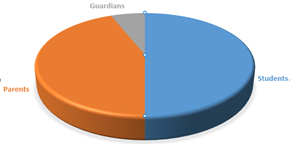
Figure1: Respondents Ratio.
Table 1 displays the respondents’ responses according to their sex. As is customary, 58.6% of replies are female pupils and 67.58% of respondents are parents. Among the teaching staff on this board, female instructors comprise 61.20% of the total. There are lots of female guardians.
Procrastination Indicators Related to Academic Performance
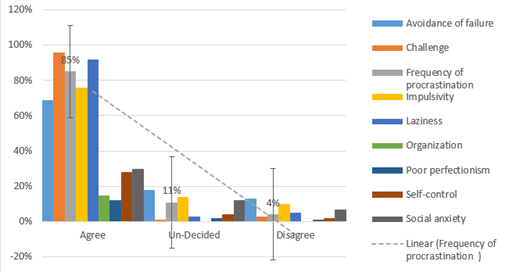
Nine parameters explain the procrastination signs. To determine the degree of procrastination among students, the indicator’s performance levels are presented in three-point scale levels.
The degree to which ICSE students delay in several academic domains is seen in Table No. 2. 96% of procrastination cases, according to research, are caused by challenges that teachers pose. 92% of the kids in their class are reflected in their lax academic performance. Only 85% of students who procrastinate also perform poorly academically. Because they put off achieving their academic goals, the least number of students obtain poor perfectionism, which is related to and affects academic success.
| S.No | Procrastination Indicators | Agree | Un- Decided | Disagree |
|---|---|---|---|---|
| 1 | Avoidance of failure | 69% | 18% | 13% |
| 2 | Challenge | 96% | 1% | 3% |
| 3 | Frequency of procrastination | 85% | 11% | 4% |
| 4 | Impulsivity | 76% | 14% | 10% |
| 5 | Laziness | 92% | 3% | 5% |
| 6 | Organization | 15% | 0 | 0 |
| 7 | Poor perfectionism | 12% | 2% | 1% |
| 8 | Self-control | 28% | 4% | 2% |
| 9 | Social anxiety | 30% | 12% | 7% |
| Total | 828 |
Table 1: Procrastination Indicators Related to Academic Performance.
Procrastination Indicators Related to Academic Record
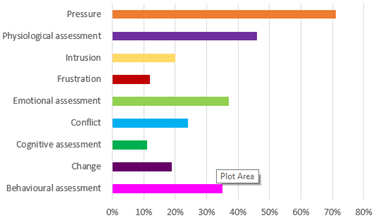
The procrastination factors that are linked to academic achievement are included in Table 3. Most students experience pressure about their academic records, which occasionally serve as a reflection of their academic pursuits. Many of them employ behavioural evaluation as an alternative to emotional evaluation to affect procrastination. At least some pupils feel displeased, irritated, and encroached upon. The least number of students put things off because of the environmental shift of new institutions. Additional staff physiological exams affected a sizable percentage of pupils, perhaps leading to work deferral.
| S.No | Procrastination Indicators | % |
|---|---|---|
| 1 | Behavioural assessment | 35% |
| 2 | Change | 19% |
| 3 | Cognitive assessment | 11% |
| 4 | Conflict | 24% |
| 5 | Emotional assessment | 37% |
| 6 | Frustration | 12% |
| 7 | Intrusion | 20% |
| 8 | Physiological assessment | 46% |
| 9 | Pressure | 71% |
Table 4: Procrastination Indicators Related to Academic Record.
Procrastination Indicators Related to Social Anxiety
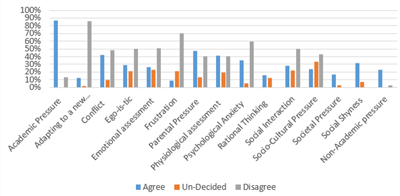
Table 4 presents a collection of scholastic records’ procrastination elements. Eighty-seven percent of procrastination indications were linked to pressure from the classroom. Parental pressure is identified by 47% of participants as a secondary indicator of procrastination, which is associated with physiological evaluation, social anxiety, and conflict. These are significant elements that could encourage children to put off doing their schoolwork.
| S.No | Procrastination Indicators Related to Social Anxiety | Agree | Un- Decided | Disagree |
|---|---|---|---|---|
| 1 | Academic Pressure | 87% | - | 13% |
| 2 | Adapting to a new environment | 12% | 2% | 86% |
| 3 | Conflict | 42% | 10% | 48% |
| 4 | Ego-is-tic | 29% | 21% | 50% |
| 5 | Emotional assessment | 26% | 23% | 51% |
| 6 | Frustration | 9% | 21% | 70% |
| 7 | Parental Pressure | 47% | 13% | 40% |
| 8 | Physiological assessment | 41% | 19% | 40% |
| 9 | Psychological Anxiety | 35% | 5% | 60% |
| 10 | Rational Thinking | 16% | 12% | 72%% |
| 11 | Social Interaction | 28% | 22% | 50% |
| 12 | Socio-Cultural Pressure | 24% | 33% | 43% |
| 13 | Societal Pressure | 17% | 3% | - |
| 14 | Social Shyness | 32% | 7% | - |
| 15 | Non-Academic pressure | 23% | - | 3% |
Table 3: Procrastination Indicators Related to Academic Record.
Area of Procrastinations
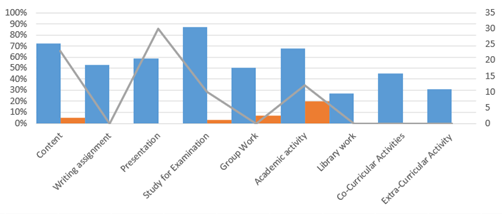
Table 5 displays the areas where students exhibit procrastination indications. Eighty-six percent of students delay studying for tests, according to this research report. 68% of students procrastinate, according to academic activity across various domains, but 72% of students are advised by the topic study. Students who put off completing their library tasks are the fewest, at 27%. Consequently, the majority of problems with procrastination are associated with reading and evaluating academic literature.
| S.No | Areas of Procrastination Indicators | Agree | Un- Decided | Disagree |
|---|---|---|---|---|
| 1 | Content | 72% | 5% | 23% |
| 2 | Writing assignment | 53% | - | - |
| 3 | Presentation | 59% | - | 30% |
| 4 | Study for Examination | 87% | 3% | 10% |
| 5 | Group Work | 50% | 7% | - |
| 6 | Academic activity | 68% | 20% | 12% |
| 7 | Library work | 27% | - | - |
| 8 | Co-Curricular Activities | 45% | - | - |
| 9 | Extra-Curricular Activity | 31% | - | - |
Table 5: Areas of Procrastination.
Hypothesis Formation
Hypothesis Testing: The Likert scale is a psychometric tool used to evaluate people’s attitudes, tendencies, and beliefs. It is used by many academic disciplines, including the social sciences. The most popular kind of Likert scale is the five- point one, which ranges from strongly disagree to strongly agree. According to McLeod, each response is assigned a score, which is a number between one and five. A score of 1 might be assigned to “strongly disagree,” 2 to “disagree,” 3 to “neutral/undecided,” 4 to “disagree,” and 5 to “strongly agree.” The frequency of each response option was multiplied by the matching Likert scale score to determine the overall Likert scale scores. Σ (fi × Likert scale score) + Total Scores Where: Fi = Likert scale score frequency (total number of responses) The Likert Scale scores are represented by the letters SD (1), D (2), Neutral (3), A (4), and SA (5). Finding the means of the Likert scale scores: By dividing the total scores by the total number of respondents, the mean score is determined. (fi x Likert Item Score) ÷ Number of Respondents = Mean Score.
For example, the first statement’s mean score, as displayed in the table, is as follows: Average Score is 1.44. Let’s take an example where the questionnaire evaluates user satisfaction with a school, and you are attempting to determine if the website is “acceptable.” Let’s say it has five things and each one has a three-point rating system (1 being agree, 0 being neutral, and 1 being disagree). The items will be averaged to determine the final scores. Consequently: The mean score for the whole is 2.54.
| S.No | Procrastination Indicators | % | Total Score | Mean Score |
|---|---|---|---|---|
| 1 | Avoidance of failure | 571 | 1193 | 1.44 |
| 2 | Challenge | 795 | 885 | 1.06 |
| 3 | Frequency of procrastination | 704 | 984 | 1.18 |
| 4 | Impulsivity | 630 | 1108 | 1.33 |
| 5 | Laziness | 762 | 926 | 1.11 |
| 6 | Organization | 125 | 125 | 0.15 |
| 7 | Poor perfectionism | 100 | 161 | 0.19 |
| 8 | Self-control | 232 | 349 | 0.42 |
| 9 | Social anxiety | 249 | 621 | 0.75 |
| Total No. of Respondents | 828 | 7.63 | ||
| Overall Mean score | 2.54 |
Table 6: Academic Procrastination Indicators.
Below is an indication of the high customer satisfaction score (CSAT): 1.1% of the population is unfavorable. 2. In contrast, the promoter performed exceptionally well, with a score of 1.71%. 3. The average score, or overall score, is 2, a positive figure. 4. A score above 2.3 is considered excellent overall. The null hypothesis, or H0, is the first step in every significance test. Ho is a hypothesis that has been put up but not tested, either because it is assumed to be true or because it is intended to provide support for a claim. The total score value is 2.54, which is higher than 2. According to the results of this exam, procrastination affects most ICSCE 12th standard students, to varying degrees. The theory is important. The total score value is 2.54, which is higher than 2. According to the results of this exam, procrastination affects most ICSCE 12th standard students, to varying degrees. The theory is Important for Ha. The tendency to procrastinate will grow daily. After the test is completed, the researcher’s conclusion from this research survey is always provided in terms of the null hypothesis. We never conclude that we “reject Ho” or even “accept Ha”—we either “reject Ho in Favour of Ha” or do not reject Ho. Ho=Ha.
Output of the Research
Findings: Researchers call the final product they produce a finding. These findings imply that students can develop their time management abilities through instruction and practice. During times or sessions, provide the kids with more positive and encouraging instruction. 2. Redesigned to make it easier to understand academic papers that can provide them with creative, fun, and relaxing thoughts. 3. Organisations are set up to prevent this kind of procrastination by offering constructive guest lectures from subject matter experts in psychology and neuroscience. 4. Respectable establishments train staff members using practical time management techniques through workshops. 5. To prevent these kinds of detrimental actions to their scholastic and life-learning growth, all institutions must offer primary- and secondary- level procrastination correction programmes based on individual intake.
The Role of the Government in Offering Schoolchildren Procrastination Remedies
Based on society’s requirements for the development of the next generation, every state and federal government should offer the public the facilities that are required.
- Through the appropriate regularity organizations and advisory boards, the government will enact new regulations to incorporate these technologies.
- Procrastination support systems, counselling services, and a 24-hour helpline for school students at their level of study are framed by state, central, or federal boards through the Higher Education Board.
- The provision of primary-level software databases and online and offline self-motivation tools linked to procrastination correction is the government’s mandated duty.
- Periodically, the relevant government will screen and oversee the institution. The relevant body is required to physically inspect any institution at any time to verify that procrastination facilities are present.
- All instructors, tutors, and teachers must have frequent training and workshops from Statutory organisations, and each board must receive an efficient psychological programme each year.
- All national governments introduce courses in universities about procrastination as a means of promoting the development and well-being of the younger generation.
- All universities implement survey-based methods and offer training canters, Research and Development Cells, and Discussion Forums to help students, from elementary school to university level, prevent procrastination issues.
- Made use of non-governmental organizations (NGOs) activities and requested that they address the pressures associated with procrastination on all fronts.
- Establish distinct Procrastination Rectification Centres (PRC) in each state, region, zone, district, and taluka.
- All national and state authorities must offer public and self-service community services to the public as a means of delivering awareness programmes to the public.
Future Research Scope
The research projects and documents must be preserved for use as future research instruments, and the relevant state and federal governments must fund research programmes at all levels, from elementary to university. These changes can be used by the UGC and other mandated educational authorities to develop and offer high-quality educational, environmental, and improvement programmes as well as training facilities for state and national development. Senior secondary CICSE students participated in the current study. As such, it can be held in Maharashtra and the surrounding areas of Mumbai at the state level. The focus of this study is academic procrastination among ICSE 12th standard students and how it affects their academic performance in different settings. Specifically, procrastination indicators linked to social anxiety, academic records, academic performance, and anxiety are examined, along with the reasons behind the procrastination, the area in which it occurs, and its level. In a particular discipline within educational institutions, more research can be carried out using the same variables as examined in this study or separately. In the future, there is potential to carry out comparison research between various specialties and streams. Replica table research of this kind may be conducted abroad, in other parts of the nation, or multiple nations.
Discussion
This study looks at nine factors that are common to student study environments and that, when considered independently or in combination, increase the risk of procrastination. These factors are covered in nine tables. Given the prevalence of academic procrastination, a better knowledge of these risk factors and strategies for managing them is necessary to prevent and reduce procrastination.
Although we cannot control what kids do, we do have some say in how schools encourage behaviour that is better for students’ academic achievement. We now briefly review the problem-solving strategies that legislators, educators, and colleges should employ. A list of variables that encourage procrastination: The next sections will address the situational, social, contextual, cultural, and organizational factors that have been found to encourage procrastination. Before selecting a few, the researchers considered a larger variety of factors and evaluated how they linked to the academic setting. Next, they selected nine elements that met the following criteria by applying their expert judgment: They stand for different levels of specification depending on the areas, that is:
- Proven scientific results around procrastination.
- Describe circumstances related to the classroom that are beyond the student’s control, such as extended deadlines.
- Indicate elements that require task aversion or institutional, social, and educational interventions for the learner to effectively address them on their own.
- Suggest that taking steps to address the cause will probably lead to less procrastination [5].
We ought to be cognizant of the diversity of the elements. While some aspects, such as a lot of freedom in the study space and prolonged deadlines, point to the structural and organizational features of the academic environment, other aspects, such as task aversiveness, place more emphasis on subjective assessments. It should be highlighted that the elements under investigation might exhibit “main effects,” which could affect the majority of students, as well as “interaction effects,” in which features act as moderators. For example, most students might experience temptations and distractions in the classroom, but highly impulsive and easily distracted individuals might be particularly at risk [6].
Furthermore, the discussion’s order of criteria does not imply that they are differentiable in significance. Measuring the relative influences of each component in academic contexts may be difficult. Finally, some guidance on how to use the term “factor.” This expression is used in academic contexts to characterize traits or features that are known to be strongly associated with procrastination. Since they are exogenous variables in the procrastination equation, they suggest possible circumstances that might be altered to alter the likelihood of procrastination [7]. Rather than making strong assumptions about causality in the current context, we think that future research should focus more on these potential causal relationships. The discussion of each component is not meant to be a complete examination, as a review at this stage of the research would be premature. Rather, we highlight important discoveries that connect every facet to procrastination research, its relationship to the academic environment, and possible ways to mitigate the adverse effects of a certain problem [8].
Conclusion
The topics that are covered by the current study sample are constrained to some extent. It is hoped that more research in this field will be able to resolve this constraint, however, caution should be exercised when extrapolating the results to other groups. Additionally, given the prevalence of negligence among the graduating class, it is imperative that educational authorities, planners, and practitioners pay the necessary attention, evaluate, and take appropriate action to stop, lessen, or prevent anomalous behaviours [9, 10, 11].
Every national government and Ministry of Education should set aside one hour each week in the curriculum for formal self-care instruction and family communication pattern modification by qualified experts [12, 13]. Using the findings of this study, educators and tutors should arrange social, psychological, and cultural preventive sessions for pupils which may help the school students to rectify the procrastination problems through respective psychologists will be present.
References
-
Elen Kuftyak (2022) Procrastination, stress, and academic performance in students. ARPHA Proceedings.
-
Biswal A, Bhatt N, Lathigara A (2024) An Approach to balance Learning and Procrastination through a Strategic Model in the context of Higher Education. Journal of Engineering Education Transformations 37(S2): 446- 455.
-
Kamyabi M, Nekooie M, Hajipoor Abaei N, Bahreini Zade A (2024) Designing a Model of Academic Procrastination Based on Self-Efficacy and Perfectionism in Kerman Islamic Azad University Psychology Students in the Academic Year 2022-2023 with the Mediating Role of Metacognitive Beliefs: A Descriptive Study. Journal of Rafsanjan University of Medical Sciences 22(12): 1259- 1278.
-
CISCE (2024) Council for the Indian School Certificate Examination.
-
Ezatpour EED, Yarahmadi Y (2021) Prediction of addiction based on procrastination, distress tolerance, and perceived competence in senior high school girl students Chronic diseases 9(2): 48-54.
-
Svartdal F, Dahl TI, Gamst-Klaussen T, Koppenborg M, Klingsieck KB (2020) How study environments foster academic procrastination: Overview and recommendations. Frontiers in Psychology 11: 540910.
-
Batool SS (2020) Academic achievement: Interplay of positive parenting, self‐esteem, and academic procrastination. Australian Journal of Psychology 72(2): 174-187.
-
Ebadi S, Shakoor Zadeh R (2015) Investigation of academic procrastination prevalence and its relationship with academic self-regulation and achievement motivation among high-school students in Tehran City. International Education Studies 8(10): 193-199.
-
Ward A, Stoker HW, Murray-Ward M (1996) Educational measurement: Origins, theories, and explications. Journal of Educational Measurement 35(3): 273-275.
-
Knaus WJ (2000) Procrastination, blame, and change. Journal of Social Behavior & Personality 15(5): 153.
-
Kader A (2014) Academic procrastination and student achievement in an introductory economics course. SSRN pp: 25.
-
Owens AM, Newbegin I (1997) Procrastination in high school achievement: a causal structural model. Journal of social Behavior & personality 12(4): 869-887.
-
Ferrari M, Mahalingam R (1998) Peersonal cognitive development and its implications for teaching and learning. Educational Psychologist 33(1): 35-44.
- Occupational Stress and Mental Health Outcomes Among Police Officers: A Mini Review
- The Experience of Counterproductive Leadership on Mental Health and Impact on Retention in U.S. Marines: A Phenomenological Study
- Nomophobia in the Digital Age: A Study on College and University Students
- Emotional Regulation in Children with Autism and Learning Disabilities
- Antisemitism on American College Campuses and Its Impact on Jewish Students
- Exploring the Role of Empathy in the Associations of Family Functioning and Purpose in Life with Attitude towards Abortion among Undergraduates: A Moderation Analysis