
Visualization of Social Networks in a Recovery Home
This study utilized the SNA and NDTV packages in R to model the social network behaviors of residents within an Oxford House recovery home, where one of the entering residents was on Medication for Opioid Use Disorder (MOUD). The social network dynamics of this person on MOUD over time showed positive transformative connections among residents for friendship, advice-seeking, and lending resources, as well as increases in recovery capital. We provide the script, code, and data to allow for replication and adaptation to other studies involving social networks.
Abbreviations
OH: Oxford Houses; MOUD: Medications for Opiate Use Disorders.
Introduction
A Visualization of Social Networks in Recovery Homes
Several studies have examined social networks within Oxford Houses (OH), one of the largest networks of recovery homes in the US. Encouraging findings have emerged on this community-based self-run, innovative program. For example, those who remain in OH for six or more months are less likely to relapse at a two-year follow-up [1, 2]. In addition, the best predictor of remaining in the recovery homes for six months is having a friend in the house [3]. These types of findings suggest it is critical to better understand the evolution of friendship social networks among those in these recovery homes, particularly for those who might be at higher risk for relapse.
Some abstinence-based self-help groups and organizations have had mixed to skeptical opinions regarding those taking Medications for Opiate Use Disorders (MOUD), which might make it more difficult for those taking these medications to participate successfully in community-based recovery settings. In contrast to some abstinence-based groups, OH has been positive toward residents on MOUD [4, 5]. It is still unclear, however, how residents of these recovery homes interact with those on MOUD as these individuals become integrated into the house settings.
The current case study explored the relationship between a person on MOUD and his peers in an OH, using a visual methodology to illustrate transformative behavior and network changes among residents within this recovery community. This case study includes micro-step social dynamics [6], thereby providing a deeper insight into the social structures and network formations specific to residents within OH. We provide the script, code, and data to allow for replication and adaptation to other models.
Materials and Methods
The OH consists of over 3,400 homes that are self- governed with no professional staff [7]. Each house is rented and gender-segregated and residents can stay in these settings as long as they remain abstinent, pay weekly rent, and follow house rules. Our study was part of longitudinal data collected from 42 OHs every four months for a two-year period (See [8] for more details). Participants were paid $20 for each interview. The current study focused on one OH over three waves which had a resident on MOUD. The individual on MOUD was a 37-year-old white male who reported using methadone to support his recovery from substance use disorder. The 3 to 4 other members of the house were white males with ages ranging from 27 to 53. The mean age of all residents of the house was 37 years.
Measures
Social Network Instrument [9]: Social Network data were collected using the SNI. A whole network approach was used whereby all residents of the house rated each other on different domains. In this study, friendship was measured by responses to “How friendly are you with this person?” Responses on a five-point scale ranged from “close friend” to “adversary”. A friendship relationship was considered present if the respondent identified another resident as a close friend or friend, but not present otherwise (acquaintance, stranger, adversary). Resource sharing which is referred to as money loaning was considered present if the respondent reported being willing to loan another resident $100 or $500 but was not considered present if the respondent reported being willing to loan another resident $0, $10, or $50. Advice-seeking was considered present if the respondent reported seeking advice from another resident very often or quite often, but not present otherwise (i.e., regularly, rarely, never). The SNI used with our sample had a Cronbach’s alpha of .85 and all items contributed positively. A multilevel confirmatory factor analysis of the SNI found an excellent fit and per-item contribution, and neither age nor sex significantly correlated with this instrument [9].
Network Measures
Utilizing the SNA package in R various network measures were utilized in this study. A breakdown of how the SNA package calculates various network measures is as follows. Each resident is referred to as a node (below denoted A, B, C, etc.) and each relationship between the nodes of a dyad is referred to as an edge. Reciprocity is a network statistic that captures whether individuals in a network have a tendency for mutual connection. Two edges are considered reciprocal if a directed edge goes from node A to node B, and another from B to A. Higher reciprocity values indicate more mutual relationships. Density measures the overall interconnectedness of the network and is the sum of the directed edges divided by the number of possible directed edges. Since both of these measures are proportions, they are naturally bounded between zero and one. In these networks, isolates represent the residents without any connections to other house members. A higher percentage of isolates indicates reduced social cohesion and potential barriers to social integration.
Latent Recovery Factor
The latent recovery factor was based on a confirmatory factor analysis of the following recovery capital indicators: wages, self-efficacy, stress, self-esteem, social support, alcoholics anonymous affiliation, quality of life, and length of stay [10]. The analysis includes the resident on MOUD’s recovery factor score at each wave. Scores range from 1 to 4 with higher scores indicating more recovery capital.
Data Analytic Strategy
This study utilized SNA and NDTV packages to depict the transformative patterns of residents visually. Appendix A provides the syntax and the instructions for creating the visualizations. The data set utilized in this study as well as the code to run the model utilized in this study is available in Appendix B.
Results
Friendship
By clicking on this link, you can see the friendship networks in one Oxford House over 3 waves. This visualization shows micro-steps of relationships and how they transform over time. As depicted in the visualization, the resident on MOUD (resident number 1228 in red) moved into the recovery home at the first wave. The resident on MOUD had reciprocal friendship ties with two of the three other residents and a tie with the third resident (resident number 1038). Of interest, this third resident (1038) had friendship ties directed to him by the three other peers, but he did not reach out for friendship with any of the other house members. Overall, at this first wave when the person on MOUD moved into the house, there was a moderate level of density (58%) and reciprocity (57%). Such metrics suggest that the residents were moderately connected on friendship.
During the next wave, which is depicted in Figure A, a new resident (1156) entered the OH, and reciprocal ties now exist among each of the residents, including resident 1038 who did not have any outgoing friendship ties with other residents during the previous wave. At the third and final wave, resident 1227 moved out of the recovery home but the remaining residents had reciprocal ties with each other. During these last two waves, density and reciprocity had reached their maximum at 100%, indicating complete by-directional, reciprocal friendship interactions among residents. There had been a shift towards a more supportive and interconnected house.
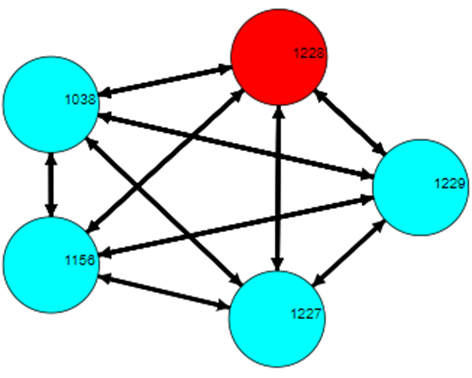
Figure 1. Click on this visualization to observe the changes in friendship that occurred (the Figure depicts wave 2 data). For each wave, circles represent residents (called nodes) and the lines indicate friendship connections or ties. Blue nodes represent individual household members, while a red node signifies the individual reporting MOUD use. The connecting lines between nodes indicate social ties, specifically friendships within the household. The directionality of the arrows illustrates the nature of the relationships: an arrow from resident A to resident B indicates that A identifies B as a friend. If both residents identify each other as friends, the arrow is bidirectional, indicating a reciprocated relationship.
Advice-seeking
Our investigation also extended to advice-seeking networks, revealing similar trends of augmented network connectivity and density. In this link, the advice-seeking relationship is portrayed within the house over the same 12-month period as the friendship network. In the first wave, when the resident on MOUD first entered the house, there was no reciprocal advice-seeking (0%) and low density (25%). The subsequent wave followed a trend similar to the friendship dimension, with a notable increase to moderate levels of reciprocity (57%). Additionally, network density for advice-seeking increased from 25% to 70% in this period. As the network continued to evolve, the relationships improved further, as at the last wave, the advice-seeking network reached high reciprocity (89%), and network density continued to improve to 75%.
Willingness to Lend Money
The third relationship examined was a willingness to lend money, and by clicking this link, you can view this network over three waves. This relationship dimension had the most profound increases over time. The first wave showed no reciprocity (0%) or density (0%), exemplified by the total isolation of this network. No resident in the house was willing to loan another resident money when the MOUD resident entered the house. By the following wave, all metrics had improved: reciprocity increased to 80%, and density rose to 25%, with only one member of the network remaining in isolation (resident 1227). These loaning relationships continued to evolve into the third wave, with no residents isolated in the network at this time point.
Recovery Factor
In addition to the positive growth in these three social network dimensions, the MOUD resident’s Recovery Factor increased from a score of 1 at wave 1, to a score of 2 by wave 2, and the score increased to 3 in the final wave. By the end of the data collection, this resident was still living in this recovery home.
Discussion
These findings showed that four months after a resident on MOUD entered an OH, there was a dramatic increase in the network’s friendship density and reciprocity. In addition, reciprocal advice-seeking increased over time as did loaning. The increases in reciprocal ties and network density in these dimensions illustrate dynamic and evolving positive social network changes over time in this recovery community.
The person on MOUD also showed impressive gains over time in the recovery factor. These changes are likely due to the exposure to supportive social networks, as studies have found that the availability of supportive social capital in a recovery home is associated with improved recovery prospects [10]. Further evidence (e.g., [11]) has consistently shown that access to recovery capital—that is, recovery- supportive social relationships—is key to recovery more generally.
These types of visualizations can help researchers and clinicians better understand how recovery homes create desirable social connections that lead to better outcomes and reduce early dropout. Our case study illustrates how a resident on MOUD enhanced overall supportiveness and connectivity among house members which was associated with higher recovery scores over time. At a theoretical level, social networks help identify the mechanisms that underlie the changes that occur among recovery home residents and suggest possible ways that vulnerable residents can be integrated and welcomed into their new community of recovering residents [12, 13]. Our study provides insights that could guide improvements in recovery home practices and policies.
This case study focused on only one resident on MOUD and needs to be replicated with larger samples. As a new resident entered into the house at wave 2, it is possible that changes were due to this new resident or other factors within the house. There is a need for examining houses with individuals on MOUD versus those without individuals on MOUD. Such work is currently ongoing, with a future paper that will analyze houses with a person on MOUD matched to houses with a person not on MOUD, charting changes over time on a larger number of social network measures, including average path length, isolation, network density, reciprocity, mean degree, diameter, cohesion, transitivity, and centrality. The findings will provide insights into the overall connectedness, efficiency, and influence within the network, helping us better understand the complex and evolving social dynamics of various relationships in recovery homes and beyond.
References
-
Jason LA, Olson BD, Ferrari JR, Lo Sasso AT (2006) Communal housing settings enhance substance abuse recovery. American Journal of Public Health 96(10): 1727-1729.
-
Jason LA, Davis MI, Ferrari JR, Anderson E (2007). The need for substance abuse after-care: Longitudinal analysis of Oxford House. Addictive Behaviors 32(4): 803-818.
-
Jason LA, Stevens E, Ferrari JR, Thompson E, Legler R (2012) Social networks among residents in recovery homes. Advances in Psychology Study 1: 4-12.
-
Majer JM, Jason LA, Norris J, Hickey P, Jeong H, et al. (2020) Medications for opioid use disorder utilization among Oxford House residents. Community Mental Health Journal 56: 925-932.
-
Soto-Nevarez A, Abo M, Hudson M, Bobak T, Jason LA (2023) Lived experiences of Oxford House residents prescribed Medication-Assisted Treatment. Journal of Community Psychology 51: 2828-2844.
-
Adams J, Schaefer DR (2018) Visualizing Stochastic Actor-based Model microsteps. Socius 4.
-
Oxford House (2022) Annual report.
-
Jason LA, Guerrero M, Lynch G, Stevens E, Salomon- Amend M, et al. (2020) Recovery home networks as social capital. Journal of Community Psychology 48(3): 645-657.
-
Jason LA, Stevens E (2017) The Reliability and Reciprocity of a Social Network Measure. Alcoholism Treatment Quarterly 35(4): 317-327.
-
Jason LA, Guerrero M, Salomon-Amend M, Stevens E, Light JN, et al. (2021) Context matters: Home-level but not individual-level recovery social capital predicts residents’ relapse. American Journal of Community Psychology 67(3-4): 392-404.
-
Best D, Gow J, Taylor A, Knox A, White W (2011) Recovery from heroin or alcohol dependence: A qualitative account of the recovery experience in Glasgow. Journal of Drug Issues 41(3): 359-377.
-
Bender-DeMoll S (2022) Package vignette for NDTV: Network dynamic temporal Visualizations pp: 1-33.
-
Butts C, Leslie-Cook A, Krivitsky P, Bender-deMoll S (2022) network Dynamic: Dynamic Extensions for Network Objects. R package version 0.11.2.
- Occupational Stress and Mental Health Outcomes Among Police Officers: A Mini Review
- The Experience of Counterproductive Leadership on Mental Health and Impact on Retention in U.S. Marines: A Phenomenological Study
- Nomophobia in the Digital Age: A Study on College and University Students
- Emotional Regulation in Children with Autism and Learning Disabilities
- Antisemitism on American College Campuses and Its Impact on Jewish Students
- Exploring the Role of Empathy in the Associations of Family Functioning and Purpose in Life with Attitude towards Abortion among Undergraduates: A Moderation Analysis