
Assessing the Level of Nanoimpurities in Water
An approach is considered that makes it possible to quickly estimate the concentration of various nanoimpurities, including nanobubbles, in water even in samples of small volumes. The method is based on the effect of periodic generation and cavitation collapse of bubbles near the fiber tip during laser heating. We used a laser source with a wavelength of 1.94 μm coupled to an optical fiber with a fiber core diameter of 400 μm. The high sensitivity of the proposed approach lies in the fact that one critical nucleus of a new phase is sufficient for explosive boiling to begin, resulting in a growing bubble.
Short Communication
Water is one of the most common reagents used in modern nanotechnological, biotechnological and laboratory processes, in which in many cases it is required to control the degree of water purity [1]. Therefore, there is currently a need for rapid assessment of the level of various nanoimpurities in water. Routine water purity monitoring is commonly carried out off-line using inductively coupled plasma mass spectrometry (ICP-MS). This powerful characterization tool is capable of precisely identifying and measuring most of the elements from the periodic table and is deployed in diverse fields such as biophysics, environmental science, forensic science, materials science, speciation analysis. ICP- MS is capable of part per trillion level detection limits, up to 10 orders of magnitude in linear dynamic rage, and high sample throughput. Because of their bulkiness, high cost, and measurement complexity, these systems are only suitable for large scale production lines.
Currently, many methods have been developed that allow for the rapid assessment of water quality in the laboratory.
One such method is to measure the level of hydrogen ion concentration using a pH meter, expressed in equivalents per liter of aqueous solution pH = -log[H+]. In pure water, which is neutral, the hydrogen ion concentration is 10-7 gram equivalents per liter, which corresponds to pH=7. Note that the pH level is not an indicator of ultrapure water, as many researchers believe. This is because immediately after a spill from the laboratory water supply, carbonic acid is formed due to absorption of CO2 and the pH drops to an acidic level. In addition, nano-pollutants may not change the pH level. Such devices, based on measuring the electrical resistance of water, are sensitive only to impurities that change the electrical conductivity of water upon dissolution. In addition, it must be taken into account that water undergoes auto- ionization at any temperature above absolute zero, therefore even “deionized” water is not completely free of ions.
There are devices that make it possible to evaluate the purity of water by the level of optical signal scattering from impurities. Such devices are also insufficiently sensitive to low impurity concentrations, especially when the characteristic particle size is much smaller than the wavelength of the optical signal. In addition, all the devices listed above are not sensitive to nano-microbubble inclusions, which is very important, for example, for problems in nanotechnology, microfluidics, microbiology, environmental engineering (including environmental remediation, water treatment, aerobic fermentation, anaerobic digestion, and algal biomass production), and agriculture (including agronomy, horticulture, aquaculture, aquaponics, bioponics, and hydroponics).
The concentration of various nanoimpurities and nano- microbubbles in water can be estimated using the method based on measuring the parameters of the acoustic signal that occurs when water is heated by continuous laser radiation due to thermocavitation [2]. The essence of the effect of thermocavitation is as follows. When heating a small volume of water under normal conditions, before the water boils, its temperature can significantly exceed the saturation temperature (100 °C), at which the pressure of saturated water vapor above a flat surface is equal to atmospheric pressure (101,325 Pa). Upon reaching a certain temperature, which depends on the concentration of nanoimpurities and the size of nano-microbubbles in water, explosive boiling occurs. As a result, an expanding bubble is formed, which, having reached its maximum size, collapses. These processes are accompanied by the generation of acoustic pulses [3, 4]. The purer the water, the higher the temperature to which it can be heated, and the greater the energy of acoustic pulses and the lower their generation frequency.
In Yusupov V [5] the implementation of the proposed approach is demonstrated. In the device, a fiber connected to a laser source is introduced into a measuring cuvette filled with water, and acoustic pulses are registered by a broadband hydrophone. A necessary condition for the effective operation of such a device is the use of laser radiation, which is well absorbed in water. A significant disadvantage of the proposed device is the need to use a hydrophone, which does not allow measurements in small volumes. Another approach for assessing the degree of water purity allows measurements by immersing a miniature optical quartz fiber into a sample with the liquid under study [6]. The basis of the device (Figure 1a) consists of a laser source 1, an optical fiber 2, a probe laser 3, an optical mixer 4, an optical coupler 5, a photodetector 6, and an indicator 7. An LS-1.9 continuous fiber laser (IRE-Polus, Russia) was used in the setup) with a wavelength λ=1940 nm, the radiation of which is well absorbed in water with an absorption coefficient a = 92 cm−1. The diameter of the light-transmitting quartz core of the laser fiber was 400 μm. The device works as follows. The radiation from the main and probe lasers through the mixer 4 and the optical coupler 5 hits the fiber tip 2. As a result of the absorption of laser energy, a small volume of water near the optical fiber tip is heated to a temperature exceeding the boiling point. When a certain temperature value is reached in the specified volume, explosive boiling of water occurs according to the thermal cavitation mechanism [7]. As a result, an expanding gas-vapor bubble is formed, which, after reaching its maximum size, collapses (Figure 1b,c). The process is repeated many times, and the purer the water, the lower the frequency of bubble generation. When a bubble appears at the fiber tip, due to a sharp decrease in the refractive index of the medium near the tip, the level of the probe laser radiation reflected from the fiber tip increases, and after the bubble collapses, it returns to its previous values. The indicator 7, based on the frequency of pulses at the output of the photodetector 6, shows the purity of the water.
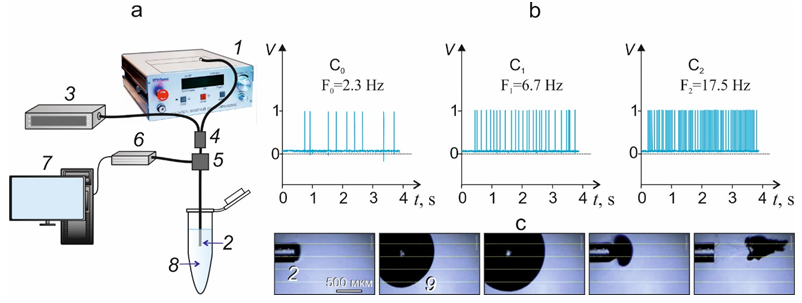
Figure 1: Scheme of the instrument for assessing the degree of purity of water: a - scheme of the instrument. 1 – main laser, 2 – tip of the optical fiber, 3 – probing laser, 4 – optical mixer, 5 – optocoupler, 6 – photodetector, 7 – indicator, 8 – water sample. b – examples of signals at the output of the photodetector at different concentrations of salt NaCl in water С0< С1< С2. Signal frequencies are shown. c – successive frames of high-speed shooting. 2 – fiber tip, 9 – steam-gas bubble. The time between frames is 0.13 ms.
Figure 1b shows, as an example, the signals at the output of the photodetector at various concentrations of NaCl salt in water C0< C1< C2. It can be seen that with an increase in the impurity concentration, the value of the average pulse frequency increases monotonically F1<F2<F3. It is important to note that the proposed method will work for any nature of impurities, since the effect used is associated with the appearance of nano-microbubbles in water due to pollution. With an increase in their concentration and size, explosive boiling occurs at a lower overheating [2], therefore, the frequency of the appearance of bubbles increases. Theoretically, the frequency of bubble generation in absolutely pure water will be determined by the time at which the maximum temperature in the heated water region near the fiber tip reaches the value Tc·(0.9+0.1P0/Pc), where Tc=647 К, Pc=221·105 Pa - critical parameters for water, P0=101·105 Pa - atmospheric pressure [2, 3]. In this case, as a result of the high energy stored during overheating of water, a bubble of the maximum size is formed, therefore, the time of its existence from the appearance to cavitation collapse will be also maximum.
It is important that during laser heating, the region with maximum temperatures is formed not on the surface of the fiber tip but in bulk water at some distance from the interface. Physically, this is due to a strong outflow of heat into the cold fiber. It is in this region with the highest temperatures that, when a certain temperature is reached, explosive boiling will occur as a result of the presence of various nanoimpurities and nano- microbubbles in the water. Estimates made using numerical simulations show that the temperature maximum is located at a distance of several tens of microns from the fiber tip. The high sensitivity of the proposed approach lies in the fact that the launch of explosive boiling in the above volume of superheated water, which is ~10-2 mm3, can ensure that only one critical new phase nucleus enters it [2, 3]. The radius of such a critical nucleus is determined by the ratio Rc= 2σ/(Ps-P0), where Ps is the saturated vapor pressure, σ is the surface tension coefficient of water. The higher the temperature of the superheated water, the smaller the bubble will be able to initiate the process of its explosive boiling.
In summary, an approach has been proposed that makes it possible to quickly assess the degree of water purity, even in small volumes. It is important that the method is highly sensitive to a wide variety of impurities and, in addition, allows one to estimate the concentration of nano- microbubbles.
Funding
This work was supported by the Russian Science Foundation (Grant No. 20-14-00286, https://rscf.ru/en/ project/20-14-00286/) and partly performed within the State assignment of Federal Scientific Research Center “Crystallography and Photonics” of Russian Academy of Sciences in part of using the equipment of the Сenter for collective use.
References
-
Ahuja S (2009) Handbook of water purity and quality. 1st(Edn.), Elsevier.
-
Skripov VP, Sinitsyn EN, Pavlov PA, Ermakov GV, Muratov GN, et al. (1988) Thermophysical properties of liquids in the metastable (superheated) state. OSTI.GOV, USA.
-
Bonch-Bruevich AM, Konov VI, Libenson MN (1991) In Optical Radiation Interaction with Matter. SPIE 1440: 127.
-
Yusupov VI, Konovalov AN, Ul’yanov VA, Bagratashvili VN (2016) Generation of acoustic waves by cw laser radiation at the tip of an optical fiber in water. Acoustical Physics 62: 537-544.
-
Yusupov V (2022) Patent RF No: 215745.
-
Yusupov V (2023) Patent RF No: 2780540.
-
Padilla-Martinez JP, Berrospe-Rodriguez C, Aguilar G, Ramirez-San-Juan JC, Ramos-Garcia R (2014) Optic cavitation with CW lasers: A review. Physics of Fluids 26(12): 122007.
- Sense, Gravity, Parity & Chirality in Mathematical Physics
- Quantum Lattice Simulations PHYSICS: Microcircuit Particle Formation and Observable Macroscopic Irreversible Time - A Discrete Lagrangian with Cellular Automata Framework
- Quantum Biology from Biomacromolecule to Cell, and Central Dogma Described by Quantum Theory
- Focus, Agility, Speed and Technology (FAST) for Sustainability and Growth
- Square Root Metric Geometry and Pati-Salam Model in Curved Space-Time
- A Simple System Demonstrating the Mpemba Effect in Classical Mechanics