
Anion Binding Poly (p-Aryltriazole) with High Affinity to Fluorine
Anion-binding polymer system based on click synthesized para (aryl-1,2,3-triazole) (PAT) functionality is described. The sensitivity and binding ability of the PAT system to halide ions such as F-, Cl-, Fand Br- which involve re-organisation of the aryl-triazole bonds, is explored using NMR and fluorescence spectroscopy. F-ion which induces the highest shift of the triazole C-H proton signal also shows the highest dynamic quenching of the PTA’s fluorescent intensity compared to Br- and Cl- ions.
Introduction
Recent studies have presented the triazole ring as multifaceted in functionality. Easily accessed via the Cu(I) catalyzed 1,3-dipolar cycloaddition (click) reaction of azides and acetylenes [1, 2]. The triazole ring binds and forms complexes with cations, anions and neutral molecules. These properties are derived from the three electronegative sp2 hybridized nitrogens which are nested on one side of the ring and the electropositive C-H group, which also offers minor steric hindrance [3, 4, 5, 6, 7]. Utilizing the C5-H, the triazole affords hydrogen bonds, with electronegative species, that are as strong as the classical, intrinsically polarized hydrogen bond donors (N–H and O–H) and plays an important role in the conformation, interaction, and recognition of both organic and inorganic structures [8]. Consequently, electron-deficient 1,4-diarylated 1,2,3-triazole derivatives form intermolecular bonds with halogens ions and other anions. Examples include a series of shape-persistent pre-organized triazolophanes, designed by Li and Flood [9], that binds the chloride ion with a high affinity and selectivity over all halide ions. A pre- organized triazole-based anion receptor with two hydroxyl groups on the central phenylene ring has been reported by Lee S, et al. [10]. Also, anion-binding light-induced triazole- based foldamer containing a photoresponsive azo-benzene in between the two phenyl-triazole oligomer units has been reported by Jiang, et al. [11].
Herein, we show the electropositive triazole C-H atom of 1,2,3-triazole as a potent intramolecular hydrogen bond donor and the re-organisation or tuning of the conformation and/or shape of poly (p-aryl triazole)s backbone, synthesized via AB step growth click polymerization, following the hydrogen bonding pattern. Different anions are introduced to the polytriazoles and the changes in NMR and flourescent properties arising from the binding effect of triazole moiety to the halogen ions are investigated.
Experimental: Synthesis of Polymer
To afford polymers via the CuAAC reaction, terminal acetylene and azido functionalized aryl monomer was required. However, the anticipated polymer would have aromatic repeating units in the backbone that are known to exhibit poor due to π-π stacking and the aromatic backbone rigidity. With this in mind, tetraethylene glycol substituents were incorporated in the structure of the monomer to improve solubility of the resultant, otherwise insoluble aryltriazole polymers. Acid-catalyzed THP hydroxyl protection afforded mono-protected tetraethyl ethylene glycol 2. The aryl group 3 was then coupled to alcohol 2 under DMAP/DCC catalysis followed by Palladium catalysed cross-coupling of aryl iodode with TMS-acetylene and acid catalysed THP deprotection of the alcohol, respectively, affording the TMS-protected aryl alcohol 6. Finally, TBAF- catalysed desilylation afforded the required monomer 7. The poly (p-aryl triazole) 8 was synthesized in high yields and considerable molecular weight, via CuAAC [1, 2] from p-terminal alkyne functionalized ary-azide monomer shown (Scheme 1).
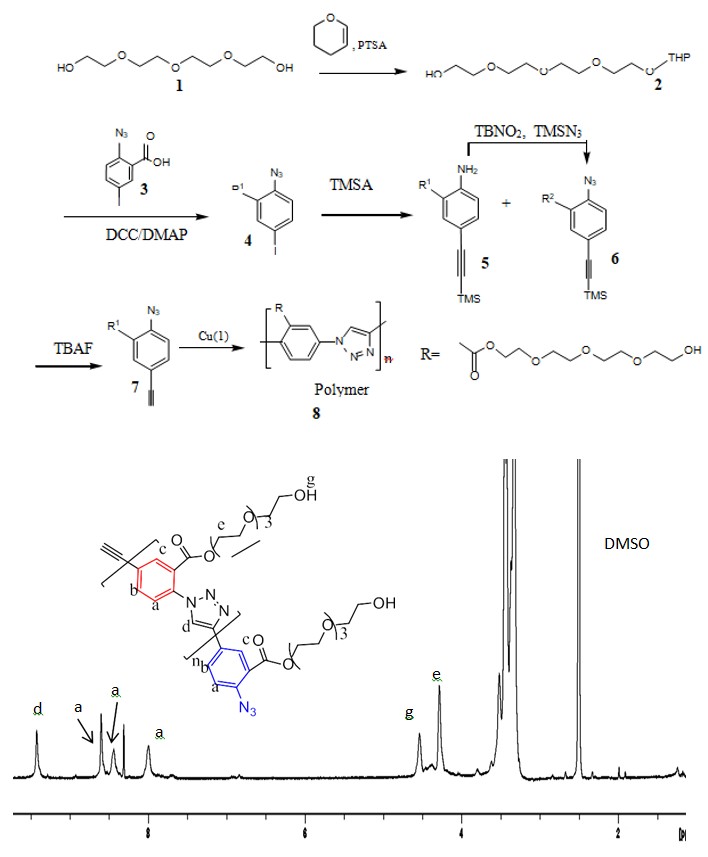
Scheme 1: Monomer and polymer synthetic route.
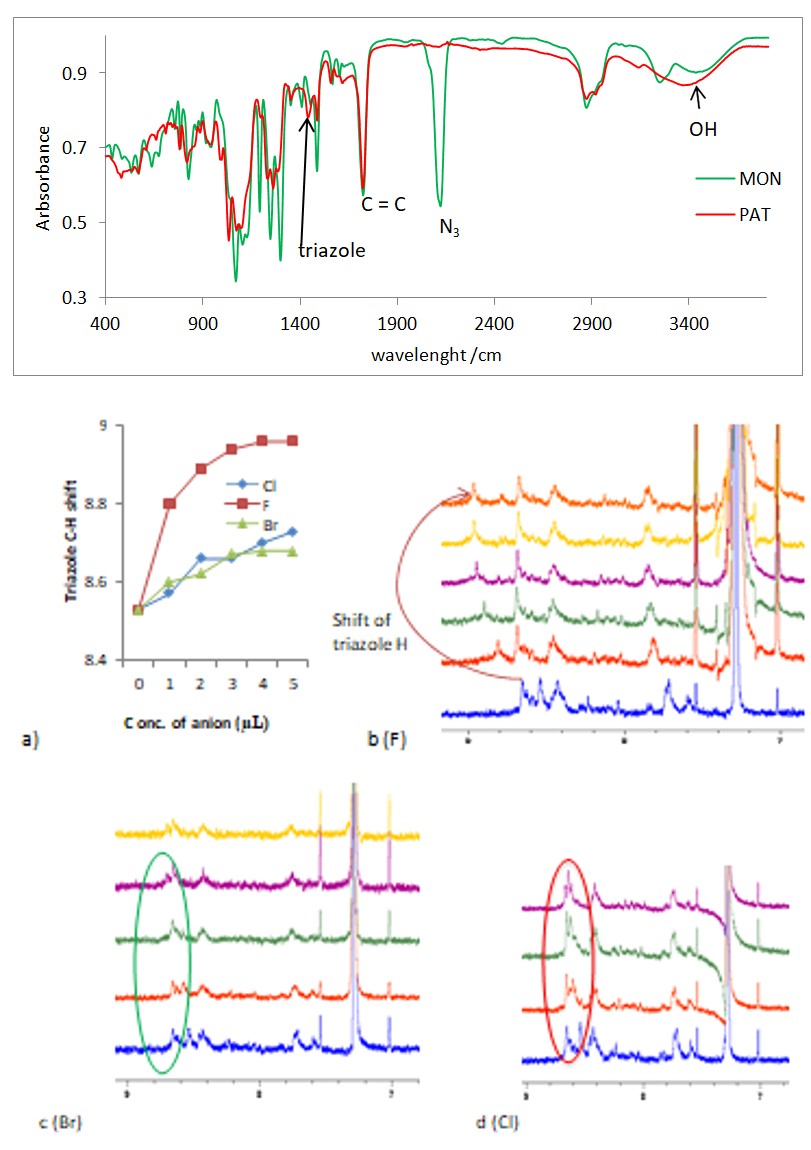
The structure of the PAT was confirmed by 1H NMR (Figure 1) and FTIR spectra (Figure 2). Besides the up-shifting of the polymeric proton signals compared to the monomer, the characteristic triazole ring C-H signal is observed at 8.53 ppm while the monomeric alkyne proton signal at 3.11 ppm disappears.
Results and Discussion
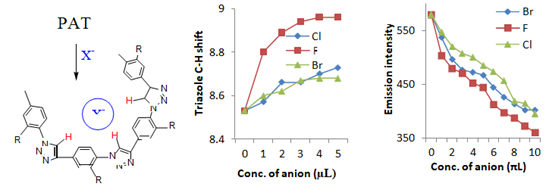
Considering the triazole ring as a functional group that can coordinate and form complexes with anions as shown in the (Scheme 2), we set out investigate the ability of the PAT to bind and form complexes with halide ions through the changes in the PAT’s NMR and fluorescence specra upon introduction of F-, Cl- and Br- ions using their tetra butyl ammonium sources. Titration of these anions into the PCT solution in CDCl3 induced significant shifts of the triazole C-H proton signal in the 1H MNR spectra. F-ion induced the highest shift of the triazole C-H proton signal from 8.53ppm for the uncoordinated PAT to 8.96 ppm upon titration of up to 6 µL as shown in the partial proton NMR (Figure 2). This shift of triazole C-H proton signal confirms the participation of triazole C-5 proton, as hydrogen bond donor, in the coordinating the halide anion. The same trend is observed upon titration of Cl- and Br- ions but with weaker shifts from 8.53 ppm for the uncoordinated PAT to 8.73 ppm and 8.68 ppm upon titration of up to 6 µL, respectively as shown in Figure 2.
In general, the binding of the halides to the PAT presumably arises from an organisation that involves folding up of the analogous PAT strand such that the polarized triazole CH H-bonds and the positive ends of their 5 D dipoles are directed into the central cavity to accommodate the halide. You LY, et al. [8] consequently, the presence of the halide ions induces rotation about the bonds connecting the triazole ring to the aryl ring leads to folding into a helical conformation. The ester functionality is likely to exert a stronger polarizing effect on the CH H-bonds due its electron withdrawing character.
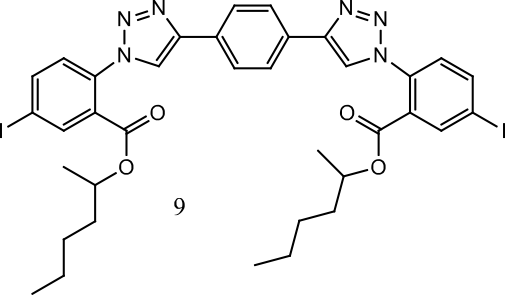
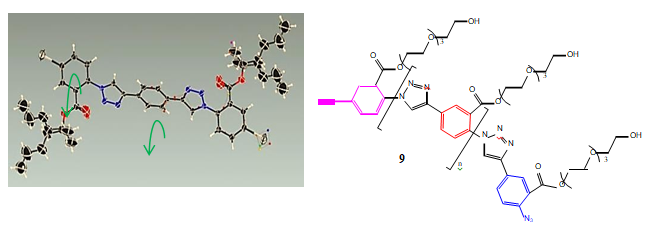
Numerous attempts to crystallize foldamers 8 for detailed structural analysis were unsuccessful, presumably due to the less ordered tetra (ethylene glycol) side chains. Hence, short analogue foldamer 9 (oligomer), that can form crystals, was designed. The oligomer shown in (Figure 3) contains the few phenyl-triazole repeat units, which are typical to the aryl- triazole repeat units of PAT 8, for easy purification via column chromatography and characterization. It also contains more ordered hexyl side chain.
Structural analysis of the crystal of 9 (Figure 4), obtained by slow evaporation the dichloromethane and methanol solvent mixture at room temperature, reveals anti–anti conformations this compound. With the ant-anti conformation of the triazole rings in the polymetic strand, it is apparent that the introduction of the halides into the PAT solution induces strand organisation that involves folding up of the PAT strand and rotation of the triazole ring about the bonds connecting the triazole ring to the aryl ring such that the polarized triazole CH H-bonds and the positive ends of their 5 D dipoles are directed into the central cavity to accommodate the halide [8]. This process of folding and rotation of bonds yields helical conformation. The ester functionality is likely to exert a stronger polarizing effect on the CH H-bonds by virtue of its electron withdrawing character.
In our further Studies to confirm the participation of the triazole C-H in coordinating the anions, changes in the fluorescence spectra upon introduction of the halide anions were studied. Recent studies have shown that the formation of the complexes between C-H group of the triazole and anions does enhance or quench fluorescence of the triazole bearing chromophores. It was observed that the emission intensity of the PAT decrease with increase in the concentration of F-, Br- and Cl- ions. As shown in (Figure 5) and consistent with NMR titrations, the PAT displays more pronounced quenching effect from F- compared to Br- and Cl- for which weak quenching effect is observed upon titration of the ions of up to 10 µL into PAT solution in chloroform (Figure 6).
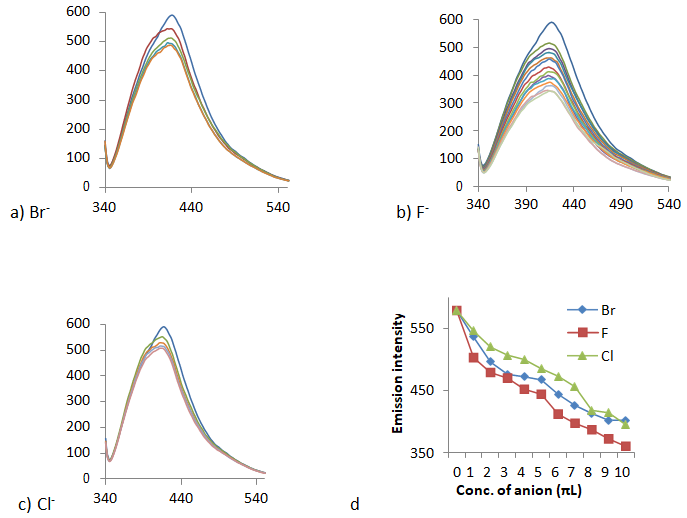
The quenching is attributable to the electron transfer resulting from the collisions between the PAT and the quenchers. In comparison to Br- and Cl-, the pronounced quenching upon introduction of F- can be attributed to higher electron affinity arising from its high nuclear charge.
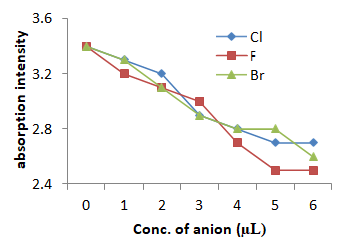
The same results were observed with absorption intensity as show in Figure 3. The PAT displays more pronounced UV Vis quenching effect from F- compared to Br- and Cl- upon titration of the ions into PAT 8 solution in chloroform.
Conclusion
In conclusion, a PAT has been prepared in good yields from azide and alkyne functionalized monomer, demonstrating the facile modularity click chemistry. Halide recognition by the PAT was observed with higher affinity to F- ion with the PAT in chloroform. This PAT, therefore, will be well-suited for basic studies of triazole as donor for hydrogen, with the present study clearly showing the importance of aromatic CH H-bond donors in binding anions.
Acknowledgements
For this work we acknowledge Nelson Mandela University (NMMU) for funding and facilities to carry out this project, and the department of Chemistry and Polymer science at Stellenbosch University for assistance.
References
-
Qin A, Lam JWY, Tang BZ (2010) Click Polymerization: Progresses, Challenges, and Opportunities. Macromolecules 43(21): 8693-8702.
-
Binder WH, Sachsenhofer R (2008) Click’ Chemistry in Polymer and Material Science: An Update. Macromol Rapid Commun 29(12-13): 952-981.
-
Bianchi A, Bowman-James K, García-España E (1997) Supramolecular chemistry of anions. Wiley-VCH, New York, USA, 15: 461.
-
Sessler JL, Gross DE, Lynch VM, Gale PA, Cho WS, et al. (2006) Calix[4]pyrrole as a Chloride Anion Receptor: Solvent and Countercation Effects. J Am Chem Soc 128(37): 12281-12288.
-
Hua Y, Flood AH (2010) Click chemistry generates privileged CH hydrogen-bonding triazoles: the latest addition to anion supramolecular chemistry. Chem Soc Rev 39(4): 1262-1271.
-
Alcantara-Garcia J, Jancik V, Barroso J, Hidalgo-Bonilla S, Cea-Olivares R, et al. (2009) Coordination Diversity of Aluminum Centers Molded by Triazole Based Chalcogen Ligands. Inorg Chem 48(13): 5874-5883.
-
Tropiano M, Record CJ, Morris E, Rai HS, Allainan, et al. (2012) Synthesis and Spectroscopic Study of d–f Hybrid Lanthanide Complexes Derived from triazolylDO3A. Organometallics 31(16): 5673-5676.
-
Li-Yan You, Shi-Gui C, Xin Z, Liu Y, Wen-Xian L, et al. (2012) C-H⋅⋅⋅O Hydrogen Bonding Induced Triazole Foldamers: Efficient Halogen Bonding Receptors for Organohalogens†. Angew Chem Int Ed 51(7): 1657- 1661.
-
Li Y, Flood AH (2008) Pure C----H Hydrogen Bonding to Chloride Ions: A Preorganized and Rigid Macrocyclic Receptor†. Angew Chem Int Ed 47(14): 2649-2652.
-
Lee S, Hua Y, Park H, Flood AH (2010) Intramolecular Hydrogen Bonds Preorganize an Aryl-triazole Receptor into a Crescent for Chloride Binding. Org Lett 12(9): 2100-2102.
-
Wang Y, Bie F, Jiang H (2010) Controlling Binding Affinities for Anions by a Photoswitchable Foldamer. Org Lett 12(16): 3630-3633.
- Sense, Gravity, Parity & Chirality in Mathematical Physics
- Quantum Lattice Simulations PHYSICS: Microcircuit Particle Formation and Observable Macroscopic Irreversible Time - A Discrete Lagrangian with Cellular Automata Framework
- Quantum Biology from Biomacromolecule to Cell, and Central Dogma Described by Quantum Theory
- Focus, Agility, Speed and Technology (FAST) for Sustainability and Growth
- Square Root Metric Geometry and Pati-Salam Model in Curved Space-Time
- A Simple System Demonstrating the Mpemba Effect in Classical Mechanics