
Luck: The Everything about
Most of the mankind is divided into two extreme views between the fatalists and non-believers in luck. Both these views are extreme views as a Creation’s luck appears to have two distinct components; one fixed component (scripted component) which is gifted to it by the Almighty at the time of its birth and second; a variable component (karma component) which could be cultivated by the Creation itself through its deeds by training of mind, planning of events, making preparations for the success of events, using social situations, personal strengths and by developing requisite intentions to assist the Almighty in running His majestic show of managing the activities of Universe. This variable component depends upon the Creation’s talent, capability of handling chance events, domain knowledge of the events, opposing forces, favoring forces and its capability to effect the change. The fixed component or the scripted component is dependent upon one’s origin, lineage, place of birth, date and time of birth, race, religion, caste, creed, class, sex etc. The total luck at any given point of time will be the sum total of the two components at that point of time. It can be concluded that every Creation has been given freedom by the Almighty to choose its own luck by making amendments in its scripted or by birth luck gifted by the Almighty through the variable component.
Introduction
Very often, we sincerely feel and believe that how lucky or how unlucky we are. Such beliefs become stronger whenever we happen to get something without our deserving to have so. We have a habit of blaming our luck every time we fail in an important task. These thoughts come to our mind without actually knowing the true meaning of the four letter word ‘luck’. We tend to intermix success with luck and try to relate every small or big result with our luck.
Heather Summers and Anne Watson have started their famous book ‘The Book of Luck’ with seven word sentence – There is no such thing as luck. They have mentioned seven luck indicators, namely, contend-ability, stick-ability, risk- ability, sense-ability, social-ability, perception-ability and person-ability. The authors very beautifully summarized that the book of luck is not about chance – it is about how to create your own luck by controlling your reaction to the chance events.
Richard Wiseman in his book ‘The Luck Factor’ states four principles of Luck- 1) Lucky people create, notice and act upon the chance opportunities in their life 2) Lucky people make successful decisions by using their intuition and gut feelings 3) Lucky people’s expectations about the future help them fulfil their dreams and ambitions. 4) Lucky people are able to transform their bad luck into good fortune.
Robert H. Frank’s book ‘Success and Luck’ shows how a more accurate understanding of the role of chance of life could lead to better, richer and fairer economies and societies.
A large number of great thinkers, philosophers, professors and authors have successfully explained the relation of success of a person or an organization with luck factor. Some of them have explained how to improve one’s own luck. Some others have explained the importance of chance management. And so on.
But as of now, a holistic understanding of luck appears to be illusory. We do not know the components of luck; its variability with time and surroundings; whether one can change his own luck; impact made by other persons etc. The available literature appears to be silent whether the other species of the Universe also possess any luck or not.
Components of Luck
A large number of people in the world are fatalists. They try to prove every good or bad event happening in their lives as the pre-written script in their luck. They sincerely believe that a person’s efforts have no bearing on the outcome of any event happening in his life and everything is pre-decided by the Almighty.
While some others believe, equally sincerely, that there is no such thing as luck. They are of the view that one can himself decide the fate of any event happening in his life.
Both the views look like extreme views. The Almighty has scripted some part of the luck at the birth of His every Creation and has given the freedom to the Creation to make amendments (addition or subtraction) in it through efforts/ deeds depending upon the Creation’s talent, capability to handle chance events, domain knowledge of the event efforts made by him, outside helping forces, outside opposing forces and the Creation’s capability to effect a change.
Based on the above discussion, we may conclude that luck has two components, namely, the scripted component and the karma component. The composition of each component is different from the other Creation and it varies with time for the same Creation.
The Scripted Component
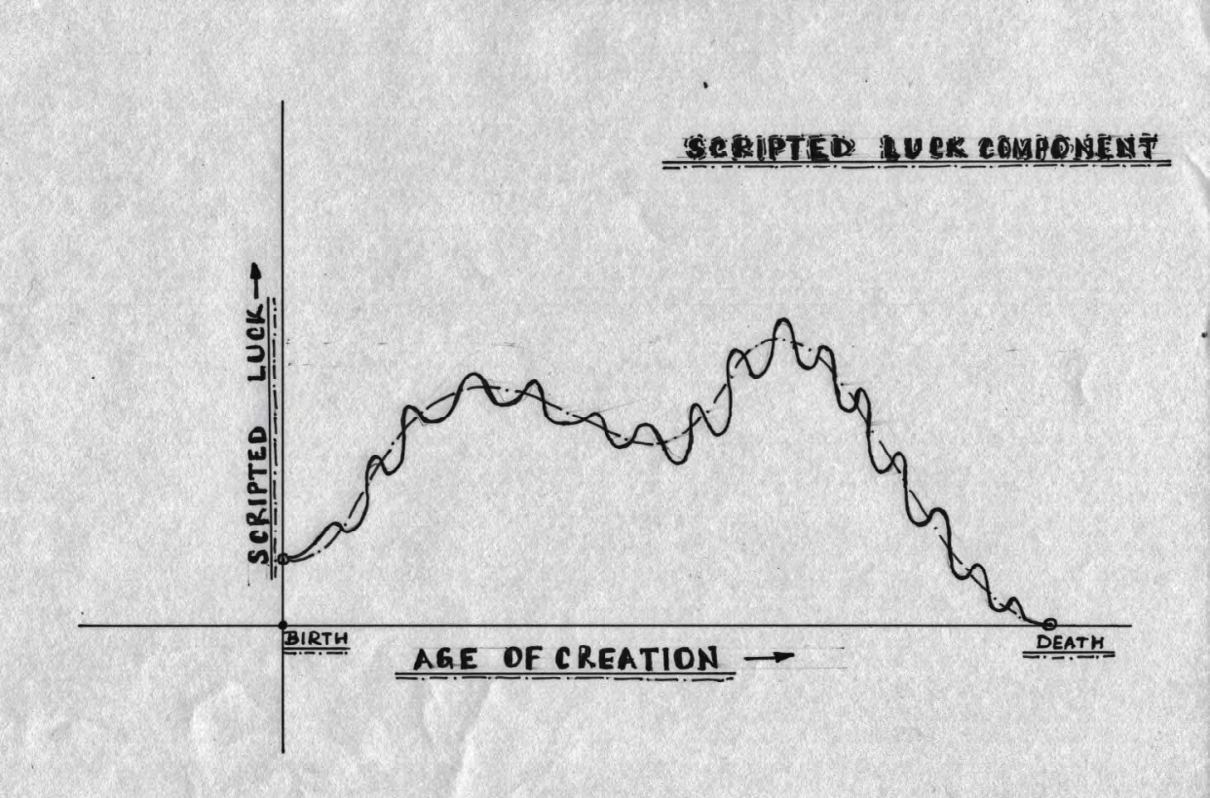
The God Almighty bestows upon every Creation a certain level of scripted luck regarding its survival, exposure to the vagaries of nature, important events in one’s life, death etc. That is to say the major milestones in a Creation’s life are scripted to a certain extent. The script is dependent upon one’s origin, lineage, place of birth, date and time of birth, race, religion, caste, creed, class, sex etc. The Creation enters the world with this scripted component. It is a fixed component which typically could be depicted, from birth to death of a Creation, as under:
The Karma Component
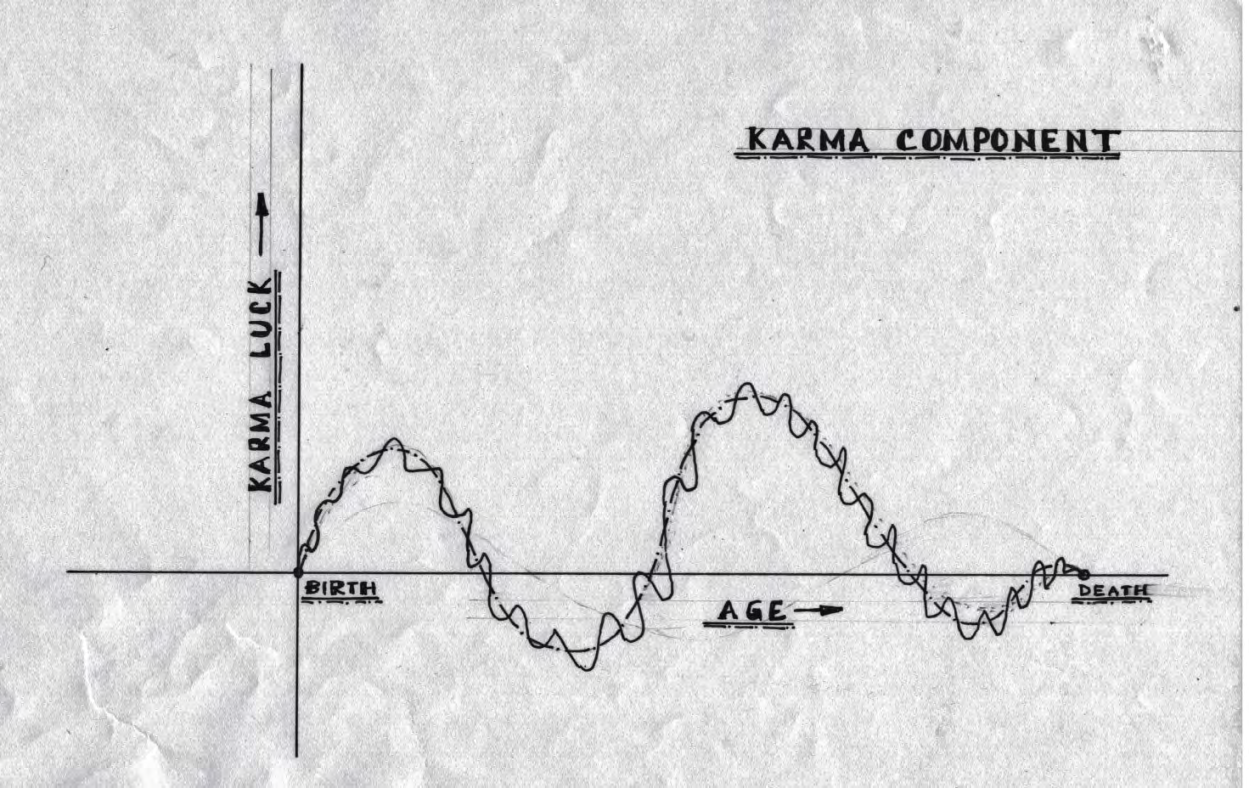
The Karma Component is mainly regarding day to day life events, small issues pertaining to survival etc. It has the capability to amend some important milestones of one’s life. The Karma basically denotes one’s desire to change, resolve to work, ability to do planning and strength to execute the planning. His capability, preparedness and readiness to handle chance events play a major role in developing the Karma Component and en-cashing the opportunity. External factors like outside opposing forces and the outside helping forces are equally important. A Creation needs to have an eye for recognizing such forces and it needs to have a readily available plan to handle them as per the call of the situation. The Karma component is a variable one and is dependent upon one’s willpower, integrity, positivity, sincerity, courage, ability to take decisions, respect for other Creations of the Universe etc. A Creation can always change this component through its actions that is, by exerting appropriate force on the constituents of the Universe. The Almighty, through this Variable Component levels the injustice meted out to a Creation by the mankind or by the nature. Un-adjudicated unpunished crime and deeds are also taken care of by the Variable Component. A typical Karma Component graph, from Birth to Death, of a Creation could be as under:-
Total Luck
Total luck of a Creation at any given point of time is the sum total of the two components at that point of time. The total luck could be more than the scripted luck or less than the scripted one depending on the value of the Karma Component at that particular point. It could even go below the zero line indicating a very bad luck. That is to say, everything or most of the things go contrary to the Creations’ expectations. However, if the total of the two components go above the value of the Scripted Component at a specific point of time, the Creation feels a good luck and most of the things whether planned or not, move in its favour. If the total remains very near to the Scripted Component, the things move as per the fatalistic view that is the Scripted Component.
Conclusion
A Creation is born with a certain quantum of luck at the time of its birth, a pre-determined luck during its lifetime and zero luck at the time of death. But that does not mean that everything in its lifetime is pre-determined. Infact, the Creation knowingly or unknowingly continuously adds or subtracts in the pre-determined luck component by effecting additions through the Karma Component. It does so by exerting force on the Universe through its deeds. This addition could be positive or negative depending on the force exerted. We may conclude that a Creation can partly choose its own luck by using social situations, personal strengths, training of mind, planning, making preparations and developing requisite intentions to assist the Almighty in running His majestic show of managing the activities of Universe.
References
-
Divine Intervention.
-
Richard W (2003) The Luck Factor.
-
Robert H Frank (2016) Success and Luck.
-
Summers H, Watson N (2006) The Book of Luck.
-
Ed Smith. Luck: What It Means and Why It Matters.
-
Amy Treadwell (2018) The Red Book of Luck.
-
Gay H, Carol K (2020) Conscious Luck.
-
Bechtel S (1997) The Good Luck. https://www.goodreads.com/book/show/248670.The_ Good_Luck_Book
-
Kaplan J. How Luck Happens.
-
Max G (1978) The Luck Factor. Ballantine Books.
-
Joan Barfoot. Luck.
- The Place of Wittgenstein’s Tractatus in the History of Philosophy
- Digital Hermeneutics Embodied in Brian Kim Stefans’ “The Dreamlife of Letters,” and Memory: Analog to Flash Interface in the Light of Ecofeminism
- Using C-Tables to Teach Class Logic
- The Ideology of Education’s Postponed Fantasies: Deepenings on a Pressing Problematic
- Phantasia and Perceptual Realism in Aristotle
- The Pleasures of Solitude