
Paradoxical Relationship between Concept and Experience: An Examination on the Possible Resemblance between Immanuel Kant’s Synthetic Cognition a Priori and New-born Neurodevelopmental Research
This article examines whether Immanuel Kant’s synthetic cognition a priori proposition is similar to the recent neuroscientific findings and contains empirical evidence from quantitative scientific research. It discusses the legitimacy and logical validity of Kant’s proposition. It also discusses whether such a proposition can answer which came first in the human cognitive system, concepts or experiences. This begins the natural process of acquiring new concepts and experiences daily. My research begins by extracting the meanings from the texts in §32 to §35 of Prolegomena to Any Future Metaphysics and interpreting what Kant sees as conditions for possible experiences. I shall then compare necessary conditions with scientific hypotheses and discoveries made by experts of infant neuroscience on initiating the human cognitive process. I shall comment on the strength of Kant’s proposition and conclude with relevant insights based to answer the above-mentioned question about concept or experience.
Introduction
Experience and concept have an interesting common dilemma, and it is sometimes puzzling to understand their relationship. A person’s everyday experience allows them to form relevant concepts to increase their knowledge capacity. For example, imagine when a person learns from a textbook (without encountering the real object) about a piano is, their concept of a piano is relatively vague as they have never actually seen nor touched a real piano in life. Although this person may know the textbook workings of a piano, like sounds from the piano keys, they would form a different concept (or a more comprehensive concept) of what a piano is when they experience its beautiful sounds. These “new concepts” would bring out some new experiences with the piano, like mentally forming a more coherent picture of what a piano is. This leads to “new concepts” combined with the previous concepts and the experience of playing them.
This example shows that concept and experience are inseparable from each other. Concept motivates new experiences, and previous experiences allow the formation of new concepts. This correlation of concept and experience is natural to us throughout life. We form new concepts and new experiences each day, and their accumulation forms us individually.
Let us have a thought experience and assume that we could go back to the moment of our birth. It is the exact moment when we left our mother’s womb, the moment when none of us had any worldly concept or experience since we arrived in the world. In the situation, devoid of any experience to build any concept, how does the first concept appear and kick-start the process of having new experiences? This is a paradox. It shares, in theory, some characteristics with the “chicken or egg” paradox. Similar to the age-old question about, which came first, the chicken or the egg? It is a natural phenomenon that people observe that hens lay eggs and chicks are hatched from eggs.
The “concept or experience” paradox also concerns the ultimate origin of something. In this case, it asks whether concept or experience comes first, so it becomes natural for us in the future to acquire new concepts and experiences every day. It is perhaps fair to assume that any of those paradoxes regarding the ultimate origin of any object (rather such object is physical or metaphysical) don’t usually have a straightforward answer to them.
The objective of the “concept or experience” paradox is certainly not a new discourse, according to philosophical and scientific traditions. This kind of discourse consists of a long debate between Immanuel Kant and David Hume about causality and whether metaphysics is even possible. Such kind of discourse is also discussed in the scientific research of today’s neuroscience by studying the workings of the human cognitive system on forming different experiences.
Perhaps, an answer to the “concept or experience” paradox is to assume the foundation of philosophy to understand the metaphysical relationship between concept and experience.
These assumptions have to be testified by drawing affirmations from the applied science to understand how the human brain may connect concepts and experiences metaphysically. The final assumption can even have some substantial support from the philosophical and scientific traditions and coherence with multiple aspects.
In the debate between Kant and Hume, Kant offered a new insight into the possibility of metaphysics by introducing a new kind of cognitive knowledge, namely the synthetic cognition a priori (which will be discussed in detail below). This proposition provides a better understanding of what a concept is and helps define the correlation between concept and experience. This article also examines the similarity of Kant’s proposition on synthetic cognition a priori to the recent findings of neuroscience. This proposition could be supported by some empirical evidence from quantitative scientific research. It would lead to further discussions regarding the legitimacy and logical validity of Kant’s proposition. There would be discussions on the propositions to answer, which of them, concept or experience, comes first in the human cognitive system to begin acquiring new concepts and experiences daily.
Hume vs. Kant: The Possibility of Metaphysics
In An Enquiry Concerning Human Understanding, Hume’s sceptical approach towards causality suggested that “causes and effects are discoverable, not by reason, but by experience.”1 It is because “the mind can never possibly find the effect in the supposed cause, by the most accurate scrutiny and examination. For the effect is different from the cause, and consequently can never be discovered in it. As the first imagination or invention of a particular effect, in all-natural operations, is arbitrary, where we consult not experience; so must we also esteem the supposed tie or connexion between the cause and effect, which binds them together, and renders it impossible that any other effect could result from the operation of that cause.”2 Because “every effect is a distinct event from its cause. It could not, therefore, be discovered in the cause, and the first invention or conception of it, à priori, must be entirely arbitrary…the conjunction of it with the cause must appear equally arbitrary; since there are always many other effects, which, to reason, must seem fully as consistent and natural. In vain, therefore, should we pretend to determine any single event, or infer any cause or effect, without the assistance of observation and experience.”3 From this, Hume concludes that reason has no power to think that there is any connection between cause and effect.
1 See Hume D, Beauchamp T (2000) An enquiry concerning human understanding: A critical edition (Hume, David, 1711-1776. Works 1998). Oxford: Clarendon Press. 20.
2 Ibid. 21.
3 Ibid. 21-22.
Kant understood that Hume’s sceptical approach towards metaphysics might be a challenge. Although Kant may not endorse this specified piece of the Humean solution towards causality, he would still affirm Hume’s efforts in the preface of Prolegomena to Any Future Metaphysic (hereafter to be referred as Prolegomena). He agrees that he (Hume) has “indisputably proved that reason can’t think such a connection a priori and from concepts, (because this [connection] contains necessity); and it can in no way be comprehended how, because something is, something else must necessarily also be, and, how, therefore, the concept of such a connection could be introduced a priori.”4 And metaphysics would never make it a possibility in such cases since only analytical a priori knowledge and synthetic a posteriori knowledge may exist.
Kant commented that Hume’s proposition infallibly makes “concept. And all of its cognitions allegedly established a prior would be nothing but falsely marked ordinary experiences.”5 Under such a proposition by Kant, then the above-mentioned “concept or experience paradox” would only be a false/fictional paradox because there is no correlation between concept and experience, as “concept” cannot appear at all in the first place.
Kant responded to Hume’s criticism on the impossibility of metaphysics by proposing the existence of a new type of knowledge, namely the synthetic a priori knowledge, and that metaphysics can exist by introducing it. The synthetic a priori knowledge, suggested by Kant, describes the transcendence of a mind capable of generating the structure of objects and its unity synthetically, is before any experience.6 But how is synthetic judgement a priori possible? Such a proposition go against the principle of contradiction by combining multiple concepts without using any experience to bridge it.
This is also one of the central questions revolving around and penetrating through Kant’s most influential works like Critique in Pure Reason (hereafter to be referred as Critique) and Prolegomena. Kant questions in Critique that, “if I want to go beyond the concept A to find another concept B connected
4 Ibid. 7.
5 Kant I, Hatfield G (2004). Prolegomena to any future metaphysics that will be able to come forward as science : With selections from the Critique of pure reason (Rev. ed., Cambridge texts in the history of philosophy). Cambridge, UK ; New York: Cambridge University Press. 7-8. Hereafter Prolegomena.
6 Wikipedia contributors (2020, April 28). “Transcendence (philosophy).” In Wikipedia, The Free Encyclopedia. Retrieved 02:58, August 11, 2021, fromhttps://en.wikipedia.org/w/index.php?title=Transcendence_ (philosophy)&oldid=953729103.
with it, what do I rest on through which a synthesis might be possible, considering that I cannot be looking in the field of experience?”7 And Kant stressed the importance of answering this question by emphasising in Prolegomena that “all metaphysicians are solemnly and lawfully suspended from their occupations until they satisfactorily answer the question-How are synthetic cognitions a priori possible?”8 Such questions also touch Kant’s thoughts on how a transcendental procedure may initiate any received intuition to be subsumed into the concept for forming any experience. Therefore, proving the possibility of synthetic cognition a prior brings a predictable solution for how experience and concept are related. It is because it proves that a concept may appear before experience in the beginning. The solution to the “concept or experience” paradox is through evidence that proves whether it truly accords to Kant’s proposition that synthetic cognitions a prior is possible so that concepts are not just some “falsely marked ordinary experiences”.
I will begin my research by extracting the meanings from the texts in §32 to §35 of Prolegomena and interpret what Kant regards as the necessary conditions for possible experience. I will then compare these conditions with scientific hypotheses and discoveries from the expertise of infant neuroscience on how human cognitive processes initiate. I shall comment on the strength of Kant’s proposition based on this comparison and conclude with relevant insights by replying to the original question in this article, which appears first concept or experience, in the very beginning for any person?
An Overview on Kant’s Text in §32 to §35 of Prolegomena
This section of the article covers some brief overviews on the specified texts in §32 to §35 of Prolegomena. These texts provide a hint on how Kant imagines the cognitive process that constructs the psychological associations and understandings of a human being.
In §32, Kant emphasises the existence of the two worlds, the sensible and the intelligible world. While the sensible world consists of sensible beings or appearances that Kant refers to as the phenomena. The intelligible world consists of special intelligible beings that Kant refers to as
7 Kant I, Guyer P, Wood A (1998) Critique of pure reason (Kant, Immanuel, 1724-1804. Works. English. 1992) Cambridge; New York: Cambridge University Press. [A:8-10; B:11-14]. Numbers in brackets refer to the Critique of Pure Reason first (A) and second (B) editions respectively. Hereafter Critique.
8 See Kant, Prolegomena, 29.
the noumena. Phenomena refer to “things of senses” that include subsumption under pure concepts of understanding. Noumena refer to “thing in itself” and is completely inaccessible in anyhow.9 Despite the differences between noumena and the phenomena, they have certain similarities. It is the same way when appearance and illusion are considered alike. For instance, in this case, the objects of the senses are merely appearances in the phenomena.
The “objects of the senses” are mentioned,10 referring to the information which our sensations collectively grant to us. Our five senses include sight, sound, smell, taste, and touch. Each of them corresponds to a unique consciousness that is visual, auditory, olfactory, gustatory, and tactual consciousness, respectively. We get various external data from this consciousness, and they collectively contribute to building important information a person receives.
When someone views the “objects of the senses” as phenomena, it implies that the person also admits to the noumena that lay the foundation for the phenomena. Kant, in response to Hume, does not deny the fact that nobody can access the noumenal world; and the fact that nobody knows what possibly determine a thing in itself or to know what it is composed of. Even though the noumena world is completely inaccessible and its contents unknown to us, it exists through its representation in the phenomena, as this unknown something affects our senses.11 When someone accepts the phenomenon, they also admit the existence of a thing in itself. It is because pure concepts of understanding and pure intuition (which will be introduced more in the next paragraph) refer to nothing except the objects of possible experiences.12 The representation of the noumena in the phenomena must be coherent with and build upon possible experiences.
In §33, Kant emphasises what experience cannot teach us and what is the category (and it is often known as the transcendental table of concepts of the understanding). The category contains four primary aspects of any judgement. They each contain three variations and collectively, they form a family of pure concepts, shown in the figure in the earlier section, §21 of _Prolegomena._13
9 Kant, Prolegomena, 66.
10 Ibid. 66.
11 Ibid. 66. Note that the idea that human sensations can impacted by the noumena contains a lot of controversies, but the direct text of Kant (in the Cambridge translation) on section 32 seems to support this idea.
12 Ibid. 67.
13 Ibid. 55.
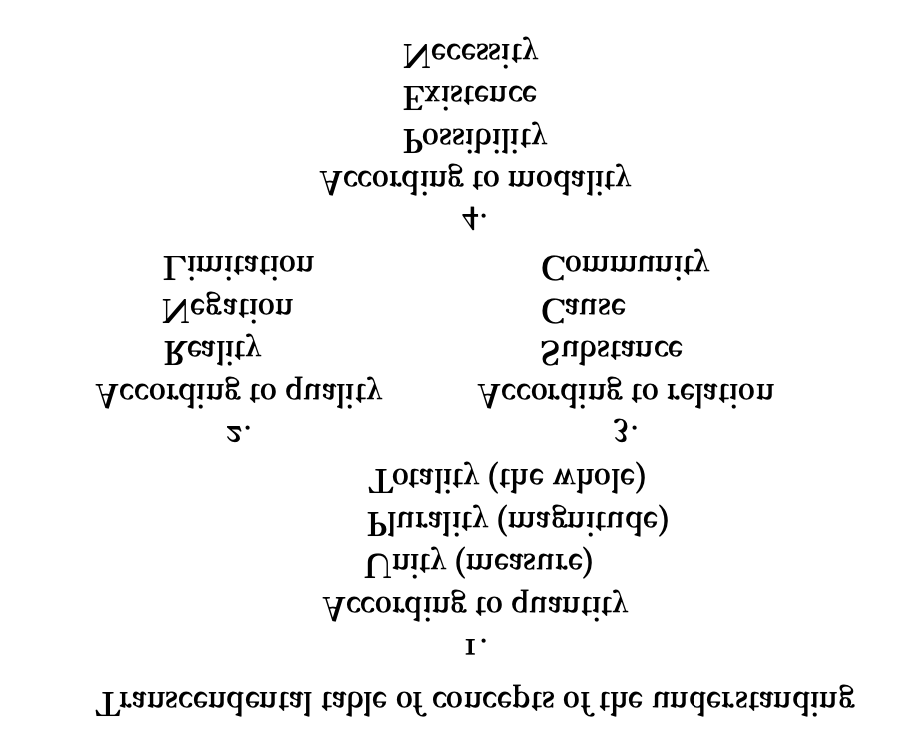
Kant also explains that pure concepts of understanding are independent of all possible experiences, and these pure concepts do not have the sensory appearance (and that is why they cannot be any object of senses). Pure concepts of the understanding refer to the “things in themselves”, and they include the necessity of determination that is beyond all possible experience.14 Kant uses this point to argue that there is much more to the noumena, much more than its sole application on possible experience. These experiences set boundaries for what noumena can express or reach.
In §34, Kant relates to Critique for the two investigations on pure concepts of the understanding. These two investigations reiterate how pure concepts of understanding and their principles are independent of possible experiences. The first investigation states that the senses do not and cannot contribute to the pure concepts concretely (in concreto), except to establish a cognitive framework for applying pure concepts of understanding.15 The objects applicable for this framework must associate with possible experiences as the product of the understanding from materials of sensibility.16 Kant’s second investigation suggests that pure concepts of understanding exist before any possible experiences.17
14 Ibid. 67. Note that this is another controversial debate among Kantian studies, on whether it shall be “thing in itself” or “things in themselves”. Since “thing in itself” should already refer to the total combination of the intelligent beings which represent the noumena, so there should not be a plural form of “thing in itself” as there is only one noumena. But Kant in the text of §32 and in some previous sections (in Cambridge translation) had employed the term “things in themselves” a few times, and Kant had also suggested in §3 that pure concepts of the understanding seem to refer to “things in themselves”.
15 Kant, Critique, A 037 ff. / B 076 ff
16 Kant, Prolegomena, 68.
17 Kant, Critique, A 235 ff. / B 294 ff.
However, the only way for pure concepts of understanding can be meaningful is through experiences. Pure concepts of understanding are more significant than the entire application of their vocations to possible experiences. Nothing can develop from or through pure concepts of the understanding when they are outside of the region of possible experiences.
It is because the core function of pure concepts of the understanding determines the logical form of judgement related to given intuitions, but since sensibility provides a person with the intuitions, it is a possible experience. Although pure concepts of the understanding, in theory, are independent of possible experiences, they have inherent principles18 and can “survive” by themselves. The pure concepts of the understanding, however, do not concretely show up without possible experience. This would make them completely lose their significances.19 Possible experiences serve as a connecting platform to generate intuitions that are then used as materials to process with a logical form of judgement built by pure concepts of the understanding. Pure concepts would have no choice but to become dysfunctional, which would make pure concepts completely meaningless.
Kant explains in §35 the process of understanding in correlation to possible experiences. Understanding occurs before possible experiences. It puts the existing elementary cognitions before all experiences. They must always have their application in experience for them to have meaning.20 Since understanding extracts its principle from itself, it is independent of possible experiences. It makes the removal of restrictions possible by itself that bind imagination within an experience.21
An Interpretation to the Selected Kant’s Texts
We can interpret how Kant imagined the various stages of experiences that occur within a person by extracting the meanings of the texts from §32 to §35. It starts from an initial stage of receiving intuitions, moves on to another stage for it to be subsumed under concepts, and finally forms a possible successful experience.
It considers the entire process as one completed picture of cognition. On the one hand, we have the noumena that are completely inaccessible and makes “thing in itself” to be indeterminable. On the other hand, we have the phenomena
18 Kant, Prolegomena, 68-69.
19 Ibid. 68.
20 Ibid. 69.
21 Ibid. 68-69.
divided into two faculties and are the faculty of sensation and understanding. The faculty of sensation contains two types of intuitions, pure and empirical. While pure intuitions are space and time, empirical intuitions refer to the sense data configured and organised according to pure intuition.
The entire process begins with the impact of the noumena on human sensations and intuitions arriving in a subject’s mind through their senses. The empirical intuitions come out of sensation. However, we can determine the intuitions are determinable but have not yet been determined. This means that they could be made sense of, but no sense has been made out of it yet. These intuitions also motivate the beginning of a thinking process in the subject’s mind. They begin to “interact” with the noumena and form the first stage of the constitution of experiences.
Pure institutions also arrive at this first stage that has the ordering of outer sense according to space, and the ordering of inner sense has to be according to time. There is nothing before this first stage as there is no space and time. According to the space and time that are according to outer and inner senses, the phenomena then forms this specified moment onwards. All this includes the first stage of the constitution of experience, and this stage is more passive than active. It is fair to assume that a subject has no control to prevent these intuitions from generating through their sensation. This is why it makes the subject more passive and have no other choice but to receive all of these unprocessed sense data. These unprocessed sense data would be used in the following stage for the subject’s mind and thinking.
After this comes the second stage of the constitution of experience. It corresponds to the faculty of understanding and heavily revolves around “concepts”. The faculty of understanding consists of two types of content, empirical concepts and pure concepts. In this stage, the activity of understanding happens that becomes the act of judgment (The act of judgment here refers to the “judgement of perception” although this article does not thoroughly include this idea).
Pure concepts of the understanding define possible ways for judging, and that makes them the necessary conditions for the occurrence of any possible experiences. Both pure and pure concepts of the understanding are categorised as synthetic a priori knowledge by applying them to Kant’s proposition. It is because they both are independent of any experiences and could survive independently (meaning that they do not rely on something to exist). The empirical concepts arise from empirical experience, which includes concepts like colour, feature, texture, etc. These types of concepts collectively construct the second stage of the constitution of experience. This stage is more active than passive since it corresponds to the process of actively subsuming intuitions under concepts.
In conclusion, there are two major aspects of experience, a passive and an active aspect that are the two stages of the constitution of experiences. The two stages of constitutions of experiences correspond to two types of faculties, the faculty of sensation and understanding. Each type of faculty includes two types of content, pure and empirical. It is only after these two stages of processes and experience is established.
Philosopher Ray Liikanen proposes a similar idea that multiple concepts (or, in his expression, “ideas”) “are inextricably linked”22 before experiences are established. According to my interpretation of Kant’s text, it is before the second stage of the constitution of experience finally coming into realisation. As Liikanen states, “I find that I do not have only one idea in mind – namely, the common-sense definition of nothing – but what I find is that I have in mind an idea of that, which reaches infinitely beyond my finite powers of comprehension… (also) there are no arbitrary limitations of any kind that I can impose upon such a pure concept. Therefore, I can judge this concept amounts to an idea, which is absolute… but as this idea stretches infinitely beyond my reach, I am left with not only one idea. Rather, I am left with two ideas, and these two ideas are: A) the idea of an external, objective, unconditional, infinite, absolute, voids state, and this only and necessarily related to B) an internal, subjective, conditional, and finite representation of A.”23 Liikanen’s definition of “the idea of external and objective” shares some coherent features related to my idea of “the active stage”. Liikanen’s definition of “the idea of internal and subjective” also shares some coherent features related to my idea of “the passive stage”. There is also textual evidence from Kant’s other works supporting the “two stages” interpretation, where cognition is formed only if both the passive stage and the active stage are complete.
Philosophers Marcus Willaschek and Eric Watkins commented in their recent research that Kant “in three separate places…provides either a definition of cognition or a taxonomy of representations that includes cognition as its central components: (1) a passage from the so called Jäsche Logik (9:64), (2) the so-called Stufenleiter passage (A320/B376–7), and (3) several passages at the beginning of the Transcendental Logic (A50–51/B74–75; A92/B125; B137; B146).”24 Willaschek and Watkins argue that out of
22 Liikanen R (2013) BEYOND KANT AND HEGEL: IN ANSWER TO THE QUESTION, “HOW ARE SYNTHETIC COGNITIONS A PRIORI POSSIBLE?”. The Review of Metaphysics, 66(3): 487.
23 Ibid. 487.
24 Willaschek M, Watkins E (2020). Kant on cognition and knowledge.
Kant’s three separated works, the “most comprehensive and detailed classification involving cognition (is to be) is there in the Jäsche Logik, where he distinguishes seven “degrees of cognition”.25 These seven “degrees of cognition” are necessary to complete the circle of cognition.
According to Willaschek and Watkins, these seven “degrees of cognition” distinguished by Kant are as follows:
- The first degree of cognition is representing something
- The second is representing something with consciousness, or to perceive (percipere);
- The third is acquaintance with (noscere), or representation of something compared to other things, both for similarity and difference.
- The fourth is acquaintance with something with consciousness, i.e., to cognise it (cognoscere). Animals are acquainted with objects, but they do not cognise them.
- The fifth is to understand something (intelligere), i.e., to cognise something through the understanding of concepts, or to conceive. Although one cannot comprehend it, one can conceive much, e.g., a perpetuum mobile, whose impossibility we see in mechanics.
- The sixth is to cognise something through reason or to have an insight into it (perspicere). With few things do we get this far, and our cognitions become fewer and fewer in number the more that we seek to perfect them as to content.
- The seventh is to comprehend something (comprehendere), i.e., to cognise something through reason or a priori to the degree that is sufficient for our purpose.”26 Although it may not be the exact wording, on closely analysing the above-mentioned summary, these seven “degrees of cognition” can be categorised into two stages. The degree I to III is one stage and degree IV to VII, the other one.
The stage involving degrees I to III focuses on the action of perceiving and creates more passive situations position of waiting where the agent becomes conscious of the intuitions that they receive. The stage that involves degrees IV to VII focuses on the action of conceiving and creates more active situations position of requiring where the agent constructs an understanding/makes sense of the intuitions received.
Both Willaschek and Watkins also support the classification of the seven degrees into two stages-a passive Synthese (Dordrecht), 197(8), 3197.
25 Ibid. 3197.
26 Ibid. 3198.
stage and an active stage. They would argue that “cognition in this sense must satisfy two conditions: (i) a givenness- condition, according to which an object must be given to the mind and (ii) a thought-condition, according to which the given object must be conceptually determined.”27 Cognitive experience (which is certainly the mainstream of experience in the wider spectrum of “experience”) is known as a property of cognition. Therefore, the distinction that Kant provides on going through the different stages before forming cognition shall support my “two stages” interpretation mentioned above. Kant also affirms the “two stages” interpretation in his other argument on Critique that, “there are two conditions under which the cognition of an object is possible: first is intuition, through, which it is given, but only as appearance and second is the concept, though, which an object is thought that corresponds to this intuition.”28
Some Recent Developments and Discoveries in infant Neuroscience
Now let us try to understand some recent discoveries in neuroscience, specifically related to infant development. There has been some remarkable progress in studying the way of how infants organise the concept of idea and motivate the actualisation of human experience. The studies on this topic focus on studying the object identification process occurring in immature brains. The outcome of such processes is often regarded by neuroscientists as object individuation.
Object individuation refers to the functional organisation of the brain. It determines how the human brain forms the basis of complex thoughts and behaviour. This specified type of research examines how the organisation of knowledge functions precedes experience and gains them, whether social or educational.
One of the most basic human cognitive capacities, from the perspective of neuroscience, is tracking the identity of objects. It constructs coherent representations of objects even when lacking direct perceptual experience.29 Several studies show that neuroscientists have “identified developmental hierarchies in the type of information to
27 Ibid. 3200.
28 Kant, Critique, A92/B125.
29 Baillargeon, R. et al. (2012) “Object individuation and physical reasoning in infancy: an integrative account_.” _Lang. Learn. Dev. 8, 4–46; and Leslie, A. et al. (1998) “Indexing and the object concept: developing ‘what’ and ‘where’ systems.” Trends Cogn. Sci. 2, 10–18; and Wilcox, T. (1999) “Object Individuation: Infants’ use of shape, size, pattern, and color.” Cognition 72, 125–166.
which infants will probably attend when tracking objects through occlusion, age-related changes in the way that individuals are represented, and mechanisms for change.”30 There is a bottom-up process (the dorsal stream, indicated with the blue arrow in the figure below) and a top-down process (the ventral stream, indicated with the yellow arrow in the figure below) to understand how the human brain functions when it configures and organises any received perception and cognition. When some unprocessed sense-data arrives at the human’s visual cortex, depending on the data type, it would either follow the dorsal or ventral stream to activate the organisation of such data.
When following the ventral stream, it moves from the posterior temporal cortex to the anterior temporal cortex. “The posterior temporal cortex manages the elementary- level object processing without making any reference to type or function, while the anterior temporal cortex manages a higher-level object processing, like object identification, categorisation, and semantic information.”31 When following the dorsal stream, it moves through the posterior parietal cortex that mediates shape representations, formed based on motion-carried information.3233
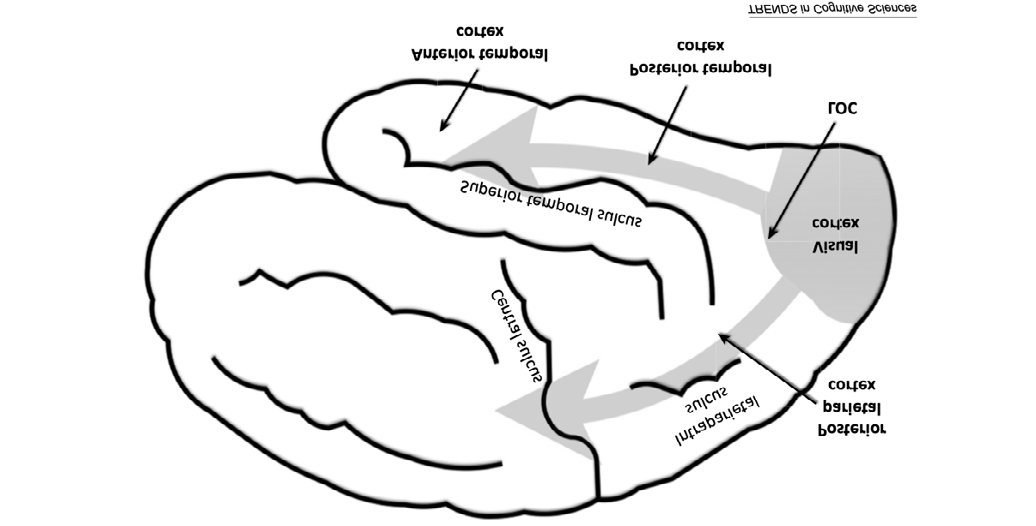
While the dorsal stream is crucial for processing information about the spatiotemporal properties of objects, the ventral stream is crucial for processing information about the featural properties of objects.34 Multiple research experiments, conducted on human infants across different stages of their infancies, observed how the different areas of their immature brain react to the
30 Wilcox, T., & Biondi, M. (2015). “Object processing in the infant: Lessons from neuroscience.” Trends in Cognitive Sciences, 19(7): 406.
31 Ibid. 406.
32 Ibid. 407.
33 Ibid. 407.
34 Ibid. 407.
incoming unprocessed sense data. The experiment aims to test whether age difference would influence how infants employ the different streams of processing (either dorsal, ventral, or both) for the configuration and organisation of perceptions. This also assumes that older infants have already obtained more social and educational experiences than the younger ones and that these accumulated experiences affect the processing of various data.
When the tested subjects received various shaped objects in several colours, the experimental data showed that infants aged approximately 4.5 months use the shape difference to individuate objects, but by 11.5 months, they begin to use the colour differences to individuate objects.35 The anterior temporal cortex activates only when infants individuate objects by their features. For example, infants aged between 3–9 months used shapes and not colour information to individuate objects, we saw activity in the anterior temporal when viewing the shapedifference but not the colour-difference. For infants aged between 11–12 months who used shape and colour information to individuate objects, the activity shows in the anterior temporal cortex when viewing either the shape-difference or the colour-difference.36 The fact that the anterior temporal shows up only when infants interpret featural differences to signal the presence of distinct objects implies that the anterior temporal cortex activates during an individuation process.37 This shows that younger infants, in the early stages of infancy, depend heavily on spatiotemporal information for individuating objects. For instance, “infants of 3.5 months show sensitivity to discontinuities in speed and path of motion. This remains the same throughout their infancy.”38 For 6 months and younger (but not older) infants, activation shows up in the posterior parietal cortex during the shape-difference event. Younger infants, who have undeveloped vision, are likely to depend on motion-carried rather than contour information to extract object shape. This implies that younger infants are likely to show activation in the dorsal stream when they process information from a shape-difference event.39 The hypothesis, made by the experiment data, is that
35 Ibid. 408.
36 Ibid. 409.
37 Ibid. 409.
38 Ibid. 408.
39 See Banks, M. (1977). Visual acuity development in human infants: A re-evaluation. Investigative Ophthalmology & Visual Science, 16(2): 191-193.
the attention of infants to colour depends on the structure of the physical world. Their experience of the physical world is supported by studies revealing that, given experiences that point to the predictive value of colour information, or highlight colour as a stable and integral part of an object, infants will focus on colour differences.40 Another important reason such experimental data appears is the colour of an object is considered arbitrary. It does not help infants, aged less than 11.5 months, to predict the object functions nor how it moves in space and interacts with the physical world. The concept of colour is subjective to the test subject’s perspective and changes over time.
A Comparison of Kant’s Proposition & Infant Neuroscientific Discoveries
So a person might question the relation of this experiment with Kant’s suggestion on Prolegomena about the constitution of experiences. There are a few distinct features found in the experimental data that share strong resemblances with Kant’s proposition.
Firstly, the experiment shows that when experience is insufficient to provide the additional information (like previously known concepts) to make a personal judgement, the inner system of the human brain leans towards the naturally fundamental concepts inserted in us. These construct a necessary foundation for forming basic human cognitive capacities. It would be the identification process, in this case. We can say there are some “pre-installed” concepts preceding experience.
Secondly, this experiment highlights the significance of time and space. One may have an inaccurate first impression by imagining that both shape and colour are empirical concepts and they are similar to each other. Empirical concepts still require certain social or educational experiences to obtain the necessary knowledge for the identification of different shapes and colours, like square, triangle, circle, etc., for shape; and blue, red, green, etc., for colours. Thus, we can argue that this does not have adequate strong evidence that the tested infants need pre-installed concepts to understand the event. It is true that from some perspectives, the shape and colour events would have similar concepts that require experiences for proper representation. This analysis, conducted by researchers, includes a specified emphasis on how various shaped objects would stimulate the infants’ minds and motivate them to observe their somewhat “hidden” functions while interacting with the physical world. It includes how different shapes of objects have varied physical spaces and movements. (E.g. for the same size of a
40 See Wilcox, Object processing in the infant: Lessons from neuroscience, 409.
square and a circle, the square appears to be larger than the circle because of its four angles.) Lastly, the experiment data also shows that the natural human cognitive capacity is independent of any possible experience. This cognitive capacity exists before experiences and helps compose a foundation for the organisation of human knowledge. It must contain some “pure” contents to serve as its foundation for something like natural cognitive capacity to precede experience. Otherwise, it would lose its prime function to construct the foundation of knowledge organisation. All of these would echo the “synthetic a priori” concept introduced by Kant. The “pure” contents included in natural cognitive capacities share similar characteristics and principles with pure intuition and the concept of understanding. For instance, if a younger infant processes data from the event, without sufficient experiences, it would be “observing a shapely object move in motion”. It would require the pure intuitions of space for them to recognise that the shapely object interacts with the physical world similarly as it occupies physical space. After adding the pure intuition of time, the infant would be able to subsume all of the “determinable but not yet determined” information into the pure concept of quantity. They can even analyse its motion through physical space that is built upon a series of collective moments in time. That would finally include an experience for the infant.
As the discipline of neuroscience rapidly developed in the recent decades, we can certainly see the remarkable resemblances between the neuro-scientific discoveries and Kant’s synthetic a priori proposition, which precedes the rise of neuroscience. This comparison helps assert a degree of legitimacy of how Kant’s metaphysics on the human cognitive system is coherent with neuroscience. Unlike Hume’s proposition that may conflict with the findings of neuroscience, Kant’s proposition shows very minimal contradiction if it is to exist simultaneously with various forms of applied science.
Conclusion
In conclusion, it seems that Kant’s proposition can be grounded in the tradition of (applied) science. This, alone, fulfils one of the primary objectives Kant indicated in Prolegomena.
Kant’s proposition on causality and metaphysics also align well with the research findings of neuroscience.
Kant’s approach suggests the possible existence of synthetic prior knowledge makes room for the appearance of pure concept before any experiences arrive. It seems more advantageous than Hume’s approach that merely affirms the existence of experience and nothing else.
Thus, going back to the “concept or experience” paradox and the original question of which of the two came first, the whole experience initialisation process can begin thereafter. It seems logical to accept Kant’s proposition and positively affirm the possibility that there are some well-constructed concepts pre-installed in the human cognitive system. These “preinstalled” concepts can act as a preliminary foundation in forming the first human experience. Therefore, it may not be completely inaccurate to assume that concept precedes experience. Such assumptions can even find favours in both the traditions of philosophy and science.
References
-
Baillargeon R, Stavans M, Wu D, Gertner Y, Setoh P, et al. (2012) Object Individuation and Physical Reasoning in Infancy: An Integrative Account. Lang Learn Dev 8(1): 4-46.
-
Banks M (1977) Visual acuity development in human infants: A re-evaluation. Investigative Ophthalmology & Visual Science 16(2): 191-193.
-
Hume D, Beauchamp T (2000) An enquiry concerning human understanding: A critical edition (Hume, David, 1711–1776. Works. 1998). Oxford: Clarendon Press.
-
Kant I, Hatfield G (2004) Prolegomena to any future metaphysics that will be able to come forward as science: With selections from the Critique of pure reason (Rev. ed., Cambridge texts in the history of philosophy). Cambridge, UK; New York: Cambridge University Press.
-
Kant I, Guyer P, Wood A (1998) Critique of pure reason (Kant, Immanuel, 1724–1804. Works. English. 1992). Cambridge; New York: Cambridge University Press.
-
Leslie AM, Xu F, Tremoulet PD, Scholl BJ (1998) Indexing and the object concept: developing ‘what’ and ‘where’ systems. Trends Cogn Sci 2: 10-18.
-
Liikanen R (2013) Beyond kant and hegel: in answer to the question, “how are synthetic cognitions a priori possible?”. The Review of Metaphysics 66(3): 469-493.
-
Wikipedia contributors (2020) “Transcendence (philosophy).” In Wikipedia, The Free Encyclopedia.
-
Willaschek M, Watkins E (2020) Kant on cognition and knowledge. Synthese (Dordrecht) 197(8): 3195-3213.
-
Wilcox T (1999) Object Individuation: Infants’ use of shape, size, pattern, and colour. Cognition 72: 125-166.
-
Wilcox T, Biondi M (2015) Object processing in the infant: Lessons from neuroscience. Trends in Cognitive Sciences 19(7): 406-413.
- The Place of Wittgenstein’s Tractatus in the History of Philosophy
- Digital Hermeneutics Embodied in Brian Kim Stefans’ “The Dreamlife of Letters,” and Memory: Analog to Flash Interface in the Light of Ecofeminism
- Using C-Tables to Teach Class Logic
- The Ideology of Education’s Postponed Fantasies: Deepenings on a Pressing Problematic
- Phantasia and Perceptual Realism in Aristotle
- The Pleasures of Solitude