
The Grothendieck’s Toposes as the Future Mathematics of AI
The aim of this article is to discuss the idea that the notion of topos could become the future mathematics of AI, by giving more emphasis to geometric forms, compared to the currently mainstream approach, which favors numbers through statistical procedures. AI engineers are looking for theories that can formalize the basic elements that shape their daily work, as well as the basic operations that structure how the human brain works. The notion of topos could contribute largely to satisfying these two main aspirations of AI engineering. The article is a part of a questioning on the nature of intelligence and supposedly intelligent machines. In this respect, it would be useful to enrich the approach that assimilates the topos as a kind of bridge that removes all the inessential aspects of things to be connected to keep an common essence that associates mathematical things. One of the most promising avenues from the archeology of the discourse on the topos is the reading by meaning. This art of reading well gives rise to the notion of conceptual strata which shows that the things to be connected have a layered configuration. What seems insignificant –in view of a supposed essence– through one conceptual stratum, might seem important through another, even capital. Rather than calling something ‘insignificant’, a consistent relativism of ‘insignificant for’ would be more appropriate, according to the conceptual stratum considered.
Introduction
According to John McCarthy, considered as one of the founding fathers of AI, together with Claude Shannon, Alan Turing, Marvin Minsky [1, 2, 3, 4, 5], Nathaniel Rochester [2], Allen Newell and Herbert Simon [6], AI “is the science and engineering of making intelligent machines, especially intelligent computer programs. It is related to the similar task of using computers to understand human intelligence, but AI does not have to confine itself to methods that are biologically observable”. Creating and developing artificial intelligence essentially requires three major ingredients: data, an algorithm, and Conceptual Paper the of fast processing complex mathematical calculations. Artificial Intelligence has evolved into Machine learning, then Deep learning, and currently Generative AI, which describes algorithms that can be used to create new content, including audio, code, images, text, simulations, 3D objects, videos, and so forth. Generative AIs, have an impressive number of parameters (more than a trillion parameters for ChatGPT-4), and they need to feed a very large volume of data to be trained correctly and offer relevant responses.
The notion of topos, for its part, is very difficult to understand [7], even for the most experienced mathematicians, because it is extremely difficult to imagine its scope by limiting oneself solely to formal mathematical language [8]. It
is difficult to understand the reason for this difficulty if you have not studied mathematics in its milieu [9], to the point of becoming aware of the need to become something other than a mathematician [10]. In the same way that a writer writes to become something other than a writer (p. 54) [11]. This is the paradox of AI with the topos that this article tackles through the following question: how could an AI based on numbers and the minimization of calculation time feed through Grothendieck’s toposes on knowledge about geometric forms which requires reading by meaning and a long time?
The Invention of the Notion of Topos by Alexandre Grothendieck
The notion of topos was invented by Alexandre Grothendieck, who is to mathematics what Einstein was to physics. It is one of the notions of which he was most proud, along with that of pattern and motif (p. 60) [12], which despite the fact that he did not realise what he could really contribute to knowledge in general, its influence was great [13]. This is evidenced by a passage from Récoltes et Semailles (Harvest and Sowing) where writes:
“The theme of the topos comes from that of the diagrams, the same year in which the diagrams appeared -but in extent it goes far beyond the mother theme. It is the theme of the topos, and not that of the diagrams, which is that bed, or this deep river, where geometry and algebra, topology and arithmetic come together, mathematical logic and category theory, the world of the continuous and that of structures discontinuous or discrete. If the theme of diagrams is like the heart of new geometry, the theme of the topos is the envelope, or the abode. It is what I have designed more broadly, to grasp with finesse, through the same language rich in geometric resonances, a common “essence” to situations of the most distant from each other, coming from such and such a region of the vast universe of mathematical things” (p. 59) [12]. In terms of the history of mathematical ideas, Grothendieck’s topos is inspired by two fundamental notions as following:
The notion of sheaf (p. 47) [12], introduced by Jean Leray after the Second World War. Under the impetus of Henri Cartan, Jean-Pierre Serre and Alexandre Grothendieck, the theory of sheaf have taken on considerable importance in many areas of mathematics. For a given problem, the aim is to move from a local solution to a global solution [14]. In Récoltes et Semailles, Grothendieck identifies Jean Leray as one of the pioneering scholars who were important in his mathematical life:
“I am not strong in history, but if I had to give the names of mathematicians in this line, Galois and Riemann (in the last century) and Hilbert (at the beginning of the present century) come spontaneously to mind. If I look for a representative among the elders who welcomed me, at my beginnings in the mathematical world, Jean Leray’s name would come to mind first, even though my contacts with him have been very sporadic” (p. 39) [12].
The notion of category (p. 54) [12], introduced by Samuel Eilenberg and Saunders MacLane [15], to provide a new type of foundation for mathematics, which is more general than set theory. Following the work of Grothendieck, category theory makes it possible to identify connections between mathematical objects of different natures by means of common structures. It offers the advantage of getting rid of certain things, so as to obtain a theory whose objects behave completely like sets, even if they are not defined on the basis of elements. The theory of categories makes it possible to obtain a very general type of abstract structure, much more general than the sets structure, and consequently to gain in abstraction and founding power.
A thorough reading by meaning of the article “On some points of homological algebra”, published by [16], in the Tôhoku Mathematical Journal, reveals the two pillars of the notion of topos: the notion of sheaf and that of category. As long as we understand, without getting lost in the mathematical language that is strictly formal, that Grothendieck had the idea of extending the notion of sheaf to sets we will discover that the category of sets is unsuspectedly rich [8].
AI engineers are looking for theories that can help them on the one hand to formalize the basic elements that shape their work focused on the development of tools, systems and processes allowing the application of intelligence artificial in real-world contexts. On the other hand, to formalize in a more realistic way the basic operations, which structure the functioning of the human brain, beyond numerical considerations relating to computing capacity. Grothendieck’s _topos_es theory could help satisfy these two major concerns that AI engineering aspires to significantly improve.
Grothendieck identifies the most general context which allows sheaves to be defined in the way that satisfies his initial intuition. This is the context site which is essentially made up of a small category C and a topology J on C. He shows that for any site_(C,J), the categories of linear sheaves on (C,J) verify the needed properties with the idea of considering not only linear sheaves but also set-valued sheaves on sites (C,J). On this basis, he calls _topos a category equivalent to some J C category of set-valued sheaves on a site (C,J) [17].
For Grothendieck, in a less formal way, the most interesting object associated with a site is the category of all the sheaves on the category of the site. It is this category of sheaves that he calls topos. More generally, a topos is a category equivalent to the category of sheaves on a site. The notion topos has led us to understand with new eyes the notion of space, so familiar to everyone but inadequate to account for the invariants of geometric forms. It allows to connect what cannot be connected through space as it is traditionally perceived. This is why Grothendieck calls it “a new style space” (p. 55) [12].
Grothendieck discusses the creative power of topos_es in the sense that studying invariants, in terms of _topos not only offers the possibility of analyzing them in various contexts, but also leads to connect them in new ways. What really matters in a space, is not its points and the connections they form, but the sheaves in this space, and the category they form. This allows to forget the initial space and only use the associated category, which will be considered as the most adequate incarnation of the spatial structure that needs to be expressed (p. 54) [12].
In this spirit, certain researchers have developed the notion of “classifying topos” [18]. This theme will remain without echo for more than three decades, before it finds an attentive ear, in a doctoral thesis devoted to Grothendieck’s topos_es theory, which develops the notion of _topos as a “bridge” [19]. A bridge is an equivalence between topos_es $$ \varepsilon_ {\mathrm {T}} $$ associated with theories T and T’. _Topos invariants can be used to transfer information from one theory to another.
and $$ \left| \varepsilon_ {\mathrm {T} ^ {\prime}} \right| $$
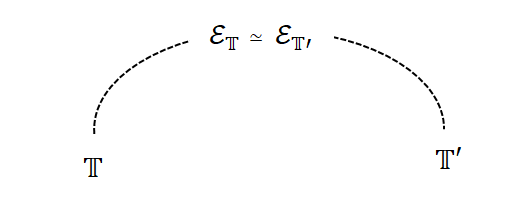
The field of application of Grothendieck’s topos_es goes beyond the strictly mathematical framework. It makes it possible to connect literary works, which seem at first glance to have nothing in common, as evidenced by the connection between Homer’s _The Iliad, Kurāʿ’s al-Muntakhab and Dostoyevsky’s The Idiot. This connection could in turn enrich research on topos, if it is taken seriously as an archeology [20], which invites to deepen the knowledge of things beyond binary oppositions to explore how things are formed.
It is appropriate to work on a genealogy of the topos_ic episteme, that is, a critical study of the devices relating to _topos, understood as a heterogeneous whole made up of said and unsaid things. This opens up the analysis of the conditions of discursive possibilities to non-discursive practices. In this archeology of knowledge, the aim of the topos would not be to link things through their common structures after having removed what is perceived as ‘inessential’, but to explore what links things to grasp the importance of what was thought to be ‘inessential’. Such process enables to progress in the art of reading through meaning, and to understand that the real enemy of knowledge is the illusion of knowledge.
The Importance of Homer’s the Iliad, Kurāʿ’s al- Muntakhab and Dostoyevsky’s the Idiot
Reading the translations of The Iliad [21], the reader is struck by the fact that the translator Philippe Brunet is trying to convey something of the source language, that is absolutely unimaginable in the target language. The Homeric poems are written with a kind of overflow of passion, with words that are always merging and without any standards apart from those that are created on the spot. The basis is that it is not written, it is said. It is spoken over many centuries and through many forms of talking. This can be seen in Kurāʿ’s Al-Muntakhab min Gharib Kalam al-Arab (Selection from the strange language of the Arabs) [22], and Dostoyevsky’s Идиот (The Idiot) [23], where the reader has the impression that it is a voice expressing itself with its own rules of syntax, rhythm and breath.
Such readings raise awareness, with regard to the languages used today, that originally there were several ways of speaking, and that one of them emerged for one reason or another. This monopoly where official languages take the place of ways of speaking constitutes an impoverishment of life. Each language, is like a net cast over the world and, depending on the way we speak, it is not the same reality that emerges. It is because we never say quite the same thing through the ways of speaking, that reading of books like The Iliad, al-Muntakhab and The Idiot is important. Such writings raise awareness that literature is both a means of being in the world and a means for the world to appear to us.
If the ways of speaking are not immediately literary in the authentic sense of the term, it is because they are caught in the language which erases the world, expels it from itself to only make it appear according to the point of view words as they are defined by language itself in a self-reflexive way. Language veils the world through a magic curtain [24]; literature aims to rediscover it, that is to make possible a life that language prevents. Beyond words and their single underlying meanings, ways of speaking can enable authentic arrangements with the world, links other than the one through which the world is lost, mediation with the world as much as with ourselves.
The discovery of such authentic literary writings after extensive reading, provides an opportunity to detoxify from language, whatever its form, and to grasp the importance of the notion of topos, away from the mathematization of the world oriented towards calculation, reductionism, standardization, and confinement in a closed system, rather than towards imagination, the building of bridges between knowledge, the promotion of the diversity of modes of existence, and the generation of open systems that allow for bifurcations, by reconnecting knowledge, particularly through the relationship between the epistemology of literature, and that of mathematics. Hence the importance of revisiting the latest writings of Henri Poincaré which provide enormous reading pleasure.
The Importance of Poincaré’s books on the Epistemology of Mathematics
Reading Science and Hypothesis, The Value of Science, Science and Method, written by Henri Poincaré at the end of his life, offer the occasion to understand the importance of the epistemology of science, and that ultimately the reading of Homer, Kurāʿ, and Dostoyevsky, falls within the framework of an epistemology of literature. By epistemology, I generally mean the field of knowledge which is based on the question: how do we know what we think we know? Epistemology constituted a sort of bridge –a topos– between literature and mathematics.
Before Poincaré, there was The Geometry – commonly referred to as ‘Euclidean Geometry’–, the one we learn at school, through notions like line, triangle, circle, and theorems such as that of Pythagoras, Tales, and that of central angle. Then Poincaré understood that The Geometry we were learning, was not the only possible one, and that there were other possibilities of seeing space, and therefore other ways of being in the world. Like literature, mathematics translates both a way of being in the world and a way for the world to be for us.
With Poincaré, we discover that building a bridge between things –a topos– can arise from an intuition as he relates in his book Science and Method:
“At that moment I left Caen where I then lived, to take part in a geological expedition organized by the École des Mines. The adventures of the trip made me forget my mathematical work; Arriving at Coutances, we boarded an omnibus for I do not know what ride; at the moment when I put my foot on the step, the idea came to me, without any of my previous thoughts seeming to have prepared me for it, that the transformations which I had used to define the Fuchsian functions are identical to those of non-Euclidean geometry” (p. 53) [25].
This passage through which he describes the mental process, which led him to recognize the importance of non- Euclidean geometry, in his work on automorphic functions, allows us to understand that his statement, according to which “it is by logic that we prove, but by intuition that we discover” (p. 144) [25], is the product of the several experiences of his life as a researcher. It allows us to understand even more one of the main reasons which pushes most mathematicians to reject the notion of topos. In his work The Value of Science, Poincaré writes the following:
“This shows us that logic is not enough; that the Science of demonstration is not the entire Science and that intuition must retain its role as a complement, I was going to say as a counterweight or as a counterpoison to logic” (p. 25) [26].
For the French mathematician, intuition is the mark of a necessary openness towards freer forms of thought, less sclerotic and locked in fixed demonstrations based solely on logic which is based on formal language. Hence the importance of vision in mathematics, in the sense that authentic people who imbue themselves, with original innocence see the link between things, and then they are explained with the formal language (p. 49) [12]. As shown by the debate, which took place during the conference ‘Visions in mathematics: from Grothendieck to the present day’, organized in Paris on 14 June 2023, by Grothendieck Institute and Poincaré Institute, the problem is that few mathematicians risk admitting the role of vision in their research, otherwise they risk losing the advantages they have acquired within the ‘mathematical community’. “Vision unites the already known points of view which embody it, and it reveals to us others hitherto ignored”, writes Grothendieck (p. 126) [12]. Recognizing the role of vision means admitting that the same thing can be perceived in different ways. This draws attention to the importance of exploring how the knowledge is woven.
The Tension between ‘What Requires Slow Time’ and ‘What Requires Fast Time’
Two requirements condition the elucidation of the experience of Homer, Kurāʿ, and Dostoyevsky. The first is to accept the orality as an original state both for learning, data collection, written transcription, and making data speak, to connect what cannot be connected quantitatively through numeric functions, which can be used to make machine learning robust and reliable. Hence the importance of exploring the interface between the written and the oral [27].
These classical authors do not make a discourse, they express a voice. If who gives a discourse communicates a word whose meaning has been previously established by a community of interest, the one who expresses a voice constitutes his own meaning through internal elaboration procedures. Try to simulate the voice by assimilating it to discourse leads to closed entopic system, the full consequences of which have yet to be fully appreciated. Such a trend reveals the limits of mainstream AI, which uses statistical, mathematical, and computational mathematical methods to extract actionable knowledge from big data.
To be faithful to the experience of Homer, Kurāʿ, and Dostoyevsky, the reading of The Iliad, al-Muntakhab and The Idiot must be a resolutely immanent exploration. Such a substantive examination, can only be based on a detailed analysis of the procedures of signification, implemented by the original orality that expressed itself, through writing to preserve the trace of its author. Concerning the antecedence of meaning on the word (p. 132) [28] –or of orality on discourse, in other words–, Al-Taftazani writes: “If meanings are left in their natural state, they seek for themselves the words that suit them” (p. 704) [29]. It is therefore clear that the time of orality, where the meaning precedes the word is not that of discourse where the word precedes the meaning.
This tension between ‘what requires slow time’ and ‘what requires fast time’, recalls a passage at the end of the Foreword to the book Morgenröte (The Dawn of Day), written by Nietzsche in Ruta near Genoa in Italy, in the fall of 1886, where he evokes philology as a fundamental metaphor which raises awareness of the trap of modern man’s relationship to time:
“For philology is that venerable art which demands of its votaries one thing above all: to go aside, to take time, to become still, to become slow it is a goldsmith’s art and connoisseurship of the word which has nothing but delicate, cautious work to do and achieves nothing if it does not achieve it lento. But for precisely this reason it is more necessary than ever today, by precisely this means does it entice and enchant us the most, in the midst of an age of ‘work’, that is to say, of hurry, of indecent and perspiring haste, which wants to ‘get everything done’ at once, including every old or new book: this art does not so easily get anything done, it teaches to read well, that is to say, to read slowly, deeply, looking cautiously before and aft, with reservations, with doors left open, with delicate eyes and fingers ... My patient friends, this book desires for itself only perfect readers and philologists: learn to read me well!” (p. 13-14) [30].
As incredible as it may seem in view of the binary opposition ‘science vs. philosophy’ as two alternate approaches to life, Nietzsche’s relationship to time recalls that of Grothendieck as evidenced by the following passage from Récoltes et Semailles (Harvests and Sowing):
“Take for example the task of proving a theorem which remains hypothetical (to which, for some, mathematical work would seem to be reduced). I see two extreme approaches to going about this. One is that of the hammer and chisel, when the problem posed is seen as a large nut, hard and smooth, the inside of which must be reached, the nourishing flesh protected by the shell. The principle is simple: place the edge of the chisel against the hull, and hit hard. If necessary, we start again in several different places, until the shell breaks –and we are happy. [...] I could illustrate the second approach, keeping the image of the nut that needs to be opened. The first parable that came to mind earlier was that we immerse the nut in an emollient liquid, just water why not, from time to time we rub so that it penetrates better, to the rest we let time take its course. The shell softens over the weeks and months –when the time is ripe, a touch of the hand is enough, the shell opens like that of a ripe avocado. Or, we leave the nut to ripen under the sun and in the rain and perhaps also under the frost of winter. When the time is ripe, it is a delicate shoot emerging from the substantial flesh which will have pierced the shell, as if playing - or to put it better, the shell will have opened of itself, to allow it passage. [...] The reader who is somewhat familiar with some of my work will have no difficulty recognizing which of these two modes of approach is mine” (p. 71) [12].
This is the paradox facing AI which has given itself the mission of simulating human intelligence. But what type of man does AI aim to simulate? The man of orality where the meaning precedes the word if we take the trouble to read well? As is the case with Homer, Kurāʿ, Dostoyevsky, Nietzsche, Poincaré, and Grothendieck, to name only a few. Or the man of discourse where the word precedes the meaning? So far, mainstream AI has developed through an approach that relegates meaning of things into the background, by giving more importance to numbers. However, numbers fuel the calculations that rule the world, while “from the form the idea is born”, as Gustave Flaubert says (p. 377) [31]. This sentence reveals the importance of Grothendieck’s interest in forms since his childhood.
From an AI based on Numbers to another based on Geometric Forms
Grothendieck’s ideas on the notion of space were fundamentally based on his work in algebraic geometry, which led him to the notion of topos, and finally to the formulation of a geometry of forms. The form has fascinated Grothendieck, as a passage from Récoltes et Semailles testifies.
“If there is one thing in mathematics that has always fascinated me more than any other, it is neither the number nor the size, nor magnitude, but always form. And among the thousand and one faces that form chooses to reveal itself to us, the one that has fascinated me more than any other and continues to do so is the structure hidden in mathematical things. The structure of a thing is not something we can invent. All we can do is patiently and humbly bring it up to date —get
to know it, discover it” (p. 43) [12].
In mathematical language, it appears that AI has developed more around numbers than geometric forms [32]. In other words, deep learning techniques are based on a numerical approach to the subtle worlds that surround us, whereas the human mind tends to focus more on geometric forms, and then to distinguish geometric forms according to certain correspondences. This is where the notion of topos comes in by considering the correspondences. This is one of the reasons why the notion of topos is attracting the interest of AI engineers, who use machine learning techniques to develop systems that can help organizations increase efficiency, i.e. to minimize costs and turnaround times, and maximize volumes and profits.
The notion of topos offers the opportunity to develop models for many aspects of life, closer to the way humans perceive the worlds around them, starting from the limits of the conceptualization of AI assimilating human mind to a digital system limited to calculation operations, to the detriment of the approach of the human mind being more interested in forms, then which distinguishes forms according to certain correspondences. It is preferable to use the notion of correspondence instead of that of invariants, which is based on the idea that in mathematics there can be different theories, possibly belonging to different branches of the speciality, which describe the same invariants in different languages. In this respect, the notion of topos is presented as a tool that offers the possibility of identifying invariants by eliminating aspects considered to be inessential while retaining what is essential [32].
In the world of meanings where words arise from meaning through an underlying structure (p. 4) [33], the essential and insignificant dichotomy seems far from real life. Everything, no matter how small, is important if we take the time to look into it, as is the case in the animal world. In his novel Without the Orangutan, Eric Chevillard [34], which highlights a contradiction without imposing a conclusion, challenges the reader to the fact that humans did not suspect the importance of the orangutan in the general organization of the world nor that everything was held together thanks to him, to his discreet but decisive action. He was the subtle cog. It was enough for him to disappear for everything to collapse. How could the world live without him?
The notion of correspondence refers to the idea that in exploring the relationship between things, the object of research is no longer the things in themselves, but the things left open to human interrogation, because every instrument carries within it the spirit in which it was created. “We only hear the questions to which we are able to find an answer”, writes Nietzsche in Die fröhliche Wissenschaft (Gay Science) (p. 193) [35]. In this respect, the answers appear more like blockages to further exploration than as revealing elucidations. The primary virtue of the answers could even be to set prohibitions, and not to open the questioning. Deleuze said later: “language is a system of commands, not a means of information” (p. 60) [36]. Grothendieck is perceptive about the performative nature of language, as a passage from Récoltes et Semailles illustrates:
“We are constantly having to invent the language capable of expressing in ever finer detail the intimate structure of the mathematical thing, and to ‘construct’ with the help of this language, as we go along and from scratch, the theories which are supposed to give an account of what has been apprehended and expressed” (p. 43) [12].
By exploring the approaches specific to the knowledge of things, Nietzsche shows that the desire to penetrate the essence of things is always triggered by the observation of a correspondence of forms. Through such a perspective, the process of constructing knowledge appears as a matching of these forms, which presupposes an intervention of the mind, a work of sorting and selection, of transformation by deformation of what exists. This coherent deformation is achieved by eliminating the unusual, the irregular, the non- linear, the rough, so that to know is essentially, in one way or the other, to reduce the unknown to the known because “what is known is recognized”, as Nietzsche said (p. 328) [35].
The notion of topos could prove fruitful as long as the one who uses it realizes that the will to know could become a veil to knowledge [37]. This invites to take steps to minimise as far as possible the gap between what is targeted and what is actually achieved. The notion of conceptual strata [38] will undoubtedly constitute an important step forward, in this awareness to the extent that the exploration of correspondences is carried out through a layered approach. What seems insignificant through one layer could prove to be significant through another layer. This allows those who use the notion of topos to move from ‘Invariant’ to ‘invariant for’ and from ‘Insignificant’ to ‘insignificant for’. If the notion of invariants suggests that it is possible through the notion of topos to link parts supposed to exist separately and independently, the epistemology of quantum physics shows that the parts supposed to function independently are simply particular forms and fortuitous within a set that is capable of expansion [39]. The notion of conceptual strata is part of an approach in which the world is perceived as a complex web of facts, in which relationships of various kinds are superimposed, thereby determining the fabric of the set [40].
But as someone digs into anything, sooner or later he will discover that the layers are not infinite and that they will be confronted with the abyss of nothingness that Stéphane Malarmé referred to in a letter dated 28 April 1866 to Henri Cazalis (p. 696) [41]. However, nothingness by definition does not exist, since it is precisely the opposite of what exists. In his poem Peri Physeos (On Nature), Parmenides writes in fragment 6: “Being is, non-being is not”.
With the theory of loop quantum gravitation [42], it is possible to illustrate what happens at the bottom of conceptual strata at a moment when time seems to stop and space is torn apart. From their depths, time and space are reversed to the point where new conceptual strata are born. So what we cannot see or imagine, we can no longer ignore.
Conclusion
In view of the data collected from press articles, TV reports, interviews, lectures, and papers, the notion of topos is likely to become the future mathematics of AI, with a greater emphasis on geometric forms than the mainstream approach in the business world, which favors numbers through statistical procedures to make predictions and more informed decisions. Numbers have no meaning in themselves. As a result, when things are reduced to collections of numbers, their meanings disappear. AI engineering requires models capable of formalizing the basic variables that shape its practice, as well as the basic operations that impact both the structure and functioning of the human brain. The notion of topos could help to satisfy these two main aspirations of AI engineering geometric forms by connecting things through a common essence after removing the inessential aspects.
My study is part of an investigation into the nature of intelligence and supposedly intelligent machines, as well as the interpretation of Grothendieck’s topos_es as the future mathematics of AI in terms of impact and consistency. In this regard, it would be useful to enrich the approach which assimilates the _topos to a sort of bridge which removes all the inessential aspects of the things to be linked to retain only a common essence.
One of the most promising avenues in the archeology of discourse on the topos is reading through the senses to which Heraclitus referred based on the extremely lucid observation that at the very heart of language there was a very deep gap which separates the man between what he said and what he meant. This lucidity is found in Grothendieck who invites in his autobiography Récoltes et Semailles to constantly invent the language capable of expressing more and more finely what has been apprehended and seen.
From this art of reading well stems the notion of conceptual strata, which shows that the things to be connected have a stratified configuration that invites us to discover the complexity of the relationship between what happens deep inside ourselves and what we designate by words. Rather than calling something ‘insignificant’, a consistent relativism of ‘insignificant for’ would be more appropriate, depending on the conceptual stratum under consideration. As Gorthendieck writes:
“What makes for the quality of the researcher’s inventiveness and imagination is the quality of his attention, listening to the voice of things. For the things of the Universe never tire of speaking for themselves and revealing themselves to those who care to listen” (p. 43-44) [12].
Unfortunately, we often mishear what we think we hear well, just as we often misread what we think we read well.
References
-
McCarthy J (2007) What Is Artificial Intelligence? Computer Science Department, Stanford University pp: 1-15.
-
McCarthy J, Minsky M, Rochester N, Shannon C (2006) A Proposal for the Dartmouth Summer Research Project on Artificial Intelligence. AI Magazine 27(4): 12-14.
-
Shannon C (1948) A Mathematical Theory of Communication. The Bell System Technical Journal 27: 379-423.
-
Turing AM (1950) Computing Machinery and Intelligence. Mind 59(236): 433-460.
-
Minsky M (1961) Steps toward Artificial Intelligence. Proceedings of the IRE 49: 8-30.
-
Newell A, Simon H (1972) Human Problem Solving. Prentice-Hall, Englewood Cliffs, New Jersey pp: 51.
-
Caramello O (2017) Theories, Sites, _Topos_es. Relating and studying mathematical theories through _topos_-theoretic ‘bridges’. Oxford University Press, United Kingdom pp: 1-39.
-
Connes A (2021) Un topo sur les topos. In: Jaëck F (Ed.), Lectures grothendieckiennes. Nouvelles Visions des Sciences. Spartacus-Idh, Paris pp: 205-238.
-
Stengers I (2003) Thinking about science through its environment. Rue Descartes 41(3): 41-51.
-
Whitehead AN (1929) Process and Reality: An Essay in Cosmology. The Free Press, A Division Of Macmillan Publishing Co., Inc. New York, pp: 398.
-
Deleuze G (1977) Dialogues avec Claire Parnet. Flammarion, Paris pp: 190.
-
Grothendieck A (1986) Récoltes et semailles [Harvests and Sowing]. Université des Sciences et Techniques du Languedoc de Montpellier et Centre National de la Recherche Scientifique pp: 202.
-
Deligne P (1998) Quelques idées maîtresses de l’oeuvre de A. Grothendieck. Matériaux pour l’histoire des mathématiques au XXe siècle, Actes du colloque à la mémoire de Jean Dieudonné, Séminaires et Congrès 3: 11-19.
-
Houzel C (2000) Histoire de la théorie des faisceaux. Gaz Math 84: 35-52.
-
Eilenberg S, MacLane S (1945) General Theory of Natural Equivalences. Transactions of the American Mathematical Society 58(2): 231-294.
-
Grothendieck A (1957) Sur quelques points d’algèbre homologique. Tôhoku Mathematical Journal 9(2): 119- 221.
-
Lafforgue L (2023) Grothendieck _Topos_es for future AI: imagining new _topos_-inspired representations of images. Second Calabi Lecture. Institute of Mathematical Sciences, Shanghai Tech University.
-
Giraud J (1972) Classifying topos. Lecture Notes in Math., 274: 43-57.
-
Caramello O (2009) The Duality between Grothendieck _Topos_es and Geometric Theories. Ph.D. thesis, University of Cambridge.
-
Foucault M (1969) L’archéologie du savoir. Gallimard, Paris, pp: 294.
-
Homère (2010) L’Iliade, traduction de Philippe Brunet. Paris: Seuil, pp: 560.
-
Kuraʿ A (1989) Al-Muntakhab min Gharib Kalam al-Arab [Selection from the strange language of Arabs]. Makkah: Umm al-Qura University Press, pp: 779.
-
Dostoïevski F (2001) L’Idiot. Paris: Actes Sud, pp: 544.
-
Kundera M (2006) Le Rideau. Paris: Gallimard, pp: 208.
-
Poincaré H (1908) Science et méthode. Paris: Flammarion, pp: 314.
-
Poincaré H (1939) La valeur de la science. Paris: Flammarion, pp: 278.
-
Goody J (1987) The interface between the written and the oral. Cambridge University Press, New York, pp: 328.
-
Al-Sakaki Y (1987) Miftah al-ʿUlum [The Key of Sciences]. Beirut: Dar al-Kutub Al-Ilmiya, pp: 602.
-
Al-Taftazani S (2001) Al-Mutawwal [The Long Commentary]. Beirut: Dar al-Kutub Al-Ilmiya, pp: 620.
-
Nietzsche F (1901) Aurore: réflexions sur les préjugés moraux. Paris: Mercure de France, pp: 435.
-
Grancourt E, Grancourt J (2005) Journal des Goncourt, Tome I: 1851-1857. Paris: Honoré Champion, pp: 874.
-
Caramello O (2023) Toposes and their place in Mathematics. Interviewed by Nathan Thomas Carruth. ICCM Notices 10: 1-24.
-
Al-Jurjani A (1991) Asrar al-Balaghah [The Secrets of Eloquence]. Cairo: Sharikat al-Quds, pp: 580.
-
Chevillard E (2007) Sans l’orang-outan. Paris: Minuit, pp: 192.
-
Nietzsche F (1901) Le Gai savoir. Paris: Mercure de France, pp: 413.
-
Deleuze G (1990) Pourparlers. Paris: Minuit, pp: 249.
-
D’Espagnat B (2019) Veiled Reality. London: CRC Press, pp: 500.
-
Belabes A (2025) Economic Life beyond Economists. Routledge, London, pp: 178.
-
Teodorani M (2022) David Bohm: La physique de l’infini. Cesena: Macro Editions, pp: 132.
-
Heisenberg W (2007) Physics and Philosophy. New York: Harper Perennial Modern Classics, pp: 256.
-
Mallarmé S (1998) Œuvres complètes I. Paris: Gallimard, pp: 1600.
-
Rovelli C (2018) Black Hole Evolution Traced Out with Loop Quantum Gravity. Physics 11: 127.
- Digital Hermeneutics Embodied in Brian Kim Stefans’ “The Dreamlife of Letters,” and Memory: Analog to Flash Interface in the Light of Ecofeminism
- Using C-Tables to Teach Class Logic
- The Ideology of Education’s Postponed Fantasies: Deepenings on a Pressing Problematic
- Phantasia and Perceptual Realism in Aristotle
- The Pleasures of Solitude
- Super Science